How to Hire a Data Entry Virtual Assistant Who Gets It Right
How to hire a data entry virtual assistant, from the job post and skills test to rates, onboarding and the first 30 days.
On this page
- What does it mean to hire a data entry virtual assistant?
- Key data entry hiring terms you should know
- Why does hiring the right data entry VA matter?
- How does hiring a data entry virtual assistant work?
- Types of data entry virtual assistant hires
- How is hiring a data entry VA different from related hires?
- Data entry VA vs. a freelance marketplace gig
- Data entry VA vs. a BPO data processing team
- Data entry VA vs. an in-house data entry clerk
- What are the benefits of hiring a data entry virtual assistant?
- What are the drawbacks of hiring a data entry VA?
- Who needs to hire a data entry virtual assistant?
- Data entry VA hiring examples
- Good data entry hiring examples
- Bad data entry hiring examples
- How do you create a data entry VA hiring plan, step by step?
- Step #1
- Step #2
- Step #3
- Step #4
- Step #5
- What does an effective data entry hiring strategy look like?
- Data entry hiring tools and software
- 10 proven tips for hiring a data entry virtual assistant
- Overcoming common data entry hiring challenges
- How do you measure whether a data entry hire is working?
- How long does it take to hire a data entry VA and see results?
- How much does it cost to hire a data entry virtual assistant?
- Is hiring a data entry virtual assistant worth it?
- How do you choose a data entry virtual assistant agency?
- Data entry hiring statistics, trends and future predictions
- How is AI changing data entry VA hiring?
- FAQs
Clean Records Protect Revenue You've Already Earned
Hyperstaff has placed 70+ virtual assistants with 30+ clients, and our data entry virtual assistant services start from $3/hour with pre-vetted talent across 5 regions. You get a dedicated specialist in 5 business days, a dedicated account manager, and a free replacement in 5 to 7 business days if the fit is wrong.
What does it mean to hire a data entry virtual assistant?
Hiring a data entry virtual assistant means bringing on a remote specialist who keys, updates, cleans and checks business records for you, on a part-time or full-time schedule. The work runs inside your own systems: spreadsheets, a CRM, an accounting tool, an e-commerce back end or a database.
If you're still pinning down the role itself, our guide on what a data entry virtual assistant is breaks it down. The hiring side is narrower. You're picking one person whose accuracy, judgment on unclear records and data handling habits you'll trust with information your revenue depends on.
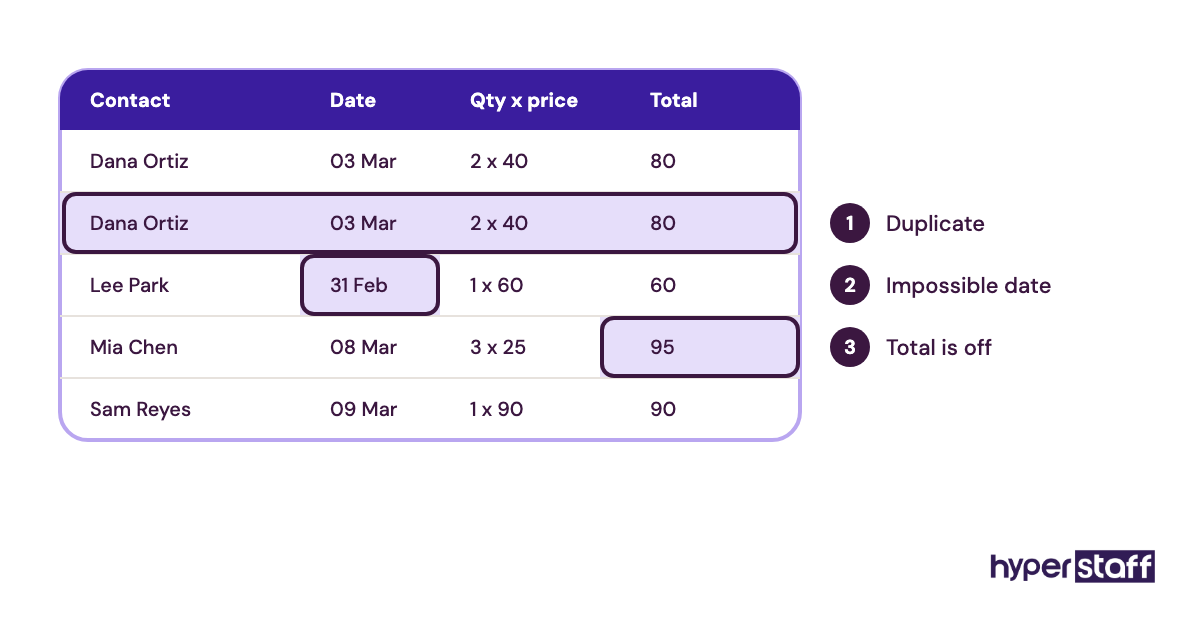
Data entry rarely stays "just typing" for long. A good hire starts flagging duplicate contacts, mismatched invoice totals and product listings with missing weights, and that judgment is the part you're really paying for.
Key data entry hiring terms you should know
- WPM = words per minute, the standard typing speed measure used in hiring tests.
- KPH = keystrokes per hour, a speed measure for numeric and form-based entry.
- Accuracy rate = the share of fields entered without an error, usually checked on a sample.
- Double-entry verification = two people (or two passes) key the same record and a tool flags any mismatch.
- Data validation = rules in a sheet or system that reject entries in the wrong format.
- Deduplication = finding and merging records that describe the same customer, product or vendor.
- OCR = optical character recognition, software that reads text from scans and PDFs.
- SOP = standard operating procedure, the written steps for one recurring task.
- Least-privilege access = giving a user only the permissions their tasks need.
- NDA = non-disclosure agreement covering the confidential data the assistant sees.
- Paid trial task = a short, paid piece of real work used to test a candidate before hiring.
- Turnaround time = how long a batch takes from handoff to finished, checked records.
Why does hiring the right data entry VA matter?
Hiring the right data entry VA matters because bad data spreads. A wrong email address breaks a follow-up sequence, a swapped digit sends an invoice to the wrong amount, and a duplicate SKU oversells stock you don't have.
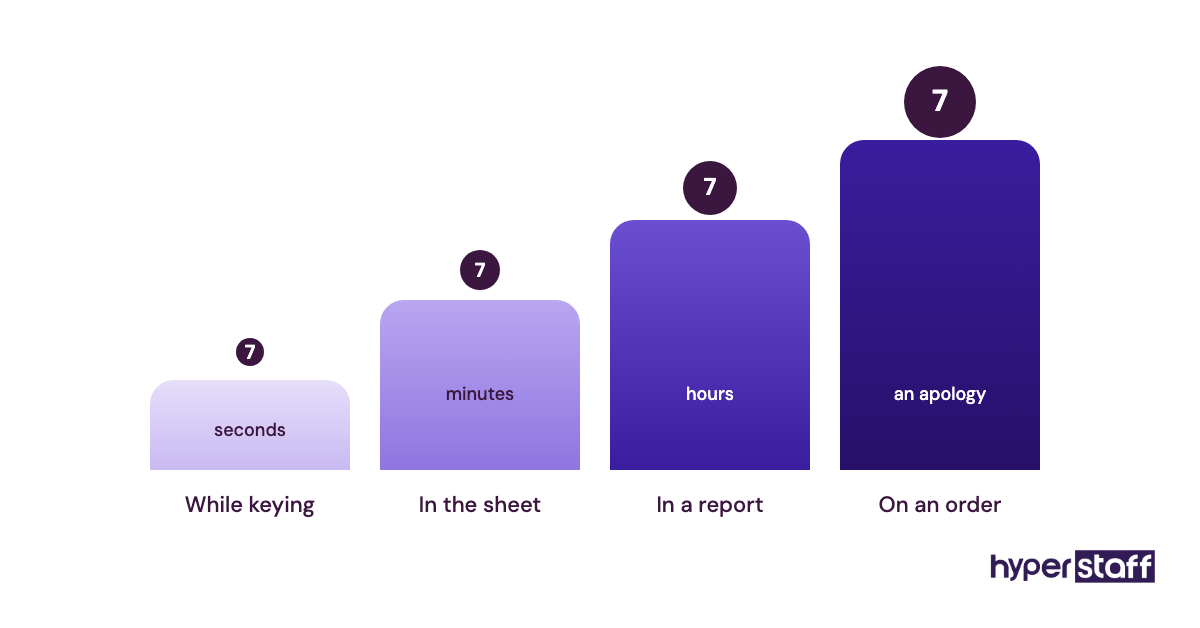
The cost of an error also grows the longer it sits. Catching a typo while the record is being keyed takes seconds; finding it after it's fed into a monthly report, a tax filing or a customer's order takes hours and sometimes an apology.
There's a less obvious reason too. Most owners only notice data entry quality when it fails, so a careless hire can run for weeks before anyone spots the pattern.
How does hiring a data entry virtual assistant work?
The data entry hiring process follows five stages: define the work, source candidates, test them on real records, pick one and agree terms, then onboard with written rules and scoped access. Going through an agency compresses the first three stages, since candidates arrive already vetted.
Going alone through a freelance marketplace, you'll write the post, screen the applications, run your own tests and chase references yourself. With an agency, you describe the role and review a shortlist.
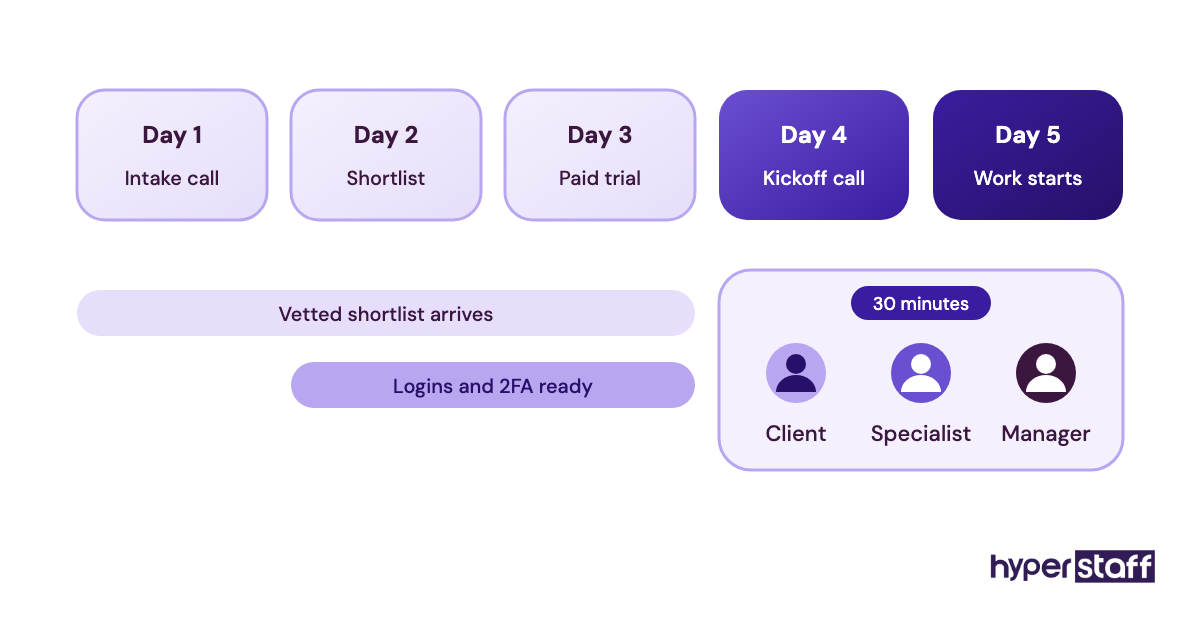
The stage that people rush is the last one. Access approvals, two-factor codes that go to your phone and software seats you forgot to buy can eat the first two or three days of a new hire's time, so start them before day one.
Types of data entry virtual assistant hires
Data entry VA roles split by the kind of records involved, and each type calls for a different hiring test. The table below matches common types to the tier and test that usually fit.
| Type of data entry | Typical tasks | Usual experience tier | Common bundle | What to test when hiring |
|---|---|---|---|---|
| General keying and transcription | Forms, handwritten notes, scanned documents into sheets | Essential (0 to 2 years) | 40 or 80 hours | Speed with accuracy on a scanned sample |
| CRM and lead data | Adding contacts, updating deal stages, cleaning lead lists | Essential or Professional | 80 hours | Spotting duplicates and bad emails |
| E-commerce product listings | SKUs, prices, variants, descriptions, inventory counts | Professional (2 to 5 years) | 80 or 160 hours | Bulk upload from a CSV without breaking variants |
| Bookkeeping data entry | Invoices, receipts, bills, bank lines into accounting software | Professional or Expert | 40 or 80 hours | Matching totals and catching mismatched amounts |
| Data cleansing and deduplication | Merging records, fixing formats, filling gaps | Professional | 40 hours, often as a project | Judgment on which duplicate record wins |
| Web research and data collection | Building lists from directories, websites and public sources | Essential or Professional | 40 or 80 hours | Source notes and consistent formatting |
| Survey and form processing | Coding open answers, tallying responses | Essential | 40 hours | Following a coding guide without drifting |
| Database administration support | Imports, field mapping, validation rules, reports | Expert (5+ years) | 80 or 160 hours | Mapping a messy import to your schema |
How is hiring a data entry VA different from related hires?
A data entry VA hire differs from other options mainly in who manages the person, who vets them and who covers you when they leave. The three comparisons below are the ones buyers weigh most often.
Data entry VA vs. a freelance marketplace gig
A marketplace freelancer is usually paid per task or per hour and may work for several clients at once. A dedicated data entry VA learns one business, so the second month goes faster than the first because they already know your field rules.
Marketplaces work well for one-off cleanup projects. For records that change every day, the rotation of freelancers means you re-explain your rules every time someone new picks up the work.
Data entry VA vs. a BPO data processing team
A business process outsourcing (BPO) firm typically runs data entry as a volume service with a team behind a ticket queue. You get capacity and formal QA, but you rarely know who touched which record.
BPO makes more sense once you're processing tens of thousands of documents a month. Below that, a single named specialist is easier to brief and to hold to a standard.
Data entry VA vs. an in-house data entry clerk
An in-house clerk sits on your payroll with taxes, benefits and equipment on top of the wage. A remote VA costs less per hour and can start within days, but you'll rely on written instructions more than a quick question across the desk.
We've laid out the full side-by-side in our data entry VA vs in-house comparison, including which records some owners keep in-house for compliance reasons.
What are the benefits of hiring a data entry virtual assistant?
Hiring a data entry virtual assistant gives you accurate records at a fraction of an in-house wage, with hours you can scale up or down by bundle.
- Rates from $3/hour, far below a typical in-house clerk's wage.
- Monthly bundles of 40, 80 or 160 hours, so you pay for the volume you have.
- A dedicated specialist who learns your field rules and gets faster each month.
- Time zone coverage, so a batch handed over in the evening can be done by morning.
- Owners and senior staff stop spending their own hours on keying and checking.
- Room to grow the role into reporting, CRM hygiene or order processing later.
What are the drawbacks of hiring a data entry VA?
The drawbacks of a data entry VA hire are real but manageable, and most of them trace back to how the role is set up.
- You'll need written rules; unclear field definitions show up as errors.
- Sharing access to customer or financial data needs planning and scoped permissions.
- Time zone gaps can slow answers to quick questions in the first weeks.
- The first two weeks need your time for checking samples and answering questions.
Who needs to hire a data entry virtual assistant?
Businesses need to hire a data entry virtual assistant when record-keeping is eating hours that should go to selling, serving customers or running operations. Common signs are a growing backlog of invoices, a CRM full of half-filled contacts, or product updates that wait a week to go live.
E-commerce stores, accounting and bookkeeping firms, real estate teams, recruiters, healthcare admin teams and agencies with lead lists all fit. Our list of data entry virtual assistant tasks is a quick way to check how much of your week would move over.
Volume isn't the only test. A small business with just 10 hours of data work a week can still benefit, because those 10 hours often belong to the owner.
Data entry VA hiring examples
These examples show hiring patterns we see repeat, the ones that lead to a steady hire and the ones that end in a replacement.
Good data entry hiring examples
A skills test built from your own messy records
The strongest tests use 30 to 50 real rows with the problems you actually have: a misspelled company, a phone number with a missing digit, two contacts that are the same person. Candidates who flag those, instead of silently keying them, are the ones to keep.
A first-week error budget agreed up front
Telling a new hire "we'll check 20 records from every batch this week, and we're aiming for under 1 or 2 errors per 100 fields" gives them a target. It also stops you from judging the whole hire on one bad afternoon.
Hiring the tier the records actually need
Keying names from business cards suits an Essential hire. Reconciling bills against bank lines calls for Professional or Expert experience, and paying the extra few dollars an hour is cheaper than fixing a quarter's books.
Bad data entry hiring examples
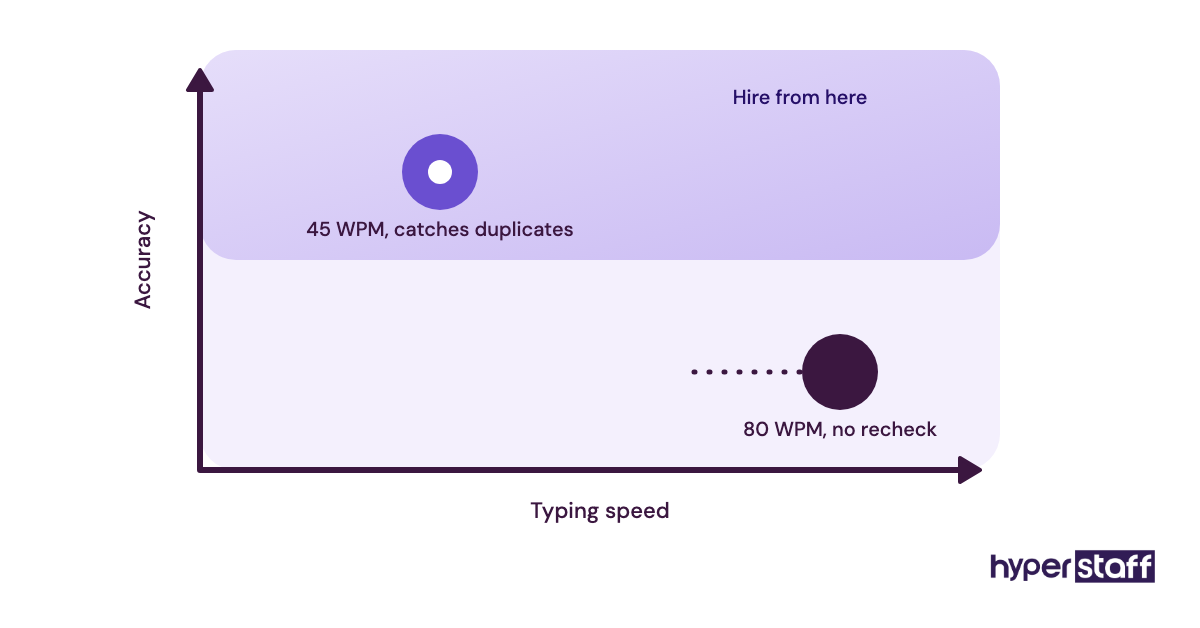
Hiring on typing speed alone
A candidate at 80 WPM who never double-checks will create more cleanup than a 45 WPM typist who catches duplicates, yet speed tests get overweighted because they're easy to run. The list of common data entry VA mistakes has more of these traps.
Admin access on day one
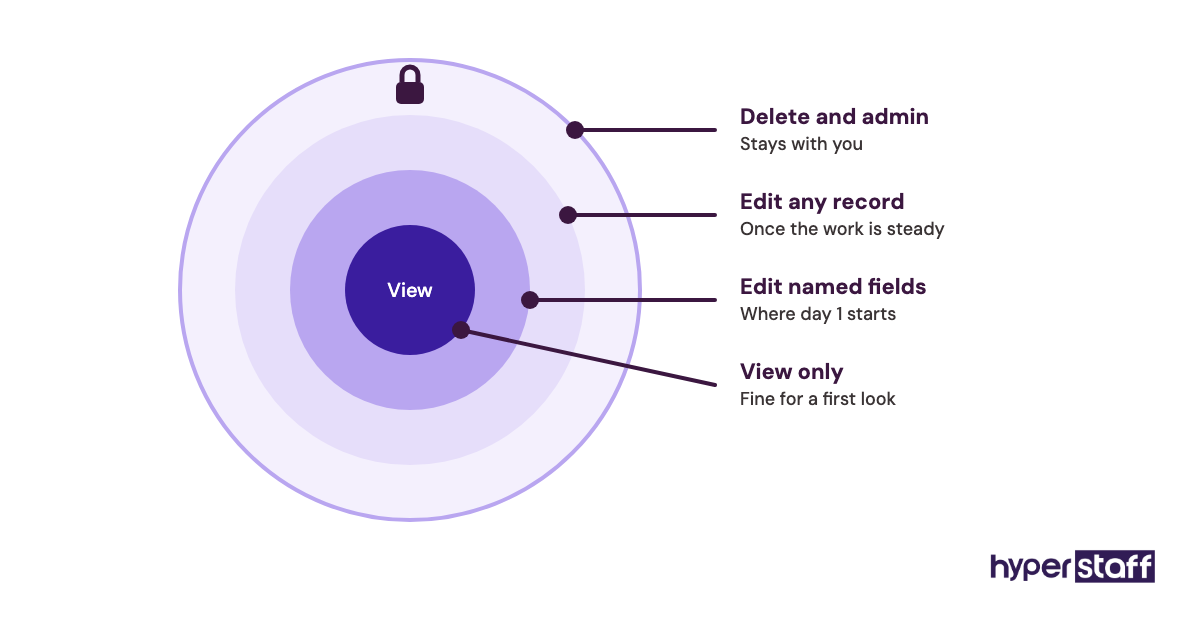
Giving a brand-new hire full admin rights in your CRM or accounting software is the fastest route to an accidental bulk delete. Start with edit rights on the fields they need, and widen access once the work is steady.
A job post that just says "data entry"
Vague posts attract hundreds of identical applications. Without naming the software, the record types and the volume, you can't tell a fit from a guess.
How do you create a data entry VA hiring plan, step by step?
A data entry VA hiring plan runs in five steps, from scoping the work to the first review. Each step below has a clear output you can check before moving on.
Step #1: Scope the records and write the job description
List every record type, the software it lives in, the weekly volume and who checks it today. Turn that into a role brief using our data entry virtual assistant job description template, and include the hours bundle you expect to need.
Be specific about judgment calls. "Merge duplicates, keeping the record with the most recent order" tells a candidate far more than "attention to detail."
Step #2: Source candidates
Choose your channel: an agency shortlist, a freelance marketplace or a referral. Agencies hand you vetted profiles in days; marketplaces give you volume but leave screening to you.
Step #3: Test on real data and interview
Send a short paid trial using anonymized rows from your own records, then interview the top two or three. Our set of data entry VA interview questions focuses on how candidates handle unclear records, which a typing test can't show.
Step #4: Agree terms, access and security
Settle the hours, rate, working window and NDA, then create named accounts with least-privilege access. Shared logins make it impossible to trace who changed what.
Step #5: Onboard and review at day 14
Hand over written field rules and a sample of finished records that show "done right." Our guide to onboarding a data entry virtual assistant sets out the first two weeks, ending with a review of accuracy and turnaround.
What does an effective data entry hiring strategy look like?
An effective data entry hiring strategy tests the exact skills the job uses, in the order that filters out weak fits cheapest. The scorecard below is the sequence we'd recommend, with pass marks you can adjust to your records.
| Hiring checkpoint | What you check | Typical pass mark | Time needed |
|---|---|---|---|
| Application review | Software named, record types, written English | Clear match to the brief | 2 to 5 minutes each |
| Typing test | WPM or KPH with accuracy | 40 to 60+ WPM at 98%+ accuracy | 5 to 10 minutes |
| Paid trial task | Real rows, planted errors flagged | 98% to 99.5% field accuracy | 1 to 2 hours |
| Interview | Judgment on unclear records, communication | Asks clarifying questions | 20 to 30 minutes |
| References or agency vetting | Reliability and past data handling | No access or accuracy issues | 1 to 2 days |
| First two weeks | Sampled accuracy and turnaround | Error rate falling week on week | 10 business days |
Practitioners disagree on one point: paid versus unpaid trials. We side with paid, because the strongest candidates often skip unpaid tests, and a one-hour fee is small next to a bad hire.
Data entry hiring tools and software
The tools you'll need for a data entry hire fall into four groups: where the records live, how work moves in, how access is shared and how quality is checked. Our full list of data entry virtual assistant tools goes deeper; here are the ones that matter at the hiring stage.
Spreadsheets such as Google Sheets and Microsoft Excel are still where most data entry trials happen, and data validation rules in either will catch a lot of format errors before you do. Google Workspace pricing varies by region, so check the plan page for your country.
Airtable suits teams that have outgrown a sheet but don't want a full database; its Team plan is $20 per user a month and Business is $45, both billed annually, with a free tier for testing. Zapier can push form submissions straight into a sheet or CRM, with a free plan of 100 tasks a month and paid plans from about $20 to $30 a month depending on billing.
For document-heavy work, Docparser pulls fields from PDFs and invoices, with plans from about $33 to $159 a month depending on volume and billing. A password manager such as 1Password or Bitwarden lets you share logins without sending them in chat, which matters from day one.
Our honest opinion: start the new hire in a plain spreadsheet with validation rules for the first month. Fancy tooling hides whether the person is accurate.
10 proven tips for hiring a data entry virtual assistant
These tips come from the hiring patterns that most often separate a steady data entry hire from a quick replacement.
- Write field rules before you post the job.
- Test with your own records, anonymized.
- Plant deliberate errors in the trial and score how many are flagged.
- Weight accuracy above speed when you rank candidates.
- Pay for trial tasks so strong candidates actually take them.
- Match the experience tier to the records: bookkeeping needs more than keying.
- Create named accounts with only the permissions the job needs.
- Sort out two-factor login codes before day one.
- Check a sample of every batch for the first two weeks, then taper off.
- Keep a running "decisions log" of edge cases so the rules grow with the work.
Overcoming common data entry hiring challenges
The most common data entry hiring challenge is too many similar applicants. Specific posts and a planted-error trial cut a pile of hundreds down to a handful quickly.
The second is security nerves about client data. Named accounts, an NDA and least-privilege permissions answer most of it, and logs show who changed what.
The third shows up after the hire: rules that live only in your head. Every question the new assistant asks in week one is a rule you haven't written down yet, so add the answer to the SOP the same day.
How do you measure whether a data entry hire is working?
You measure a data entry hire by sampled accuracy rate, turnaround time per batch and how many questions repeat. Check 20 to 50 random records a week early on and log the errors by type.
Falling error counts matter more than any single week's number. A hire who makes the same mistake twice after it's been written into the SOP is the clearer warning sign.
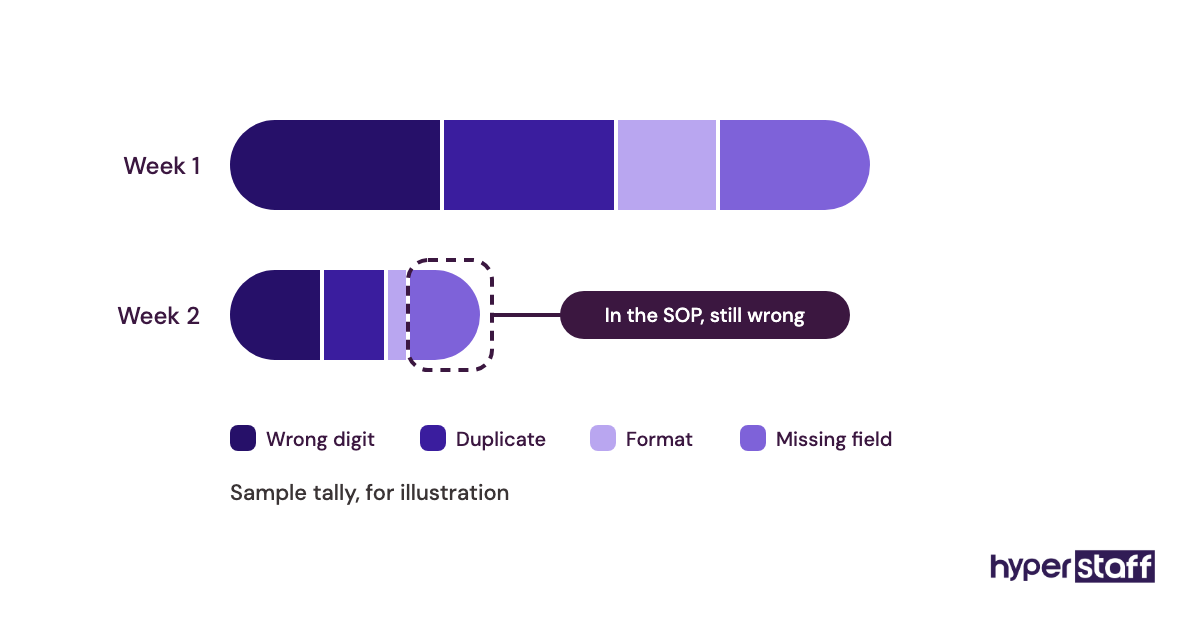
Track backlog too. If the pile of unprocessed invoices or leads keeps shrinking, the role is doing its job.
How long does it take to hire a data entry VA and see results?
Hiring a data entry VA takes from 5 business days through an agency to two to four weeks on your own. Writing the brief usually takes longer than people expect.
Results arrive in stages. Week one is slower while access gets sorted and rules get clarified; by weeks two to four, most hires reach steady accuracy on routine records.
Complex work such as reconciliations or messy imports can take a month or more before you stop checking every batch.
How much does it cost to hire a data entry virtual assistant?
Hiring a data entry virtual assistant through Hyperstaff costs from $3 to $12+ per hour depending on experience tier, compared with roughly $18 to $25 per hour in base pay for a US in-house clerk. The table compares 80 hours a month, before any extras.
| Option | Experience | Hourly rate | 80 hours a month | Extra costs |
|---|---|---|---|---|
| Hyperstaff Essential | 0 to 2 years | From $3 | From $240 | Billed by monthly bundle |
| Hyperstaff Professional | 2 to 5 years | From $6 | From $480 | Billed by monthly bundle |
| Hyperstaff Expert | 5+ years | From $12 | From $960 | Billed by monthly bundle |
| In-house clerk (US) | Varies | About $18 to $25 base | About $1,440 to $2,000 | Payroll taxes, benefits, equipment, often 20% to 30% on top |
| Freelance marketplace | Varies | About $5 to $20+ | About $400 to $1,600+ | Platform fees, your own vetting time |
Paying quarterly with Hyperstaff saves a further 10%. Our breakdown of data entry virtual assistant cost covers the bundles in detail.
Important: our prices above are averages, not fixed quotes. Your final cost depends on the records, software, volume and hours your work actually needs.
Is hiring a data entry virtual assistant worth it?
Yes, hiring a data entry virtual assistant is worth it when the records feed your revenue, because accurate data at $3 to $12 an hour frees your own hours and stops errors that cost far more than the wage. Done right, it's one of the cheapest ways to get time back in a business.
Here's an example calculation. A US information clerk's median pay is $21.84 an hour, according to the US Bureau of Labor Statistics, so 80 hours a month is about $1,747 before taxes and benefits.
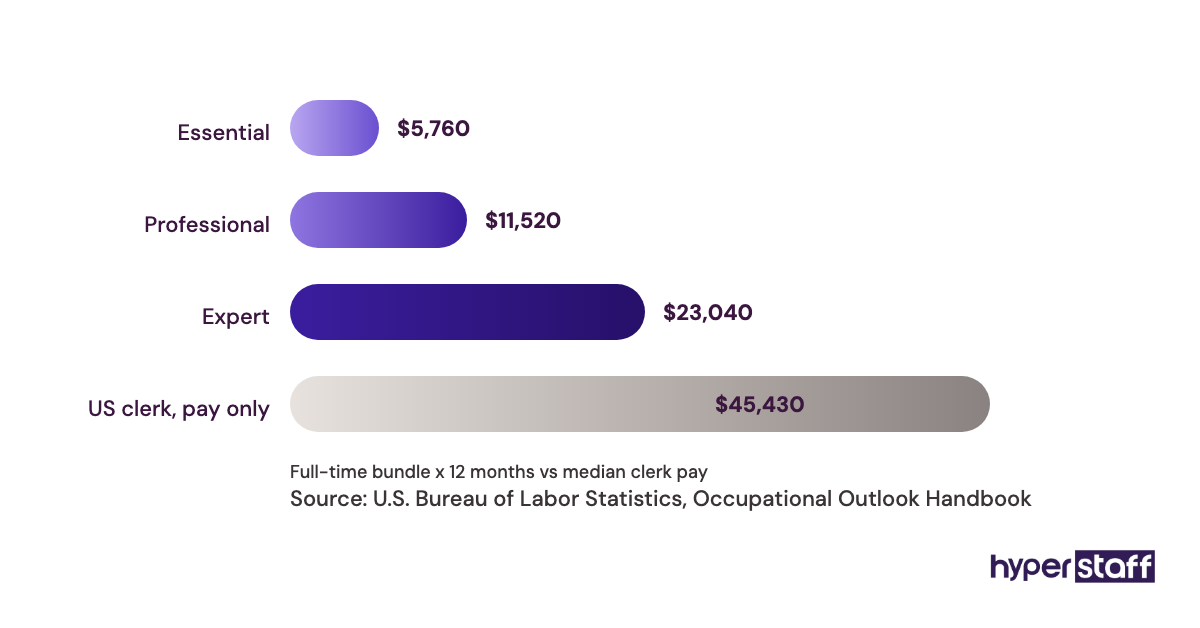
A Hyperstaff Professional hire at $6 an hour for the same 80 hours is $480, or $432 with quarterly billing. That's a gap of roughly $1,270 to $1,315 a month, or over $15,000 a year.
The numbers only hold if you put in the setup time. For a fuller look at when the math breaks down, read our take on whether a data entry VA is worth it.
How do you choose a data entry virtual assistant agency?
Choose a data entry virtual assistant agency by checking how it vets accuracy, how fast it replaces a poor fit, and who you talk to when something goes wrong. Ask to see the actual test candidates sit before they're shortlisted.
Ask what happens to your process knowledge if the assistant leaves. At Hyperstaff, your SOPs, tools and context live in an Operations Vault we maintain for you, so a replacement in 5 to 7 business days starts already briefed.
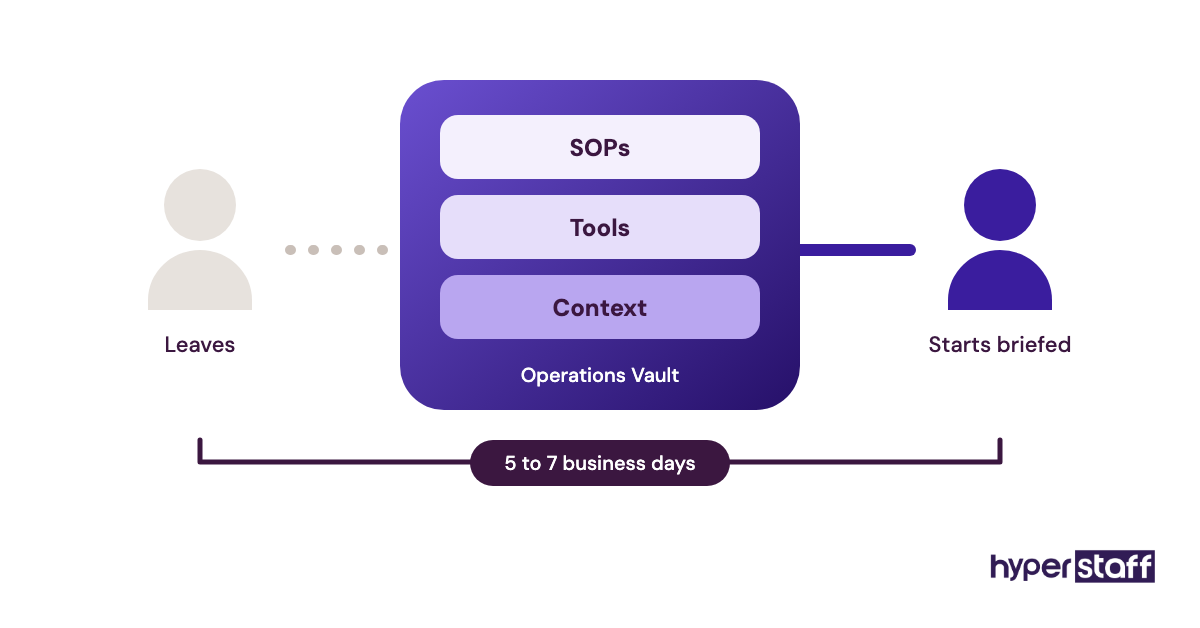
Check the commercial terms as well. Hyperstaff works in monthly bundles of 40, 80 or 160 hours, starts with a 30-minute kickoff call, and gives every client a dedicated account manager.
Data entry hiring statistics, trends and future predictions
US demand for in-house clerical data roles is flat to falling. The US Bureau of Labor Statistics projects information clerk employment to decline 2% over its ten-year outlook, and file clerks, who enter and retrieve data, to fall 16%.
The records still need keying, checking and cleaning somewhere. In our view, that work is shifting toward remote specialists who combine keying with checking, cleaning and light reporting.
We expect hiring tests to change with it. Pure typing speed is losing weight; the ability to spot a wrong record and explain why is gaining it.
How is AI changing data entry VA hiring?
AI is changing data entry VA hiring by taking over first-pass extraction, so the person you hire spends more time checking and correcting than typing. OCR and document parsing tools now read many invoices, receipts and forms well enough to produce a draft.
That draft still needs a human. Handwriting, unusual layouts, faded scans and fields that need context (which vendor is this, really?) are where extraction tools slip.
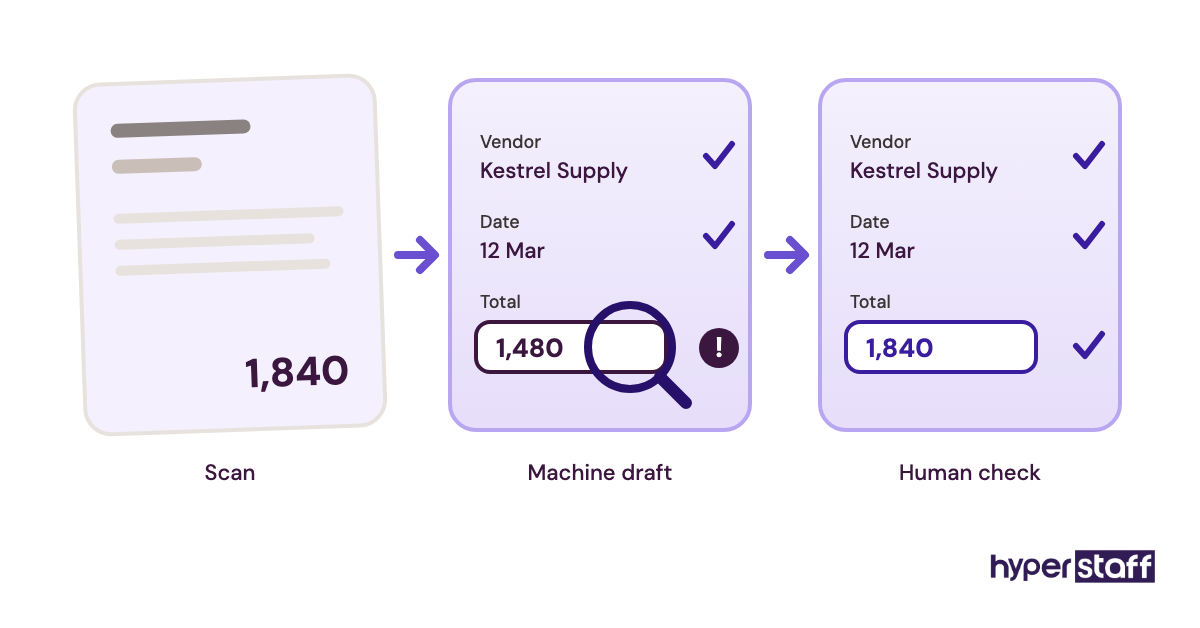
For hiring, add one question to the interview: how has the candidate checked machine-read data before? We're less certain how fast this will shift entry-level work, and it likely varies a lot by record type.
Disclaimer: This article is for general information only and isn't legal, financial or employment advice. Rates, tool pricing and statistics may change; confirm current details with the relevant provider before making hiring decisions.
Common questions
Can I hire a data entry VA for just a few hours a week?
You can. Hyperstaff's smallest bundle is 40 hours a month, roughly 10 hours a week, which suits many small businesses starting with a backlog.
Is it safe to give a data entry virtual assistant access to customer data?
It can be, with the right setup. Use named accounts, least-privilege permissions, an NDA and a password manager, and avoid sharing logins over chat or email.
Should a data entry VA work in my time zone?
It depends on the work. Overnight batch processing benefits from a time zone gap, while live CRM updates during sales calls need some overlap with your hours.
What happens if the data entry VA I hire quits?
Through Hyperstaff, you get a free replacement in 5 to 7 business days. The new hire is briefed from your Operations Vault, so your rules don't leave with the person.
Do I need to train a data entry virtual assistant myself?
You'll need to explain your own field rules and edge cases, since no one else knows them. General skills like spreadsheets and typing should already be there when you hire.
Book a free 15 min call
We place a pre-vetted specialist in 5 business days, fully managed, from $3/hour.