Is an Ecommerce Virtual Assistant Worth It? Here's the Math
An ecommerce virtual assistant pays off when repeat store work costs you more than the hours you buy, and here's how to check that before you hire.
On this page
- What Is an Ecommerce Virtual Assistant?
- Key Ecommerce VA Terms You Should Know
- Why Does an Ecommerce VA Matter for a Growing Store?
- How Does Hiring an Ecommerce Virtual Assistant Work?
- Types of Ecommerce Virtual Assistants
- How Is an Ecommerce VA Different From Related Roles?
- Ecommerce VA vs. General Virtual Assistant
- Ecommerce VA vs. Freelance Shopify Developer
- Ecommerce VA vs. 3PL
- What Are the Benefits of an Ecommerce Virtual Assistant?
- What Are the Drawbacks of an Ecommerce Virtual Assistant?
- Who Needs an Ecommerce Virtual Assistant?
- Ecommerce Virtual Assistant Examples
- Good Ecommerce VA Examples
- Bad Ecommerce VA Examples
- Creating an Ecommerce VA Plan, Step-by-Step
- Step #1
- Step #2
- Step #3
- Step #4
- Step #5
- What Does an Effective Ecommerce VA Strategy Look Like?
- Ecommerce Virtual Assistant Tools and Software
- 9 Proven Ecommerce VA Tips and Best Practices
- Overcoming Common Ecommerce VA Challenges
- How Do You Measure Whether an Ecommerce VA Is Working?
- How Long Before an Ecommerce VA Pays Off?
- How Much Does an Ecommerce Virtual Assistant Cost?
- So, Is an Ecommerce Virtual Assistant Worth It?
- How Do You Choose an Ecommerce VA Agency?
- Ecommerce VA Statistics, Trends and Future Predictions
- Can AI Replace an Ecommerce Virtual Assistant?
- FAQs
Turn Admin Hours Back Into Revenue
Hyperstaff places pre-vetted dedicated ecommerce virtual assistant services for online stores, with one specialist who learns your store and stays on it. We've placed 70+ virtual assistants across 30+ clients, with rates from $3 an hour and placement in 5 business days. If the fit is wrong, a free replacement arrives in 5 to 7 business days, already briefed.
What Is an Ecommerce Virtual Assistant?
An ecommerce virtual assistant is a remote team member who runs the daily work of an online store: customer replies, orders and returns, product listings and marketing calendars. They log into your Shopify, Amazon or WooCommerce backend and work inside your tools for a set number of hours each month.
Whether one is worth it comes down to a plain trade. You pay for hours, and those hours have to protect or produce more than they cost, either in sales or in owner time that goes back into buying and product decisions.
The role reaches well past inbox admin. A capable ecommerce VA can run support tickets, wholesale lead lists, ad reporting and operations checklists, and our explainer on what an ecommerce virtual assistant is breaks the role down further.
Key Ecommerce VA Terms You Should Know
- AOV = average order value, total revenue divided by the number of orders.
- SKU = stock keeping unit, the code that identifies one product variant.
- Fulfillment = picking, packing and shipping an order.
- 3PL = a third-party logistics provider that stores and ships your inventory.
- First response time = how long a customer waits for the first human reply.
- RMA = return merchandise authorization, the approval step before a return ships back.
- Chargeback = a payment reversed by the customer's bank after a dispute.
- SOP = standard operating procedure, the written steps for one recurring task.
- Staff account = a separate store login with its own set of permissions.
- Loaded hourly cost = what an hour of work costs once wages, benefits and payroll extras are added.
- Dedicated VA = one assistant assigned only to your business.
Why Does an Ecommerce VA Matter for a Growing Store?
An ecommerce virtual assistant matters because store work grows with order volume, and most of it repeats. Every new order can produce a tracking question, a return, a review to answer or a stock count to fix.
Owners tend to absorb that load until something slips. In our experience the first thing to slip is response time, and slow replies on "where's my order" tickets turn into disputes and bad reviews faster than most product problems do.
Cost is the other half. A US customer service rep earns a median of $21.53 an hour according to the Bureau of Labor Statistics, before benefits, which puts a local hire out of reach for many small stores.
How Does Hiring an Ecommerce Virtual Assistant Work?
Hiring an ecommerce virtual assistant runs in four stages: scope the role, get matched with a candidate, hand over access and processes, then review output after a few weeks. With an agency, the sourcing and vetting happen on their side.
At Hyperstaff, the order is a free discovery call, placement in 5 business days, then a 30-minute kickoff call. Work starts that day or the next morning.
The part people underestimate is the dead zone between kickoff and real output. Week one fills up with access requests, two-factor codes that only reach the owner's phone and questions a written process would have answered.
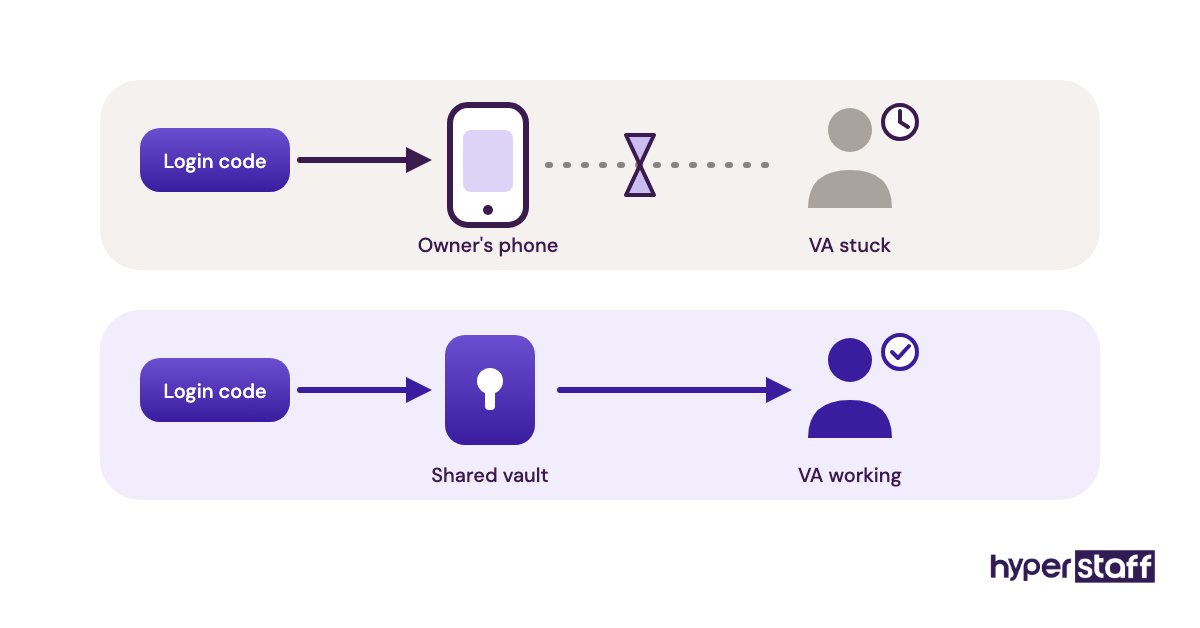
If you'd rather run the search yourself, our guide on how to hire an ecommerce virtual assistant covers sourcing, trial tasks and contracts.
Types of Ecommerce Virtual Assistants
Ecommerce virtual assistants usually specialize by function, and the type you need decides which tier and monthly bundle fit. The table maps the common roles, and the full ecommerce VA task list goes deeper on each.
| Type | Core tasks | Typical tier | Usually worth it when |
|---|---|---|---|
| Customer support VA | Tickets, live chat, order status, refunds within limits | Essential or Professional | Tickets pass 15 to 20 a day |
| Order and fulfillment VA | Order checks, 3PL tickets, address fixes, exceptions | Essential | Order exceptions eat owner time daily |
| Product listing VA | Uploads, variants, descriptions, SEO fields, image edits | Essential or Professional | The catalog changes weekly or by season |
| Marketplace VA | Amazon or Etsy listings, Seller Central cases, inventory sync | Professional | You sell on 2+ channels |
| Email and SMS marketing VA | Campaign builds, list segments, flow checks | Professional | You send campaigns every week |
| Ad and reporting VA | Weekly ad reports, budget tracking, dashboards | Professional or Expert | Ad spend is a top cost line |
| Bookkeeping support VA | Payout reconciliation, invoice entry, expense coding | Professional | Payouts come from several platforms |
| Store operations generalist | A mix of the above, plus supplier follow-ups | Professional or Expert | One person has to cover the gaps |
How Is an Ecommerce VA Different From Related Roles?
An ecommerce VA owns the recurring daily work of a store, which sets the role apart from project freelancers and logistics providers. These three comparisons come up most when owners price out their options.
Ecommerce VA vs. General Virtual Assistant
A general virtual assistant covers inbox, calendar and admin for any kind of business. An ecommerce VA already knows order flows, return logic and platforms like Shopify, so the ramp-up on store tasks is shorter.
A general VA is fine for a founder's personal admin. For anything that touches a customer's money, pay for store experience.
Ecommerce VA vs. Freelance Shopify Developer
A Shopify developer builds and fixes things like themes, apps and custom code. They bill per project or at a higher hourly rate, and the job ends when the build ships.
An ecommerce VA runs what the developer built, every day. Most stores need a developer a few times a year and a VA every week.
Ecommerce VA vs. 3PL
A 3PL stores and ships physical inventory. It won't answer the customer asking where the parcel is, and it rarely files the carrier claim when one goes missing.
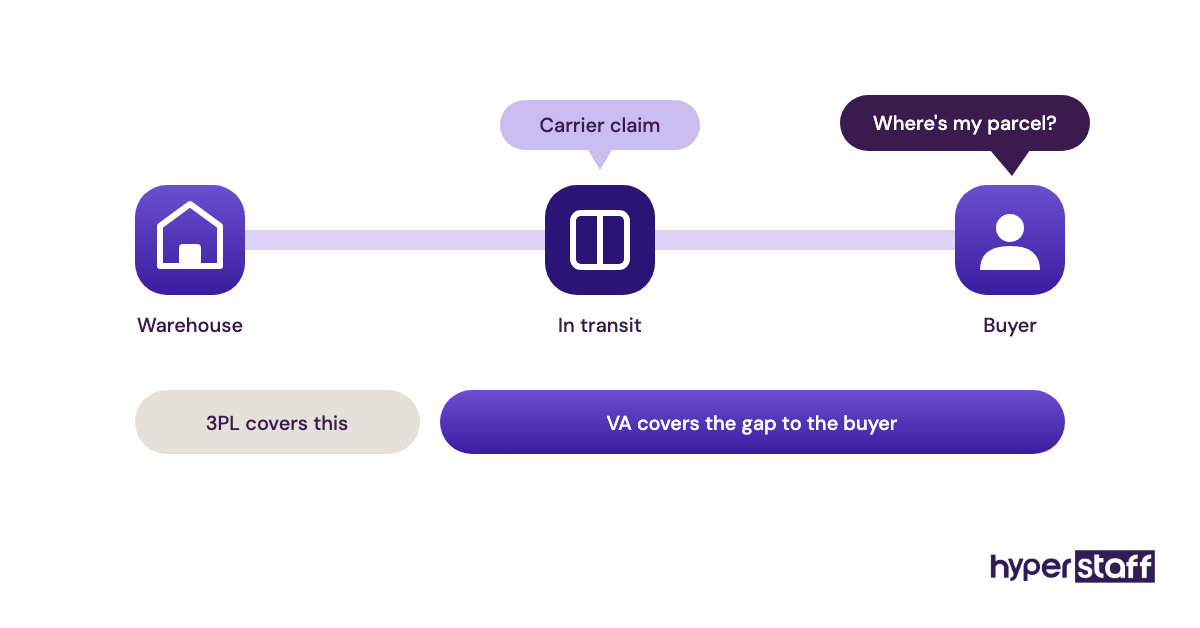
An ecommerce VA covers that gap between the warehouse and the buyer. Many stores run both.
What Are the Benefits of an Ecommerce Virtual Assistant?
The biggest benefits of an ecommerce virtual assistant are a lower cost per hour and faster customer replies, with hours that can grow for busy seasons.
- Lower cost per hour than a local hire once benefits and payroll taxes are counted
- Faster replies when the VA's shift covers hours you're offline
- Monthly bundles of 40, 80 or 160 hours that match the workload
- Processes written down, so the store stops living in one person's head
- Owner time moved back to buying, suppliers and product decisions
What Are the Drawbacks of an Ecommerce Virtual Assistant?
The honest drawbacks are ramp-up time and the management work you can't hand off. None of them kill the case, but each one costs time in the first month.
- Two to four weeks of slower output while the VA learns your store
- Time-zone friction if no overlap hours are agreed
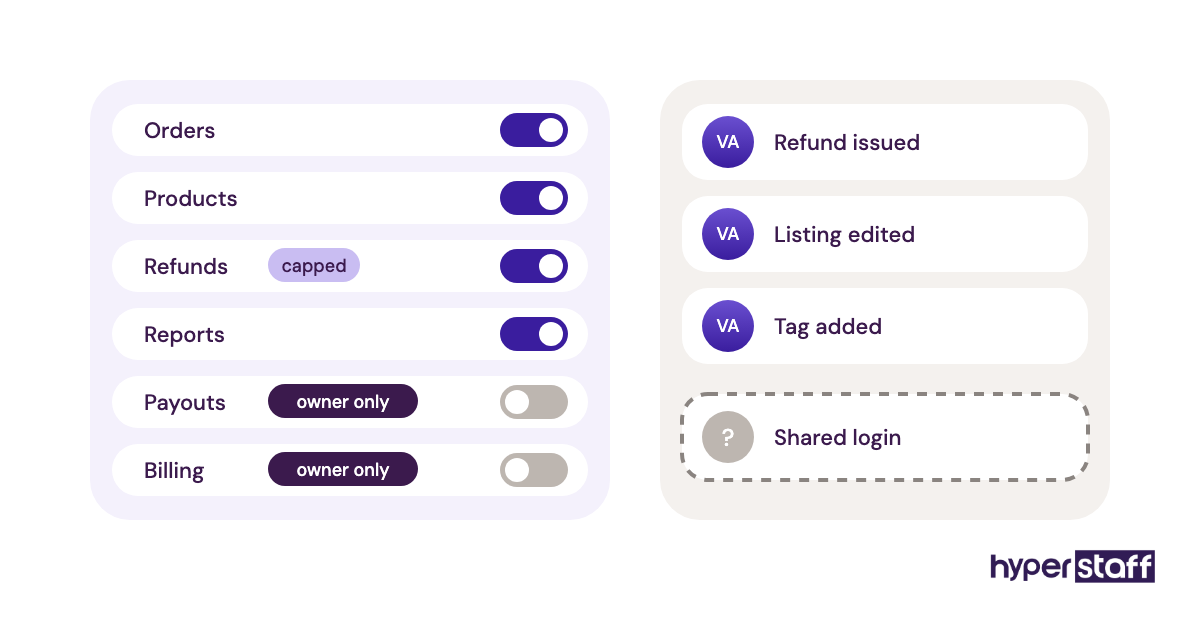
- Security setup: staff accounts, a password manager and permission levels
- Someone still reviews the work and answers edge-case questions
Who Needs an Ecommerce Virtual Assistant?
Stores that need an ecommerce virtual assistant share one sign: the owner spends more hours on repeat tasks than on buying, product or marketing decisions. Order volume matters less than how much of the week goes to work that follows the same steps each time.
Stores with seasonal spikes get a clear payoff, since hours can move between bundles for a holiday quarter. Multichannel sellers on Shopify plus Amazon or Etsy benefit too, because inventory and listing updates multiply with each channel.
A store doing a handful of orders a week, with nothing written down, is usually too early. Explaining the work would take longer than doing it.
Ecommerce Virtual Assistant Examples
The setups below show where an ecommerce VA earns its cost and where the hire goes wrong. Each one is a common role setup, described in general terms.
Good Ecommerce VA Examples
A Support VA With Written Refund Limits
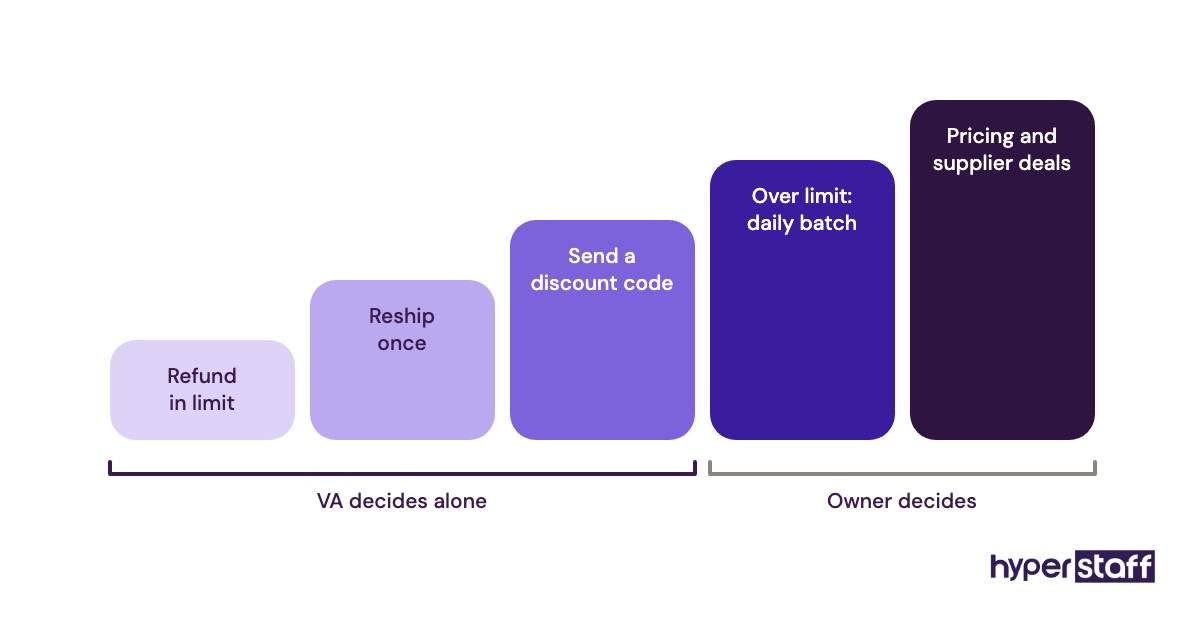
The VA answers tickets in the helpdesk and can refund up to a fixed amount, say $50, without asking. Anything above that goes to the owner in one daily batch.
Owner interruptions drop to one review a day. Customers get answers in hours.
A Listings VA Working From a Product Data Sheet
New products arrive as one row each in a shared sheet with SKU, price, variants, weight and image links. The VA builds the listing, fills the SEO fields and flags missing data before publishing anything.
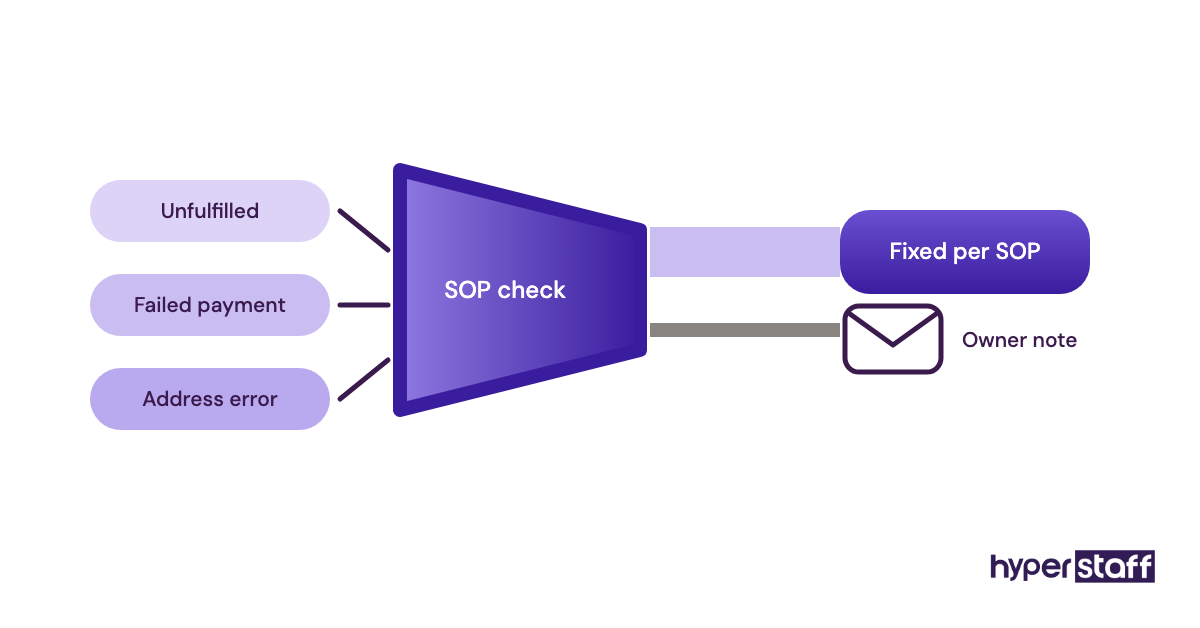
An Order Desk VA With a Daily Exception Report
Each morning the VA checks unfulfilled orders, failed payments and address errors, then fixes what the SOP covers. The owner gets one short message listing the rest.
Bad Ecommerce VA Examples
Most failed hires trace back to setup, and our list of common ecommerce VA mistakes covers more of them.
The Shared Owner Login
The VA works from the owner's own Shopify login because the Basic plan has no extra staff accounts. Every action looks like the owner's, nothing can be traced, and a payout setting can change by accident.
The "Do Everything" Hire
Support, ads, listings and bookkeeping all get handed over in week one with no priorities. Nothing gets done well, and the owner decides VAs don't work.
Feedback That Never Arrives
The owner fixes the VA's mistakes without a word and never says what went wrong. The same errors repeat for months.
Creating an Ecommerce VA Plan, Step-by-Step
A solid ecommerce VA plan starts with a time audit and ends with a 30-day review. Skipping the audit is the most common reason a hire feels expensive.
Step #1: Log Where Your Hours Go
Track every store task for two weeks with the minutes spent. Sort the list into repeatable work and judgment work.
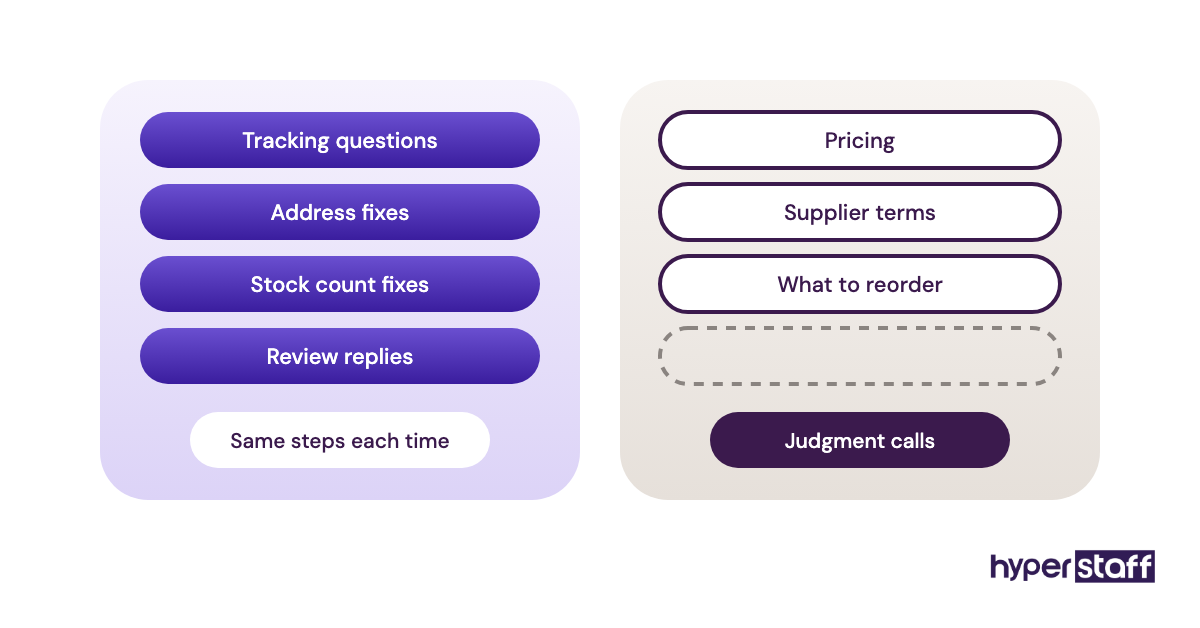
Repeatable work goes to the VA first. Judgment calls like pricing and supplier negotiations stay with you for now.
Step #2: Pick One Lane and Write the Role
Choose the single area with the most repeat hours, usually support or orders. Then write the job description around that lane, with tools and permission levels spelled out.
Step #3: Match the Tier and Hours to the Work
The Essential tier (0 to 2 years, from $3 an hour) suits tasks with clear SOPs. Professional (2 to 5 years, from $6) fits work that needs judgment within limits, and Expert (5+ years, from $12) fits ad reporting or full operations ownership.
Start at 40 or 80 hours. Adding hours later is easier than paying for hours nobody has work for.
Step #4: Set Up Access and the Playbook
Create staff accounts, share logins through a password manager and record a short video of each task. Our guide to onboarding an ecommerce virtual assistant has the week-one checklist.
With Hyperstaff, your SOPs, tools and context go into your Operations Vault, which we write down and maintain for you. A replacement VA gets briefed from it, so the knowledge stays with your store.
Step #5: Review at 30 Days
At day 30, compare response times, error counts and your own freed hours against the Step #1 log. Add a second lane only when the first one runs without daily input from you.
What Does an Effective Ecommerce VA Strategy Look Like?
An effective ecommerce VA strategy hands over one lane at a time and puts every decision limit in writing. The limits are the part most owners skip.
A VA who knows they can refund up to a fixed amount, reship once or send a 10% code works fast. A VA who has to ask each time is just a slower inbox.
Practitioners genuinely disagree on where to start. Some put the first VA on support because buyers feel it right away, while others begin with listings and back-office work because mistakes there are cheaper to catch.
We lean toward support first for stores with steady ticket volume, and toward listings for stores still writing their first SOPs. A listing error can be fixed before a customer ever sees it.
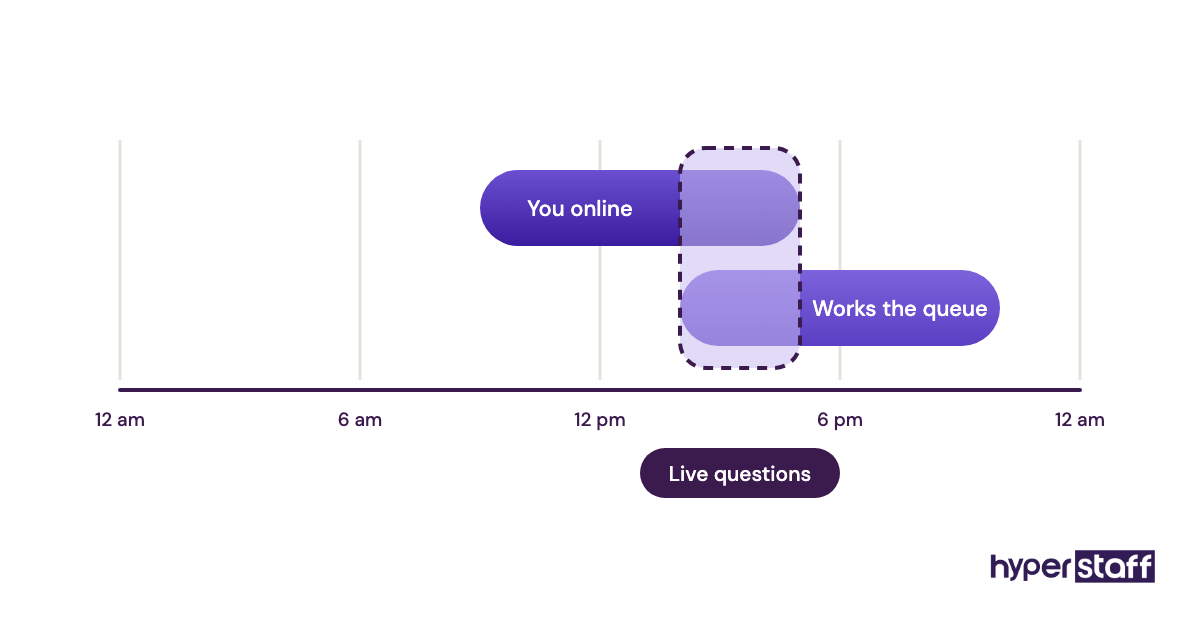
Overlap hours are the other lever. Two to four hours a day with both of you online is usually enough for questions, and full overlap rarely adds much for the extra scheduling pain.
Ecommerce Virtual Assistant Tools and Software
An ecommerce VA works inside the software your store already runs, so the tool question is mostly about access and seats. Our ecommerce VA tool stack guide covers more options, and the prices below come from each vendor's own pricing page.
- Shopify: the store backend. Shopify's plans run from about $29 to $39 a month on Basic, which has no extra staff accounts, to about $79 to $105 on Grow with up to 5 staff accounts, depending on annual or monthly billing.
- Gorgias: a helpdesk priced by ticket volume and not per agent, which makes adding a VA cheap. Gorgias plans start around $10 a month for 50 tickets.
- ShipStation: labels and order routing. ShipStation starts at $14.99 a month, with 3 users on the Starter plan.
- Klaviyo: email and SMS. The Klaviyo free plan covers up to 250 active profiles and 500 email sends a month.
- 1Password or a similar password manager: shares logins without pasting passwords into chat.
- Loom: screen recordings that become SOPs in minutes.
- Slack or Google Chat: for daily questions and the end-of-day update.
Our opinion on the one change that matters most: fix staff accounts before anything else. For any task longer than five clicks, we'd also pick a Loom video over a written doc, since VAs rewatch the exact click path.
9 Proven Ecommerce VA Tips and Best Practices
These ecommerce VA practices separate the hires that pay off from the ones cancelled after a month.
- Hand over one lane in the first month, then add the next.
- Put refund, discount and reship limits in writing.
- Use staff accounts and keep your owner login private.
- Record a video for every task done more than twice.
- Ask for an end-of-day update with ticket counts and open issues.
- Agree on two to four overlap hours a day.
- Correct mistakes in writing and update the SOP the same day.
- Review your time log at 30 and 60 days.
- Keep pricing and supplier negotiations with you until the VA has months of context.
Overcoming Common Ecommerce VA Challenges
Most ecommerce VA challenges come from missing context, and fixing the context fixes most of them. Slow output in week one is usually an access problem: two-factor codes, missing permissions or a tool nobody mentioned.
Repeated errors point to an SOP gap. Rewrite the step, record it and check the next five times the task comes up.
Time zones cause friction only when nobody sets overlap hours. Turnover is the risk owners fear most, and with Hyperstaff a free replacement arrives in 5 to 7 business days, briefed from your Operations Vault.
How Do You Measure Whether an Ecommerce VA Is Working?
Measure an ecommerce VA by the hours you got back and the store numbers they touch. Compare both against the two-week time log you made before hiring.
For support, track first response time, tickets closed per hour and repeat contacts. For orders and listings, count errors per 100 orders or listings and how many exceptions still reach you each day.
The number that settles it is your own freed hours. If those hours go into buying, ads or product work, the VA is paying off even before sales move.
How Long Before an Ecommerce VA Pays Off?
Most ecommerce VAs reach steady output in two to four weeks, and the hire pays off once that output runs without daily owner input, usually within one to three months. Narrow, well-documented lanes move faster.
Week one is access and shadowing. Weeks two and three are supervised work with corrections, and gains compound after that because every correction becomes a permanent line in the SOP.
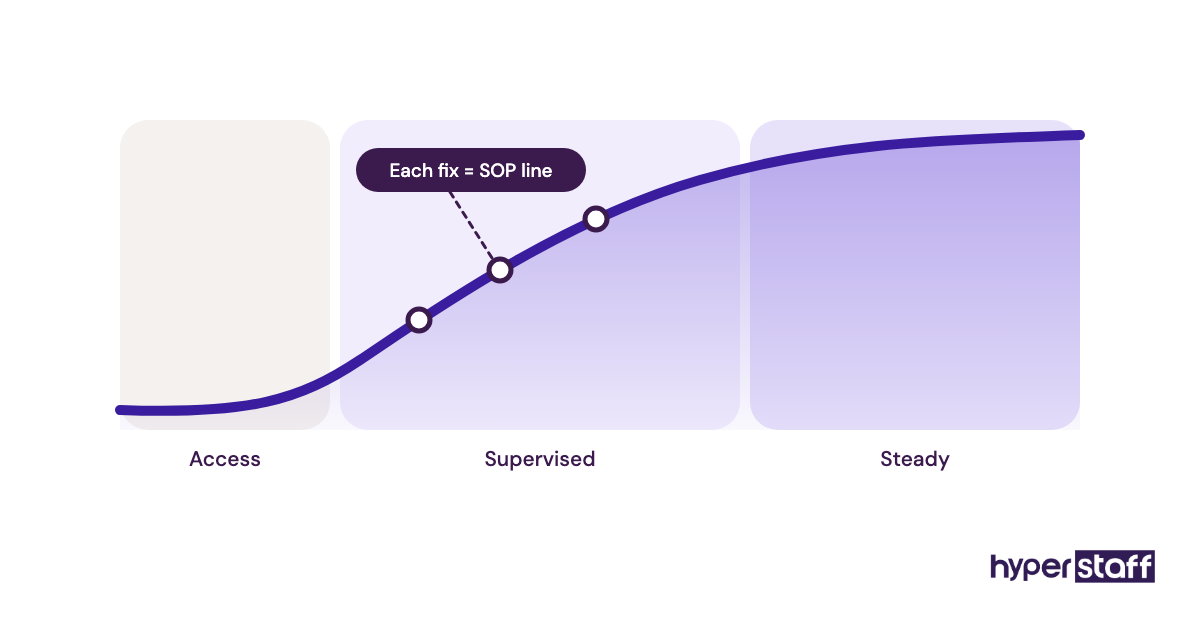
Broad roles take longer. A store operations generalist can need two months before you stop checking their work every day.
How Much Does an Ecommerce Virtual Assistant Cost?
An ecommerce virtual assistant from Hyperstaff costs from $3 to $12 an hour depending on experience tier, billed in 40, 80 or 160-hour monthly bundles. A comparable US in-house hire costs about $30 an hour once benefits are added.
That in-house figure uses the BLS median wage for customer service reps plus the 30% benefits share of private-industry pay reported in the BLS Employer Costs for Employee Compensation release. Our ecommerce virtual assistant cost breakdown goes line by line.
| Hours per month | Hyperstaff Essential (from $3/hr) | Hyperstaff Professional (from $6/hr) | Hyperstaff Expert (from $12/hr) | US in-house hire (about $30.76/hr loaded) |
|---|---|---|---|---|
| 40 | from $120 | from $240 | from $480 | about $1,230 |
| 80 | from $240 | from $480 | from $960 | about $2,460 |
| 160 | from $480 | from $960 | from $1,920 | about $4,920 |
| Paid quarterly | 10% off | 10% off | 10% off | n/a |
Important: The Hyperstaff prices above are starting averages. Your actual rate depends on the tier, hours and kind of store work you need, which we confirm with you on a free discovery call.
So, Is an Ecommerce Virtual Assistant Worth It?
Yes, an ecommerce virtual assistant is worth it for most stores with 10 or more hours of repeat work a week, and a well-scoped one is among the best-returning hires a small store can make. The math gets hard to argue with once you put a loaded in-house hour next to an offshore one.
Take a Professional-tier VA on the 80-hour bundle. Here's how the monthly numbers line up.
| Line | Monthly figure |
|---|---|
| Hyperstaff Professional, 80 hours | from $480 |
| Same bundle, paid quarterly (10% off) | about $432 |
| US in-house equivalent, 80 hours | about $2,460 |
| Monthly difference | about $1,980 |
| Sales needed to cover $480 at a 40% gross margin | $1,200 |
At a 40% gross margin, the VA covers their cost by saving or adding about $1,200 in monthly sales. For many stores that's a few rescued orders a week, before counting the owner hours moved to buying and marketing.
It isn't worth it for a store with nothing written down and no time to write it, or an owner planning to hand over everything in week one. Our comparison of an ecommerce VA vs in-house hire covers the cases where a local employee is the better call.
How Do You Choose an Ecommerce VA Agency?
Choose an ecommerce VA agency on four points: how it vets talent, whether the VA is dedicated to you, how replacements work and who keeps your process documentation. Price comes after those.
A dedicated VA matters more than it sounds. A rotating pool means re-explaining your refund rules to a new person every few weeks, while a dedicated VA learns one store and gets faster.
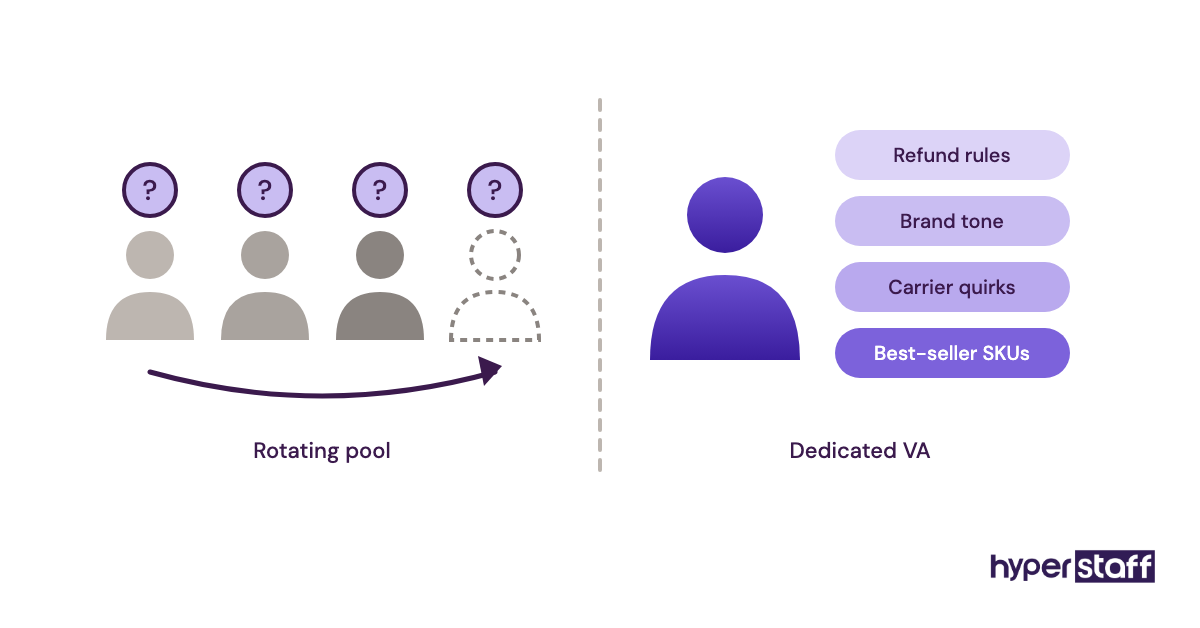
Ask how long a replacement takes and what it's briefed from. At Hyperstaff it's 5 to 7 business days, briefed from your Operations Vault, and every client has a dedicated account manager.
Billing structure is a real trade-off. Monthly bundles with clear tier rates are easier to budget, though plain hourly billing can suit a store that only needs a few hours a week.
Ecommerce VA Statistics, Trends and Future Predictions
E-commerce makes up roughly 16 to 17% of total US retail sales in the Census Bureau's quarterly e-commerce report. More online orders mean more support tickets, returns and listing updates for every store.
Labor cost is the other trend behind offshore hiring. Benefits make up 30% of private-industry compensation in the BLS employer cost data, so a US hire costs well above the posted wage.
Our prediction, held loosely: AI will take over first drafts of support replies and listing copy, and VA roles will shift toward checking, editing and handling exceptions. We're less sure how fast marketplace work changes, because Amazon and Etsy rules shift often and AI tools trail behind them.
Can AI Replace an Ecommerce Virtual Assistant?
No, not for most stores yet. AI writes the first draft of routine replies and product descriptions, and a VA still checks the output, handles exceptions and acts inside your admin.
Helpdesks like Gorgias now bundle a set number of AI interactions into each plan, and Shopify has AI writing tools built into its admin. Both work best with a person reviewing tone, facts and refund decisions.
The useful pairing is a VA who runs the AI tools. A VA editing AI drafts clears more tickets per hour than one typing every reply, and the store keeps a person accountable for each decision.
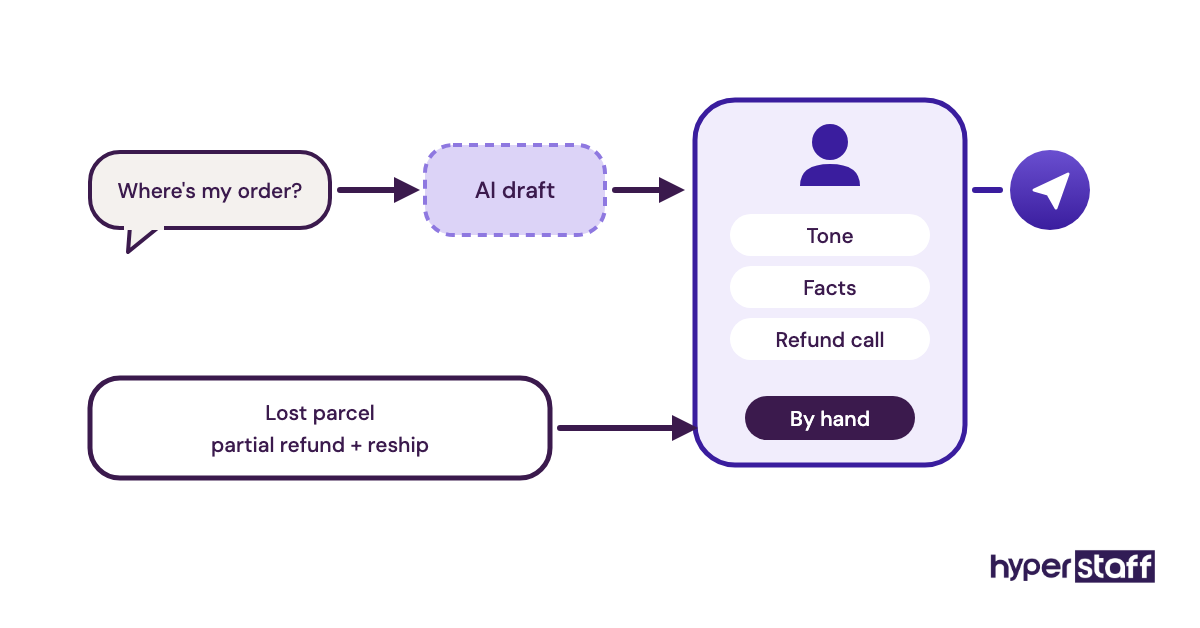
AI still struggles with the messy cases: a lost parcel that needs a carrier claim, or a buyer who wants a partial refund plus a reship. Those need someone who knows your store.
Disclaimer : This article is general information only and isn't legal, financial or tax advice. Prices, statistics and third-party tool details can change, so confirm current terms with each provider before making hiring or purchasing decisions.
Common questions
Is an ecommerce VA worth it for a small Shopify store?
Yes, once you have about 10 hours a week of repeat tasks like support, order checks or listing updates. Below that, even a 40-hour monthly bundle may sit partly unused.
Can I trust a virtual assistant with my store login?
You can, with the right setup. Give the VA a staff account with limited permissions, share other logins through a password manager and keep payout and billing settings owner-only.
Should my ecommerce VA be full-time or part-time?
Part-time fits most stores at the start, at 40 or 80 hours a month. Move to 160 hours once the first lane runs smoothly and a second one is ready to hand over.
Is an ecommerce virtual assistant worth it in slow months?
It depends on the work you line up. Slow months suit catalog cleanup, SOP writing and email flow checks, which pay back in the next busy season.
What happens if my ecommerce VA quits?
With an agency, you get a replacement. Hyperstaff replaces a VA free in 5 to 7 business days, and the new hire is briefed from your Operations Vault so your processes stay put.
Book a free 15 min call
We place a pre-vetted specialist in 5 business days, fully managed, from $3/hour.