Ecommerce Virtual Assistant Job Description: A Template You Can Copy and Adapt
A ready-to-paste ecommerce virtual assistant job description, plus how to cut it down to the work your store actually needs handed over.
On this page
- What is an ecommerce virtual assistant job description?
- Key ecommerce VA job description terms you should know
- Ecommerce virtual assistant job description template
- How do you adapt the template to your store?
- Shopify and other DTC stores
- Amazon and marketplace sellers
- Stores that use a 3PL
- Types of ecommerce virtual assistant roles
- How does it differ from related job descriptions?
- Ecommerce VA vs. general virtual assistant job description
- Ecommerce VA vs. customer service representative job description
- Ecommerce VA vs. ecommerce manager job description
- Benefits and drawbacks of a detailed ecommerce VA job description
- The benefits of a detailed job description
- The drawbacks of a detailed job description
- Ecommerce virtual assistant job description examples
- Good job description examples
- Bad job description examples
- Writing an ecommerce VA job description, step by step
- Step #1
- Step #2
- Step #3
- Step #4
- Step #5
- Ecommerce VA tools and software to list
- 10 proven tips for writing an ecommerce VA job description
- Overcoming common job description challenges
- How do you measure job description success?
- How long does it take for a new ecommerce VA to work independently?
- How much does an ecommerce virtual assistant cost?
- Is an ecommerce virtual assistant worth it?
- How to choose an ecommerce virtual assistant agency
- Ecommerce VA statistics, trends and future predictions
- Ecommerce virtual assistants and AI
- FAQs
A sharp job description protects your margins
Hyperstaff has placed 70+ virtual assistants with 30+ clients, and every placement starts from a clear brief of the work. Our dedicated ecommerce virtual assistants come pre-vetted from 5 regions, can be placed within 5 business days and start from $3 an hour, so the template below can turn into a working hire within a week.
What is an ecommerce virtual assistant job description?
An ecommerce virtual assistant job description is the written brief that tells candidates which store tasks they'll own, which platforms they'll work in and how their results get measured. Once someone is hired, it also becomes the first page of their training file.
Most stores write it too narrow. They list inbox and order admin, but an ecommerce VA can also run customer support, product listings, inventory checks, marketing support and supplier follow-up. Our full list of ecommerce VA tasks shows how far the role can stretch.
If the role itself is new to you, read what an ecommerce VA does before you write anything. The job description works best when you already know what you want to hand over.
Key ecommerce VA job description terms you should know
- SOP = a written, step-by-step process the VA follows for a repeat task.
- SKU = the stock code for one product variant, used in listings and inventory counts.
- Order fulfillment = every step from payment to a shipped package, including labels and tracking.
- RMA = return merchandise authorization, the approval a customer needs before sending an item back.
- Listing optimization = editing titles, bullets, images and keywords so a product ranks and sells on a marketplace.
- First response time = how long a customer waits for the first human reply to a ticket.
- Chargeback = a card payment reversed by the customer's bank, which the store disputes with evidence.
- Decision limit = the refund or spend amount a VA can approve without asking.
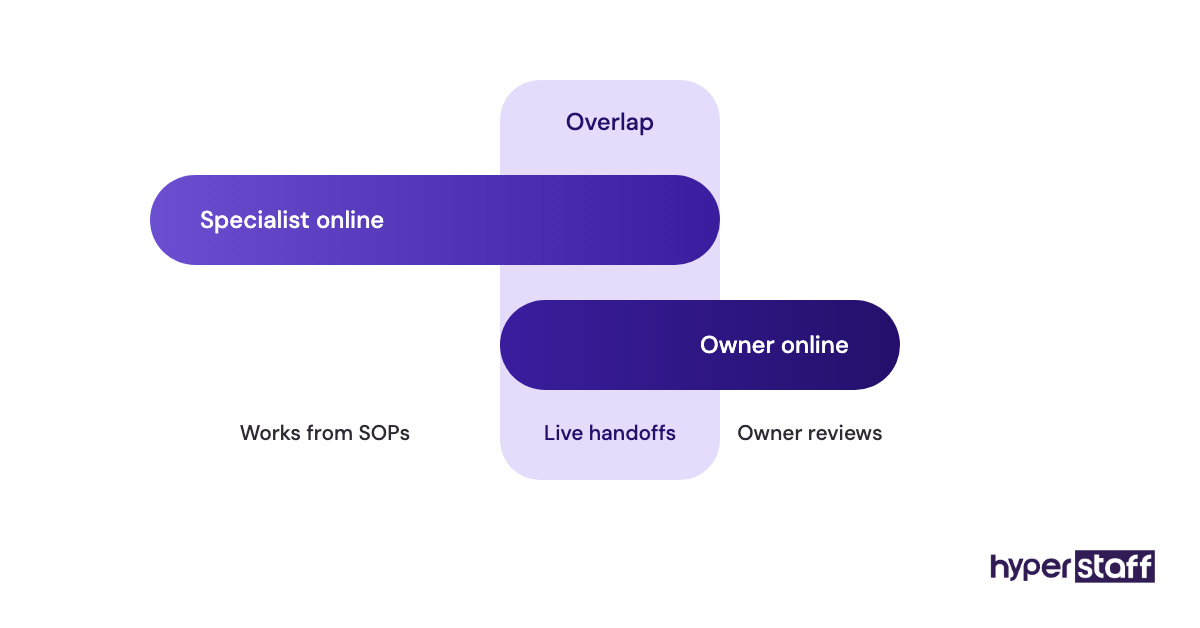
- Time zone overlap = the hours when the VA and the store owner are online together.
- KPI = a number that shows whether the work is being done well, such as order error rate.
- Dedicated VA = one person who works only on your account rather than a shared pool.
- Paid trial task = a short, paid sample of real work used to test shortlisted candidates.
Ecommerce virtual assistant job description template
The ecommerce virtual assistant job description template below is complete and ready to paste into a job board, an agency brief or an internal doc. Swap every [bracketed] field for your store's details and delete any responsibility block you won't hand over in the first 90 days.
Job title: Ecommerce Virtual Assistant ([Shopify / Amazon / WooCommerce] Store Operations)
Employment type: Remote, [full-time, 160 hours a month / part-time, 80 hours a month / part-time, 40 hours a month]
Working hours: At least [X] hours of overlap with [time zone], ideally [start time] to [end time]
Reports to: [Name, role]
About us: [Store name] sells [product category] to [customer type] through [your website / Amazon / Etsy / TikTok Shop]. We ship about [number] orders a week from [our warehouse / a 3PL / dropship suppliers].
The role: You'll keep the store running day to day: orders out on time, customers answered fast and listings accurate. You'll work from our written SOPs and help us improve them as you go.
Responsibilities: orders and fulfillment
- Process new orders in [platform] and flag high-risk orders before they ship
- Create shipping labels in [ShipStation / platform] and send tracking to customers
- Chase delayed or lost shipments with [carrier / 3PL] and keep the customer updated
Responsibilities: customer support
- Answer email, chat and marketplace messages in [helpdesk] within [X] business hours
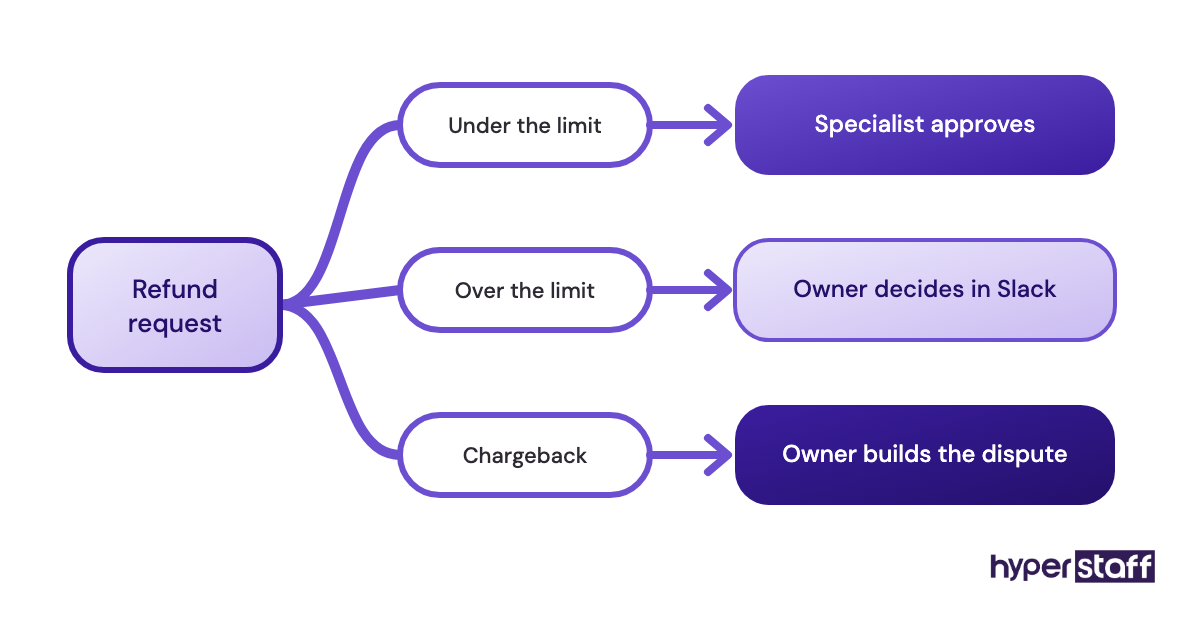
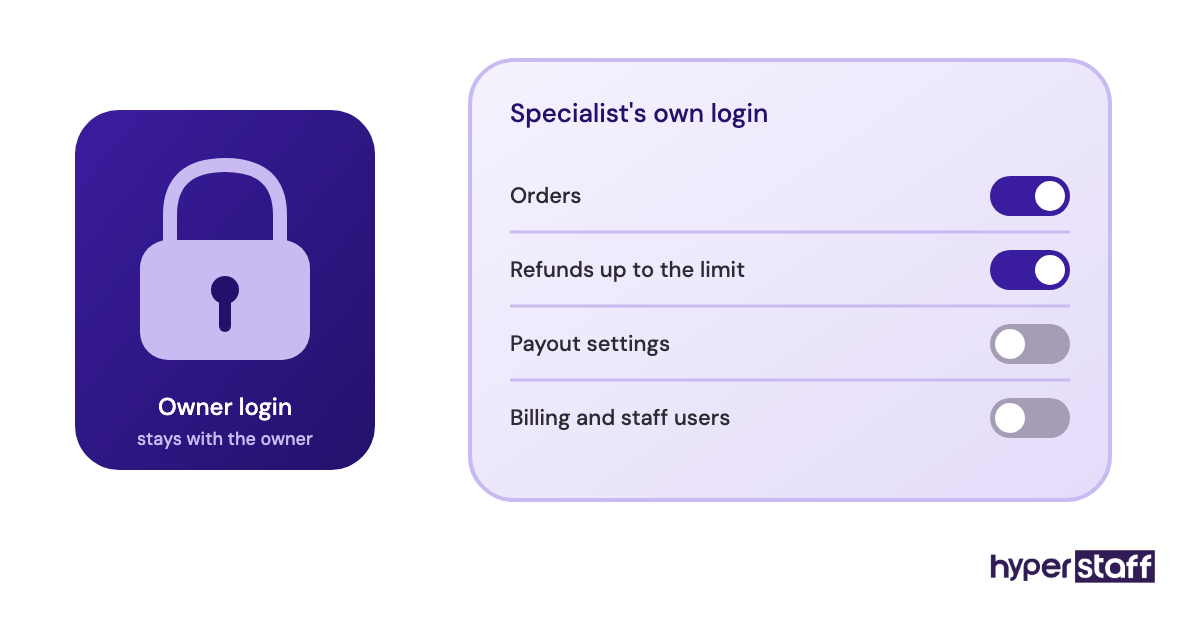
- Approve returns, exchanges and refunds up to $[amount] without sign-off
- Escalate chargebacks, legal threats and anything over $[amount] to [name]
Responsibilities: product listings
- Upload new products with titles, descriptions, images, variants and SEO fields
- Update prices, stock levels and sale banners on the schedule we set
- Fix listing errors and suppressed or inactive products on [marketplace]
Responsibilities: inventory and suppliers
- Reconcile stock counts against [platform] every [week]
- Send purchase orders and follow up with suppliers on delivery dates
Responsibilities: marketing support (optional)
- Schedule [Klaviyo] emails and social posts from approved copy
- Pull weekly sales and ad reports into [Google Sheets]
- Reply to product reviews and send review requests
- Prepare product images and banners in [Canva] from brand templates
Requirements
- [0 to 2 / 2 to 5 / 5+] years in ecommerce operations or customer support
- Hands-on experience in the [platform] admin
- Written English good enough to reply to customers without edits
- Reliable internet and a backup power source
- Comfort following SOPs and recording a short screen video when a process changes
Nice to have
- Experience with [Amazon Seller Central / Etsy / TikTok Shop]
- Knowledge of [your niche, for example apparel sizing or supplement labeling rules]
Tools you'll use: [Shopify], [Gorgias], [ShipStation], [Google Workspace], [Slack], [1Password]
How we'll measure success in the first 90 days
- First response time under [X] hours on [X]% of tickets
- Order error rate under [X]% (wrong item, wrong address, missed shipment)
- New listings live within [X] business days of receiving product data
- SOPs updated within one business day of any process change
Pay and schedule: [Rate or range], paid [monthly / every two weeks]. [Time-off and holiday policy].
How to apply: Send a short note naming the last online store you supported and the platform it ran on. Shortlisted candidates complete a paid [60-minute] trial: replying to [two] real customer emails and fixing one product listing.
How do you adapt the template to your store?
Adapting the template starts with cutting, not adding. A 40-hour role with five responsibility blocks gets half-done work on all of them, so keep the one or two blocks that eat the most of your week and delete the rest.
Use the hours you're buying as the guide for scope. The table below matches Hyperstaff's monthly bundles to what one person can realistically own.
| Monthly hours | Realistic scope | Responsibility blocks to keep | Usual tier |
|---|---|---|---|
| 40 | One task area | Support inbox or listings | Essential |
| 80 | Two connected areas | Support plus orders | Essential or Professional |
| 160 | Daily store operations | All core blocks, marketing optional | Professional or Expert |
Shopify and other DTC stores
For Shopify, WooCommerce or BigCommerce stores, the template works close to as written. Add the apps your store depends on by name, such as your reviews app or subscription app, because each one has its own admin a new hire must learn.
Amazon and marketplace sellers
Amazon sellers should rewrite the listings block around Seller Central work: case logs with Seller Support, stranded inventory, FBA shipment plans and account health warnings. Seller Central skill doesn't transfer cleanly from Shopify, and a VA can be strong in one and lost in the other.
Stores that use a 3PL
With a third-party warehouse, nobody on your side packs boxes. Change the fulfillment block to exception handling: tracking that stalls, address corrections and inventory that doesn't match the 3PL's report.
Types of ecommerce virtual assistant roles
Ecommerce virtual assistant roles split into a handful of common shapes, and naming the right one in your job title filters applicants before they read a word. Pick the closest row and pull its tasks into the template.
| Role type | Main tasks | Platform skills to require | Typical tier |
|---|---|---|---|
| Customer support VA | Tickets, returns, refunds, reviews | Helpdesk, store admin | Essential |
| Order and fulfillment VA | Order checks, labels, carrier follow-up | Shipping software, store admin | Essential |
| Product listing VA | Uploads, variants, product copy, SEO fields | Store admin, bulk CSV editing | Essential or Professional |
| Amazon marketplace VA | Seller Central cases, FBA plans, account health | Seller Central | Professional |
| Inventory and supplier VA | Stock counts, purchase orders, delivery dates | Spreadsheets, inventory app | Professional |
| Marketing support VA | Email scheduling, reports, social posts | Klaviyo, Canva, Meta Business Suite | Professional |
| Store operations VA | Runs most of the above daily | All of the store's core tools | Expert |
How does it differ from related job descriptions?
An ecommerce VA job description differs from close relatives in one way above all: it hands over money decisions inside a store. Refund limits, order holds and supplier messages show up here, while most adjacent job descriptions never mention them.
Ecommerce VA vs. general virtual assistant job description
A general VA job description centers on calendars, email, travel and documents. The ecommerce version swaps those for a named platform, an order flow and a refund limit, and it needs a trial task built on store work.
Ecommerce VA vs. customer service representative job description
A customer service job description judges people on tickets alone. An ecommerce VA often answers the same tickets, then updates the listing that caused the question and checks stock before promising a restock date.
Ecommerce VA vs. ecommerce manager job description
An ecommerce manager owns strategy, ad budgets and the profit target. Copying a manager job description and offering an assistant's rate pulls in two kinds of applicants: overqualified people who leave fast, and people who claim skills they don't have.
Benefits and drawbacks of a detailed ecommerce VA job description
A detailed ecommerce VA job description pays off mostly after the hire, in faster ramp-up and fewer arguments about scope. The costs are real but small, and they land before the hire starts.
The benefits of a detailed job description
- Fewer unqualified applicants, because the platform and tasks are named
- Faster onboarding, since the document doubles as the first training brief
- Clear refund and spend limits from day one
- Fair performance reviews based on KPIs both sides agreed to upfront
- An easier handover if the person ever needs replacing
The drawbacks of a detailed job description
- It takes a few hours of time logging before you can write it well
- Very specific tool lists can scare off good people who've used a rival tool
- It goes stale when your store changes, so it needs a review every few months
Ecommerce virtual assistant job description examples
Ecommerce virtual assistant job description examples are most useful at the line level. One badly written line can attract the wrong applicants on its own, so here are lines worth copying and lines worth deleting.
Good job description examples
Example of a clear refund authority line
"Approve refunds and exchanges up to $75 without sign-off. Escalate anything higher, plus every chargeback, to the owner in Slack." It gives a number, an exception and a channel.
Example of a measurable response time line
"Reply to every ticket within 4 business hours, Monday to Friday, 9 a.m. to 1 p.m. Eastern overlap." A candidate can say yes or no to that before applying.
Example of a specific tools line
"You'll work in Shopify, Gorgias and ShipStation. Experience with Zendesk or Shippo also counts." Naming close alternatives keeps good applicants from screening themselves out.
Bad job description examples
Example of the "wear many hats" line
"Must be a self-starter who can wear many hats in a fast-moving environment." Every applicant believes this describes them, so it filters nobody.
Example of a missing platform
"Manage our online store and marketplace listings." Shopify, Amazon and Etsy are three different jobs, and this line doesn't say which one you run.
Example of the everything list
"Handle customer service, orders, inventory, listings, ads, email marketing, bookkeeping and social media." On a part-time role, this reads as a warning to experienced people, who know it can't be done well in 40 hours.
Writing an ecommerce VA job description, step by step
Writing an ecommerce VA job description takes five steps, and the first one happens before you open a document. Budget about a week, most of it spent noticing where your own hours go.
Step #1: Log a week of store tasks
Keep a simple time log for five to seven days and write down every store task with how long it took. Memory undercounts small jobs like address fixes and review replies, which add up fast.
Step #2: Sort tasks into now, later and never
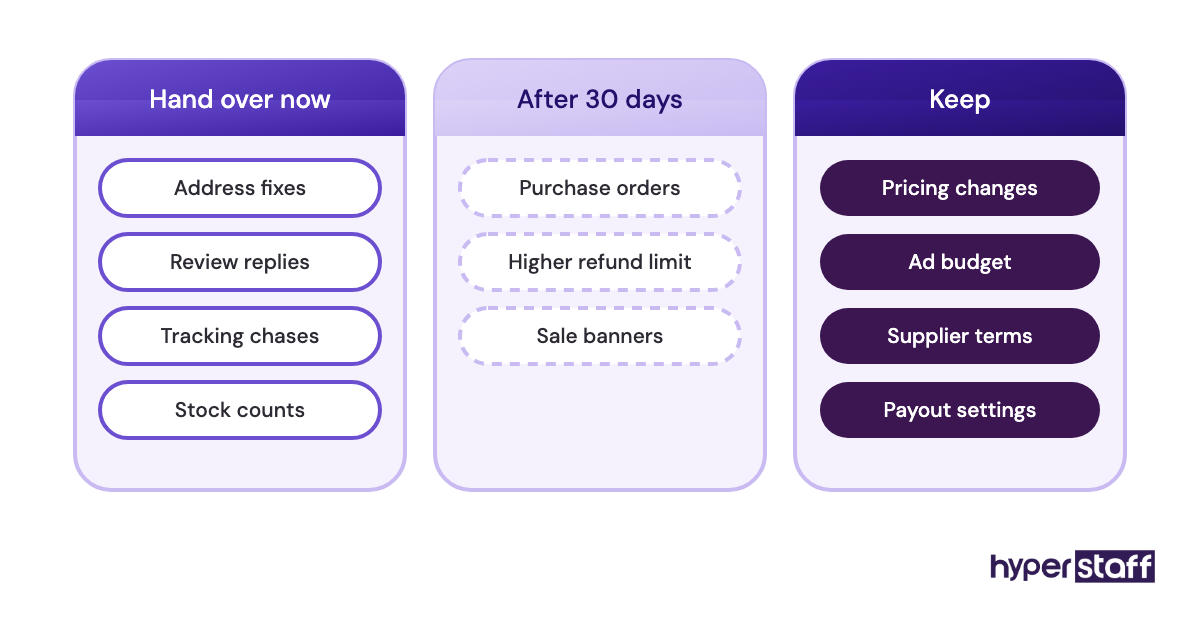
Mark each task as hand over now, hand over after 30 days, or keep. Pricing changes, supplier negotiations and ad budget calls usually stay with the owner, at least at first.
Step #3: Write responsibilities with decision limits
Turn the "now" tasks into the responsibility blocks in the template, and attach a dollar limit to every task that touches money. Without one, a new hire either asks about every $12 refund or approves a $400 one they shouldn't have.
Step #4: Add KPIs and a paid trial task
Pick three or four numbers from your own store that you'd check weekly, then design a paid trial using real, anonymized tickets and one broken listing. Our guide on hiring an ecommerce virtual assistant covers sourcing and shortlisting.
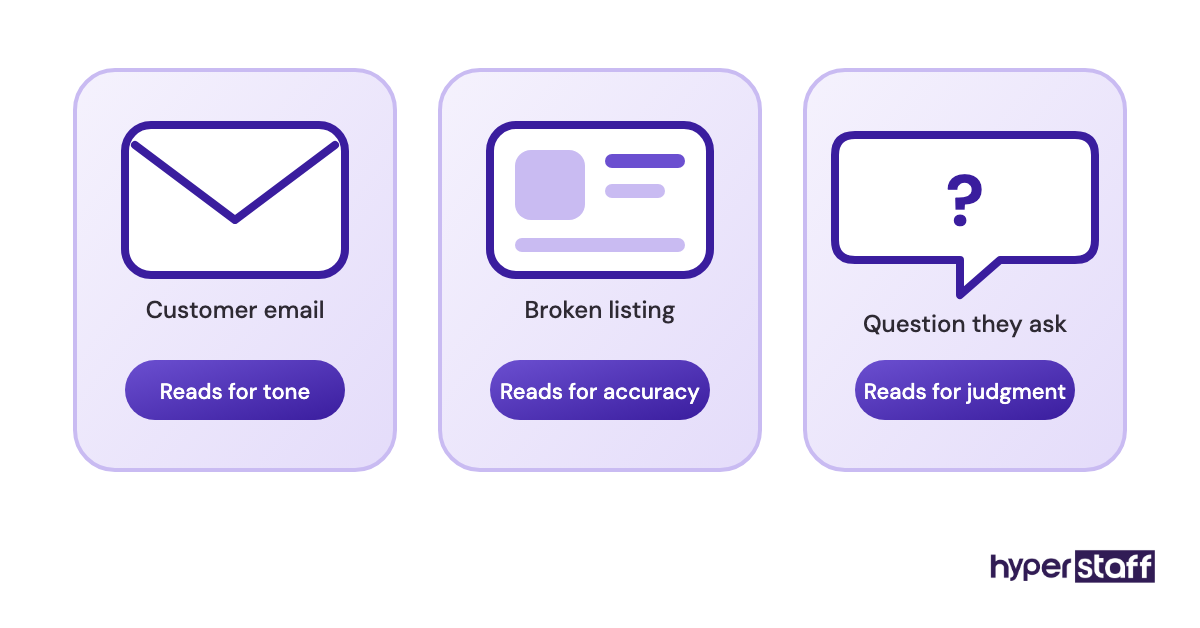
Plan the interview alongside the trial so the two test different things. These ecommerce VA interview questions map to the template's responsibility blocks.
Step #5: Reuse the description as the onboarding brief
Once someone accepts, the job description becomes the outline of their first-week training. Link each responsibility to its SOP, and use our checklist for onboarding an ecommerce VA to fill the gaps.
Hyperstaff writes this down for clients in an Operations Vault: SOPs, tools and context, maintained over time. The same vault is what a replacement is briefed from if one is ever needed.
Ecommerce VA tools and software to list
The tools section of an ecommerce VA job description should name the platform, the helpdesk and the shipping software at minimum. Those three decide whether a new hire is useful on day one or spends the first week learning screens.
- Store platforms: Shopify, WooCommerce, BigCommerce, Amazon Seller Central, Etsy, TikTok Shop
- Helpdesks: Gorgias, Zendesk, Help Scout, Re:amaze
- Shipping: ShipStation, Shippo, the native label tools in Shopify or Amazon
- Marketing: Klaviyo, Canva, Meta Business Suite
- Work and access: Google Workspace, Slack, Loom, 1Password or Bitwarden
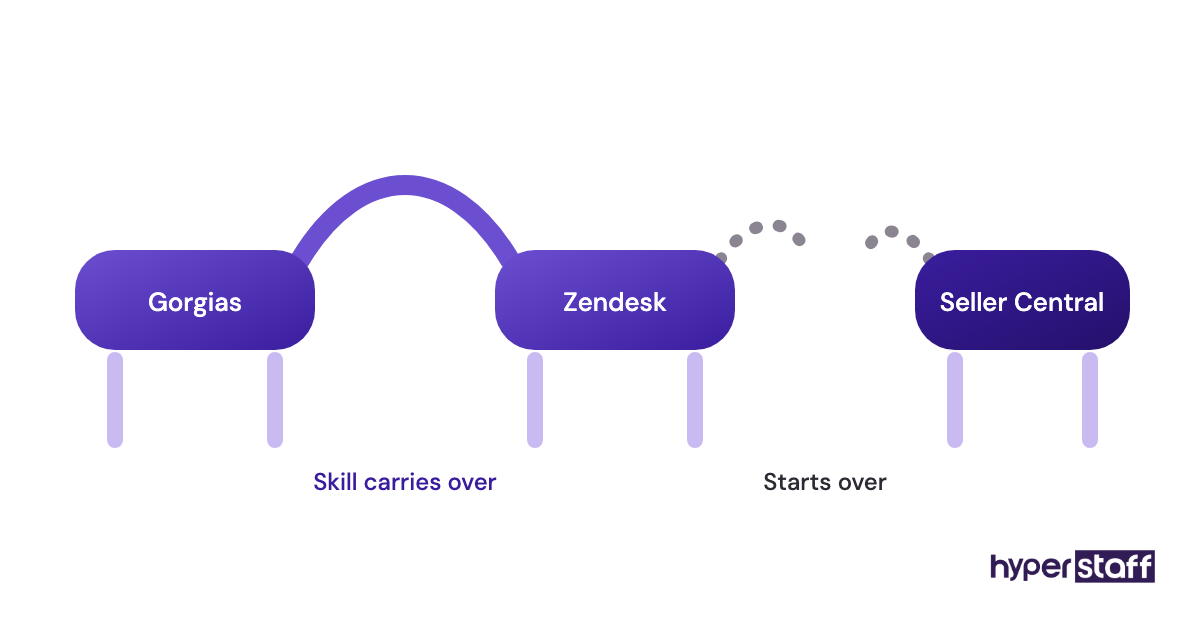
Helpdesk experience transfers well between tools, so list alternatives rather than demanding one brand. Marketplace experience transfers badly, so be strict about Seller Central if Amazon is your main channel.
For a deeper look at each category, see our roundup of tools ecommerce VAs use daily.
10 proven tips for writing an ecommerce VA job description
These tips come from the patterns that separate job descriptions that hire well from ones that need reposting.
- Name your platform in the job title, not only in the body.
- Put a dollar figure on every decision that touches money.
- State the overlap hours you need, and leave the rest of the schedule flexible.
- List KPIs you already track, so you can prove them later.
- Pay for the trial task, since good candidates skip unpaid tests.
- Write responsibilities as verbs plus objects: "reconcile stock counts weekly."
- Keep "nice to have" short, or people read it as required.
- Say who the VA reports to by name.
- Describe your order volume as a number, such as orders per week.
- Review the description every quarter and delete tasks the role no longer does.
Many hiring problems trace back to the brief. Our breakdown of common ecommerce VA mistakes shows how they play out after the hire.
Overcoming common job description challenges
The most common challenge is scope creep. A role written for support slowly picks up ads, bookkeeping and supplier calls, and quality drops everywhere at once.
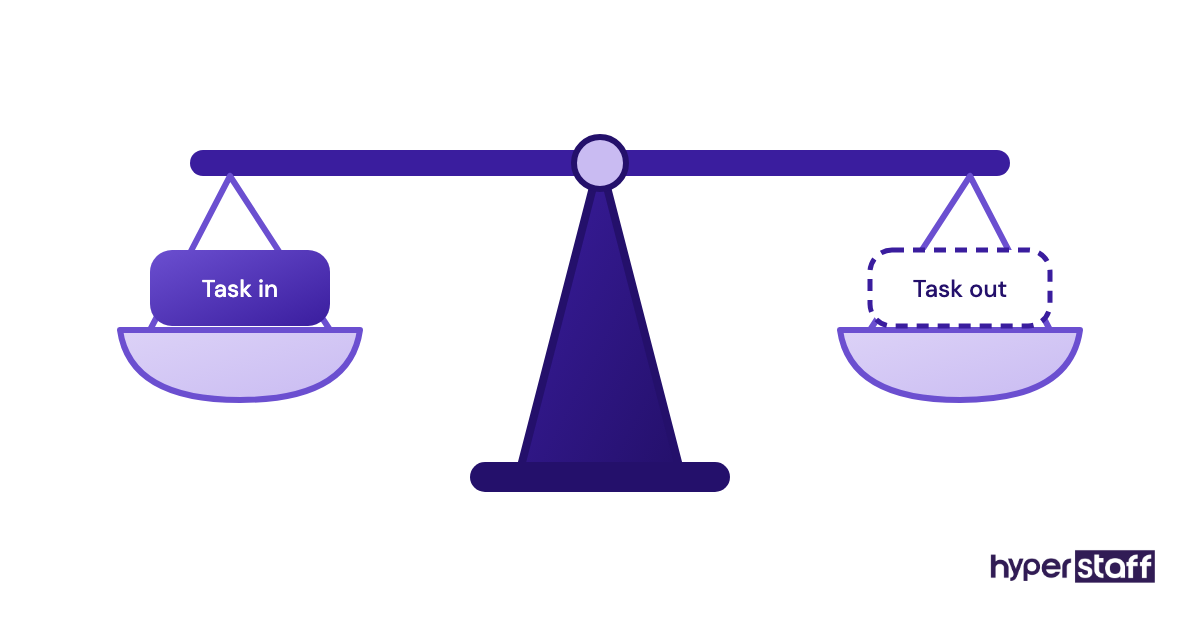
Fix it by updating the description whenever a task is added, and by removing something of equal size. When nothing can come off, buy more hours or add a second person.
The second challenge is the applicant flood on open job boards, with hundreds of near-identical applications. A specific first-line instruction in "How to apply" cuts this hard, because mass applicants rarely read that far.
How do you measure job description success?
Job description success shows up in two places: the hiring funnel and the first 90 days of work. A good brief produces a short list of applicants who match the platform, and a hire whose KPIs hold steady after training ends.
Track the share of applicants who name your platform correctly, the trial pass rate and the KPIs from the template at days 30, 60 and 90.
If the hire keeps missing one KPI, check the description before blaming the person. The target may never have been written down clearly.
How long does it take for a new ecommerce VA to work independently?
A new ecommerce VA usually handles routine tickets and orders within the first two weeks, while full independence across every task block takes closer to 30 to 90 days. Clear SOPs shorten that window more than anything else.
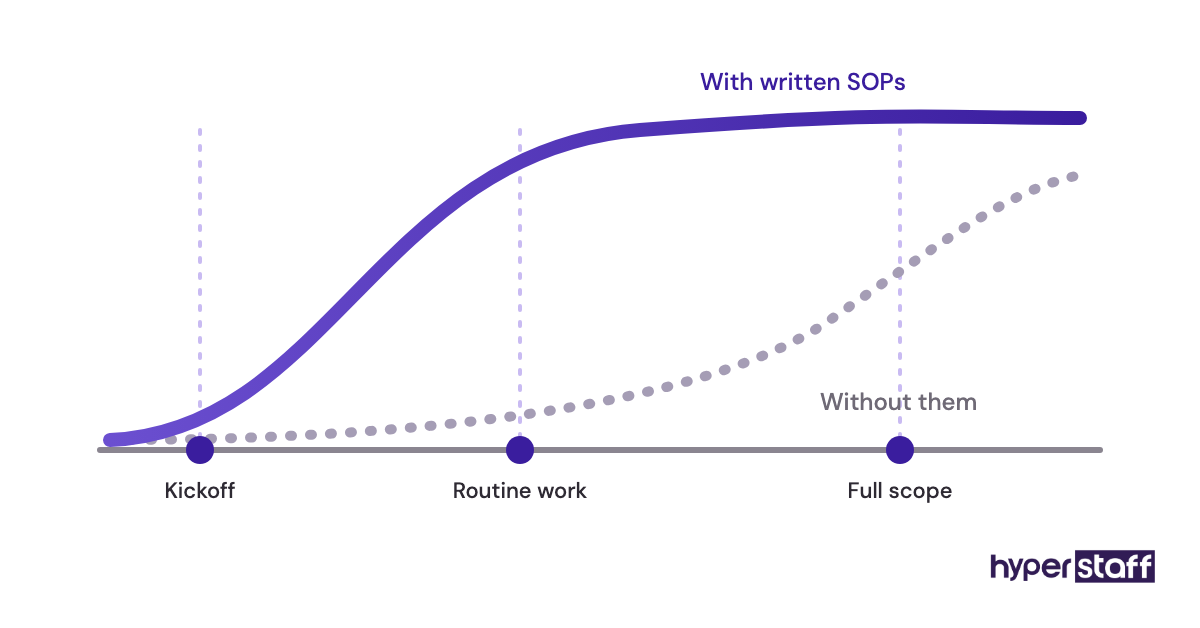
Through Hyperstaff, placement takes 5 business days. After a 30-minute kickoff call, work starts that day or the next morning, and the first weeks focus on the blocks with the clearest SOPs.
How much does an ecommerce virtual assistant cost?
An ecommerce virtual assistant from Hyperstaff costs from $3 to $12+ an hour depending on experience tier. A US in-house customer service hire runs far higher once benefits are counted, as the comparison below shows. Our full ecommerce VA cost breakdown goes deeper.
| Option | Hourly rate | 40 hours a month | 160 hours a month |
|---|---|---|---|
| Hyperstaff Essential (0 to 2 years) | From $3 | From $120 | From $480 |
| Hyperstaff Professional (2 to 5 years) | From $6 | From $240 | From $960 |
| Hyperstaff Expert (5+ years) | From $12 | From $480 | From $1,920 |
| US in-house hire, median wage only | $21.53 | About $861 | About $3,445 |
| US in-house hire, wage plus benefits | About $30.76 | About $1,230 | About $4,921 |
The in-house rows use the median hourly wage for customer service representatives from the U.S. Bureau of Labor Statistics. The benefits row grosses that up using BLS data showing wages are about 70% of private-sector employer compensation costs. Paying Hyperstaff quarterly saves a further 10%.
Important: Hyperstaff prices shown are typical starting rates, not fixed quotes. Your final cost depends on the tier, hours and tasks your store needs, which we confirm together on a free discovery call.
Is an ecommerce virtual assistant worth it?
Yes, an ecommerce virtual assistant is worth it when the job description is specific, and it's one of the highest-return hires a growing store can make. The gap between offshore and in-house cost is large enough that even a slow first month pays for itself.
Here's an example calculation using the figures above. A full-time Professional-tier VA at 160 hours costs from $960 a month, against about $3,445 in median wages alone for a US in-house hire, a gap of roughly $2,485 a month or about $29,800 a year.
The return depends on whether the VA does the work that was holding the store back, and that's decided by the job description. For the full case, read whether an ecommerce VA is worth it and how an offshore VA compares to in-house on control and cost.
How to choose an ecommerce virtual assistant agency
Choose an ecommerce virtual assistant agency by asking whether you get one dedicated person or a rotating pool. A dedicated VA learns your store, your products and your customers, and that knowledge is what makes refund limits and SOPs work.
Then ask what happens if the hire leaves. Hyperstaff replaces a VA free within 5 to 7 business days, briefed from your Operations Vault, and every client has a dedicated account manager.
Practitioners disagree on one point: some owners want to interview every candidate themselves, while others prefer the agency to shortlist and pick. If your store has unusual tools or a niche product, interviewing yourself is worth the extra hour.
Ecommerce VA statistics, trends and future predictions
Online sales make up about 17% of US retail sales on a seasonally adjusted basis, according to the U.S. Census Bureau's quarterly e-commerce report. That share keeps the daily workload of order checks, support and listings growing for stores of every size.
Benefits make up about 30% of private-sector employer compensation costs, per the BLS Employer Costs for Employee Compensation release. That overhead is a big reason store owners compare offshore hires against in-house ones.
Predictions are less certain. Marketplace work like TikTok Shop and Amazon looks set to take a bigger share of VA job descriptions, though how fast is hard to call, since platform rules change often.
Ecommerce virtual assistants and AI
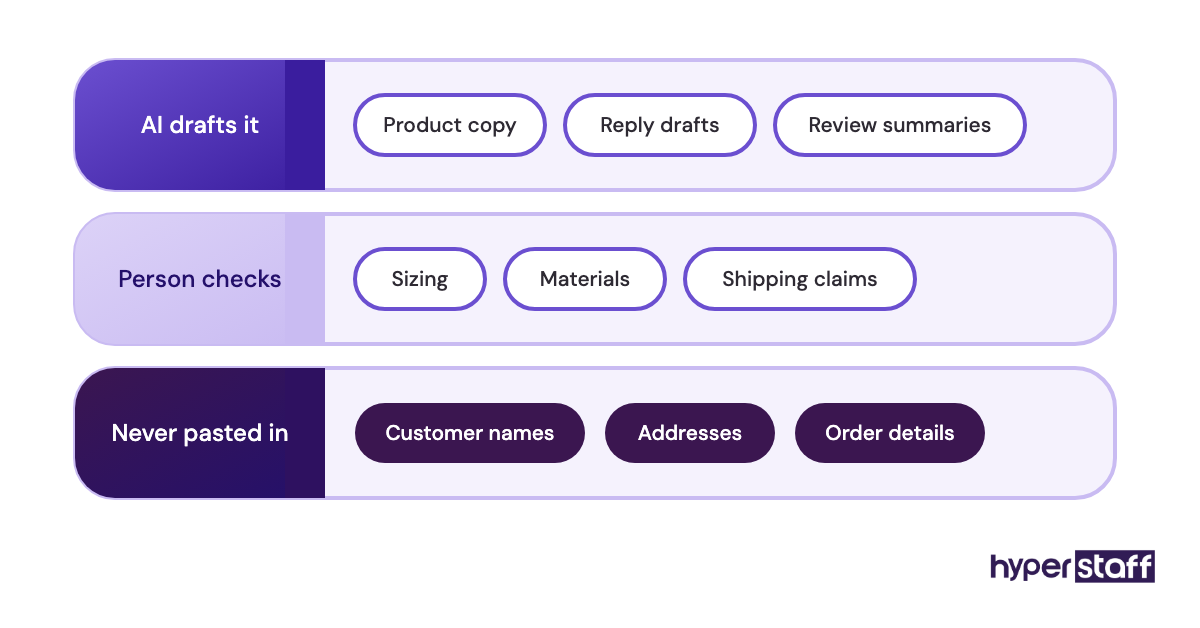
AI tools now draft product descriptions, suggest ticket replies and summarize reviews, and an ecommerce VA job description should say how the hire may use them. Silence on the topic leaves each VA to guess, and guesses differ.
The useful line is about review, not permission: AI drafts are fine, but a person checks every claim about sizing, materials and shipping before it goes live. Wrong product details lead to returns, and some marketplaces penalize listings with inaccurate claims.
Owners split on whether to require AI skills upfront. Our view is to test for judgment in the trial task and teach the tools after, since editing a weak AI draft takes the same eye as writing a good one.
Disclaimer: This article is for general information only and isn't legal, tax or employment advice. Pay figures come from public sources and may change. Hyperstaff rates are starting prices, not quotes. Check local labor laws before hiring.
Common questions
What should an ecommerce VA job description include?
It should include the platform, responsibilities grouped by task area, refund and spend limits, required overlap hours, tools and KPIs. Add a paid trial task in the application steps.
How long should an ecommerce virtual assistant job description be?
Most good ones land between 400 and 700 words. Shorter usually means missing limits or KPIs, and much longer usually means the role is trying to cover too many jobs.
Should I put the pay rate in the job description?
Yes, a rate or range saves time on both sides. Applicants who need more drop out early, and the ones who stay already agree with the number.
Can I use the same job description for Shopify and Amazon?
You can, but only if the person will truly work in both. Seller Central is its own skill set, so list it separately and test it in the trial.
What experience level should an ecommerce VA have?
Support and listing roles fit 0 to 2 years of experience with good SOPs in place. Marketplace management and full store operations usually need 2 to 5 years or more.
Book a free 15 min call
We place a pre-vetted specialist in 5 business days, fully managed, from $3/hour.