Ecommerce Virtual Assistant vs In-House Hire: Which One Fits Your Store?
A side-by-side look at what an ecommerce virtual assistant and an in-house employee really cost, where each one wins, and how to pick.
On this page
- What Is the Difference Between an Ecommerce Virtual Assistant and an In-House Hire?
- Key Staffing Terms You Should Know
- Ecommerce VA vs In-House Employee: Side-by-Side
- Why Does the Choice Matter for an Online Store?
- How Does Each Model Work Day to Day?
- Types and Forms of Ecommerce Staffing
- How Does a Dedicated VA Differ From Other Remote Options?
- Dedicated Ecommerce VA vs Freelancer Marketplace Hire
- Dedicated Ecommerce VA vs Pooled Support Outsourcing
- Dedicated Ecommerce VA vs a 3PL
- What Are the Benefits of an Ecommerce Virtual Assistant Over In-House?
- What Are the Drawbacks Compared With an In-House Hire?
- Who Should Pick a Virtual Assistant, and Who Should Hire In-House?
- Ecommerce VA vs In-House Examples
- Good Examples of the Choice
- Bad Examples of the Choice
- How to Decide Between a VA and an In-House Hire, Step-by-Step
- Step #1
- Step #2
- Step #3
- Step #4
- Step #5
- What Does a Strong Hybrid Staffing Setup Look Like?
- Tools and Software Each Model Needs
- 9 Proven Tips for Making a Remote Ecommerce Hire Work
- Overcoming Common Remote Ecommerce Staffing Challenges
- How Do You Measure Whether the Hire Is Working?
- How Long Does Each Option Take to Start Working?
- How Much Does an Ecommerce VA Cost vs an In-House Employee?
- Is an Ecommerce Virtual Assistant Worth It Over In-House?
- How to Choose an Ecommerce Virtual Assistant Agency
- Ecommerce Staffing Statistics, Trends and Future Predictions
- Ecommerce Virtual Assistants and AI
- FAQs
Keep More Margin From Every Order You Ship
Payroll is the line that eats into an online store's margin without much notice, and choosing remote help well can hand a large share of it back. Hyperstaff has placed 70+ virtual assistants with 30+ clients, and our dedicated ecommerce virtual assistant services start from $3 an hour with placement in 5 business days, so you can see the difference in your numbers within the first month.
What Is the Difference Between an Ecommerce Virtual Assistant and an In-House Hire?
An ecommerce virtual assistant is a remote team member who runs store operations online, while an in-house hire is an employee on your payroll who usually works from your office or warehouse. The work can overlap almost completely. The employment model, cost and location are what differ.
If you're still pinning down the role itself, our explainer on what an ecommerce VA does covers it in depth. In short, it reaches well past inbox and calendar admin into customer support, listings, marketplace management, lead follow-up and day-to-day operations.
Key Staffing Terms You Should Know
- Dedicated VA = one assistant who works only on your business, on a fixed schedule.
- Fully loaded cost = wages plus benefits, payroll taxes, equipment and recruiting for an employee.
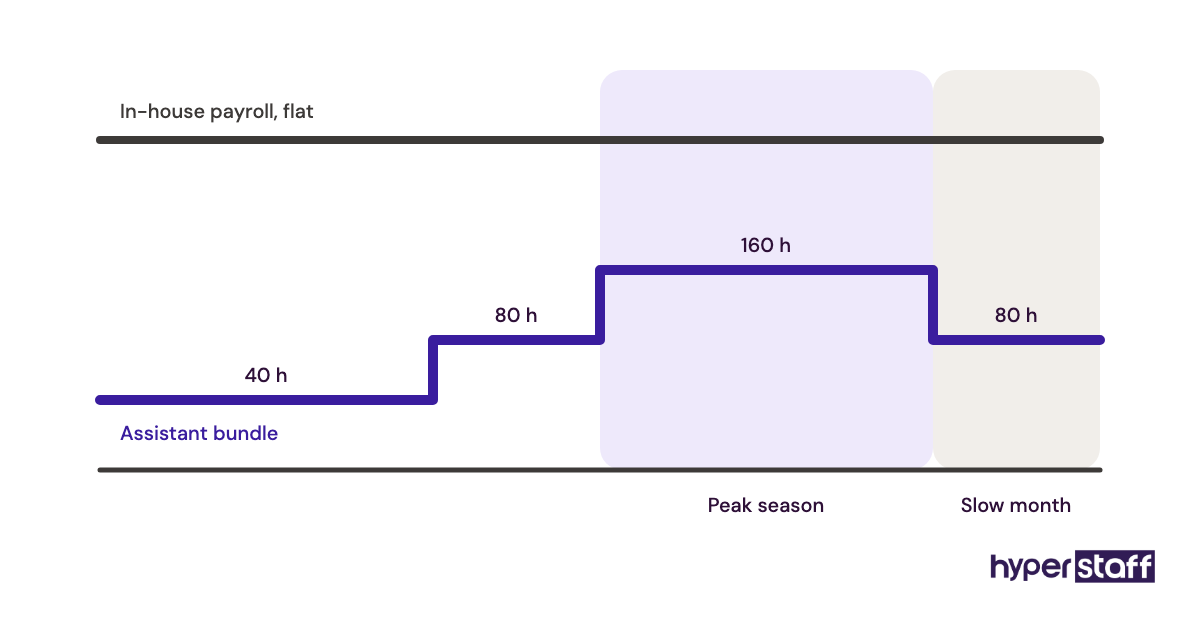
- Hourly bundle = a block of prepaid monthly hours, such as 40, 80 or 160.
- Time-zone overlap = the hours your assistant and your team are both online.
- SOP = a written standard operating procedure for one repeatable task.
- Replacement guarantee = the agency's promise to swap in a new assistant if the fit fails.
- Ticket backlog = unanswered customer emails and chats waiting in your helpdesk.
- 3PL = a third-party logistics company that stores, picks and ships your stock.
- Offshore staffing = hiring talent based in another country through an agency.
Ecommerce VA vs In-House Employee: Side-by-Side
The quickest way to compare the two models is factor by factor. The table below uses US figures for the in-house side and Hyperstaff's published rates for the virtual assistant side.
| Factor | Ecommerce virtual assistant | In-house employee |
|---|---|---|
| Hourly cost to you | From $3 to $12+ | About $31 fully loaded (US median support wage plus benefits) |
| Time to start | About 5 business days | Often 4 to 8 weeks |
| Hours | 40, 80 or 160 a month | Usually full-time |
| Physical tasks | No | Yes |
| Benefits and payroll tax | None on your side | Yours to pay |
| Replacement if it fails | 5 to 7 business days | Restart hiring |
| Equipment and desk | Assistant supplies | You supply |
| Best for | Support, listings, admin, marketing tasks | Warehouse, product, leadership |
Why Does the Choice Matter for an Online Store?
Staffing is often the biggest controllable cost after inventory and ads, so the choice directly shapes your contribution margin. Pick the wrong model and you either overpay for remote-friendly work or understaff a job that needs hands in the building.
Speed matters too. A store heading into a sale season can't wait two months for a recruiter, and an unanswered ticket backlog during peak weeks turns into chargebacks and refund requests fast.
How Does Each Model Work Day to Day?
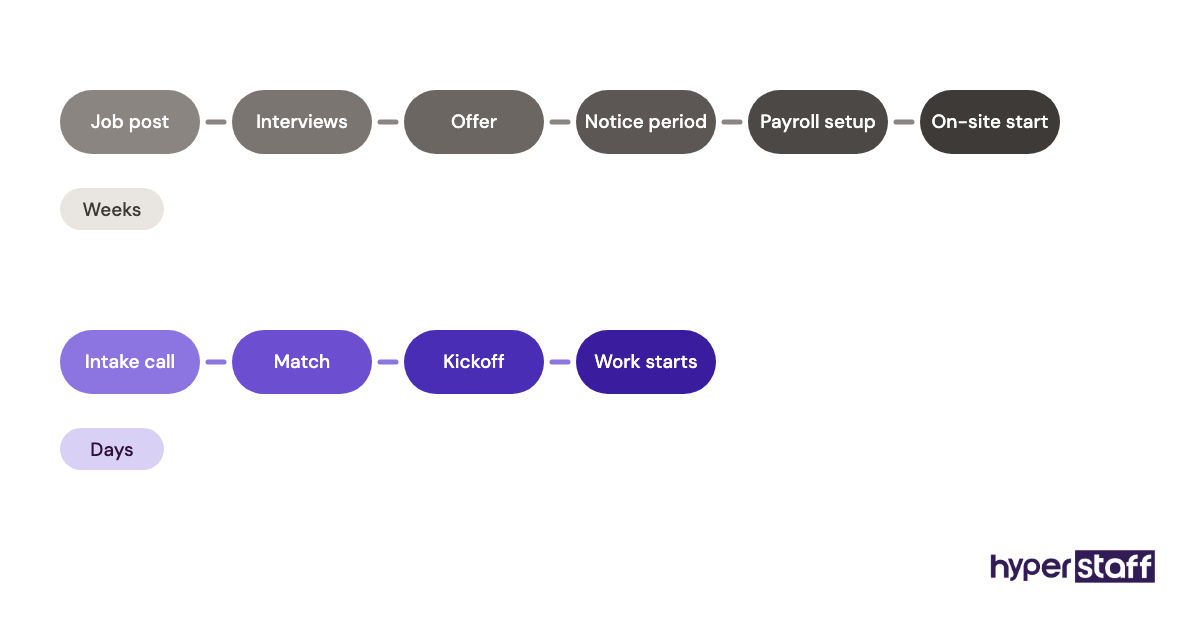
An in-house employee follows the usual path: job post, interviews, offer, payroll setup, then onboarding at your location. You handle taxes, benefits, leave and equipment, and you manage them directly.
A dedicated virtual assistant through an agency skips most of that. Hyperstaff matches a pre-vetted assistant, runs a 30-minute kickoff call, and work usually begins that day or the next morning.
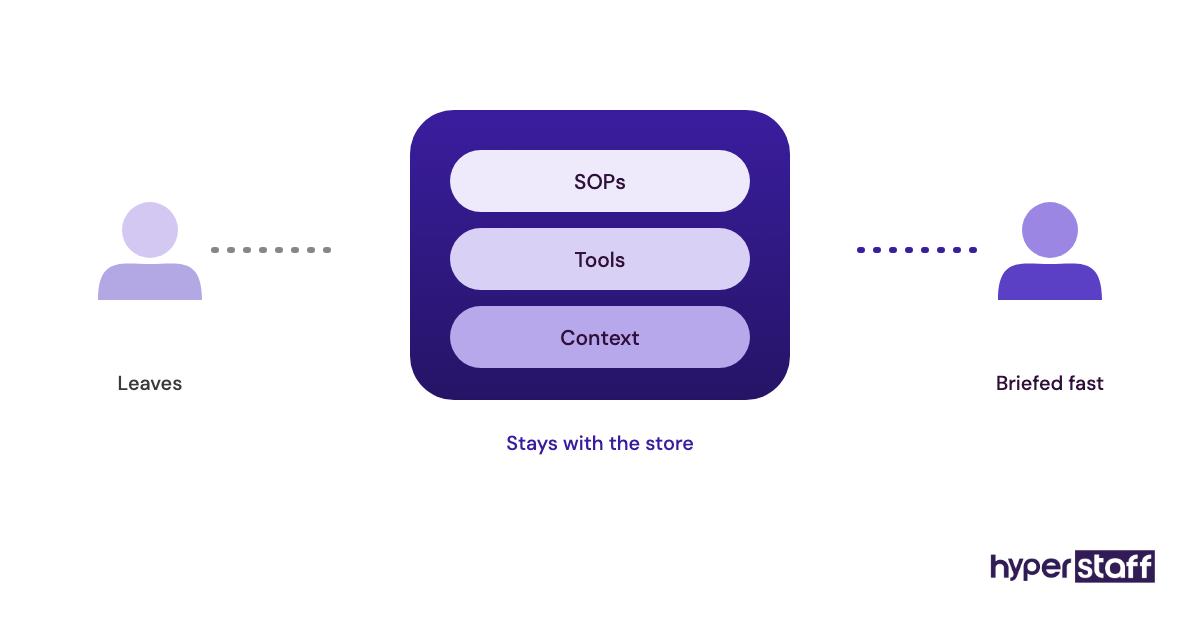
The handover lives in an Operations Vault, a written record of your SOPs, tools and context that we maintain for you. If the assistant ever needs replacing, the next one is briefed from that vault within 5 to 7 business days, which is the part most in-house setups lack entirely.
Types and Forms of Ecommerce Staffing
Store owners usually pick from six staffing forms, and they differ more in control and continuity than in price alone.
| Staffing form | Typical work | Control level | Continuity | Main risk |
|---|---|---|---|---|
| Full-time in-house employee | Warehouse, product, management | High | High | Fixed cost in slow months |
| Part-time in-house employee | Packing, local admin | High | Medium | Hard to schedule around peaks |
| Dedicated agency VA | Support, listings, order admin | High | High | Needs written SOPs |
| Freelance marketplace hire | One-off projects | Medium | Low | Disappears mid-project |
| Pooled outsourced support | Overflow tickets | Low | Low | Agents never learn your brand |
| 3PL warehouse partner | Storage, pick and pack | Medium | High | Minimums and fees |
| Hybrid team | Mix of the above | High | High | Unclear ownership between roles |
How Does a Dedicated VA Differ From Other Remote Options?
A dedicated assistant sits between a full employee and a gig worker. It keeps one person on your store long-term while removing the employer paperwork.
Dedicated Ecommerce VA vs Freelancer Marketplace Hire
A freelancer from a marketplace bills per project and juggles several clients at once. That works for a single product-photo edit, and it falls apart for daily order support, where the person has to know your return policy cold.
Dedicated Ecommerce VA vs Pooled Support Outsourcing
Pooled support sends your tickets to whichever agent is free. Customers notice the inconsistent tone, and in our experience the same questions get escalated to the owner again and again because nobody holds the store's history.
Dedicated Ecommerce VA vs a 3PL
A 3PL handles physical fulfillment, and a virtual assistant handles the information around it. They pair well: the assistant chases the 3PL on delayed shipments and updates customers while the warehouse does the packing.
What Are the Benefits of an Ecommerce Virtual Assistant Over In-House?
- Lower cost per hour, with no benefits, payroll tax or office overhead on your side.
- Start in days rather than the weeks a local hiring round takes.
- Scale hours up or down with 40, 80 or 160-hour monthly bundles.
- Coverage across time zones, so support can run while you sleep.
- Free replacement if the fit is wrong, briefed from your documented processes.
- A dedicated account manager handles the people side for you.
What Are the Drawbacks Compared With an In-House Hire?
- No physical work: packing, receiving and photography stay with someone on site.
- You'll need to write processes down, at least at the start.
- Time-zone gaps can slow live back-and-forth if overlap isn't planned.
- Culture and spontaneous hallway decisions are harder at a distance.
Keep in mind: the drawbacks above shrink a lot once the first ten SOPs exist, because most friction with a remote assistant comes from undocumented decisions that only live in the owner's head, and an in-house hire would hit the same wall a little later.
Who Should Pick a Virtual Assistant, and Who Should Hire In-House?
A virtual assistant fits store owners whose bottleneck is screen work: inbox, helpdesk, listings, supplier emails, reviews and reporting. Solo founders and small teams on Shopify, Amazon or Etsy see the fastest payoff because every hour they hand off goes straight back into product and marketing.
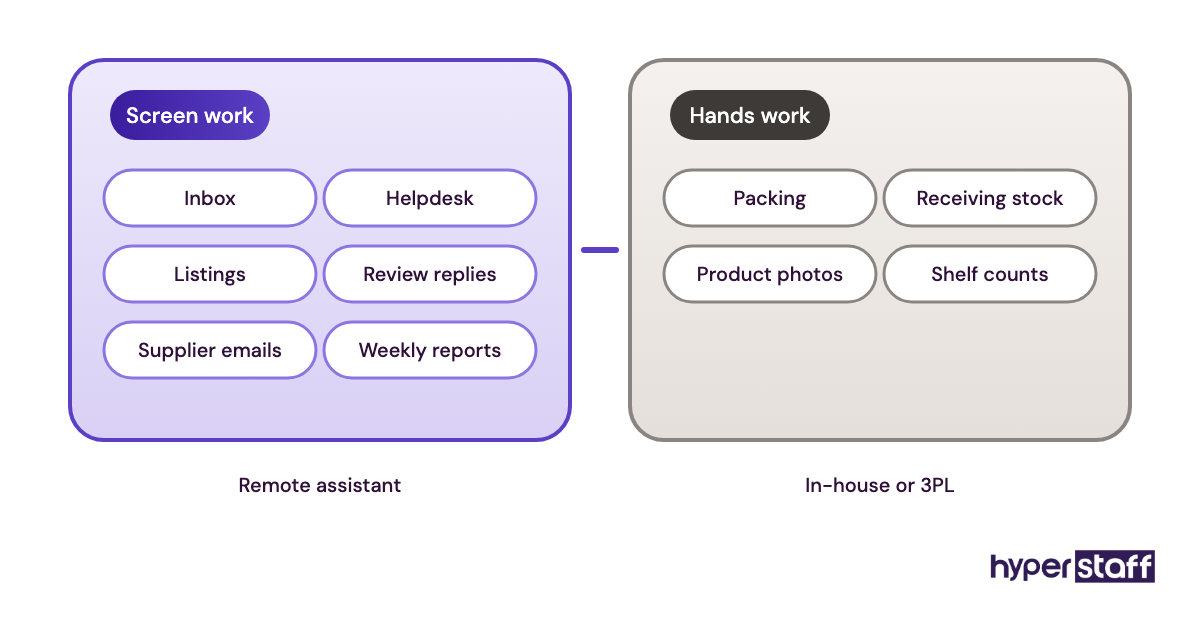
An in-house hire fits brands that hold their own stock, shoot their own content, or need a manager to run other staff. Larger operations with legal or data-access rules that require on-site staff also lean in-house.
The practitioner view and the finance view sometimes split here. Operators tend to want someone in the room, while whoever owns the P&L sees the payroll gap first; the answer usually depends on which tasks are physical.
Ecommerce VA vs In-House Examples
These setups describe patterns that come up repeatedly in remote ecommerce staffing. They show where each model holds up and where it breaks.
Good Examples of the Choice
Support Moved Remote, Packing Stayed Local
A store with a small warehouse keeps one packer on site and hands all customer emails, returns approvals and review replies to a remote assistant. The packer's day stops getting interrupted, and support hours extend past the warehouse's closing time.
Marketplace Listings Run by a Dedicated VA
A brand selling on several marketplaces gives one assistant ownership of listing updates, price checks and stock syncs. Because it's one person, listing errors get traced to a cause rather than bounced between freelancers.
Owner Buys Back Mornings With 80 Hours a Month
A founder starts with an 80-hour bundle covering order exceptions and supplier follow-ups. The part-time start keeps risk low while the SOPs get written, and hours go up once the routine is stable.
Bad Examples of the Choice
Remote Hire Expected to Handle Physical Stock
Asking a remote assistant to "keep an eye on inventory" fails when the count requires someone walking the shelves. The assistant can only report what the system says, and the system is wrong.
In-House Employee Hired for Pure Inbox Work
Paying a full local salary for a role that is 90% helpdesk replies locks in fixed cost for work that travels well. In slow months, that payroll line doesn't shrink.
No Handover, Then a Resignation
Whichever model you pick, a role with zero written process collapses when that person leaves. This failure mode is common in-house, where nobody thought documentation was needed because the employee was "always there."
How to Decide Between a VA and an In-House Hire, Step-by-Step
A short decision plan keeps the choice grounded in your actual workload. Five steps cover it.
Step #1: List Every Recurring Task for Two Weeks
Write down each task as it happens, with a rough time cost. Our ecommerce virtual assistant task list is a useful prompt if you're unsure what counts.
Step #2: Split Physical From Screen Work
Mark each task as needing hands in the building or not. Screen tasks go to the remote column, and the physical ones point toward an in-house or 3PL answer.
Step #3: Price Both Options Honestly
Use the fully loaded cost for the employee, including benefits, equipment and the weeks spent hiring. Compare that with an hourly bundle sized to the screen tasks only.
Step #4: Write the Role Before You Hire
A clear brief prevents the most expensive mistakes. Start from this ecommerce VA job description and screen candidates with targeted ecommerce VA interview questions.
Step #5: Start Small and Review at 30 Days
Begin with fewer hours than you think you need, then check response times and error rates after a month. Increase hours once the routine holds, since cutting back later is harder on everyone.
What Does a Strong Hybrid Staffing Setup Look Like?
A strong hybrid setup gives every task exactly one owner, remote or local, and writes that ownership down. The in-house team owns stock, product and brand calls, and the virtual assistant owns the customer-facing and system-facing routine.
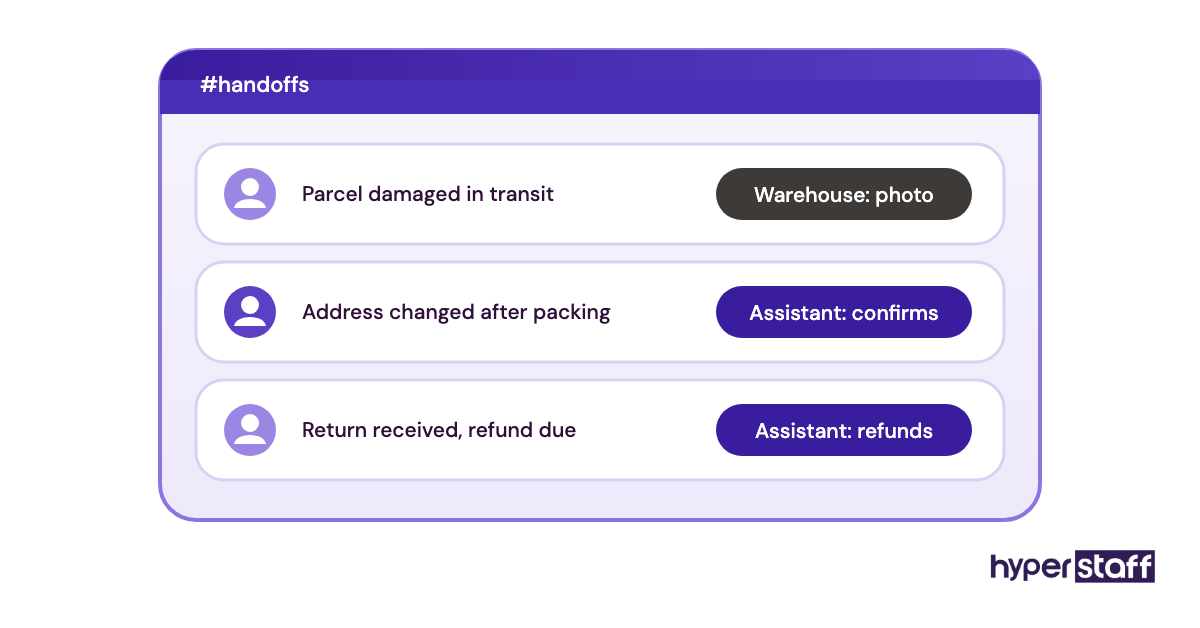
The handoff points are where hybrids fail. Returns are the classic one: the assistant approves the return, the warehouse receives the parcel, and nobody owns the refund trigger unless a rule says who does.
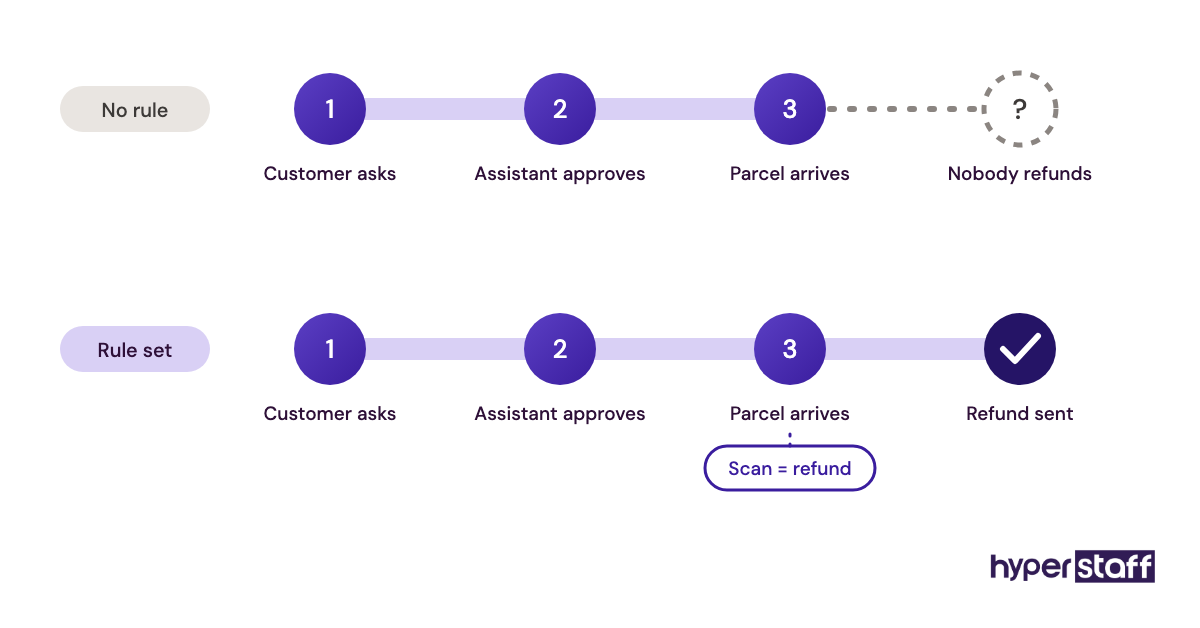
Worth knowing: a shared channel just for handoffs, with one message per order exception, cuts most of the "I thought you had it" gaps between a remote assistant and a local warehouse team, and it gives you an audit trail when a customer complains.
Tools and Software Each Model Needs
Both models run on the same core stack, and remote work mainly adds tools for access and visibility. Our longer roundup of ecommerce virtual assistant tools goes deeper on each category.
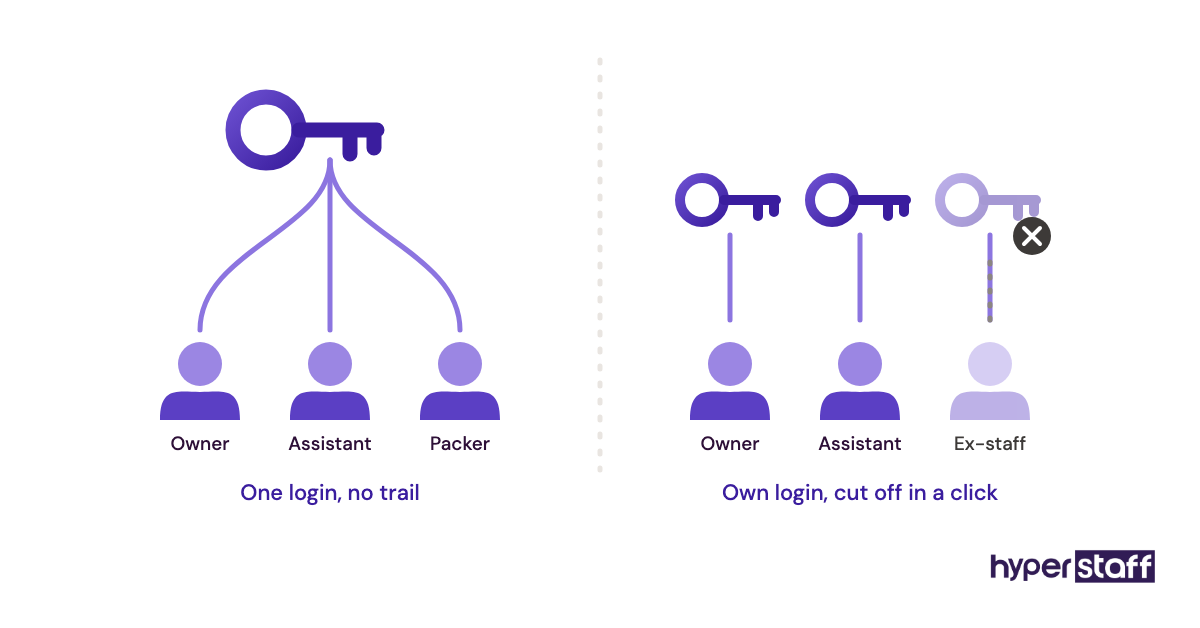
- Store platform: Shopify lets you add staff accounts with set permissions on its paid plans, which is safer than sharing the owner login.
- Helpdesk: Gorgias starts at $10 a month for 50 tickets, and its Basic plan runs about $50 to $60 a month for 300 tickets, depending on billing.
- Password sharing: Bitwarden Teams costs $4 per user a month billed yearly, so you can grant access without revealing passwords.
- Time tracking: Hubstaff prices per seat, around $10 a seat a month at the Team level.
- Communication: Slack or a similar chat tool, plus Loom for recorded walkthroughs that double as SOPs.
An earned opinion: the password manager matters more than the time tracker. Screenshots and activity scores rarely catch real problems, while a shared owner password causes real ones.
9 Proven Tips for Making a Remote Ecommerce Hire Work
These tips apply from the first week, and they also make any future in-house hire easier.
- Give staff accounts with limited permissions, never the owner login.
- Record a short video the first time you do each task yourself.
- Set at least 2 to 4 hours of daily time-zone overlap.
- Write refund and discount limits as numbers, not judgment calls.
- Start with one task area before adding a second.
- Hold a 15-minute check-in on the same day each week.
- Track response time and error rate from the first week.
- Follow a structured plan for onboarding an ecommerce virtual assistant rather than improvising.
- Review the common ecommerce VA mistakes before your first week, since most are avoidable.
Overcoming Common Remote Ecommerce Staffing Challenges
The most common challenge is context loss: the assistant doesn't know why a rule exists, so edge cases come back to you. Fix it by adding the reason to each SOP line, which takes seconds and cuts repeat questions.
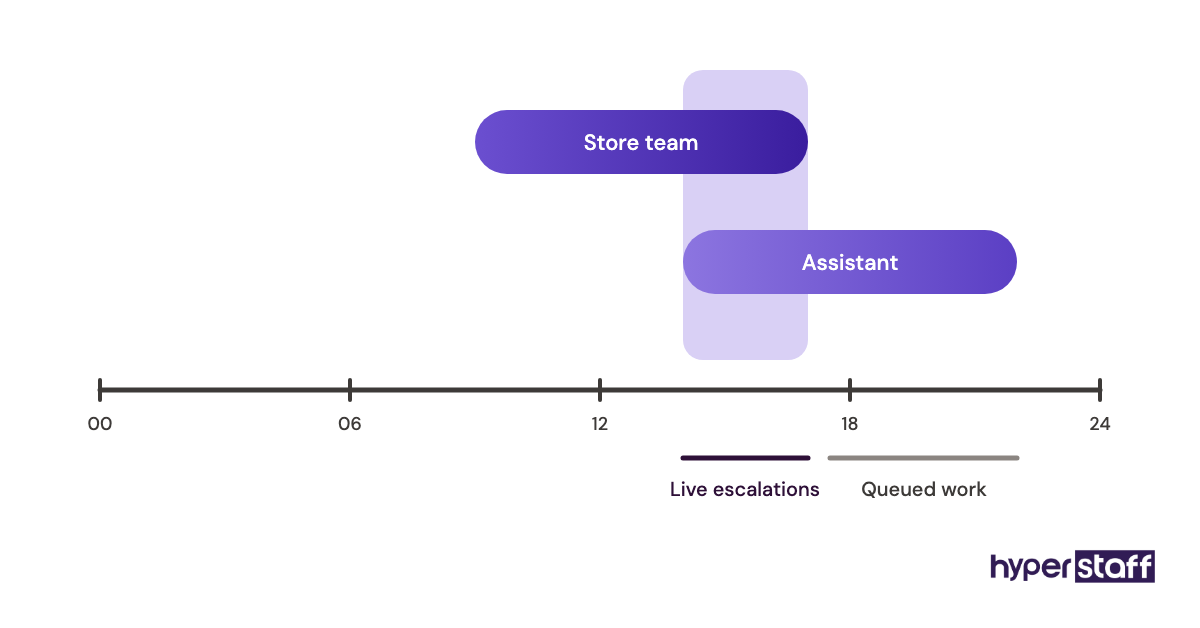
Time zones come second. Overlap of a few hours a day covers live escalations, and the rest of the shift can run on queued work such as listings and reports.
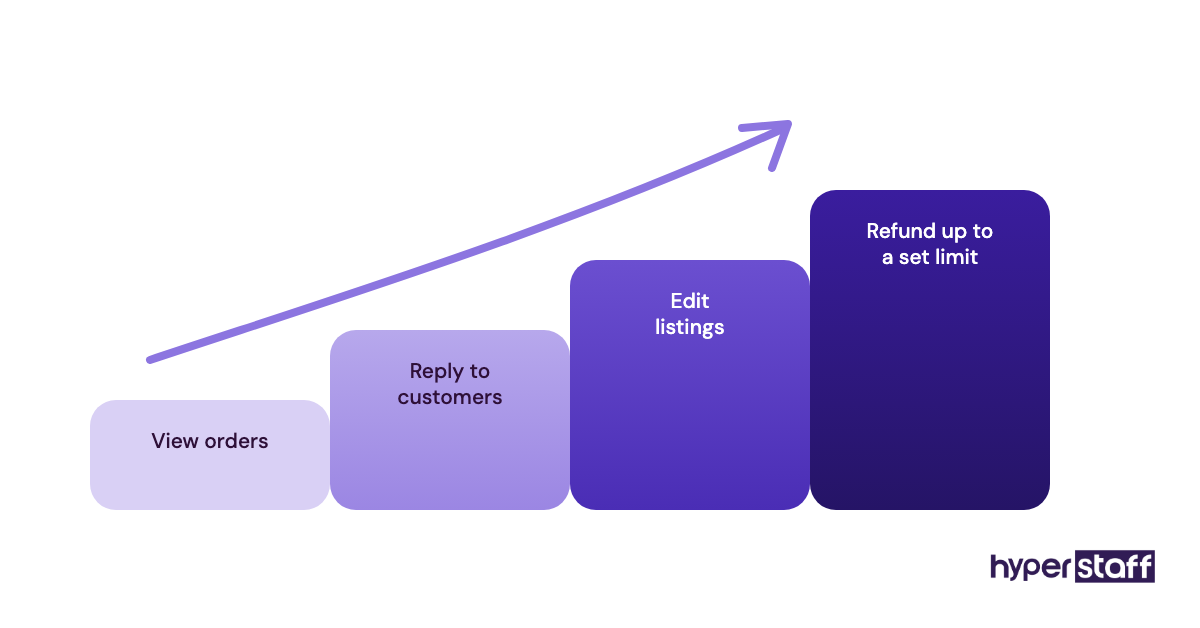
Trust is the overlooked third issue. Start with lower-risk tasks, review the output for two weeks, then widen access in steps.
How Do You Measure Whether the Hire Is Working?
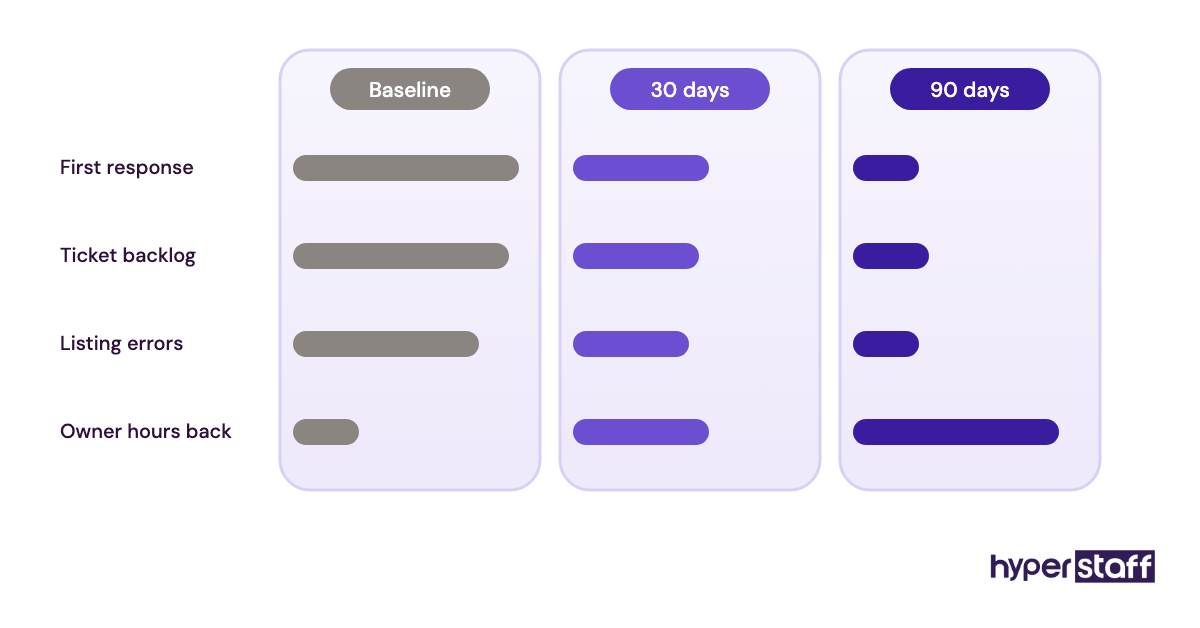
Measure an ecommerce hire on output you already track: first response time, ticket backlog, listing error rate and hours the owner gets back each week. Pick two or three and record a baseline before day one.
Compare the same numbers at 30 and 90 days. If response time drops and your own hours in the helpdesk shrink, the hire is working, whatever the employment model.
How Long Does Each Option Take to Start Working?
A dedicated virtual assistant through Hyperstaff is placed in about 5 business days, and work usually starts the day of the kickoff call or the next morning. Expect the first two weeks to involve more questions than output.
An in-house hire typically takes several weeks just to recruit, followed by notice periods and on-site onboarding. Full productivity for either model tends to arrive somewhere in the first one to three months, depending on how much is written down.
How Much Does an Ecommerce VA Cost vs an In-House Employee?
A full-time ecommerce virtual assistant at Hyperstaff costs roughly $480 to $1,920 a month at starting rates, while a US in-house support employee costs around $4,900 a month fully loaded. The in-house figure uses the BLS median wage of $21.53 an hour for customer service representatives and assumes benefits make up the 30% share of private-industry compensation that BLS reports.
| Option | Experience | Hourly cost | Monthly at 160 hours | Extras you pay |
|---|---|---|---|---|
| Hyperstaff Essential | 0 to 2 years | From $3 | From $480 | None |
| Hyperstaff Professional | 2 to 5 years | From $6 | From $960 | None |
| Hyperstaff Expert | 5+ years | From $12 | From $1,920 | None |
| US in-house employee (median) | Varies | About $31 fully loaded | About $4,920 | Recruiting, equipment, office space |
Quarterly billing takes 10% off Hyperstaff rates, and part-time bundles of 40 or 80 hours scale the monthly figure down. Our full ecommerce virtual assistant cost breakdown covers regional rate differences.
Important: Hyperstaff figures above are averages based on starting rates. Your actual cost depends on the assistant's experience tier, region, hours and the work your store needs.
Is an Ecommerce Virtual Assistant Worth It Over In-House?
Yes, for screen-based store work an ecommerce virtual assistant is one of the highest-return hires you can make, provided you document the work and keep one person on it. A full-time Professional-tier assistant at $6 an hour costs about $12,480 a year for 2,080 hours, against roughly $64,000 for a US employee at the median support wage with average benefits, a gap of around $51,000 before recruiting and equipment.
That gap is the realistic ceiling, since a remote assistant can't take on the physical half of an operation. If only half the role is screen work, the honest saving is closer to half that figure, which is still a meaningful amount for most independent stores.
The cost side is only half the case. A deeper look at whether an ecommerce VA pays off weighs the owner hours recovered, which often matter more than the payroll line.
Quick math: divide your monthly revenue by the hours you personally work on the store, and if that hourly figure is well above what an assistant costs, every task you hand off is buying your time back at a discount.
How to Choose an Ecommerce Virtual Assistant Agency
Choose an agency that assigns one dedicated assistant, publishes its rates and states a replacement timeline in writing. Those three signals separate a staffing partner from a ticket-routing service.
Ask how handover works if the assistant leaves. An agency that maintains your processes in a document such as Hyperstaff's Operations Vault can brief a replacement within days; one that doesn't will hand you a stranger and a blank page.
Check the screening too. Hyperstaff pre-vets talent across the Philippines, Latin America, India, Eastern Europe and the United States, and you get a dedicated account manager. If you'd rather recruit directly, our guide to hiring an ecommerce virtual assistant walks through both routes.
Red flag: an agency that can't tell you the name of the person who'll work on your store before you pay is likely running a shared pool, and pooled agents rarely learn a brand's return rules or tone of voice.
Ecommerce Staffing Statistics, Trends and Future Predictions
Employer costs keep rising on the in-house side. BLS data puts private-industry compensation at $46.89 an hour, with $14.07 of that going to benefits.
Support roles themselves are shifting. The BLS projects a 5% decline in US customer service representative jobs over the next decade, largely as automation absorbs simple questions.
Our prediction, stated as opinion: stores will keep fewer generalist local roles and more remote specialists who manage the tools doing the routine work. Practitioners disagree on pace, and some operators argue that brand-sensitive support should always stay close to the founder.
Ecommerce Virtual Assistants and AI
AI handles the first draft of routine work, such as order-status replies, product description drafts and review summaries, while a virtual assistant checks, edits and handles the exceptions. That split tends to work better than either alone, since AI tools still misread refund edge cases and tone.
For the in-house vs remote question, AI narrows the gap in output per hour but leaves the cost gap intact. A remote assistant who is fluent with these tools covers more ground per hour, which makes the bundle you buy go further.
Disclaimer: This article is for general information only and does not constitute legal, tax, financial or employment advice. Costs, wages and third-party pricing change over time and vary by location; verify current figures and consult a qualified professional before making hiring decisions.
Common questions
Can an ecommerce virtual assistant replace an in-house employee completely?
Yes, if the role is entirely screen work such as support, listings and order admin. If it includes packing, stock counts or photography, you'll still need someone on site or a 3PL.
Is a virtual assistant cheaper than a part-time in-house hire?
Usually, yes. Even an 80-hour monthly VA bundle at starting rates costs far less than a local part-timer once payroll taxes and equipment are counted.
Is my store data safe with a remote ecommerce assistant?
It can be as safe as with an employee if you use staff accounts and a password manager. Never share the owner login, and remove access the same day someone leaves.
What happens if my ecommerce VA quits?
With Hyperstaff, a replacement is placed within 5 to 7 business days and briefed from your Operations Vault. With an in-house employee, you restart recruiting from scratch.
Should my first ecommerce hire be remote or in-house?
It depends on your biggest time drain. If it's the inbox and listings, start remote; if it's packing orders, hire locally or use a 3PL first.
Book a free 15 min call
We place a pre-vetted specialist in 5 business days, fully managed, from $3/hour.