How to Hire an Ecommerce Virtual Assistant Who Lasts
A practical plan for scoping, testing, onboarding and paying an ecommerce virtual assistant so the hire sticks.
On this page
- What Does Hiring an Ecommerce Virtual Assistant Involve?
- Key Ecommerce VA Hiring Terms You Should Know
- Why Does Getting This Hire Right Matter?
- How Does Hiring an Ecommerce Virtual Assistant Work?
- What Types of Ecommerce Virtual Assistants Can You Hire?
- How an Ecommerce VA Hire Compares With Other Options
- Ecommerce Virtual Assistant vs. In-House Employee
- Ecommerce Virtual Assistant vs. Freelance Gig Worker
- Ecommerce Virtual Assistant vs. Outsourced Support Company
- What Are the Benefits of Hiring an Ecommerce Virtual Assistant?
- What Are the Drawbacks of Hiring an Ecommerce VA?
- Who Should Hire an Ecommerce Virtual Assistant?
- Ecommerce VA Hiring Examples
- Good Examples of Hiring an Ecommerce VA
- Bad Examples of Hiring an Ecommerce VA
- Creating Your Ecommerce VA Hiring Plan, Step by Step
- Step #1
- Step #2
- Step #3
- Step #4
- Step #5
- What Does an Effective Ecommerce VA Hiring Strategy Look Like?
- Ecommerce VA Tools and Software
- 10 Proven Ecommerce VA Hiring Tips and Best Practices
- Overcoming Common Ecommerce VA Hiring Challenges
- How Do You Measure Ecommerce VA Hiring Success?
- How Long Does It Take to Hire and Ramp Up an Ecommerce VA?
- How Much Does It Cost to Hire an Ecommerce Virtual Assistant?
- Is Hiring an Ecommerce Virtual Assistant Worth It?
- How Do You Choose an Ecommerce VA Agency?
- Ecommerce VA Statistics, Trends and Future Predictions
- How Does AI Change Hiring an Ecommerce Virtual Assistant?
- FAQs
Hire right and more orders turn into profit
Hyperstaff has placed 70+ pre-vetted virtual assistants with 30+ clients, and our ecommerce virtual assistant services match you with a dedicated specialist in 5 business days, with rates from $3/hour. You get a dedicated account manager, a 30-minute kickoff call, and a free replacement in 5 to 7 business days if the fit isn't right.
What Does Hiring an Ecommerce Virtual Assistant Involve?
Hiring an ecommerce virtual assistant means finding a remote worker to run part of your online store's daily operations, then giving them the access, instructions and checks to do it well. The work usually spans customer support, order processing, product listings, inventory updates and marketing.
The hiring itself is the short part. Most of the effort sits in scoping the role before you post it and in the first month after the person starts, which is where most failed hires go wrong.
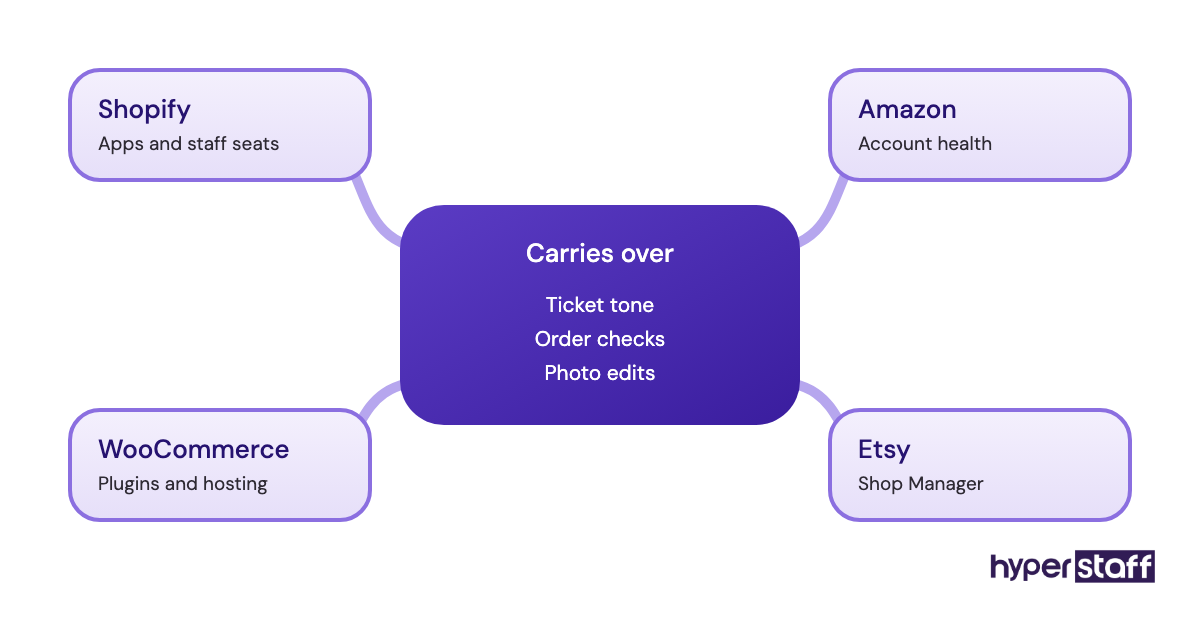
If you're still deciding what the role should cover, our breakdown of what an ecommerce VA does lists the usual duties by store size. For hiring, keep one point in mind: you're hiring for tasks on a specific platform, and Shopify, Amazon, WooCommerce and Etsy experience don't swap as easily as job posts suggest.
Key Ecommerce VA Hiring Terms You Should Know
- Scope of work = the written list of tasks, hours and tools the VA owns
- Staff account = a separate store login with permissions you set, so the VA never uses the owner login
- SOP = standard operating procedure, a step-by-step guide for one recurring task
- Paid trial task = a short, paid sample of real work used to compare finalists before an offer
- Helpdesk = shared support software, such as Gorgias or Zendesk, where tickets are answered and tracked
- SLA = the agreed response time for customer messages, for example a first reply within 4 business hours
- Order exception = any order that breaks the normal flow, including address errors, fraud flags, stockouts and failed payments
- 3PL = a third-party logistics provider that stores, packs and ships your inventory
- Time zone overlap = the hours when you and the VA are both working and can talk live
- Dedicated VA = one person assigned only to your business instead of a shared pool
Why Does Getting This Hire Right Matter?
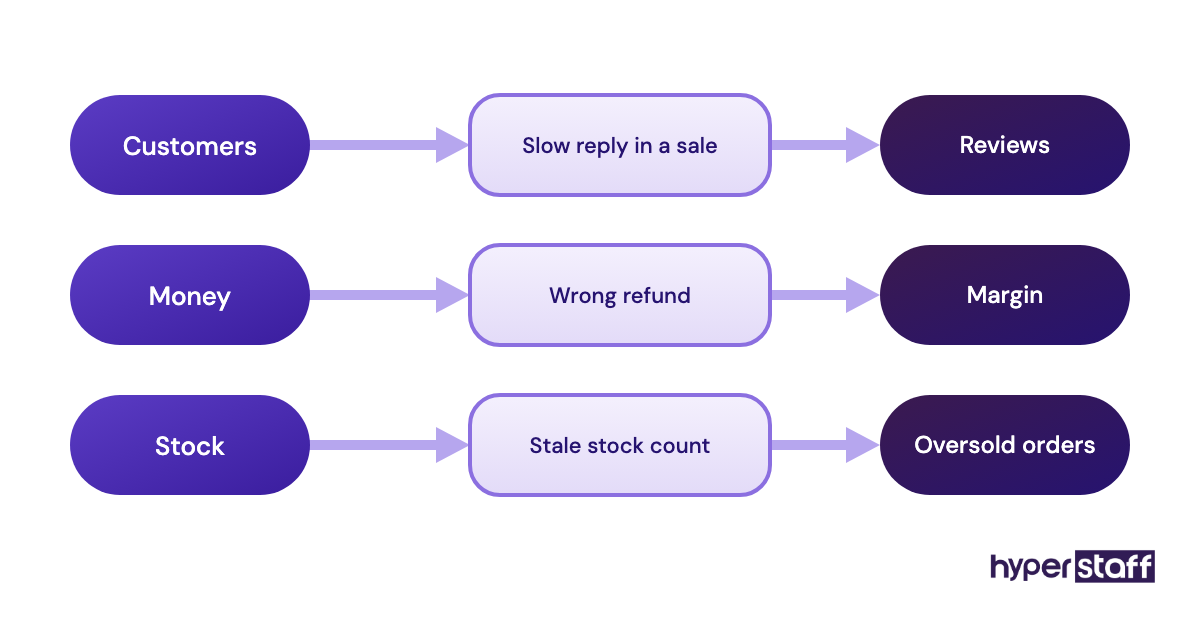
An ecommerce virtual assistant touches customers, money and stock, so a bad hire costs more than wasted wages. A wrong refund, an inventory count left stale or a slow reply during a sale shows up in your reviews and margins within days.
Online selling keeps growing, and so does the daily workload for small teams. US e-commerce sales sit at about 17% of total retail sales in recent quarterly Census data, as tracked by the Federal Reserve Bank of St. Louis FRED series.
Turnover is the other reason. Each restart means another round of training, another set of passwords to reset and a few more weeks of slower replies, so a second hire costs more than the first when nothing was written down.
How Does Hiring an Ecommerce Virtual Assistant Work?
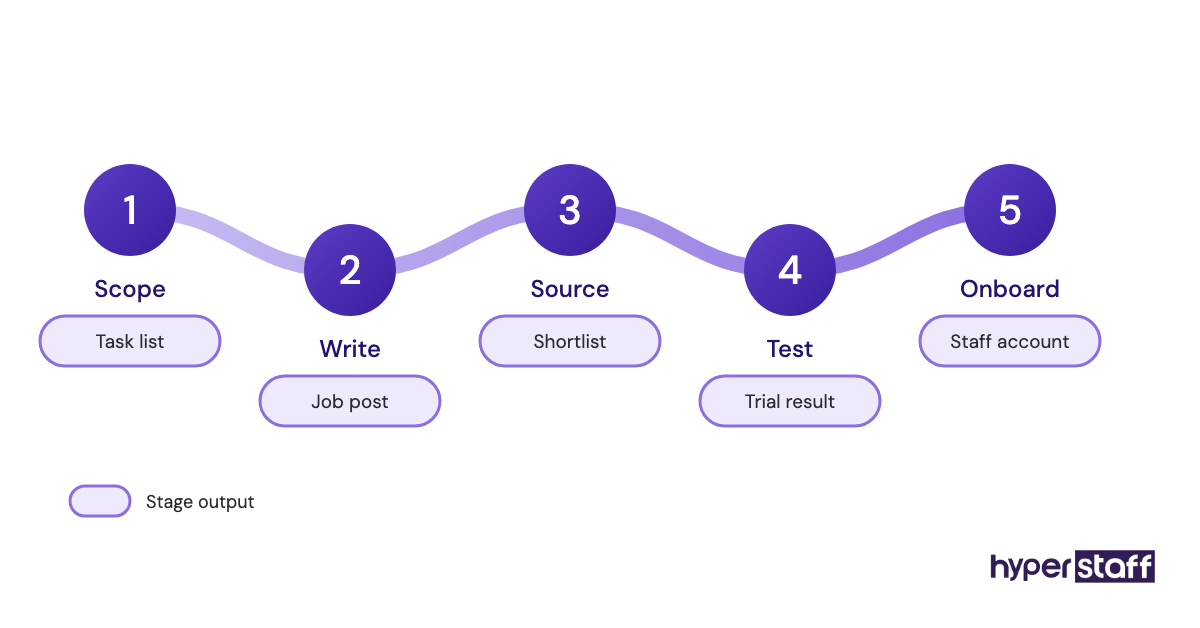
Hiring an ecommerce virtual assistant works in five stages: scope the tasks, write the job description, source candidates, test them on real work, then onboard with limited access. The route you pick changes who does the sourcing and vetting.
| Stage | Hiring on your own | Hiring through an agency |
|---|---|---|
| Scoping | You list tasks and hours | You list tasks, the agency helps size hours |
| Sourcing | Job boards, dozens of applicants to sort | Shortlist sent to you |
| Vetting | You screen and run trials | Candidates arrive pre-vetted |
| Time to start | Often 3 to 6 weeks | Often under 2 weeks |
| Contracts and pay | You handle them | The agency handles them |
| If the hire fails | Restart the search | Replacement from the agency |
Going direct usually costs less per hour and more of your own time. An agency charges for sourcing and for the safety net if the first person doesn't work out.
What Types of Ecommerce Virtual Assistants Can You Hire?
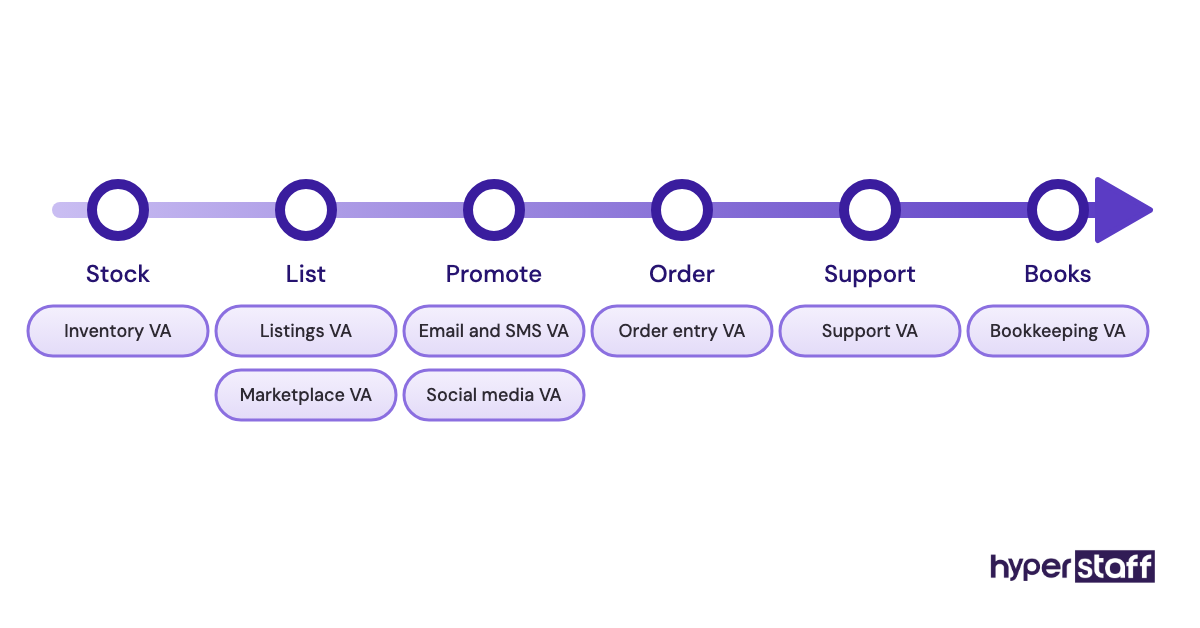
Ecommerce virtual assistants fall into about eight types, grouped by the part of the store they run. Many small stores start with one generalist covering two or three of these, then split the work as order volume grows.
| VA type | Core tasks | Tools they should know | Hours a month that usually fit |
|---|---|---|---|
| Customer support VA | Tickets, live chat, returns, refunds within limits | Gorgias, Zendesk, Shopify Inbox | 80 to 160 |
| Order processing VA | Order checks, exceptions, tracking updates | Shopify admin, ShipStation, 3PL portals | 40 to 160 |
| Product listing VA | Uploads, descriptions, image edits, SEO titles | Shopify, WooCommerce, Canva, CSV imports | 40 to 80 |
| Inventory VA | Stock counts, reorder alerts, supplier emails | Inventory apps, Google Sheets | 40 to 80 |
| Marketplace VA | Amazon, Etsy and eBay listings, account health | Seller Central, Etsy Shop Manager | 80 to 160 |
| Email and SMS marketing VA | Campaign builds, flows, list cleanup | Klaviyo, Mailchimp | 40 to 80 |
| Social media VA | Posting, comments, DMs, creator outreach | Meta Business Suite, Canva | 40 to 80 |
| Bookkeeping VA | Payout reconciliation, expense coding | QuickBooks, Xero | 40 |
For a line-by-line view, our ecommerce VA task checklist breaks each type into daily, weekly and monthly work.
How an Ecommerce VA Hire Compares With Other Options
An ecommerce VA is one of four common ways to get store work done, and each fits a different stage and type of work.
Ecommerce Virtual Assistant vs. In-House Employee
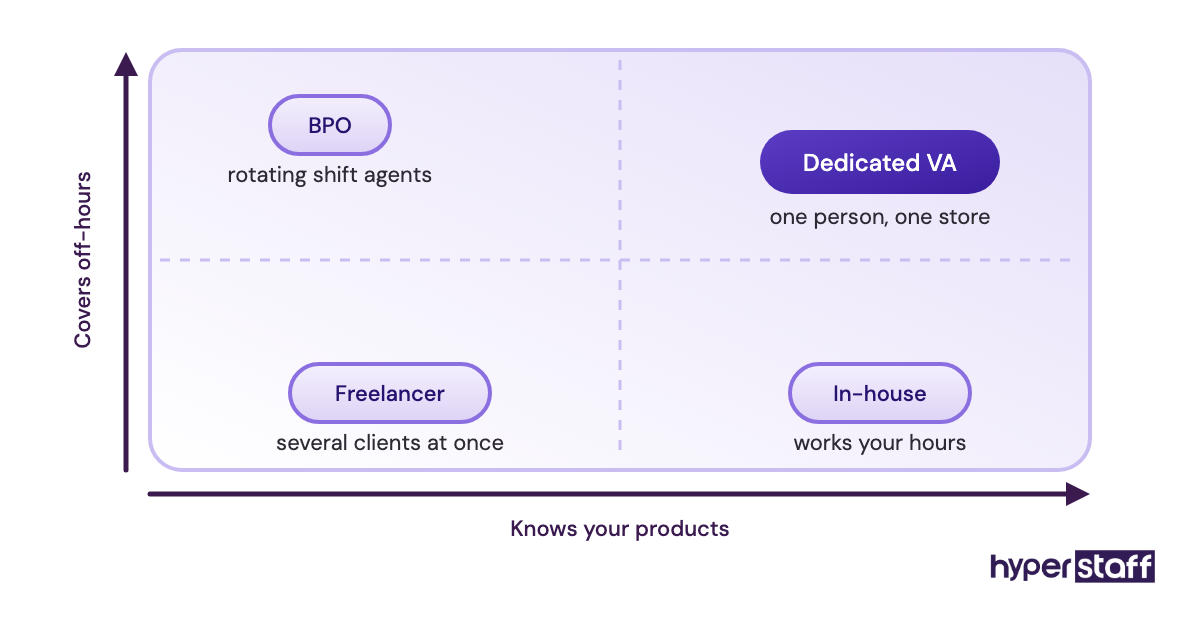
An in-house employee costs more per hour once payroll taxes and benefits are added, and you handle recruiting, equipment and HR yourself. In return you get someone who can pack boxes, inspect returns and join supplier calls in your own time zone.
If your store ships from your own space, part of the role may have to stay local. Our full ecommerce VA vs in-house comparison runs the numbers on both.
Ecommerce Virtual Assistant vs. Freelance Gig Worker
A freelancer from Upwork or Fiverr suits one-off projects, like a theme fix, a batch of product uploads or a Klaviyo flow build. Freelancers juggle several clients, so they rarely fit work that needs same-day replies or memory of your customers.
The line blurs with part-time ongoing work. A freelancer at 10 hours a week can handle listing updates well and support badly, because tickets don't wait for their next free slot.
Ecommerce Virtual Assistant vs. Outsourced Support Company
An outsourced support company, often called a BPO, answers tickets in shifts and can offer round-the-clock cover. You gain coverage and lose continuity, since the agent replying today may have never seen your product.
Reasonable owners land on both sides here. Stores with heavy volume and simple questions ("where's my order?") often do fine with a BPO, while stores selling products that need explaining tend to get better results from one dedicated person who learns the catalog.
What Are the Benefits of Hiring an Ecommerce Virtual Assistant?
The biggest benefit is getting daily store work done for far less than a local hire, with hours that grow as orders do.
- Lower cost per hour than a local employee, with no office or equipment to fund
- Faster customer replies, which protects reviews in busy weeks
- Hours that scale up for a sale or holiday rush, then back down
- Time zone spread that can cover your evenings or weekends
- Written processes, since a good VA documents tasks while learning them
- More of your own hours for products, suppliers and growth
What Are the Drawbacks of Hiring an Ecommerce VA?
The drawbacks are real, and most of them shrink with setup work done before the start date.
- Training eats your time for the first 2 to 4 weeks
- Store, payment and customer data access is a security risk when handled loosely
- Limited time zone overlap can slow urgent decisions
- Physical work like packing and returns inspection stays with you or your 3PL
Who Should Hire an Ecommerce Virtual Assistant?
Store owners spending more than 10 to 15 hours a week on repeatable tasks are the clearest fit for an ecommerce virtual assistant. Repeatable means the task has a right answer you could write down, like answering a shipping question, changing a price or uploading a product.
Solo founders on Shopify or WooCommerce usually feel the gain first, since every hour handed off goes back into buying, marketing or product work. Amazon and multichannel sellers come next, because listing upkeep and account health across channels add up fast.
Larger brands with an ops team hire differently. They tend to add a VA for one narrow job, such as returns or catalog updates, under a lead who already has the processes written.
Stores doing a handful of orders a week may be early, unless the owner's time is the bottleneck for something bigger.
Ecommerce VA Hiring Examples
The same hire can go well or badly depending on setup. These are common hiring patterns, so the details are typical of many stores and drawn from no single one.
Good Examples of Hiring an Ecommerce VA
Support Hire Tested on Real Tickets
A Shopify store owner exports 20 past tickets, removes customer names and pays each finalist for one hour to draft replies. The strongest candidate is the one who asks about the refund policy before answering the damaged-item ticket.
Listing VA Given a CSV Template
A seller hands over a product CSV template, five finished listings as models and a style sheet for titles. Week one gets checked line by line, and by week three the owner spot-checks one listing in ten.
Generalist Who Grew Into Operations
A store starts a VA on 40 hours a month of order exceptions and inbox triage. After two clean months the owner adds supplier follow-ups and moves to 80 hours, because the VA has already written SOPs for the first tasks.
Bad Examples of Hiring an Ecommerce VA
Most bad hires trace back to setup more than the person. Our list of common ecommerce VA mistakes goes deeper, and these patterns show up often.
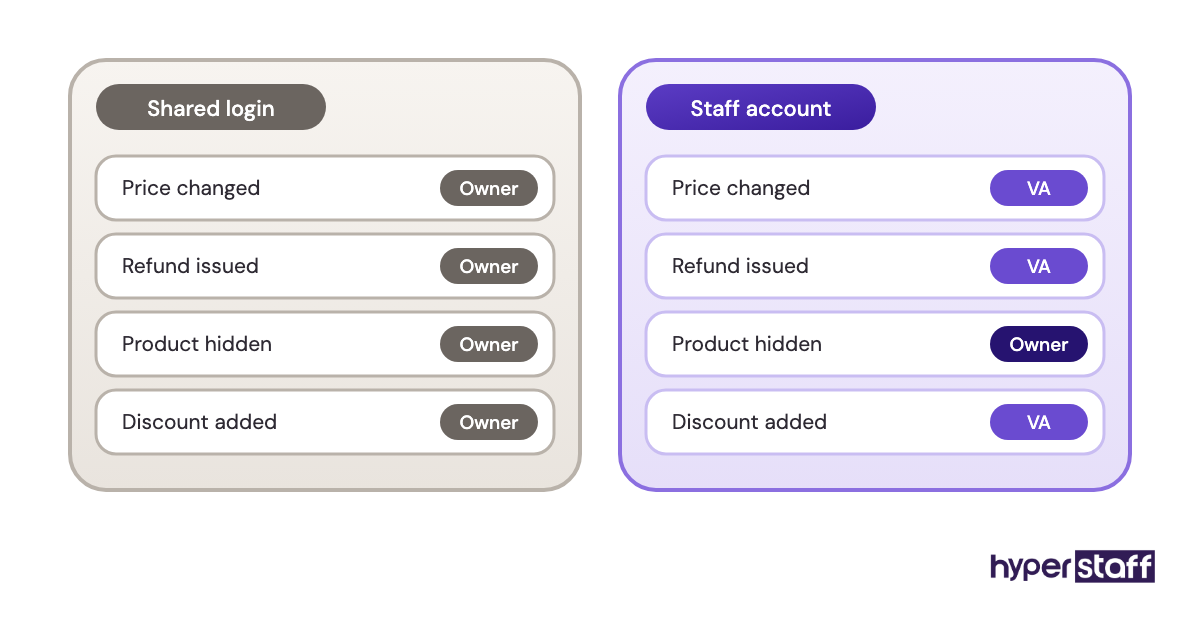
Shared Owner Login
The owner hands out their own Shopify login to skip a plan upgrade. When the VA leaves, every password has to change, and nobody can tell which edits in the activity log were theirs.
One Job Post for Every Task
The post asks for support, ads, design, bookkeeping and Amazon PPC at an entry-level rate. The applicants who fit are either stretched thin or overselling, and the trial never tests the hardest part.
No Refund Limits
A new support VA gets full refund access and no written limit. Within the first week they refund a large order that should have been a replacement, because nobody explained the difference.
Creating Your Ecommerce VA Hiring Plan, Step by Step
Five steps take you from a vague need to a working hire.
Step #1: Log Your Store Hours for One Week
Track every store task you do for five working days, with the time each one takes. Sort the list into tasks with a clear right answer and tasks that need your judgment.
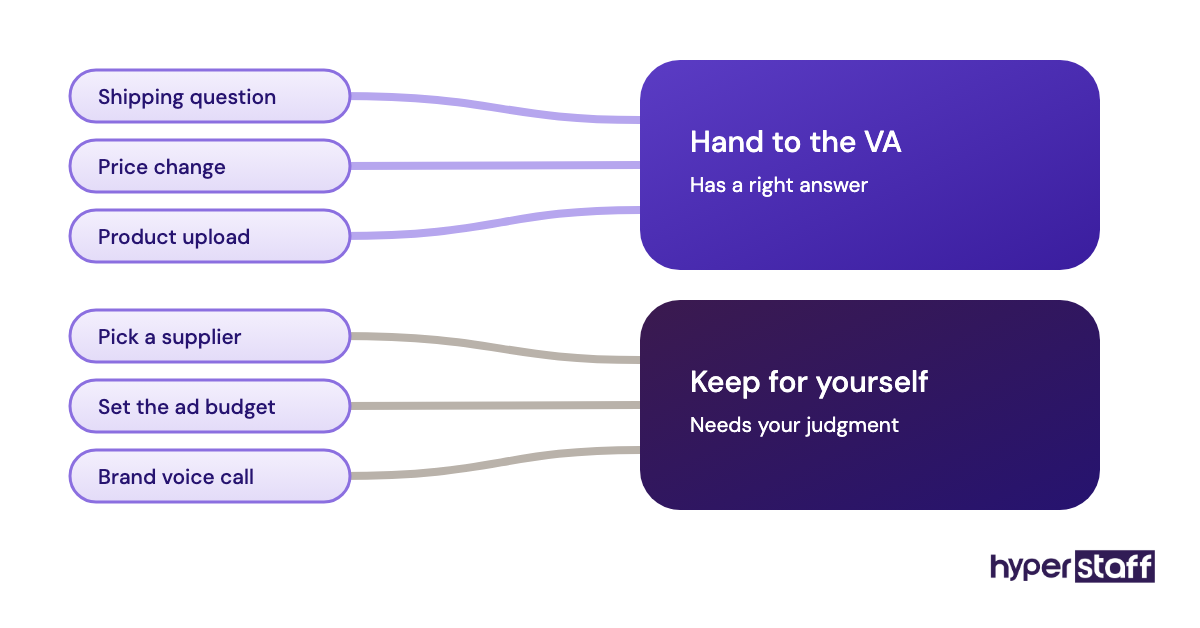
The first group becomes the VA's job. If it adds up to under 10 hours a week, start with a small monthly block of hours or a project freelancer instead of a full-time hire.
Step #2: Write a Job Description Around Outcomes
Name the five or six core tasks, the platforms, the hours and the overlap time you need. Our ecommerce VA job description template gives you a format to edit.
Add outcomes such as "first reply to customers within 4 business hours." Outcomes tell candidates what good looks like, and they become your success measures later.
Step #3: Pick Where to Find Candidates
Job boards and freelance marketplaces give you volume, and you do all the screening. A staffing agency sends a shortlist that has already passed skills and English checks, so your time goes into the final interview.
Step #4: Interview, Then Run a Paid Trial
Keep the interview to 30 to 45 minutes and lean on scenario prompts from our ecommerce VA interview questions, like how they'd handle a customer who got the wrong size. Then pay your top two or three for a 1 to 2 hour trial on real, anonymized work.
The trial tells you more than any CV. Watch the questions they ask before starting, because a careful ecommerce VA checks the policy before touching an order.
Step #5: Onboard With Limited Access
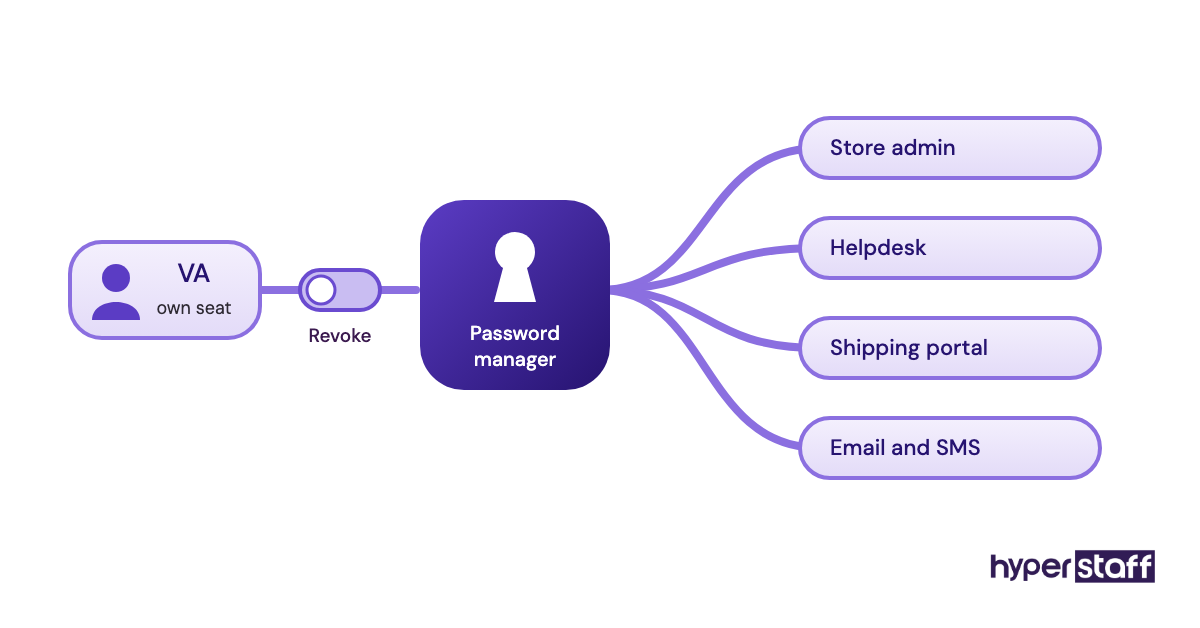
Create a staff account with only the permissions the role needs, share other logins through a password manager, and set dollar limits for refunds and discounts. Our guide to onboarding an ecommerce VA covers the first 30 days.
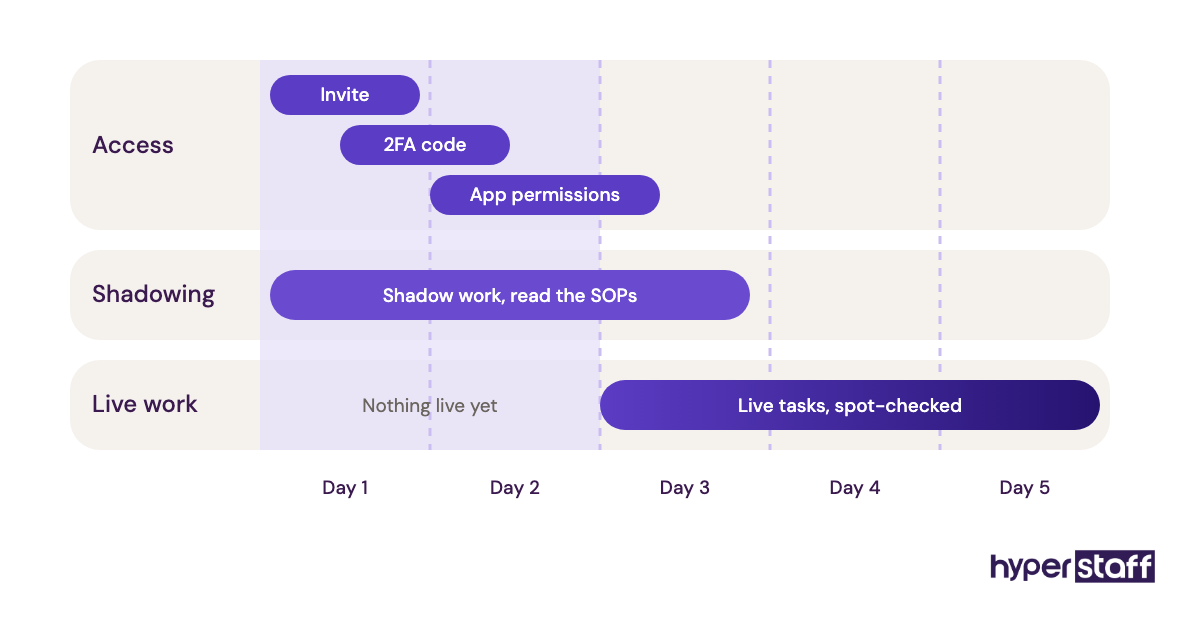
Expect a short dead zone in week one. Access invites, two-factor codes and app permissions often take a day or two to sort out, so plan shadowing work for that gap.
What Does an Effective Ecommerce VA Hiring Strategy Look Like?
An effective ecommerce VA hiring strategy starts narrow, measures early and widens the role only after the first tasks run cleanly. It also plans for the day the person leaves.
In practice that means one or two task areas for the first month, with SOPs recorded as Loom videos or docs the VA writes back to you. A weekly 15-minute check-in catches problems before customers do.
Plan the exit on day one. Keep every login under business-owned accounts and every process in one shared place, so a replacement starts from the docs instead of from you.
Hyperstaff clients get that through our Operations Vault, which holds your SOPs, tools and context, written down and maintained for you.
Ecommerce VA Tools and Software
An ecommerce VA needs access to your store platform, a helpdesk, a password manager, a task tracker and a way to record processes. Set them up before day one, because missing access is a common reason a new VA sits idle in week one.
On Shopify, plan staff seats before you hire. Shopify's pricing page shows the Basic plan without extra staff accounts, Grow with up to 5 and Advanced with up to 15, while third-party collaborator access is on every plan.
- Gorgias or Zendesk for support tickets, saved replies and order data beside each message
- 1Password or Bitwarden for sharing logins without revealing passwords
- Loom for recording SOPs as short screen videos
- Asana, Trello or ClickUp for recurring tasks and handoffs
- Slack or Google Chat for daily questions
- ShipStation or your 3PL portal for shipping exceptions
- Klaviyo for email and SMS campaigns
Our pick for the most important tool on that list is the password manager. It turns removing a VA's access into a two-minute job, and plan details for the rest are in our roundup of ecommerce VA tools.
10 Proven Ecommerce VA Hiring Tips and Best Practices
These tips come from the hiring steps that most often get skipped.
- Hire for your platform first, since Shopify, Amazon and WooCommerce skills transfer less than people expect.
- Pay for trial tasks so strong candidates take them seriously.
- Test written English on a real customer complaint.
- Set refund, discount and replacement limits in dollars before day one.
- Give each VA their own logins and keep the owner account private.
- Ask for written SOPs after the first week of each new task.
- Book a fixed daily overlap window plus a weekly 15-minute review.
- Start with 40 or 80 hours a month and add hours once the work is clean.
- Keep a list of decisions the VA can make alone and ones that need you.
- Review a few tickets or listings each week, even after trust builds.
Overcoming Common Ecommerce VA Hiring Challenges
Slow ramp-up and communication gaps cause most early friction with an ecommerce VA. Both shrink with written SOPs and a fixed daily check-in time.
Security worries are easier to fix than most owners expect. Use staff accounts with narrow permissions, a password manager, and two-factor codes sent to a shared business app.
If the person still isn't working out after four weeks, replace them early. A month of clean SOPs makes the second hire faster than the first.
How Do You Measure Ecommerce VA Hiring Success?
Measure an ecommerce VA hire against the outcomes in your job description, starting from the baseline you logged in Step #1. Useful measures are first reply time, tickets resolved per day, listing error rate, order exceptions cleared and hours you got back.
Check monthly for the first quarter. Numbers mislead early, so pair them with a weekly read of a few tickets or listings to judge tone and accuracy.
Your calendar is the simplest test. If your store hours haven't dropped by week eight, the role or the setup needs a change.
How Long Does It Take to Hire and Ramp Up an Ecommerce VA?
Hiring an ecommerce virtual assistant takes about 1 to 6 weeks: an agency can place someone within a week, while a direct search with trials often runs 3 to 6. Ramp-up to steady output takes another 4 to 8 weeks.
Week one goes to access and shadowing. Weeks two to four are supervised work, and by month two most VAs run routine tasks alone if the SOPs are clear.
Complex roles like Amazon account health or ad management can take closer to three months.
How Much Does It Cost to Hire an Ecommerce Virtual Assistant?
Hiring an ecommerce virtual assistant costs about $3 to $15 per hour offshore, depending on experience and region, versus roughly $31 per hour all-in for a comparable US employee. Agency rates fold in sourcing, vetting and replacement.
The US figure starts from the BLS median wage of $21.53 an hour for customer service representatives. Benefits make up about 30% of private industry compensation in the BLS Employer Costs for Employee Compensation release, which lifts the loaded cost to about $31.
| Option | Hourly cost | 80 hours a month | 160 hours a month | Who handles hiring and replacement |
|---|---|---|---|---|
| US in-house employee (wage plus benefits) | About $31 | About $2,460 | About $4,920 | You |
| Direct offshore freelance hire | About $5 to $15 | $400 to $1,200 | $800 to $2,400 | You |
| Hyperstaff Essential (0 to 2 years) | From $3 | From $240 | From $480 | Hyperstaff |
| Hyperstaff Professional (2 to 5 years) | From $6 | From $480 | From $960 | Hyperstaff |
| Hyperstaff Expert (5+ years) | From $12 | From $960 | From $1,920 | Hyperstaff |
Paying quarterly with Hyperstaff saves 10%. Our ecommerce VA cost guide breaks the numbers down by role and region.
Important: Hyperstaff rates above are starting averages. Your final price depends on the role, experience tier, region and hours you choose, and we confirm it with you on a free discovery call.
Is Hiring an Ecommerce Virtual Assistant Worth It?
Yes, hiring an ecommerce virtual assistant is one of the most rewarding moves a growing store can make when the role is scoped and set up well. The payoff comes from cheaper hours plus the owner time that goes back into selling.
Here's an example calculation. Say you spend 20 hours a week on support, orders and listings, about 80 hours a month, and a Professional-tier VA takes it over from $6 an hour, or $480 a month.
If you put those 80 hours into sourcing, ads or wholesale outreach, the hire pays off once that work adds more than $480 a month in gross profit. At a 40% gross margin, that's about $1,200 in extra monthly sales.
The math breaks when the freed hours go nowhere, or when the VA's work needs so much checking that the savings vanish. Our full take on whether an ecommerce VA pays off covers those cases.
How Do You Choose an Ecommerce VA Agency?
Choose an ecommerce VA agency by checking how it vets for your platform, whether the VA works only for you, what happens if the person leaves and who owns your process documents.
Ask to see how they test Shopify or Amazon skills, and get the replacement timeline in writing. A pool model, where whoever is free picks up your tasks, suits overflow work and struggles with anything that needs product knowledge.
Hyperstaff places one dedicated specialist per role, with pre-vetted talent in the Philippines, Latin America, India, Eastern Europe and the United States. If a placement doesn't work out, we replace them free in 5 to 7 business days, briefed from your Operations Vault.
Contract shape matters too. Monthly bundles of 40, 80 or 160 hours make it easy to start small and grow.
Ecommerce VA Statistics, Trends and Future Predictions
US online sales keep gaining share, with the Census quarterly series cited above climbing from roughly 16% to roughly 17% of total retail over the latest four quarters. More orders through the same small team is the pressure behind most ecommerce VA hiring.
Wages for comparable US roles keep the offshore gap wide. At a median of $21.53 an hour before benefits for customer service work, a full-time local support hire runs several times the cost of an offshore specialist working the same hours.
We expect ecommerce VA roles to tilt toward checking and fixing AI output, first in support and listings. We're less sure how fast that reaches marketplace work, where account health rules change often and mistakes are costly.
Multichannel selling is the other trend to plan for. A VA who can work across Shopify, Amazon and TikTok Shop is worth more than a single-channel specialist, though trials should test each channel on its own.
How Does AI Change Hiring an Ecommerce Virtual Assistant?
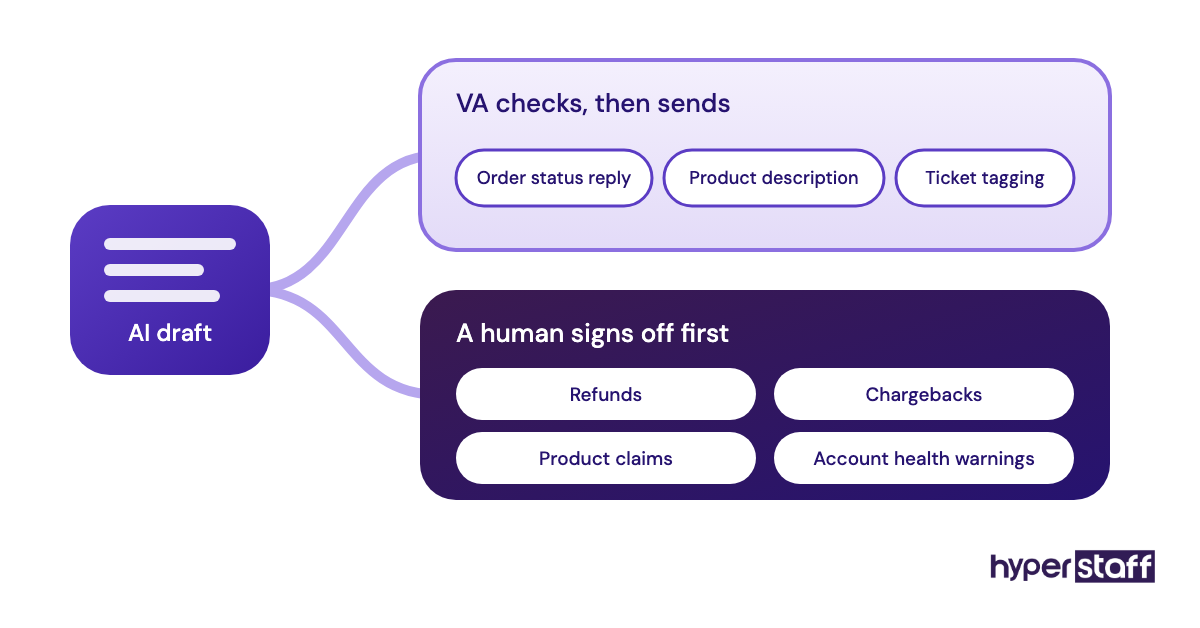
AI shifts what you hire an ecommerce virtual assistant for toward reviewing, correcting and deciding, with far less typing from scratch. Helpdesks like Gorgias and Zendesk now draft ticket replies, and AI writing tools produce first-pass product descriptions in seconds.
Judgment becomes the skill to test. In the trial task, hand candidates an AI-drafted reply with a subtle policy error and see whether they catch it.
Keep a human on refunds, chargebacks, product claims and account health warnings. AI drafts are fast, and they can be confidently wrong about your return window.
Disclaimer: This article is for general information only and is not legal, tax or employment advice. Platform policies, wages and prices change, so confirm current terms with the relevant provider or a qualified advisor before making hiring decisions. Hyperstaff is not liable for outcomes based on this content.
Common questions
Should I hire an ecommerce VA full-time or part-time?
Start part-time unless you already have 30+ hours a week of repeatable store work. A 40 or 80-hour monthly block lets you test the fit, then grow hours once tasks run cleanly.
Can an ecommerce virtual assistant work in my Shopify store safely?
Yes, with a staff account limited to the permissions their tasks need. Share every other login through a password manager and turn on two-factor authentication everywhere.
What skills should I look for in an ecommerce VA?
Look for hands-on experience with your platform, clear written English and comfort in your helpdesk. Attention to detail matters most, because small errors in prices or addresses cost real money.
Do I need a contract to hire an ecommerce virtual assistant?
Yes. It should cover scope, hours, pay, confidentiality, data handling and who owns the work, and when you hire through an agency, the agency usually holds the worker's contract while you sign a service agreement.
What time zone should my ecommerce VA be in?
Pick a region that gives you 2 to 4 hours of overlap with your working day. Latin America suits US stores wanting daytime overlap, while the Philippines and India often cover evenings and overnight support.
Book a free 15 min call
We place a pre-vetted specialist in 5 business days, fully managed, from $3/hour.