What Is an Ecommerce Virtual Assistant? Roles, Costs and How It Works
An ecommerce virtual assistant is a remote specialist who runs the daily operations of an online store, from listings and orders to support tickets and marketing tasks.
On this page
- What Is an Ecommerce Virtual Assistant?
- Key Ecommerce Virtual Assistant Terms You Should Know
- Why Is an Ecommerce Virtual Assistant Important?
- How Does an Ecommerce Virtual Assistant Work?
- Types and Forms of Ecommerce Virtual Assistants
- How an Ecommerce VA Differs From Related Roles
- Ecommerce VA vs. General Virtual Assistant
- Ecommerce VA vs. Marketplace Management Agency
- Ecommerce VA vs. In-House Ecommerce Coordinator
- The Benefits of an Ecommerce Virtual Assistant
- The Drawbacks of an Ecommerce Virtual Assistant
- Who Needs an Ecommerce Virtual Assistant?
- Ecommerce Virtual Assistant Examples
- Ecommerce Virtual Assistant Good Examples
- Ecommerce Virtual Assistant Bad Examples
- Creating an Ecommerce VA Plan, Step-by-Step
- Step #1
- Step #2
- Step #3
- Step #4
- Step #5
- What Does an Effective Ecommerce VA Strategy Look Like?
- Ecommerce Virtual Assistant Tools and Software
- 9 Proven Ecommerce Virtual Assistant Tips and Best Practices
- Overcoming Common Ecommerce VA Challenges
- How to Measure Ecommerce VA Success
- How Long Does an Ecommerce VA Take to Work?
- How Much Does an Ecommerce Virtual Assistant Cost?
- Is an Ecommerce Virtual Assistant Worth It?
- How to Choose an Ecommerce Virtual Assistant Agency
- Ecommerce Virtual Assistant Statistics, Trends and Future Predictions
- Ecommerce Virtual Assistants and AI
- FAQs
Get Your Hours Back for Revenue Work
Hyperstaff places pre-vetted remote specialists who run the daily operations of online stores, and our ecommerce virtual assistant services start from $3 per hour. With 70+ assistants placed for 30+ clients, we match you with a dedicated VA in 5 business days, so your store keeps moving while you work on growth.
What Is an Ecommerce Virtual Assistant?
An ecommerce virtual assistant is a remote worker who handles the day-to-day operations of an online store. That covers product listings, order management, customer service, inventory tracking, supplier follow-ups and routine marketing work across Shopify, Amazon, Etsy, WooCommerce and similar platforms.
The role is wider than inbox and calendar admin. A trained ecommerce VA can answer return requests in Gorgias at 9 a.m., fix a suppressed Amazon listing before lunch and schedule the weekend Klaviyo campaign by the end of their shift.
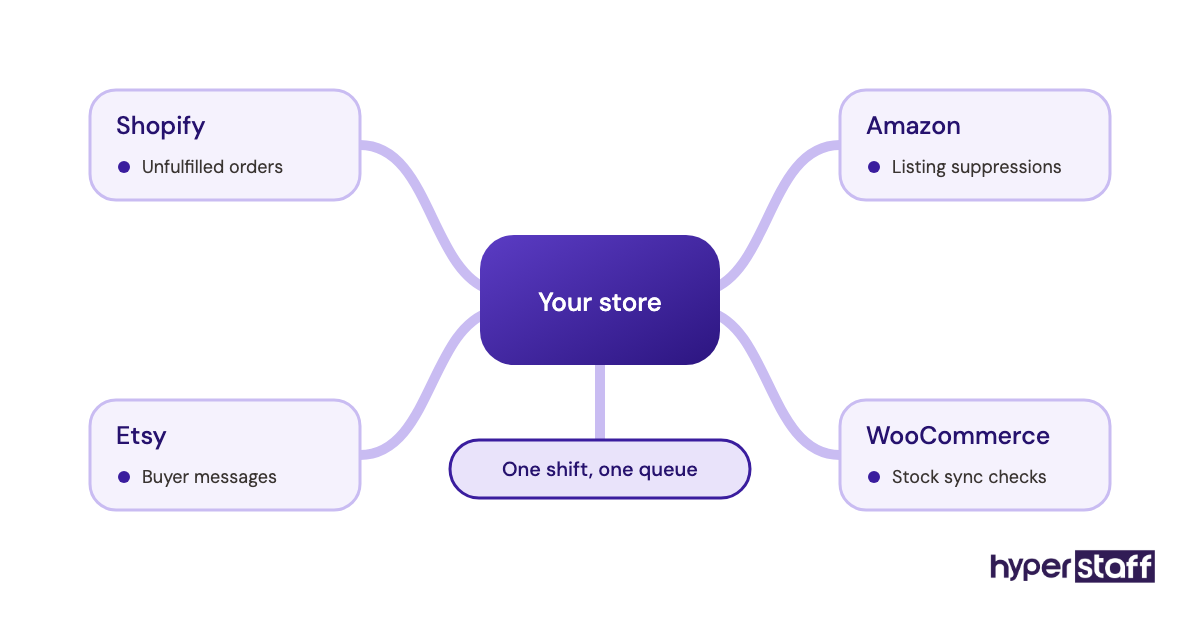
Most ecommerce VAs work from the Philippines, Latin America, India or Eastern Europe, on full-time or part-time schedules. The full list of what they can take over is long, and we keep a running version in our breakdown of common ecommerce VA tasks.
Key Ecommerce Virtual Assistant Terms You Should Know
- SKU = a stock keeping unit, the unique code a store assigns to each product variant.
- Product listing = the title, images, description, price and attributes shown for an item on a store or marketplace.
- Seller Central = Amazon's dashboard for third-party sellers, where secondary users get permission-based access.
- Collaborator account = a Shopify login type for outside partners, with access limited to chosen store sections.
- SOP = a standard operating procedure, the written steps for completing one task the same way every time.
- Fulfillment = the process of picking, packing and shipping an order to the customer.
- 3PL = a third-party logistics company that stores inventory and ships orders for a brand.
- Helpdesk = shared software, such as Gorgias or Zendesk, for answering customer emails and chats as tickets.
- Chargeback = a payment reversal a customer starts through their card issuer, often over a missing or disputed order.
- Dropshipping = a model where a supplier ships products straight to the buyer, so the store holds no stock.
- Time zone coverage = the hours a VA works relative to the store's customers and team.
Why Is an Ecommerce Virtual Assistant Important?
An ecommerce virtual assistant matters because online stores generate a steady stream of small, time-sensitive tasks that pile up fast. Orders need checking, tickets need replies and listings need fixes every single day, whether or not the owner has time.
The cost of falling behind is concrete. A support email left for 48 hours can turn into a chargeback, and an out-of-stock variant left live on a Shopify ad sends paid traffic to a dead end.
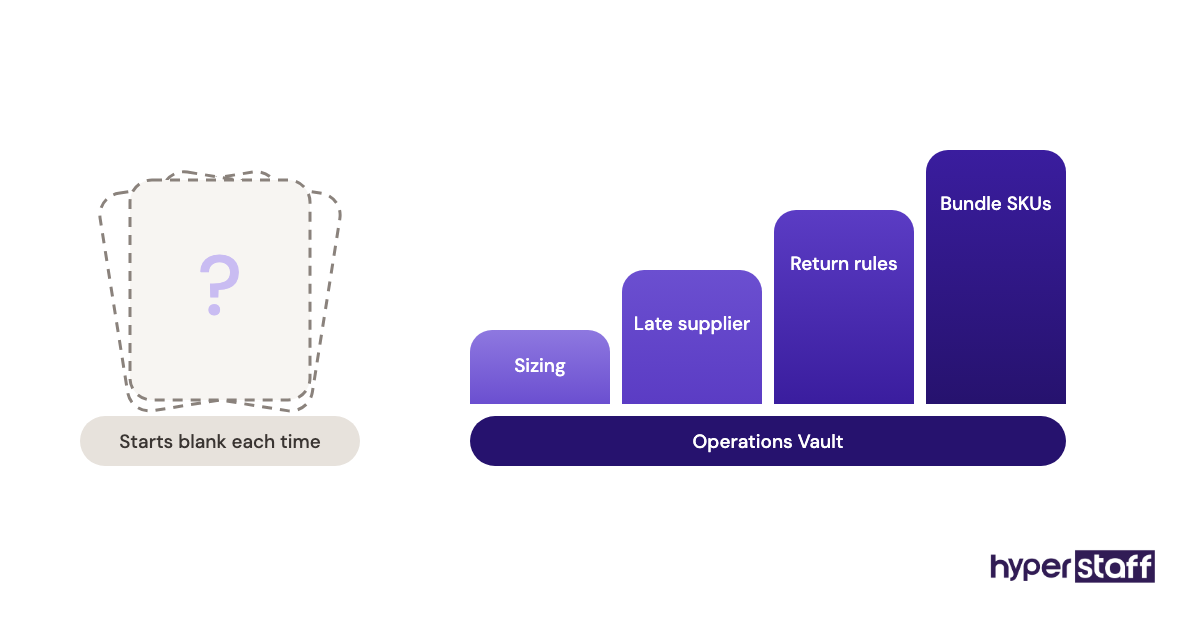
Ownership is the other reason. A dedicated VA who learns one catalog builds context a rotating freelancer never gets, like which supplier ships late in November or which product photo triggers the most "is this the right size?" questions.
How Does an Ecommerce Virtual Assistant Work?
An ecommerce virtual assistant works through shared logins, a task list and written procedures. The store owner grants scoped access to the platform and tools, the VA works set hours, and progress is tracked in a project tool or shared sheet.
A typical shift starts with order exceptions: failed payments, address problems, items stuck in "unfulfilled." Support tickets come next, then the planned work for the day, such as uploading 20 new SKUs or updating prices before a sale.
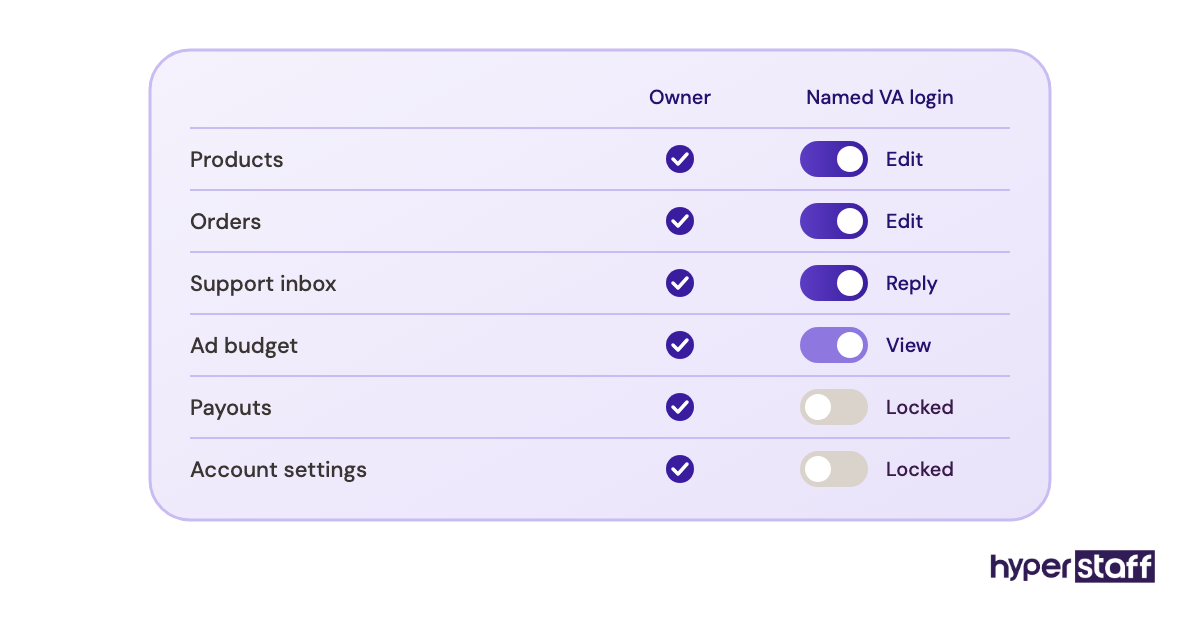
Access is where most setups go right or wrong. On Shopify, staff and collaborator accounts let you limit what each user sees, and Amazon's Seller Central lets the primary account holder invite secondary users with specific permissions instead of sharing the main login.
Types and Forms of Ecommerce Virtual Assistants
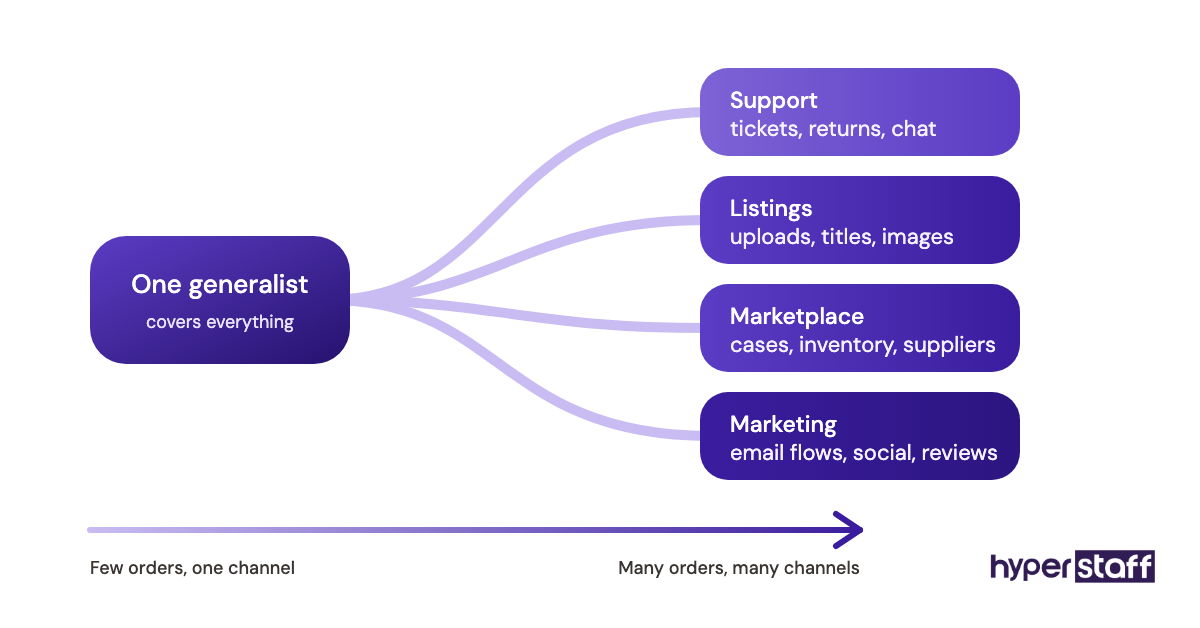
Ecommerce virtual assistants come in several forms, split by function and by platform. Some stores need one generalist, while larger catalogs split the work between two or three specialists.
| Type | Core work | Main tools | Best fit | Typical experience tier |
|---|---|---|---|---|
| Generalist store VA | Orders, tickets, listings, admin | Shopify, Gmail, Google Sheets | Stores under 100 orders a day | Essential to Professional |
| Customer support VA | Tickets, returns, refunds, live chat | Gorgias, Zendesk | High ticket volume | Essential |
| Product listing VA | Uploads, SEO titles, image edits | Shopify, Canva, marketplace tools | Large or seasonal catalogs | Essential to Professional |
| Amazon marketplace VA | Listings, inventory, case logs | Seller Central, Helium 10 | Amazon-first brands | Professional |
| Inventory and supplier VA | Stock counts, POs, supplier chasing | Sheets, ShipStation, 3PL portals | Multiple suppliers or warehouses | Professional |
| Ecommerce marketing VA | Email flows, social posts, reviews | Klaviyo, Meta Business Suite | Brands running weekly campaigns | Professional to Expert |
| Ecommerce operations lead | Process design, reporting, team coordination | Full stack plus analytics | Multi-channel stores scaling up | Expert |
How an Ecommerce VA Differs From Related Roles
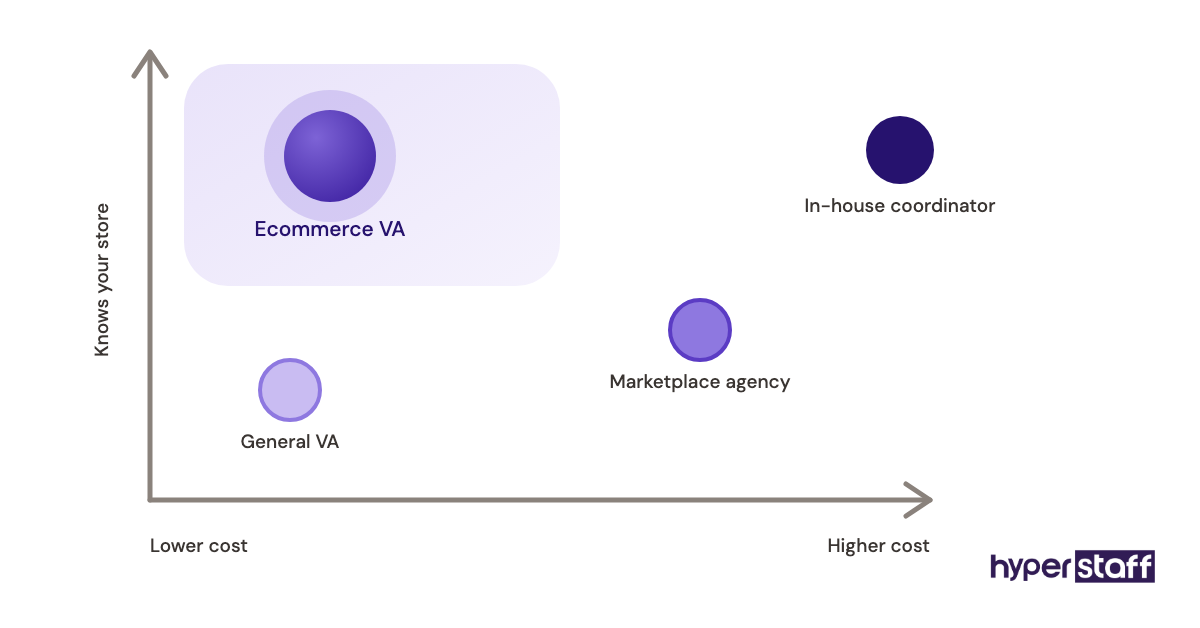
An ecommerce VA overlaps with three roles buyers often confuse it with. The differences come down to platform knowledge, ownership and cost.
Ecommerce VA vs. General Virtual Assistant
A general virtual assistant handles admin across any business, while an ecommerce VA knows how stores run. The second one already understands order statuses, variant structures and refund rules, so you skip weeks of explaining what "partially fulfilled" means.
Ecommerce VA vs. Marketplace Management Agency
A marketplace agency sells a service package and usually spreads one account manager across many brands. An ecommerce VA works your hours on your store, which costs less and builds more store-specific memory, but you supply direction on strategy.
Ecommerce VA vs. In-House Ecommerce Coordinator
An in-house ecommerce coordinator sits in your office or time zone, at a full local salary plus benefits. The VA route trades some real-time overlap for much lower cost, and we compare both in detail in our ecommerce VA vs in-house breakdown.
The Benefits of an Ecommerce Virtual Assistant
- Lower labor cost per hour than a local hire, with no office or equipment to provide.
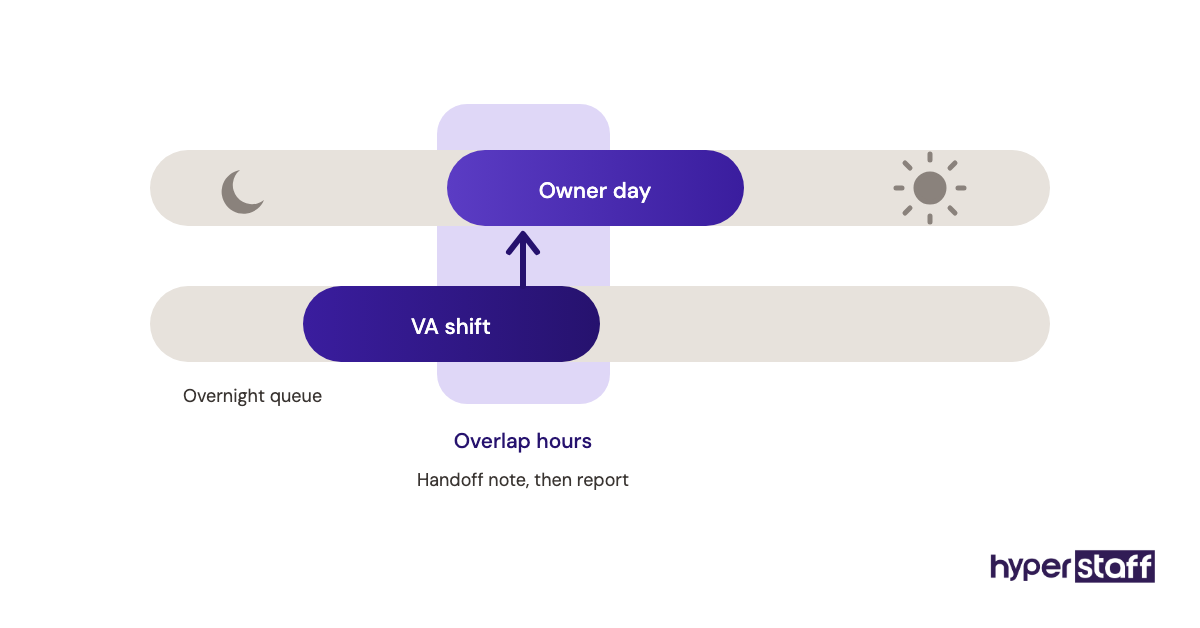
- Coverage outside your own working hours, which helps with overnight tickets and early order checks.
- Flexible hours, from part-time bundles up to full-time.
- Owner time moves from repetitive admin to product, sourcing and marketing decisions.
- Documented processes, since a VA needs written SOPs that keep working after anyone leaves.
The Drawbacks of an Ecommerce Virtual Assistant
- Onboarding takes real owner time in the first two weeks.
- Time zone gaps can slow urgent decisions, like approving a large refund.
- Access to store and payment data needs careful permission setup.
- A VA follows your strategy and rarely replaces a strategist.
Most of these drawbacks shrink with process. Clear refund limits and a written escalation path fix the time zone problem in most stores.
Who Needs an Ecommerce Virtual Assistant?
Store owners who spend a large part of each week on repeatable operations are the clearest fit for an ecommerce virtual assistant. Solo founders past their first steady sales, small brands selling on two or more channels, and agencies managing client stores all qualify.
Very new stores are the honest exception. If you have five orders a week and no fixed process yet, a VA will mostly wait for instructions, so document a few weeks of your own routine first.
The small-business and larger-brand views differ here. A founder usually wants one generalist who can cover anything, while a brand with an ops manager often prefers a narrow specialist, such as a support-only VA, who slots into a team that already has structure.
Ecommerce Virtual Assistant Examples
Ecommerce VA setups succeed or fail on scope and structure far more than on talent. The examples below are common patterns across Shopify and Amazon stores.
Ecommerce Virtual Assistant Good Examples
The Support Inbox Owner
A VA owns the helpdesk with a written refund limit, for example full authority on refunds under $50 and escalation above that. Tickets get answered within a shift, and the owner only sees the exceptions.
The Catalog Builder Before a Launch
A listing VA uploads a new collection from a supplier spreadsheet, writes titles to a set template and flags missing images. The owner reviews a finished draft instead of building 60 product pages by hand.
The Amazon Case Manager
A marketplace VA checks Seller Central daily for stranded inventory, listing suppressions and reimbursement cases. Small issues get caught while they're still small.
Ecommerce Virtual Assistant Bad Examples
The "Do Everything" Hire
An owner hires one VA for support, ads, design, bookkeeping and supplier calls in week one. Nothing gets done well, and the owner decides VAs don't work, a pattern we cover in our list of ecommerce VA mistakes.
The Shared Master Password
A VA gets the owner's primary login for every platform, including payments. When the VA leaves, nobody knows which passwords were changed or saved where.
The Unwritten Refund Policy
The VA is told to "use good judgment" on returns. One week they refuse a valid claim, the next they refund a clear abuse case, and customers notice.
Creating an Ecommerce VA Plan, Step-by-Step
An ecommerce VA plan moves through five steps, from listing tasks to the first review. Skipping the first two is the most common reason a placement stalls.
Step #1: Audit Your Store's Repeatable Work
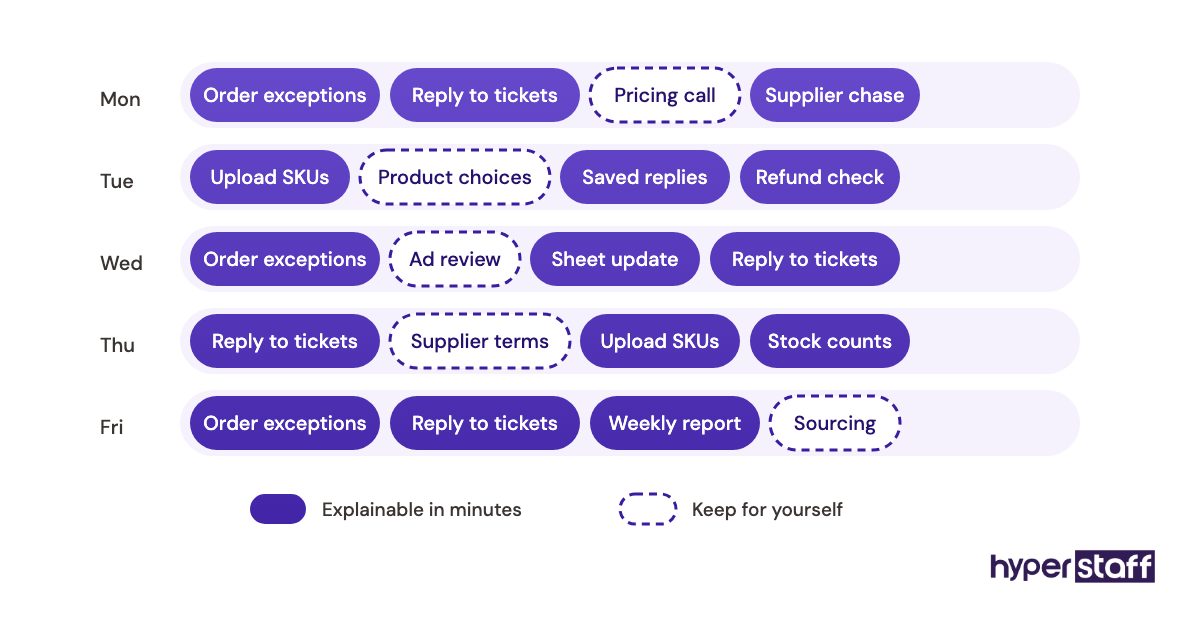
List every recurring task for two weeks with its time cost and frequency. Group them into workflows, such as "support," "listings" or "inventory," because a VA needs ownership of whole workflows to be useful.
Step #2: Write the Role and Its Limits
Turn the chosen workflows into a role with clear boundaries: refund limits, which tools they touch, what needs your approval. Our ecommerce VA job description template gives you a starting structure.
Step #3: Screen for Platform Skill
Test candidates on your real tools, such as editing a Shopify product or replying to a sample complaint. A short paid trial task tells you more than a résumé, and these ecommerce VA interview questions cover what to ask.
Step #4: Set Up Access and SOPs
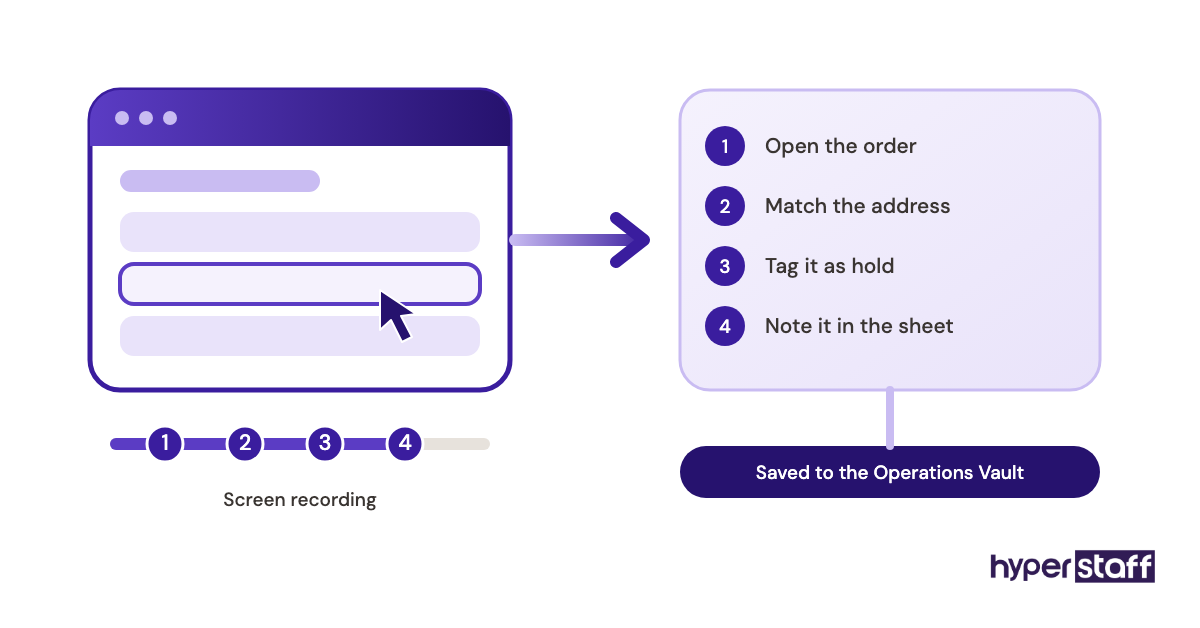
Create named logins for every tool, store passwords in a password manager and record short screen videos of each task. The full setup sequence is in our guide to onboarding an ecommerce VA.
Step #5: Review at 30 Days
Check ticket response times, listing accuracy and how often the VA escalated. Adjust their limits upward where they've earned trust, and rewrite any SOP that caused repeated questions.
What Does an Effective Ecommerce VA Strategy Look Like?
An effective ecommerce VA strategy gives the assistant ownership of outcomes with written rules, then widens their scope as trust builds. Stores that start narrow and expand on evidence tend to keep their VAs longer.
Practitioners disagree on where to start. Some owners put a new VA on customer support first because it teaches the products fastest, while others start with listings because mistakes there are less visible to customers, and both work when the SOPs are solid.
We lean toward support first for stores with clear policies. Tickets expose the VA to every product, shipping problem and customer question within a few weeks, which makes every later task easier.
Ecommerce Virtual Assistant Tools and Software
Ecommerce virtual assistants work inside the store's own software stack. The table shows common tools and their current published pricing, which we checked on each vendor's site.
| Tool | What the VA does in it | Pricing |
|---|---|---|
| Shopify | Products, orders, refunds | Store plan; staff or collaborator access |
| Amazon Seller Central | Listings, inventory, cases | Secondary user permissions |
| Gorgias | Support tickets and chat | $10 to $900/month by ticket volume |
| Helium 10 | Amazon keyword and listing research | $129 or $359/month (monthly billing) |
| ShipStation | Labels and order routing | From $14.99/month (50 shipments) |
| Klaviyo | Email and SMS campaigns | Free up to 250 profiles, 500 sends |
| Google Sheets | Inventory trackers, reports | Free |
| Password manager | Shared logins without exposing them | Per-user plans |
One earned opinion on spend: Helium 10 at $129 a month is hard to justify if the VA only runs keyword lookups once a month. For a deeper rundown, see our list of the best ecommerce VA tools.
9 Proven Ecommerce Virtual Assistant Tips and Best Practices
These practices come up again and again in ecommerce VA setups that last.
- Give each VA a named login on every platform, never your own.
- Write refund and discount limits as dollar amounts.
- Record a 3 to 5 minute screen video for every recurring task.
- Keep one shared doc of "weird cases" the VA has escalated, with your answers.
- Set a daily end-of-shift report with numbers: tickets closed, orders fixed, SKUs uploaded.
- Overlap at least one or two hours with the VA's shift during the first month.
- Add saved replies in the helpdesk for your 15 to 20 most common questions.
- Expand scope one workflow at a time.
- Review permissions every quarter and remove anything unused.
Overcoming Common Ecommerce VA Challenges
Most ecommerce VA problems trace back to missing context. When a VA keeps asking the same questions, the SOP has a gap, and fixing the document solves it faster than repeating the answer.
Time zone friction is the second issue. Pre-approved decision rules for refunds, replacements and shipping delays let the VA close most tickets without waiting overnight.
Turnover is the risk owners fear most. Written procedures and a replacement process that includes a proper handover keep the store running if a VA leaves.
How to Measure Ecommerce VA Success
Ecommerce VA success shows up in a short set of operational numbers. Track first response time on tickets, order exception resolution time, listing error rate and hours of owner time freed each week.
Measure a baseline before the VA starts, or the comparison becomes guesswork. A simple weekly sheet with four or five numbers beats any dashboard nobody opens.
The owner-hours figure matters most. If your own ops time hasn't dropped by week six, the VA is busy but the handover hasn't happened.
How Long Does an Ecommerce VA Take to Work?
An ecommerce virtual assistant usually handles simple tasks independently within the first week and owns full workflows in two to four weeks. Complex work, like Amazon case management or campaign building, can take six to eight weeks.
The waiting periods are predictable. Access invitations, platform verification and tool setup often eat the first two or three days before any real work starts.
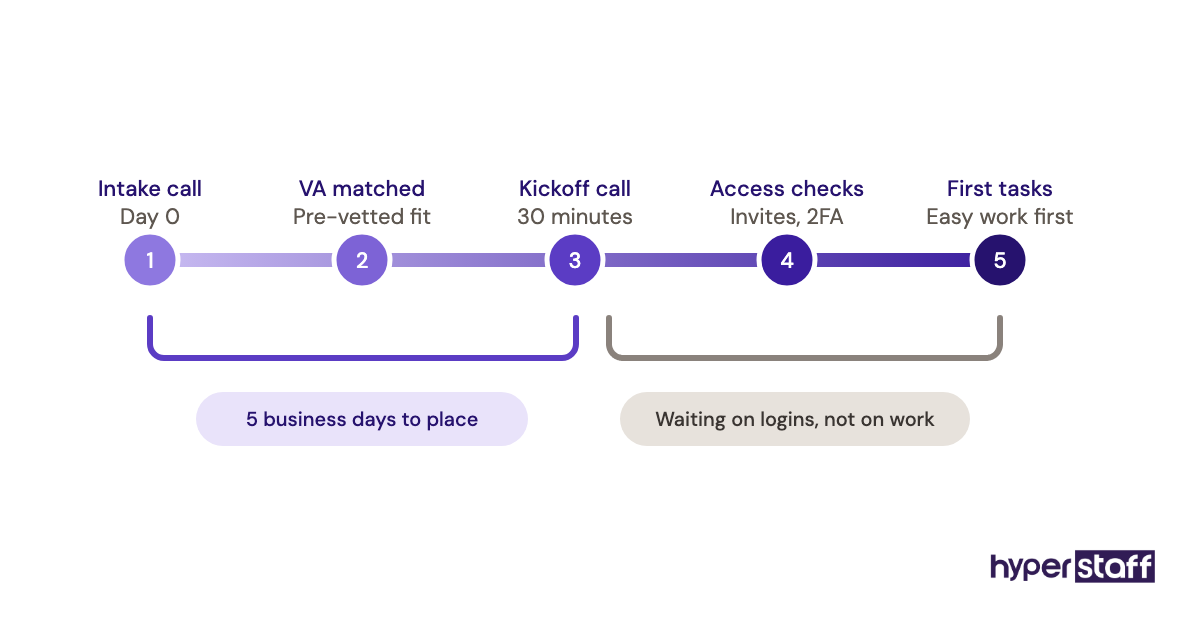
Speed depends on your documentation more than the VA. Stores with SOPs ready on day one move through this timeline noticeably faster.
How Much Does an Ecommerce Virtual Assistant Cost?
An ecommerce virtual assistant costs roughly $3 to $25 per hour depending on region, experience and hiring route. An in-house US ecommerce coordinator usually lands far higher once salary, payroll taxes and benefits are counted.
| Option | Hourly rate | 80 hours/month | 160 hours/month | What's included |
|---|---|---|---|---|
| Hyperstaff Essential (0 to 2 yrs) | From $3 | From $240 | From $480 | Vetting, account manager, free replacement |
| Hyperstaff Professional (2 to 5 yrs) | From $6 | From $480 | From $960 | Same, plus deeper platform experience |
| Hyperstaff Expert (5+ yrs) | From $12 | From $960 | From $1,920 | Same, suited to ops lead roles |
| Freelance marketplace VA | About $5 to $25 | About $400 to $2,000 | About $800 to $4,000 | Hiring, vetting and replacement are on you |
| In-house US ecommerce coordinator | About $25 to $40 fully loaded | About $2,000 to $3,200 | About $4,000 to $6,400 | Local hours, plus benefits and equipment |
Hyperstaff sells monthly bundles of 40, 80 or 160 hours, and quarterly payment saves 10%. A full breakdown of every pricing factor is in our ecommerce VA cost guide.
Important: Our listed rates are starting averages. Your final price depends on the VA's experience tier, the hours you need and how specialized your store's work is.
Is an Ecommerce Virtual Assistant Worth It?
Yes, for most stores with steady order volume, an ecommerce virtual assistant is one of the best-returning hires you can make. When the handover is done properly, it buys back owner hours at a few dollars each and puts them into the work that actually grows sales.
Here's a simple calculation. A Professional-tier VA on an 80-hour bundle starts at about $480 a month, and if they take 15 hours a week of support and listing work off the owner, that's roughly 65 owner hours a month at under $7.50 per hour.
The return depends on what those 65 hours become. Spent on sourcing, new products or ad testing, they usually pay for the VA many times over, but spent on more admin, the math gets weaker, as we discuss in whether an ecommerce VA is worth it.
How to Choose an Ecommerce Virtual Assistant Agency
Choosing an ecommerce VA agency comes down to vetting depth, replacement terms and who owns your process documentation. Ask how candidates are tested on real store tools, and how fast a replacement arrives if the fit is wrong.
Dedicated placement matters for ecommerce more than most roles. A VA who rotates across five stores never learns your SKUs, and that store-specific memory is most of the value.
Check what happens on day one too. At Hyperstaff, every client gets a dedicated account manager, a 30-minute kickoff call, and an Operations Vault where your SOPs and tool context are written down, so a replacement VA in 5 to 7 business days starts from your documented process. If you'd rather hire directly, our step-by-step guide on hiring an ecommerce VA covers that route.
Ecommerce Virtual Assistant Statistics, Trends and Future Predictions
Ecommerce keeps taking a larger share of retail, which keeps demand for store operations support growing. The US Census Bureau's quarterly retail report puts ecommerce at roughly 17 percent of total US retail sales on a seasonally adjusted basis.
Multi-channel selling is the trend we see most in ecommerce VA requests. More stores now run Shopify, Amazon and sometimes TikTok Shop together, and each channel adds its own listings, inventory sync and support queue.
Our prediction, stated with moderate confidence: the generalist "store VA" role will split further into specialists. Support, marketplace and marketing work now each need enough tool knowledge that one person covering all of them gets stretched thin past a certain order volume.
Ecommerce Virtual Assistants and AI
AI tools now handle part of the work an ecommerce virtual assistant used to do by hand, such as first drafts of product descriptions and suggested ticket replies. The VA's job shifts toward checking, correcting and deciding.
Helpdesks like Gorgias offer AI features that answer simple questions such as order status. A human still owns the edge cases: damaged items, angry repeat customers, wholesale inquiries and anything involving money.
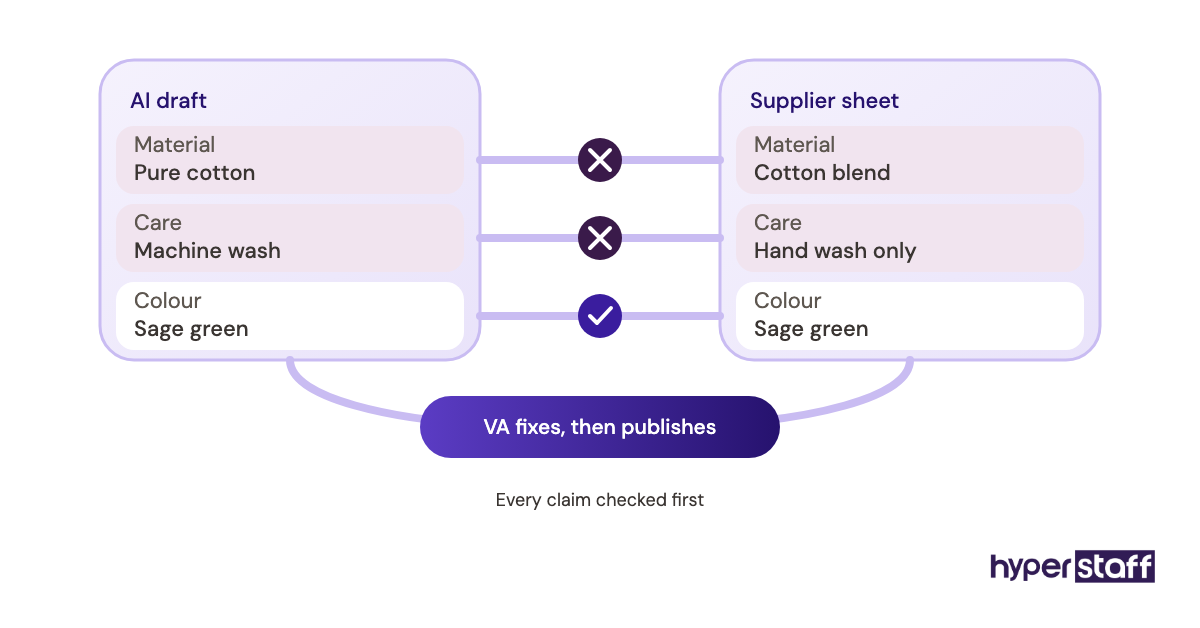
Our view is that AI raises the value of a good VA. A person who knows your catalog can run AI drafts through a fast review loop, and the store gets both speed and accuracy.
Disclaimer: This article is for general information only and isn't legal, financial or tax advice. Prices, tool features and platform policies change, so check current details with each provider before making decisions.
Common questions
Can an ecommerce virtual assistant run my whole Shopify store?
An experienced ecommerce VA can run most daily Shopify operations, including orders, support, listings and inventory updates. Pricing strategy, product choices and supplier negotiations usually stay with the owner.
Is it safe to give an ecommerce VA access to my store?
It's safe when you use named staff or collaborator accounts with limited permissions and a password manager. Keep payment settings and payout details restricted to yourself.
Do ecommerce virtual assistants work US hours?
Many do, especially VAs in the Philippines and Latin America who regularly cover US business hours. Agree on shift times and overlap hours before the VA starts.
What skills should an ecommerce VA have?
Look for hands-on experience with your platform, clear written English, attention to detail and comfort with helpdesk and spreadsheet tools. Marketplace or email marketing skills matter if those workflows are in scope.
Can I hire an ecommerce VA part-time?
You can. Many stores start with a 40 or 80 hour monthly bundle and move to full-time once the VA owns more workflows.
Book a free 15 min call
We place a pre-vetted specialist in 5 business days, fully managed, from $3/hour.