Medical Virtual Assistant Interview Questions: A Copyable Template
A ready-to-use interview template for hiring a medical virtual assistant, with the answers to listen for and how to adapt it to your practice.
On this page
- What Are Medical Virtual Assistant Interview Questions?
- Key Medical VA Interview Terms You Should Know
- Why Do Interview Questions Matter So Much for a Medical VA?
- How Does a Medical Virtual Assistant Interview Work?
- The Medical Virtual Assistant Interview Questions Template
- How Do You Adapt the Template to Your Practice?
- What Types of Interview Questions Should You Ask?
- How Is a Medical VA Interview Different From Other Hiring Interviews?
- The Benefits of Structured Medical VA Interview Questions
- What Are the Drawbacks of a Scripted Interview?
- Who Needs a Medical VA Interview Question Set?
- Medical VA Interview Answer Examples
- Creating a Medical VA Interview Plan, Step-by-Step
- What Does an Effective Medical VA Hiring Strategy Look Like?
- 9 Proven Medical VA Interview Tips and Best Practices
- Overcoming Common Medical VA Interview Challenges
- How Do You Measure Whether Your Interview Questions Worked?
- How Long Does It Take to Hire a Medical VA?
- How Much Does Hiring a Medical VA Cost?
- Is a Structured Medical VA Interview Worth It?
- How to Choose a Medical VA Agency
- Medical VA Hiring Statistics, Trends and Predictions
- How Is AI Changing Medical VA Interviews?
- FAQs
💡 Key Takeaways:
1) Good medical virtual assistant interview questions test privacy judgment, EHR and insurance skills, and how the candidate talks to an anxious patient, using scenarios instead of yes/no questions.
2) A structured interview asks every candidate the same questions in the same order and scores each answer against what a strong reply should include, which makes candidates easy to compare.
3) A live role-play and a short task with fake patient data reveal more than a résumé, because medical admin mistakes come from judgment under pressure, not from missing knowledge.
The Right Questions Protect Your Practice's Revenue
One weak hire at the front desk shows up as denied claims, missed reminders and patients who don't rebook. Hyperstaff has placed 70+ virtual assistants with 30+ clients, and our medical virtual assistant services place pre-vetted specialists from $3/hour in 5 business days, with free replacement if the fit isn't right.
What Are Medical Virtual Assistant Interview Questions?
Medical virtual assistant interview questions are the prompts a practice uses to check whether a remote candidate can handle patient scheduling, insurance work, EHR updates and protected health information safely. The best sets mix knowledge checks, real scenarios and a live role-play.
The role covers more than an inbox. If you're still working out the scope, our guide on what a medical virtual assistant does covers the full range, from patient intake to billing follow-up.
Key Medical VA Interview Terms You Should Know
- PHI = Protected health information: any health detail tied to a person, including appointment dates and phone numbers.
- HIPAA = The US federal law setting rules for how PHI is used, shared and secured.
- BAA = Business associate agreement, the contract required when an outside party handles PHI for a practice.
- Minimum necessary = The HIPAA standard that staff access only the PHI a task requires.
- EHR = Electronic health record system, such as Epic, athenahealth or eClinicalWorks.
- Eligibility verification = Confirming a patient's insurance is active and what it covers before the visit.
- Prior authorization = Payer approval needed before certain procedures, drugs or referrals.
- Clearinghouse = The service that sends claims from a practice to payers and returns rejections.
- Triage script = The practice's written rules for which patient symptoms get escalated, and to whom.
- Structured interview = Same questions, same order, same scoring rubric for every candidate.
- Paid trial task = A short, paid piece of real-format work done with fake data before an offer.
Why Do Interview Questions Matter So Much for a Medical VA?
Interview questions matter more for a medical VA than for most remote roles because the mistakes are expensive and some can't be undone. A disclosed lab result or a missed prior authorization costs money, trust or both.
A general admin hire who's slow at email costs you time. A medical hire who reads a patient's diagnosis to the wrong caller creates a **reportable privacy incident**, and no amount of training afterward reverses it.
There's also a revenue side people underrate. Front-desk work like eligibility checks and referral tracking decides whether a claim gets paid on the first pass, so the interview is the cheapest place to filter for that skill.
How Does a Medical Virtual Assistant Interview Work?
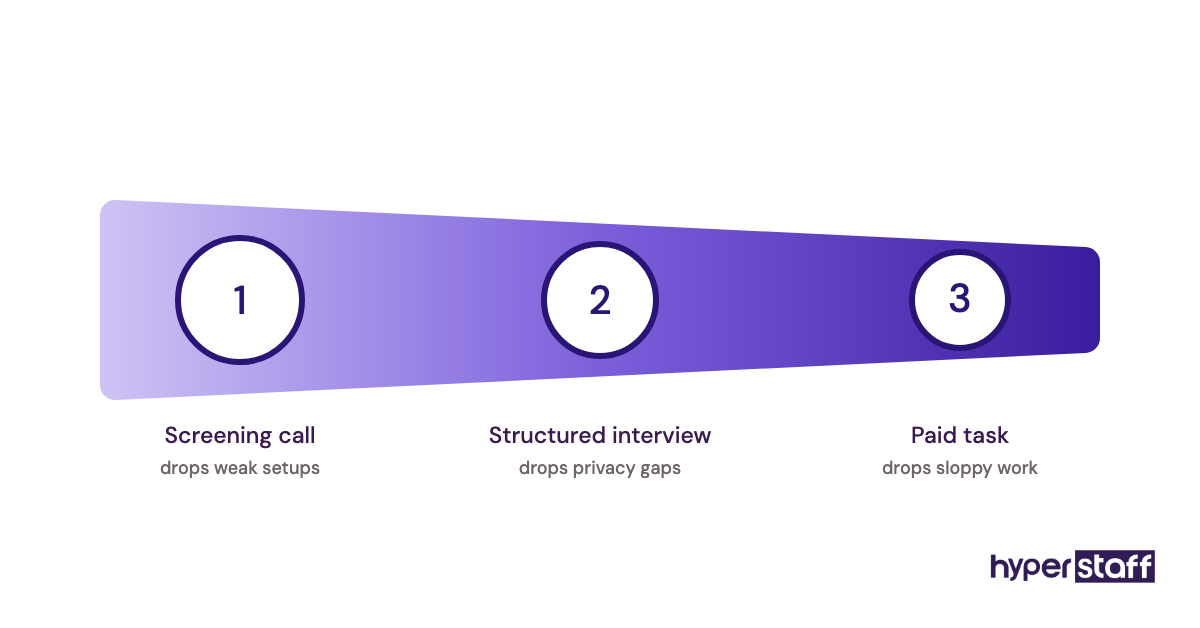
A medical VA interview usually runs in three stages: a short screening call, a structured video interview of 45 to 60 minutes, and a practical task. Most practices finish all three within one to two weeks.
The screening call checks hours, internet backup and basic healthcare experience. The structured interview is where the template below does its work, and the practical task confirms what the candidate said they can do.
Keep the video on for the main interview. You're hiring someone who'll speak to your patients, so tone and pace count as evidence.
The Medical Virtual Assistant Interview Questions Template
Copy the template below into your hiring doc, then score each answer from 1 to 3 against the "Listen for" notes. The time guides add up to roughly 50 minutes.
Section A: Background and fit (5 minutes)
- Walk me through the last healthcare team you supported. Which tasks did you own from start to finish? Listen for: a named EHR, named tasks, rough daily volumes.
- Which hours can you cover in our time zone, and what happens if your power or internet drops mid-shift? Listen for: a specific backup, such as a mobile hotspot or a second location.
Section B: HIPAA and patient privacy (10 minutes)
- In your own words, what counts as protected health information? Listen for: appointment dates, phone numbers and insurance IDs, not only diagnoses.
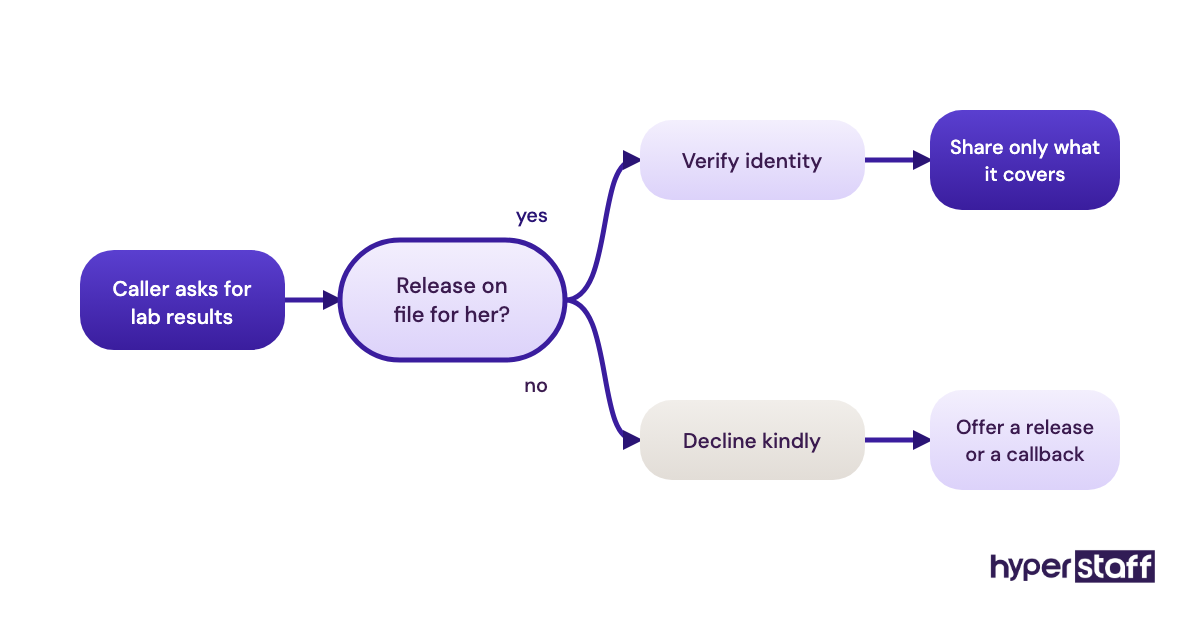
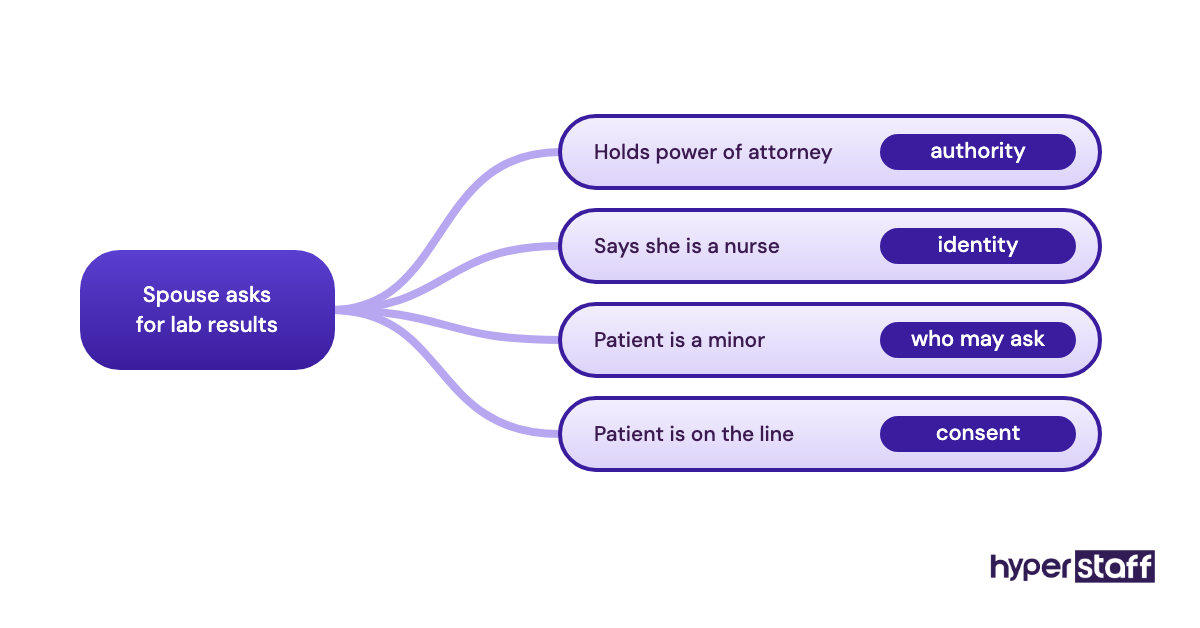
- A caller says she's the patient's wife and asks for his lab results. What do you do? Listen for: check for an authorization on file, verify identity, decline politely if none exists.
- What does "minimum necessary" mean in your daily work? Listen for: opening only the parts of a chart the task needs.
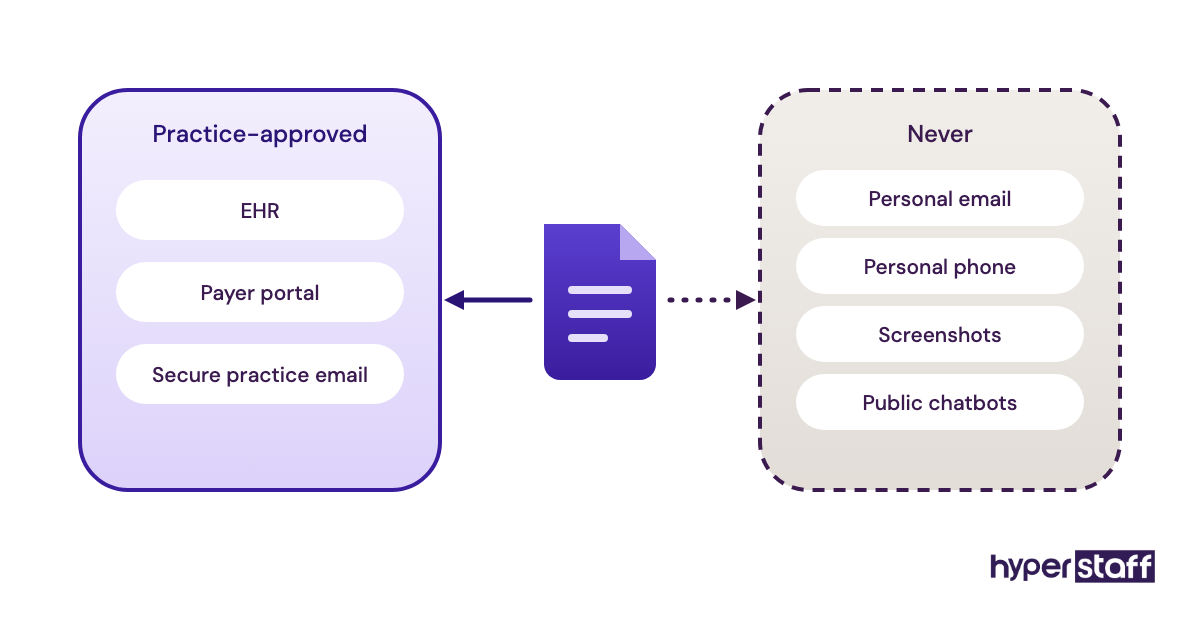
- Where would you never store or send patient information? Listen for: personal email, personal phone, screenshots, unapproved AI tools.
- You realize you just emailed a patient form to the wrong address. What happens next? Listen for: tell the supervisor right away, no attempt to quietly fix it.
Section C: EHR and insurance (12 minutes)
- Which EHR or practice management systems have you used, and for which tasks? Listen for: specific screens or workflows, not only product names.
- Walk me through verifying a new patient's insurance before a visit. Listen for: payer portal or clearinghouse, active dates, copay, deductible, referral requirements.
- Describe a prior authorization you submitted. What slowed it down? Listen for: missing clinical notes, wrong codes, follow-up calls with the payer.
- A claim comes back denied for eligibility. What do you check first? Listen for: member ID, date of service against coverage dates, secondary insurance.
Section D: Scheduling and patient communication (12 minutes)
- Role-play: I'm a patient whose appointment was moved twice and I'm upset. Go. Listen for: acknowledges first, offers concrete options, makes no promises the practice can't keep.
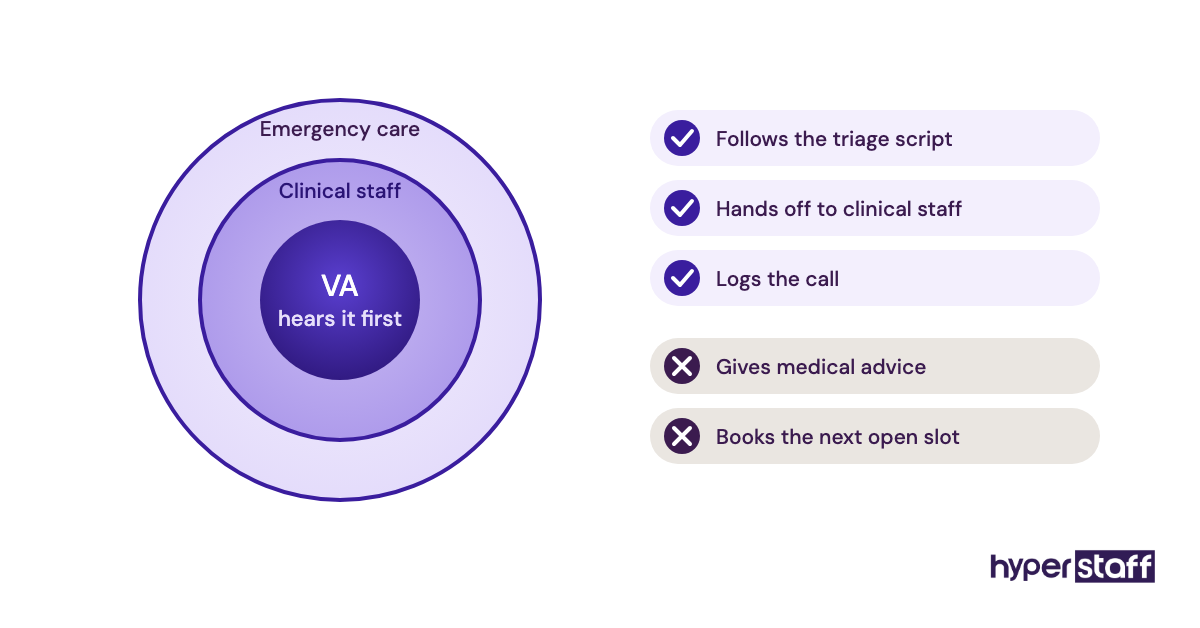
- A patient calls to book next week and mentions chest pain. What do you do? Listen for: follows the triage script, directs to emergency care, escalates to clinical staff, gives no medical advice.
- How would you cut no-shows on our schedule? Listen for: reminder timing, confirmation calls, a waitlist to backfill gaps.
Section E: Remote work and judgment (8 minutes)
- You're unsure how to handle a request and your supervisor is offline. What do you do? Listen for: a holding reply to the patient, a written note, no guessing on clinical or billing calls.
- Tell me about a mistake you made in a past role and how it was caught. Listen for: ownership and a specific change they made afterward.
- How do you track 30 or more open referrals at once? Listen for: a named tracker, follow-up dates, status columns.
- How do you document your work so someone else could pick it up tomorrow? Listen for: notes in the EHR or task log, written for a stranger.
Section F: Close (3 minutes)
- What would you want to know about our patients or workflow before day one? Listen for: questions about volume, payer mix, tools and escalation contacts.
Practical task (15 to 20 minutes, separate session): Enter three fake intake forms into a sample spreadsheet or test EHR, flag missing insurance details, and draft one appointment reminder text.
How Do You Adapt the Template to Your Practice?
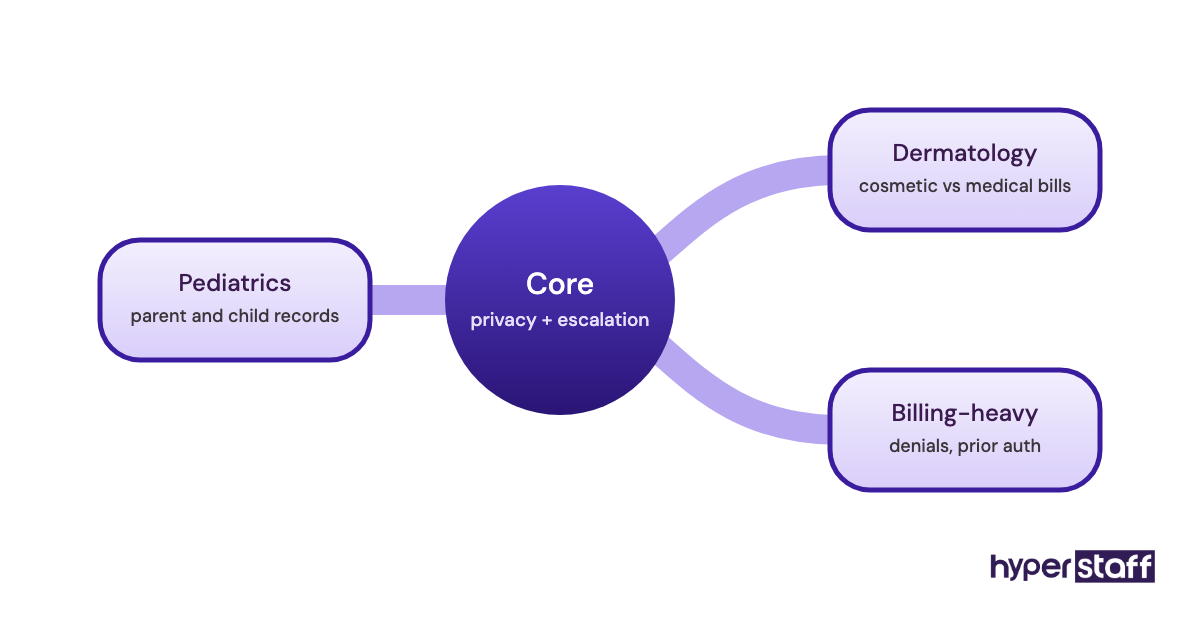
Adapt the template by cutting the sections that don't match the job and swapping in your own tools, payers and scripts. A VA who only schedules doesn't need the claim denial question, and a billing-heavy hire needs two more of them.
Start with your task list. If you haven't written one, our medical VA task checklist is a fast way to mark what the role actually covers.
Then rewrite the scenarios in your own specialty's language. A dermatology practice should use a cosmetic-versus-medical billing scenario, while a pediatric clinic should test how the candidate talks to a parent about a child's records.
What Types of Interview Questions Should You Ask?
Ask a mix of knowledge, scenario, role-play and practical questions. Each type catches a different weakness, and a set built only from knowledge questions mostly rewards candidates who memorized answers online.
| Question type | What it tests | Example prompt | Time to allow | Red-flag answer |
|---|---|---|---|---|
| Knowledge | HIPAA basics, terms | What counts as PHI? | 2 min | "Only diagnoses" |
| Scenario | Privacy judgment | Spouse asks for lab results | 3 min | Shares after a friendly chat |
| Process walk-through | Real EHR or payer experience | Verify eligibility step by step | 4 min | Vague, no portal named |
| Role-play | Tone with patients | Upset patient, moved appointment | 5 min | Argues or over-promises |
| Escalation | Knowing limits | Chest pain during booking call | 2 min | Gives medical advice |
| Behavioral | Ownership | A mistake you made | 3 min | Blames someone else |
| Remote reliability | Setup and backup | Internet drops mid-shift | 2 min | "That never happens" |
| Practical task | Accuracy, speed | Enter fake intake forms | 15 to 20 min | Skips missing fields |
How Is a Medical VA Interview Different From Other Hiring Interviews?
A medical VA interview puts privacy and escalation judgment ahead of general admin speed. The same candidate can ace a standard VA interview and still fail the medical one on a single disclosure question.
Medical VA interview vs. general VA interview
A general VA interview checks communication, tools and reliability. The medical version keeps all of that and adds **PHI handling, payer workflows and triage limits**, which carry legal weight in a way that calendar work doesn't.
Medical VA interview vs. in-house receptionist interview
An in-house receptionist interview can lean on a walk around the front desk and a gut read in person. Remote hiring removes both, so the role-play and the practical task have to carry that evidence instead. Our medical VA vs in-house comparison covers the wider trade-offs.
Interview questions vs. a skills test
Questions tell you how a candidate thinks. A skills test tells you whether their hands match their words, and we'd never make an offer on questions alone for a role that touches claims.
The Benefits of Structured Medical VA Interview Questions
A structured set of medical VA interview questions makes candidates comparable and catches privacy gaps before they reach your patients.
- Scores line up across candidates, so the decision rests on evidence.
- HIPAA weak spots surface in minutes, not after a month on the job.
- Two interviewers can split the work and still score the same way.
- Your "Listen for" notes double as onboarding material for whoever you hire.
- Candidates see a serious, organized practice, which matters to the good ones.
What Are the Drawbacks of a Scripted Interview?
The main drawbacks are rigidity and prep time, and both are manageable.
- A fixed script can miss a strong candidate's unusual background unless you leave 5 minutes for follow-ups.
- Writing scenarios for your specialty takes an hour or two up front.
- Candidates who rehearse common questions online can sound polished on knowledge questions alone.
Who Needs a Medical VA Interview Question Set?
Any practice hiring a remote assistant who'll see patient data needs a written interview set. That includes solo physicians, dental and therapy practices, specialty clinics and multi-location groups.
The set matters most for practices without an HR team, where the practice manager or the physician runs every interview. A written template stops each interview from drifting into a friendly chat that tests nothing.
Practices hiring through an agency still benefit. You'll often meet two or three pre-vetted finalists, and a short version of this template is how you pick between them.
Medical VA Interview Answer Examples
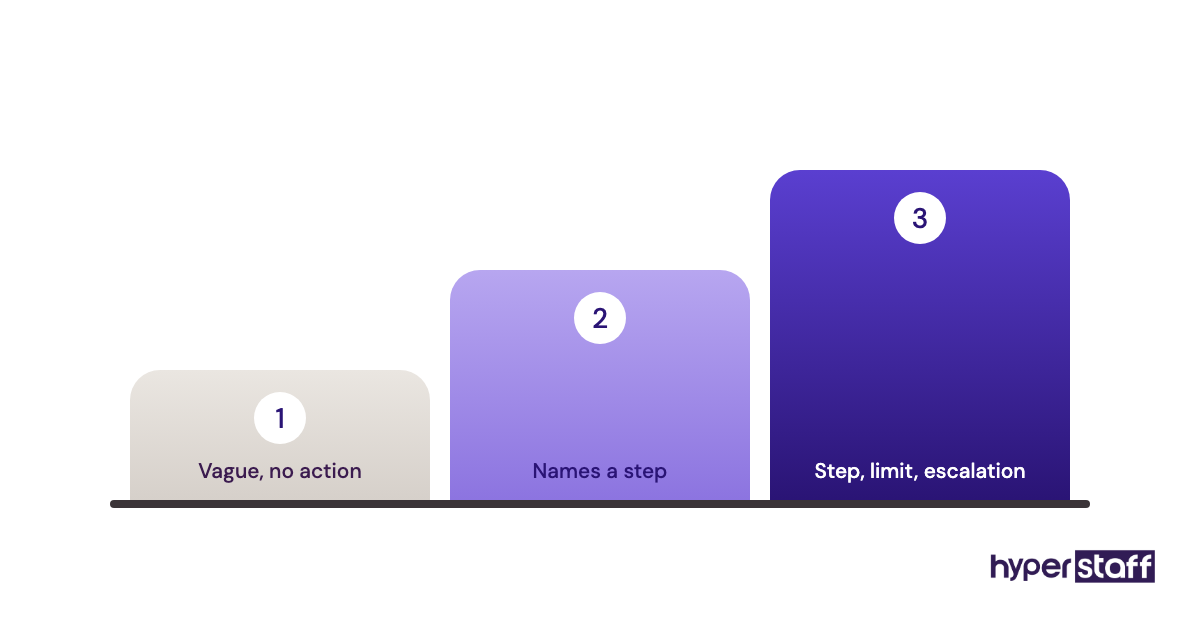
Example answers make the scoring rubric concrete. The strong answers below share one trait: they name a step, a limit and a person to escalate to.
Good Answer Examples
The spouse asking for lab results
"I'd check the chart for a release or authorization naming her. If there isn't one, I'd tell her kindly that I can't share results, and offer to have the patient call us or sign a release."
Verifying insurance eligibility
"I run the member ID through the payer portal or Availity, confirm coverage is active on the visit date, and note the copay, deductible left and whether a referral is needed. Anything odd goes into the chart before the patient arrives."
The emailed form sent to the wrong address
"I'd tell my supervisor straight away with the time, the address and what was in the form. The practice decides the next steps, and I wouldn't try to recall it quietly and move on."
Bad Answer Examples
"I'd use my judgment"
Asked about the chest-pain caller, a candidate who says they'd "use their judgment" and book the earliest slot is guessing at clinical triage. That answer should score a 1, however warm the delivery.
"HIPAA is about keeping medical records safe"
It's true, and it's thin. The candidate hasn't named any action they'd take, and that gap usually turns up again when the scenarios start.
"I've used every EHR"
Nobody has. A candidate who claims broad experience but can't describe one screen or one workflow in any system is the profile most likely to stall in week one.
Creating a Medical VA Interview Plan, Step-by-Step
A medical VA interview plan turns the template into a repeatable hiring process. Five steps cover it, from task list to decision.
Step #1: List the duties and rank them
Write down every task the VA will own and mark the three to five that carry the most risk or revenue. Those get the most interview time.
Step #2: Cut and rewrite the template
Remove sections that don't apply and swap in your EHR, your top payers and your triage rules. Write the "Listen for" notes before you meet anyone, so the first candidate doesn't set the bar.
Step #3: Run a 15-minute screening call
Check hours, internet backup and any healthcare background. Our step-by-step on hiring a medical virtual assistant covers sourcing and screening in more depth.
Step #4: Hold the structured interview and the task
Ask every question in order and score straight after each one, not at the end. Send the practical task within 24 hours, and pay for it if it runs past 30 minutes.
Step #5: Decide, then plan the first week
Compare scores, check one or two references and make the offer. Low scores on specific questions become your first training topics.
What Does an Effective Medical VA Hiring Strategy Look Like?
An effective medical VA hiring strategy weights the interview toward the riskiest tasks, verifies claims with a practical test, and decides on scores rather than rapport. Interview length matters far less than whether each question maps to a real duty.
Practitioners genuinely disagree on one point: whether to hire for healthcare experience or for sharp judgment and train the rest. Our view is conditional. For billing and prior authorization, prior payer experience saves weeks, but for scheduling and patient messages, a careful communicator with no medical background often learns faster than an experienced hire with bad habits.
Certifications such as a medical administrative assistant credential sit in the same grey area. We're honestly unsure how well they predict day-to-day performance, so we treat them as a tiebreaker rather than a filter.
9 Proven Medical VA Interview Tips and Best Practices
These habits make the template produce better hires.
- Score each answer the moment it ends, while it's fresh.
- Ask the privacy scenario early, before the candidate has warmed up.
- Run the role-play live on video, never as a written question.
- Use fake patient data for every task, without exception.
- Ask for one specific screen or step whenever a candidate names an EHR.
- Keep 5 minutes free for follow-ups on unusual backgrounds.
- Check one reference with a practice-specific question, such as how the candidate handled urgent calls.
- Have a second person score at least the finalists.
- Read our list of common medical VA hiring mistakes before your first interview.
Overcoming Common Medical VA Interview Challenges
The most common challenge is the rehearsed candidate. Scenarios with a twist, such as a caller who claims power of attorney, break memorized answers quickly.
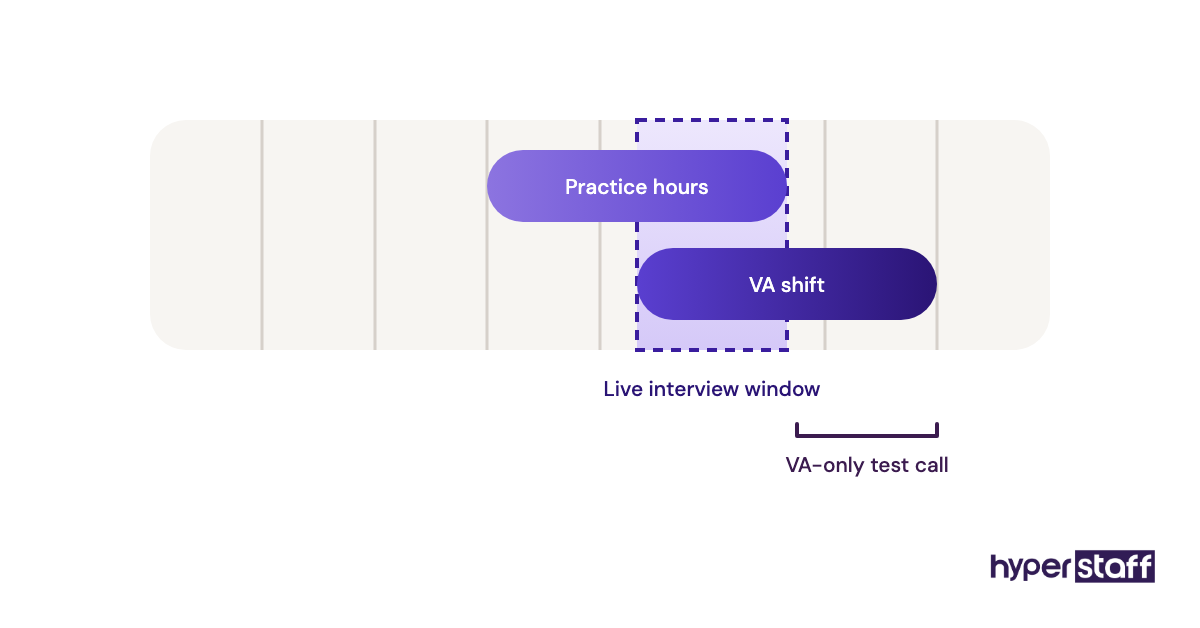
Time zones are the second one. Schedule at least one call during the hours the VA would actually work, because connection quality and alertness at that hour are part of what you're testing.
Thin experience in your exact EHR causes the most hesitation. Most EHRs share the same core logic, so ask about workflows instead and let the practical task show how fast the candidate picks up an unfamiliar screen.
How Do You Measure Whether Your Interview Questions Worked?
Measure your interview questions by comparing interview scores against how the hire performs in the first 60 to 90 days. If high scorers struggle, the questions tested the wrong things.
Track a few concrete signals: errors caught in the first month, how often the VA escalates correctly, and whether eligibility issues reach the front desk on visit day. Patient complaints about tone point straight at the role-play section.
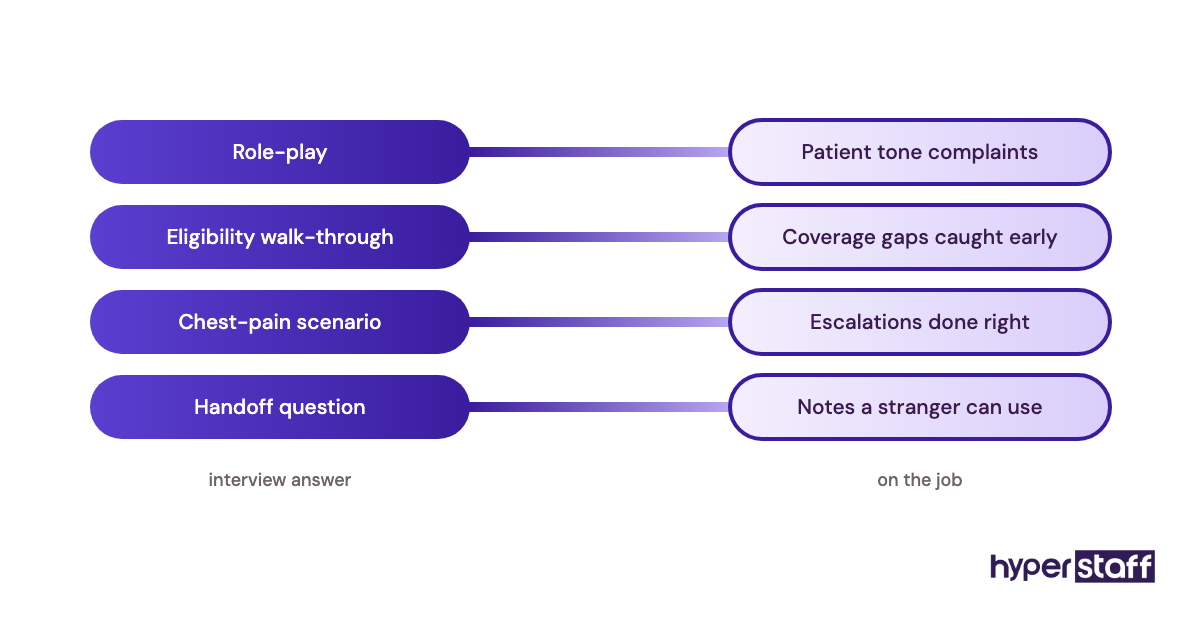
After two or three hires, drop the questions whose scores never predicted anything.
How Long Does It Take to Hire a Medical VA?
Hiring a medical VA on your own usually takes three to six weeks, from posting to offer. Screening and the practical task take most of that time.
Through Hyperstaff, placement takes 5 business days with pre-vetted candidates. A 30-minute kickoff call follows, and work starts that day or the next morning.
Full independence on EHR and payer tasks takes longer, typically two to six weeks depending on how complex your workflows are and how well they're written down.
How Much Does Hiring a Medical VA Cost?
A medical VA through Hyperstaff starts at $3/hour for the Essential tier, $6/hour for Professional and $12/hour for Expert. For comparison, the US Bureau of Labor Statistics puts the median annual wage for medical secretaries and administrative assistants at $45,930, or roughly $22/hour before payroll taxes and benefits.
| Option | Experience | Hourly rate | 80 hours/month | 160 hours/month |
|---|---|---|---|---|
| Hyperstaff Essential | 0 to 2 years | From $3 | From $240 | From $480 |
| Hyperstaff Professional | 2 to 5 years | From $6 | From $480 | From $960 |
| Hyperstaff Expert | 5+ years | From $12 | From $960 | From $1,920 |
| In-house, wage only | Median US hire | About $22 | About $1,770 | About $3,530 |
| In-house, with 20 to 30% overhead | Median US hire | About $26 to $29 | About $2,120 to $2,300 | About $4,240 to $4,590 |
Hyperstaff also offers monthly bundles of 40, 80 or 160 hours, and paying quarterly saves 10%. Our full breakdown of medical virtual assistant cost goes deeper into what changes the price.
Important: Hyperstaff's rates above are typical starting averages, not fixed quotes. Your final price depends on the tier, region, hours and the actual work your practice needs.
Is a Structured Medical VA Interview Worth It?
Yes, a structured interview is worth it, and it's one of the highest-return hours a practice manager can spend. Done right, it's how you end up with a remote hire who keeps the schedule full and the claims clean for years.
Here's the math on the hire itself. A full-time Professional-tier VA at $6/hour for 160 hours costs about $960 a month, against roughly $4,240 for a median in-house hire with overhead, a gap of about $3,280 a month or close to $39,000 a year.
Paying quarterly trims the VA side further: $2,880 for three months drops to $2,592. The interview itself costs about three to four hours of a manager's time for four finalists, which is small next to one bad hire who has to be replaced. For the broader case, see whether a medical virtual assistant is worth it for your practice.
How to Choose a Medical VA Agency
Choose a medical VA agency by checking how it vets candidates, how fast it replaces a poor fit, and who keeps your processes written down. Ask to see the vetting steps, not only the hourly rate.
Bring your own short interview anyway. Even with pre-vetted finalists, five of the template questions (numbers 4, 9, 12, 13 and 15) will tell you which candidate fits your patients.
Ask any agency directly whether it'll sign a BAA and how its VAs access your systems. HHS publishes sample business associate agreement provisions you can compare against, and our guide to a HIPAA compliant virtual assistant lists the safeguards to check.
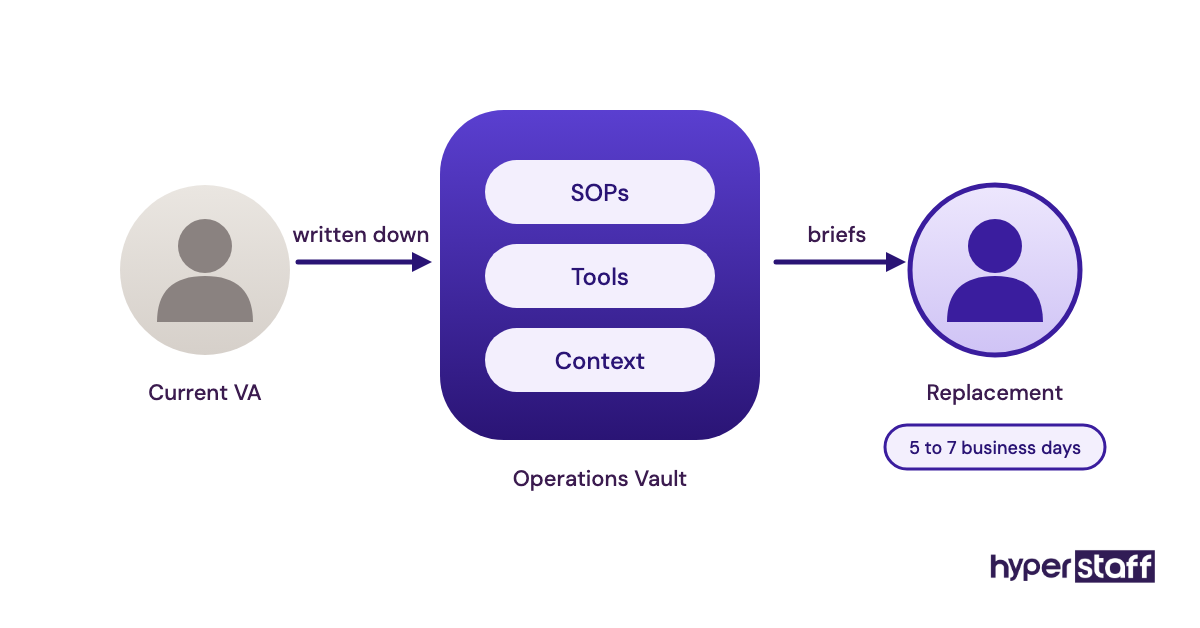
At Hyperstaff, every client gets a dedicated account manager and an **Operations Vault** that holds your SOPs, tools and context. If a placement doesn't work out, a replacement arrives in 5 to 7 business days, already briefed from that vault.
Medical VA Hiring Statistics, Trends and Predictions
The clearest benchmark for medical VA hiring is the in-house wage it gets compared against. The BLS median of $45,930 a year for medical secretaries and administrative assistants is what most practices weigh a remote hire against.
From our side of the hiring process, two trends stand out. Practices are asking for specialists in one function, such as prior authorization or patient intake, instead of one assistant doing everything, and more interviews now include a live role-play instead of a written questionnaire.
Our prediction, stated as opinion: practical tasks with fake data will become standard in medical VA hiring, because they're the hardest part of the process to fake.
How Is AI Changing Medical VA Interviews?
AI is changing medical VA interviews in two ways: candidates use it to polish résumés and rehearse answers, and the job itself now involves AI tools that touch patient data. Your questions should test for both.
Polished résumés increasingly look alike, which pushes the real signal into live role-play and timed tasks. Ask a candidate to explain their own answer in different words; rehearsed answers tend to fall apart on the rephrase.
Add one question on AI use with PHI: "Which tools would you never paste patient information into, and why?" A strong answer names unapproved chatbots and personal accounts, and says the practice decides which tools are approved. For the software side of the role, see our roundup of medical virtual assistant tools.
Disclaimer: This article is general information, not legal, HIPAA compliance or employment advice. Hyperstaff's rates and timelines are typical figures that vary by engagement. Consult qualified legal counsel before acting on hiring or privacy decisions.
Common questions
How many interview questions should I ask a medical VA?
Ask 12 to 20 questions in a 45 to 60 minute interview. Fewer than 12 rarely covers privacy, systems and patient communication together, and more than 20 leaves no room for follow-ups.
Should a medical VA have HIPAA certification?
It helps, but no single HIPAA certificate is legally required for staff. The scenario answers matter more, because a certificate shows a course was finished, while the spouse-and-lab-results question shows how the candidate will actually behave.
Can I interview a medical virtual assistant without a medical background myself?
You can. The "Listen for" notes in the template give you the strong-answer markers, so you're checking for specific steps rather than judging clinical knowledge.
What's the biggest red flag in a medical VA interview?
Sharing patient information to be helpful. Any candidate who discloses PHI in the spouse scenario, or gives medical advice in the chest-pain one, shouldn't move forward, however strong the rest of the interview is.
Should I pay for a medical VA test task?
Yes, if it runs longer than about 30 minutes. Paid tasks attract better candidates and give you a cleaner read on real work speed.
Book a free 15 min call
We place a pre-vetted specialist in 5 business days, fully managed, from $3/hour.