Is a Medical Virtual Assistant Worth It for Your Practice?
A plain look at when a medical virtual assistant pays for itself, what it costs against an in-house hire, and where practices get it wrong.

On this page
- What Does a Medical Virtual Assistant Actually Do?
- Key Medical VA Terms Worth Knowing
- Why Do Practices Question Whether a Medical VA Pays Off?
- How Does a Medical Virtual Assistant Work With Your Team?
- Types of Medical Virtual Assistants
- How Is a Medical VA Different From Similar Roles?
- The Benefits of a Medical Virtual Assistant
- The Drawbacks of a Medical Virtual Assistant
- Which Practices Need a Medical Virtual Assistant?
- Medical Virtual Assistant Examples
- How Do You Plan a Medical VA Rollout, Step by Step?
- What Does a Good Medical VA Strategy Look Like?
- Medical Virtual Assistant Tools and Software
- 9 Proven Tips for Getting Value From a Medical VA
- How Do You Overcome Common Medical VA Challenges?
- How to Measure Medical VA Success
- How Long Before a Medical Virtual Assistant Pays Off?
- How Much Does a Medical Virtual Assistant Cost?
- Is a Medical Virtual Assistant Worth It?
- How Do You Choose a Medical Virtual Assistant Agency?
- Medical VA Statistics, Trends and Future Predictions
- How Is AI Changing the Medical Virtual Assistant Role?
- FAQs
💡 Key Takeaways:
1) A medical virtual assistant is worth it when a practice has steady, repeatable admin work such as scheduling, insurance verification, prior authorizations and billing follow-up that pulls clinical staff away from patients.
2) The savings come mostly from the gap between remote hourly rates and the full loaded cost of an in-house hire, but the bigger return usually comes from recovered visits and faster collections.
3) The setups that fail share the same causes: no written procedures, shared logins, no business associate agreement and clinical decisions handed to a non-clinical person.
Turn Admin Hours Back Into Billable Visits
Hyperstaff places pre-vetted remote specialists who take over front-desk, insurance and billing work as one dedicated team member who learns your practice. With 70+ virtual assistants placed for 30+ clients, rates from $3/hour and placement in 5 business days, our medical virtual assistant services start with a free discovery call.
What Does a Medical Virtual Assistant Actually Do?
A medical virtual assistant is a remote administrative professional who handles a practice's non-clinical work: scheduling, patient calls, insurance eligibility checks, prior authorization paperwork, billing follow-up and records requests. They work inside your EHR and phone system from another location, under your rules and your access controls.
Whether one is "worth it" comes down to a simple test. Does the hourly cost of the assistant come in well below the value of the hours they free up and the revenue they protect? Our longer guide on what a medical virtual assistant is covers the role itself in more depth.
Key Medical VA Terms Worth Knowing
- PHI = Protected health information, any patient data tied to identity that HIPAA covers.
- BAA = Business associate agreement, the contract that binds an outside party handling PHI to HIPAA rules.
- Minimum necessary = Giving staff access only to the patient data their tasks require.
- Eligibility verification = Confirming a patient's coverage, copay and deductible before the visit.
- Prior authorization = Payer approval required before certain procedures, drugs or imaging.
- RCM = Revenue cycle management, the full path from booking to final payment.
- Days in A/R = How long, on average, a practice waits to get paid on a claim.
- No-show rate = The share of booked appointments where the patient never arrives.
- Role-based access = EHR permissions set per user so each person sees only what their job needs.
Why Do Practices Question Whether a Medical VA Pays Off?
The question matters because admin load is the part of running a practice that grows fastest and earns nothing on its own. Every unverified insurance plan, unreturned voicemail and stalled prior auth turns into a denied claim, a lost patient or an overtime shift.
Physicians feel it directly. A time-motion study in the Annals of Internal Medicine found that for every hour of direct clinical face time, physicians spent nearly two more hours on EHR and desk work.
Owners hesitate for good reasons, though. Remote access to patient data feels risky, and a bad hire costs weeks of retraining.
How Does a Medical Virtual Assistant Work With Your Team?
A medical VA works through remote access to the same systems your front desk uses: the EHR or practice management software, a VoIP phone line, payer portals and a secure messaging channel. They log in with their own credentials, keep set hours that overlap your clinic day and report to one person on your side.
The compliance layer sits underneath all of that. Before any access is granted, a practice needs a signed business associate agreement as described in HHS guidance on business associates, and we've written a separate guide on what a HIPAA compliant virtual assistant setup needs in practice.
The daily rhythm is usually boring, and that's the goal. Tomorrow's schedule gets verified today, voicemails clear by mid-morning and the billing queue gets worked in the afternoon.
Types of Medical Virtual Assistants
Medical virtual assistants split by the part of the practice they cover, and the type you pick shapes both cost and payoff. The full list of medical VA tasks runs longer, but these are the common role shapes.
| Type | Typical tasks | Usual experience level | Where the value shows up |
|---|---|---|---|
| Front-desk and scheduling VA | Calls, bookings, reminders, waitlist fills | Essential or Professional | Fewer missed calls, fuller schedules |
| Insurance verification VA | Eligibility checks, benefit breakdowns | Professional | Fewer denials and surprise bills |
| Prior authorization VA | Payer forms, follow-up calls, status tracking | Professional or Expert | Procedures start on time |
| Billing and A/R VA | Claim follow-up, denial rework, patient statements | Expert | Lower days in A/R |
| Remote scribe | Visit notes from live or recorded encounters | Professional | Less after-hours charting |
| Patient recall VA | Overdue-visit outreach, reactivation calls | Essential | Returning patients, steady volume |
| Practice operations VA | Records requests, referrals, vendor admin, reviews | Professional | Office manager gets hours back |
How Is a Medical VA Different From Similar Roles?
A medical VA is a dedicated person embedded in your workflows, which sets the role apart from outsourced services that sell a single function. For a direct cost and control breakdown, see our comparison of a medical virtual assistant vs in-house staff.
Medical VA vs. Medical Scribe
Scribes document clinical encounters and nothing else. A medical VA can include scribing, but most of the role sits outside the exam room, on phones, payers and schedules.
Medical VA vs. Medical Billing Company
Billing companies usually charge a percentage of collections and work claims in their own queue. A VA bills by the hour, works inside your system and can cover billing plus whatever else the week throws at the office.
Medical VA vs. Answering Service
An answering service takes messages from a script and passes them along. A medical VA books the appointment, checks the insurance and closes the loop, because they know your schedule rules.
The Benefits of a Medical Virtual Assistant
- Labor cost per hour drops sharply against a loaded in-house wage.
- Calls get answered during lunch and staff breaks, when most missed bookings happen.
- Insurance gets verified before the visit instead of after the denial.
- Clinical staff stop doing payer hold music and get back to patient care.
- Coverage can start part-time and grow with demand.
- Recall and reactivation work actually gets done, which in many offices it never does.
The Drawbacks of a Medical Virtual Assistant
- Onboarding takes real effort for the first few weeks.
- HIPAA setup (BAA, access roles, device rules) has to be done properly up front.
- Time zone overlap needs planning.
- Some patients notice a new voice and ask questions at first.
Which Practices Need a Medical Virtual Assistant?
Practices that need a medical VA most are the ones where front-desk volume outgrows the people answering it, usually with phones ringing out and insurance checks happening at check-in. Size matters less than the pattern.
| Practice type | Common bottleneck | First tasks to hand off |
|---|---|---|
| Solo primary care | One front-desk person covering everything | Calls, reminders, eligibility checks |
| Dental office | Benefit breakdowns and hygiene recall | Verification, recall lists |
| Specialty clinic | Prior auths and referral intake | Prior auth tracking, referral follow-up |
| Therapy and behavioral health | Intake paperwork and cancellations | Intake forms, waitlist fills |
| Multi-location group | Inconsistent processes between sites | Central scheduling, A/R follow-up |
| Telehealth-first practice | Async patient messages | Inbox triage (admin only), booking |
Medical Virtual Assistant Examples
The difference between a VA that pays off and one that drains money usually shows up in how the role is set up, long before the first week ends. These are role patterns, described by how they're structured.
Good Medical VA Setups
Next-Day Insurance Verification
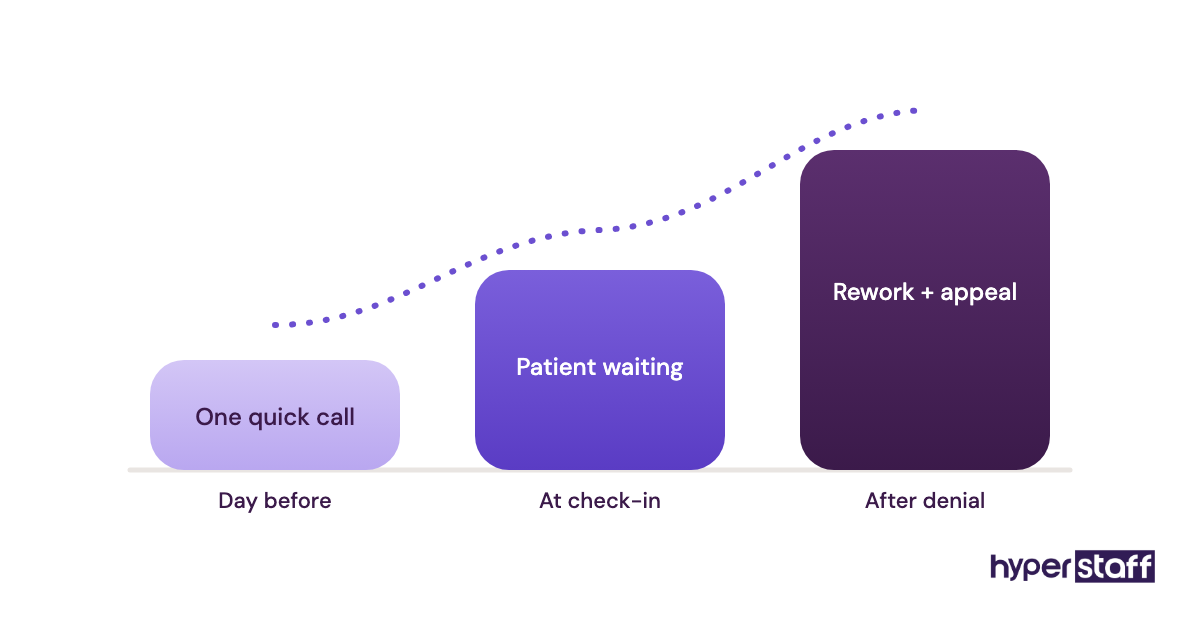
The VA works tomorrow's schedule every afternoon, verifies each patient's coverage and flags anything inactive. Front-desk staff call flagged patients before they arrive, so denials get caught at the cheapest possible point.
Cancellation and Waitlist Fills
Every cancellation triggers a call down a short waitlist. Empty slots are pure lost revenue, and a person watching the schedule all day fills more of them than an automated text alone.
Prior Authorization Tracker
One owner tracks every pending auth in a shared sheet or EHR task list, with the payer, submission date and next follow-up. Procedures stop slipping because nobody remembered to call the payer back.
Bad Medical VA Setups
Most failures trace back to a handful of avoidable decisions, and our guide to common medical virtual assistant mistakes covers more of them.
Shared Login to the EHR
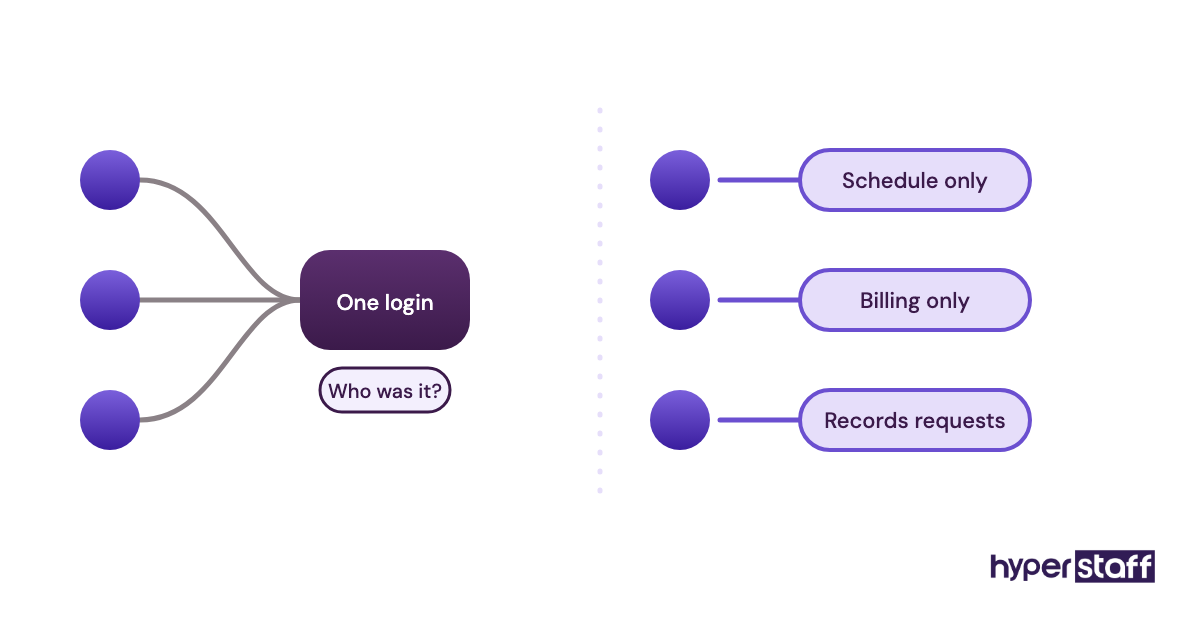
Giving the VA the office manager's login saves ten minutes and wrecks the audit trail. If something goes wrong, nobody can prove who accessed which record.
Clinical Triage by a Non-Clinical VA
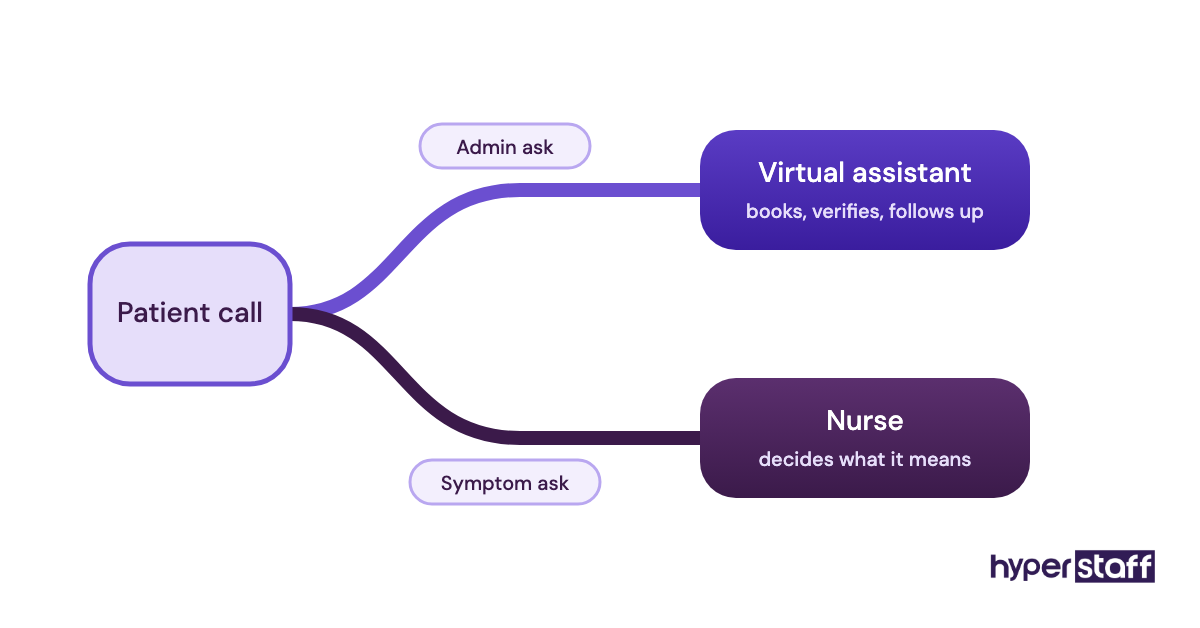
Asking an admin assistant to decide whether a symptom needs a same-day visit puts patients at risk. The VA should route clinical questions to a nurse using a written script.
Hiring With No Written Procedures
Without SOPs, the VA learns by interrupting your staff all day. Two weeks in, the office decides remote help "doesn't work," when the real gap was documentation.
How Do You Plan a Medical VA Rollout, Step by Step?
A medical VA rollout works best in five stages, from picking tasks to reviewing results at 90 days. Our guide on how to hire a medical virtual assistant covers the hiring stage in more detail.
Step #1: Log Where Admin Hours Go
Track one or two normal weeks of front-desk and billing time by task. The tasks that repeat daily and follow rules are your VA's first job.
Step #2: Write the Role Down
Turn that list into a scope with hours, systems and what the VA must never do. A clear medical VA job description keeps expectations honest on both sides.
Step #3: Screen for Systems and Judgment
Test EHR familiarity, payer-call experience and how candidates handle a confused patient. These medical VA interview questions help separate real experience from a polished résumé.
Step #4: Set Up Access and Compliance
Sign the BAA, create an individual user with role-based permissions and set device rules before day one. Access gets added as tasks grow, never all at once.
Step #5: Onboard in Phases
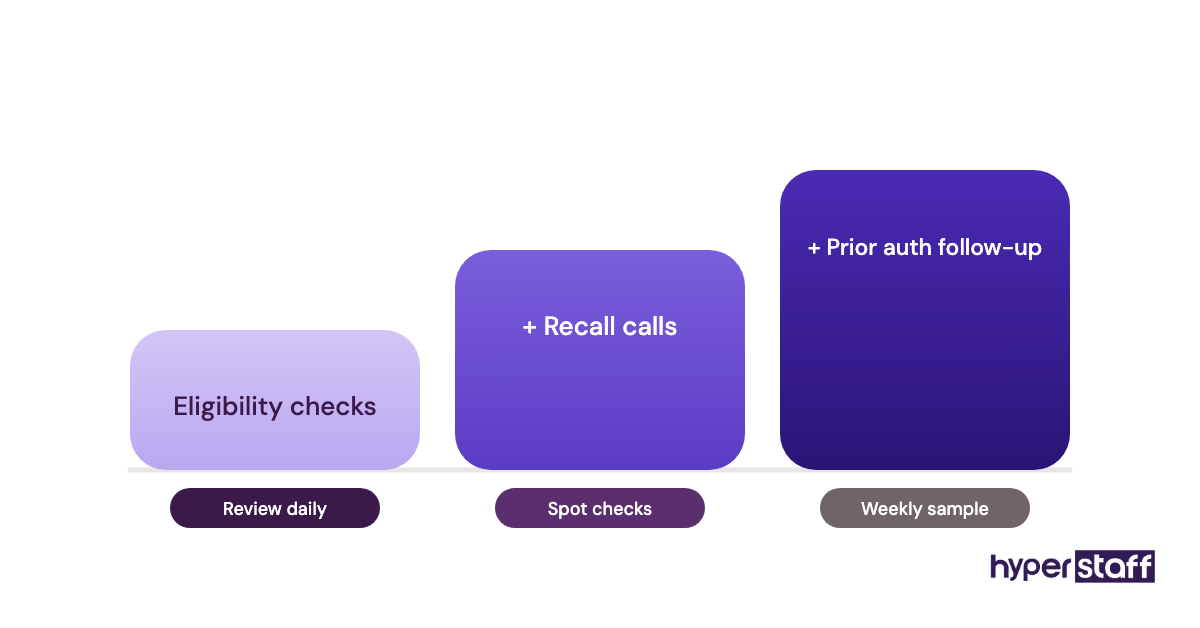
Start with one task, review the work daily for a week, then add the next. A structured plan for onboarding a medical virtual assistant keeps the first month from becoming a free-for-all.
What Does a Good Medical VA Strategy Look Like?
A good medical VA strategy assigns whole workflows to the assistant instead of scattered tasks. "Owns insurance verification for every visit" works; "helps out with whatever comes up" doesn't, because nobody can measure it.
It also names one point person on your side, sets a weekly 15-minute check-in and keeps SOPs updated as payers change their rules. Practitioners disagree on whether to start with phones or billing. Phones show results faster, while billing usually returns more money per hour but takes longer to train.
Medical Virtual Assistant Tools and Software
Medical VA tools fall into a few groups, and most practices already pay for the core ones. The full breakdown sits in our roundup of medical virtual assistant tools.
- EHR and practice management: athenaOne, eClinicalWorks, Tebra, DrChrono, Epic.
- Phones and patient messaging: RingCentral, Weave.
- Payer portals: Availity plus individual payer sites.
- Telehealth: Doxy.me.
- Password management: 1Password, Bitwarden.
Our blunt opinion: a password manager with shared vaults matters more than any fancy add-on. It lets you give and revoke access to payer portals without ever reading a password aloud.
9 Proven Tips for Getting Value From a Medical VA
These habits separate the practices that keep their VA for years from the ones that give up after a month.
- Start with one workflow and add more only once it runs clean.
- Give every VA their own login, never a shared one.
- Overlap at least four hours with your clinic day.
- Write a "never do" list covering clinical advice and refunds.
- Use a script for clinical questions that routes them to a nurse.
- Review a sample of calls or claims weekly in the first month.
- Track two or three numbers, not ten.
- Keep SOPs in one shared place and update them when a payer changes a rule.
- Introduce the VA to patients by name so the new voice feels expected.
How Do You Overcome Common Medical VA Challenges?
Most medical VA challenges come from missing context. The VA doesn't know that Dr. Patel never double-books Mondays or that one payer always needs a fax. Writing those rules down fixes the majority of early errors.
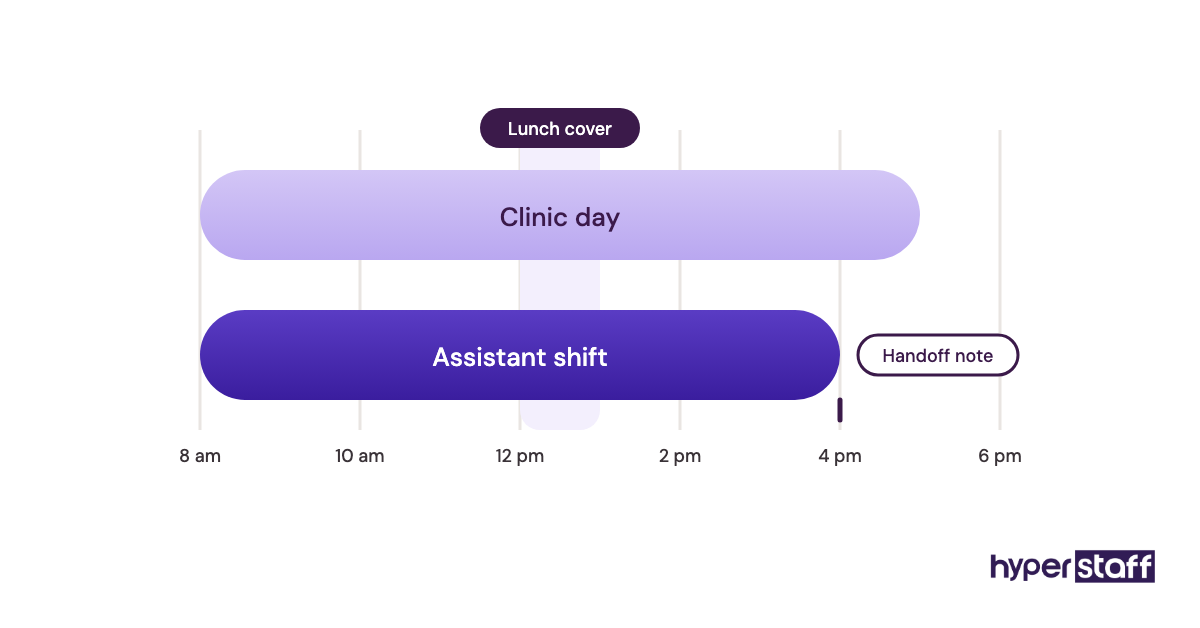
Time zones are the next friction point. Fix them with set overlap hours and a written handoff note at the end of each shift.
Staff pushback is real too. Front-desk teams sometimes read a VA as a replacement, so frame the role around the work they dislike most.
How to Measure Medical VA Success
Medical VA success shows up in a few practice numbers you likely track already: missed-call rate, no-show rate, denial rate tied to eligibility and days in A/R. Pull a baseline before the VA starts.
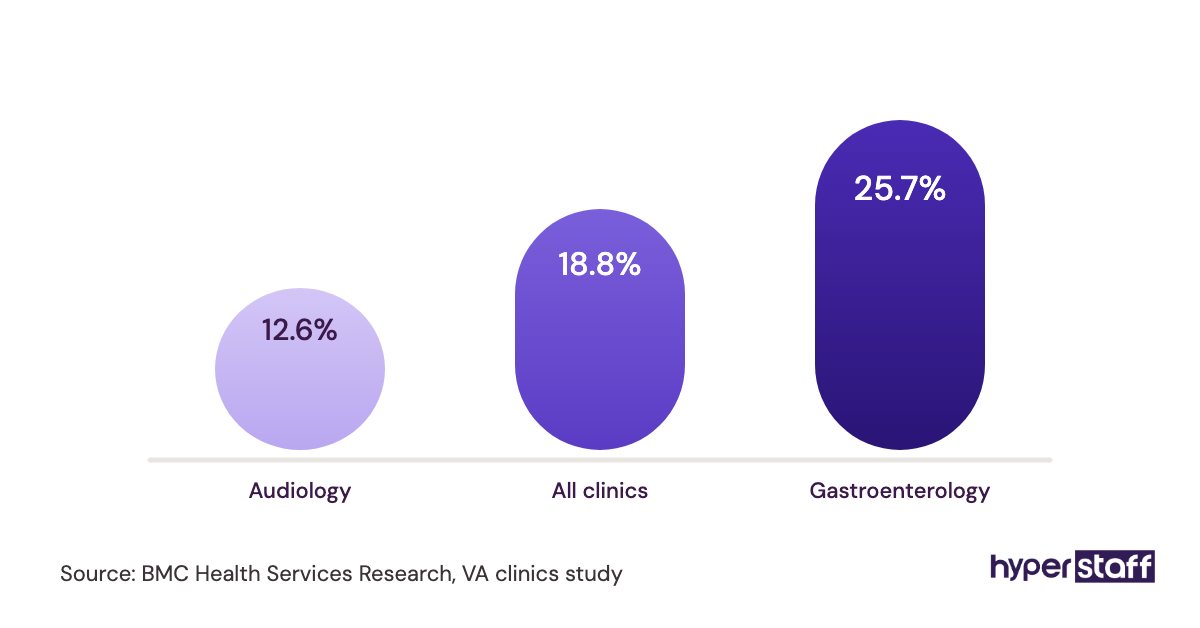
Then compare at 30, 60 and 90 days. Add one softer check: ask clinical staff how many admin interruptions they still get per day.
How Long Before a Medical Virtual Assistant Pays Off?
A medical virtual assistant usually pays off within one to three months. Phone and scheduling work shows results in the first few weeks, while billing and A/R work takes longer because claims cycle slowly.
With Hyperstaff, placement takes 5 business days and work starts the day of the 30-minute kickoff call or the next morning. The slow part is the dead zone between week two and week six, when the VA is capable but still asking questions.
How Much Does a Medical Virtual Assistant Cost?
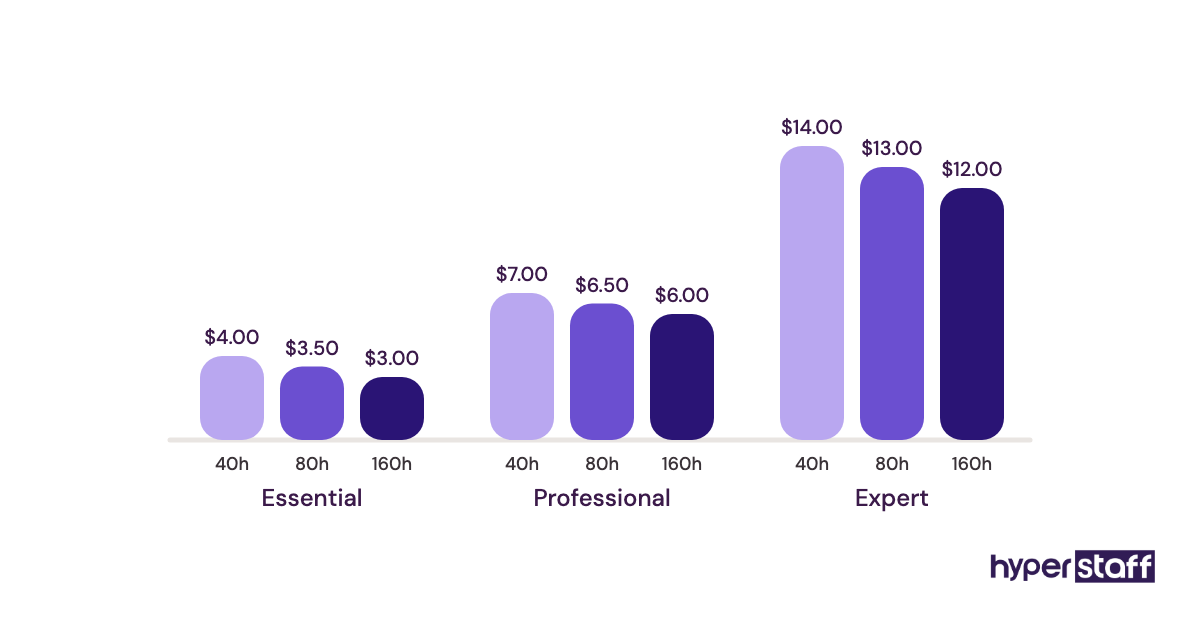
A medical virtual assistant through Hyperstaff costs from $3 to $12+ per hour depending on experience, against roughly $17 to $35 per hour in wages for a comparable in-house hire before overhead. The medical virtual assistant cost guide breaks this down further.
| Experience level | Hyperstaff rate | Hyperstaff, 160 hours | Typical in-house wage | In-house, 160 hours plus 20–30% overhead |
|---|---|---|---|---|
| Essential (0–2 years) | From $3/hour | From $480/month | $17–$22/hour | ~$3,260–$4,580/month |
| Professional (2–5 years) | From $6/hour | From $960/month | $20–$27/hour | ~$3,840–$5,620/month |
| Expert (5+ years) | From $12/hour | From $1,920/month | $26–$35/hour | ~$4,990–$7,280/month |
| Replacement if it doesn't work out | Free, in 5–7 business days | Included | New recruiting cycle | Weeks of lost coverage |
Hyperstaff bills in monthly bundles of 40, 80 or 160 hours, and paying quarterly saves 10%.
Important: Our listed rates are starting averages. Your final price depends on the tasks, experience level and hours your practice needs, which we confirm together on the discovery call.
Is a Medical Virtual Assistant Worth It?
Yes, for most practices with steady admin volume, a medical virtual assistant is one of the most rewarding hires you can make. The savings are large, but the real payoff is a front office that verifies, books and follows up on time every single day.
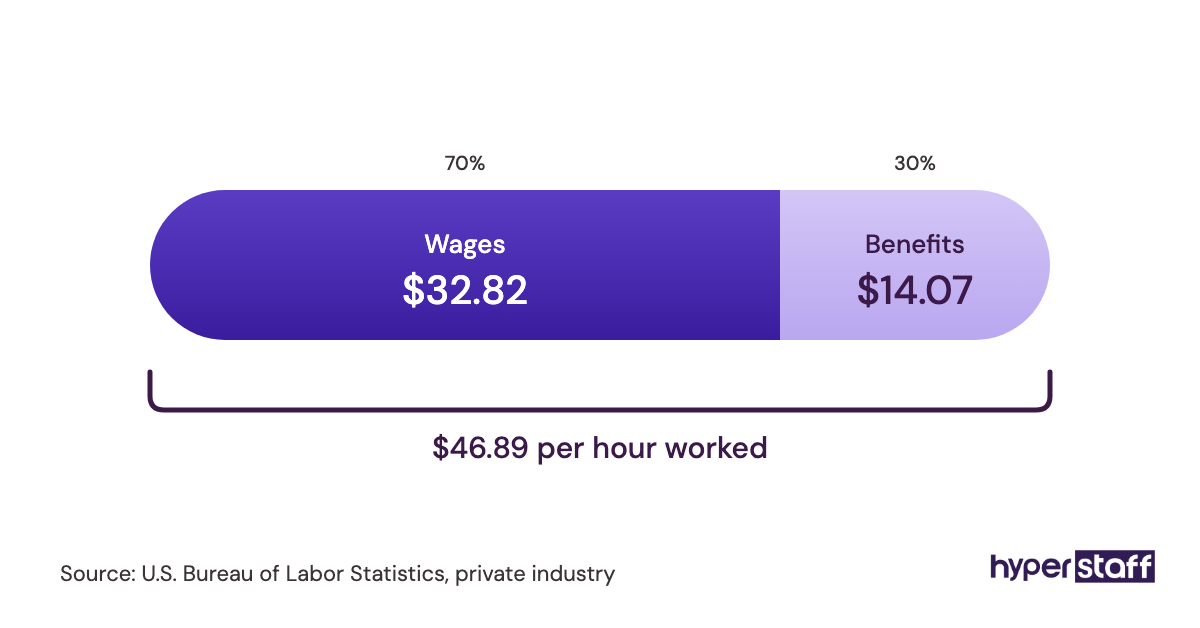
Here's an example calculation. An in-house front-desk hire at $20/hour for 160 hours costs $3,200, and adding 25% for payroll taxes and benefits brings it to about $4,000 a month.
A Professional-tier VA from $6/hour for the same 160 hours starts at $960, or about $864 when paid quarterly. That gap is roughly $3,000 a month before counting any recovered revenue.
Add the revenue side. If waitlist calls fill just four extra slots a month at $120 collected per visit, that's another $480, and eligibility checks that prevent even a few denials add more.
The honest exception: a tiny practice with low call volume and a front desk that already keeps up may not have enough work to justify even 40 hours.
How Do You Choose a Medical Virtual Assistant Agency?
Choose a medical VA agency by checking compliance readiness first, then how it vets, replaces and supports the person it places. Ask whether it signs a BAA, how it screens for healthcare experience and what happens if the fit is wrong.
Then look at continuity. A dedicated assistant who learns one practice beats a rotating pool, and written SOPs matter because they let a replacement pick up fast.
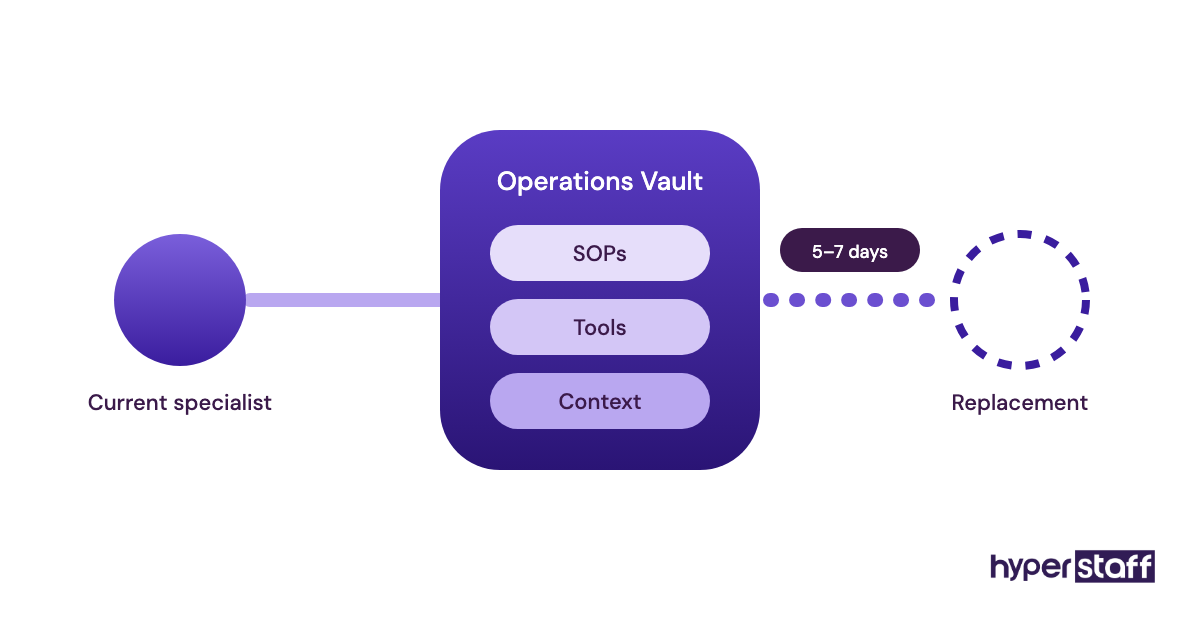
At Hyperstaff, every client gets a dedicated account manager and an Operations Vault: your SOPs, tools and context, written down and maintained for you. If a placement doesn't work out, a replacement arrives in 5 to 7 business days, briefed from that vault.
Medical VA Statistics, Trends and Future Predictions
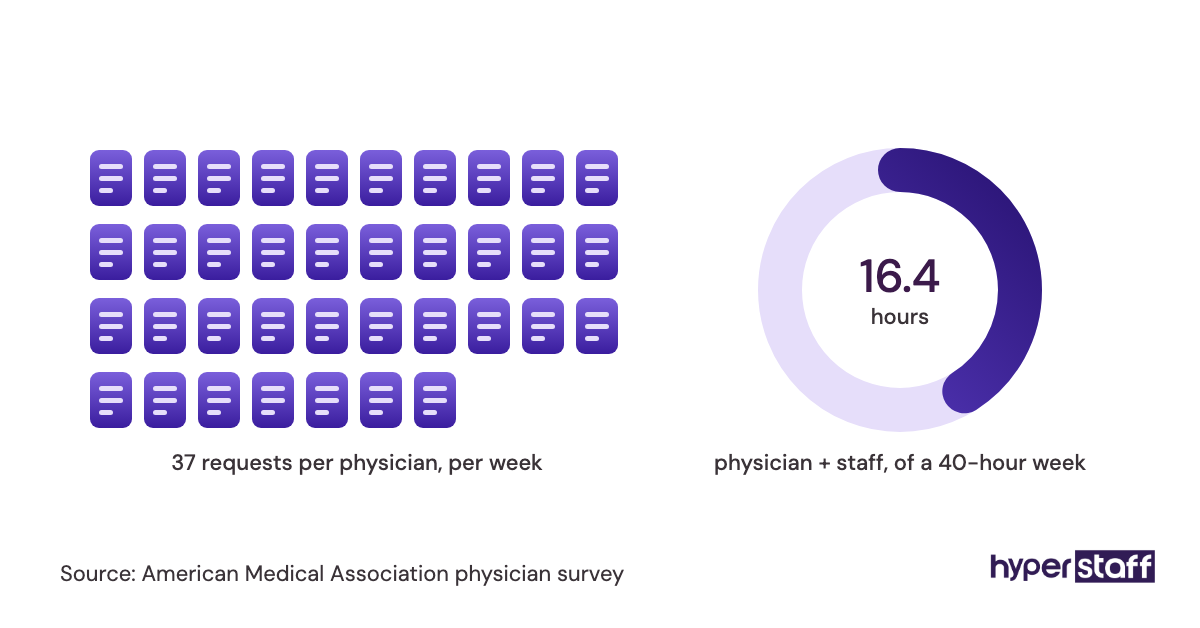
The clearest statistic behind medical VA demand is the desk-work ratio: the Annals of Internal Medicine study cited above found nearly two hours of EHR and desk work per hour of direct patient time. Admin tasks have only multiplied since, with prior authorization requirements expanding across many payers.
Two trends stand out. Telehealth normalized remote patient contact, so patients are used to talking with staff they never meet in person, and practices increasingly split admin into remote roles organized by workflow.
Our prediction, stated plainly as our view: the role shifts toward exception handling. Routine reminders get automated, and the VA spends more time on payer calls, denials and patients who need a human.
How Is AI Changing the Medical Virtual Assistant Role?
AI is taking over the drafting work in medical admin, such as visit notes from ambient scribe tools like Abridge and Microsoft's Dragon Copilot, plus automated reminders and basic phone menus. A medical VA increasingly reviews and corrects that output instead of producing it from scratch.
Payer calls, denial appeals and upset patients still need a person. A practice using AI well often needs fewer admin hours overall, but the hours that remain need a sharper, more experienced assistant.
Disclaimer: This article is for general information only and is not legal, medical, compliance or financial advice. Costs, regulations and results vary by practice and location, so confirm HIPAA and employment questions with a qualified advisor before acting.
Common questions
Is a medical virtual assistant worth it for a small practice?
Usually, yes, if you have at least 40 hours a month of repeatable admin work. Small practices often see the biggest relative gain because one VA covers phones and verification that otherwise fall on the doctor or a single receptionist.
Can a medical virtual assistant access my EHR legally?
You can give a medical VA EHR access under HIPAA once a business associate agreement is signed. Use an individual login with role-based permissions so access stays limited and auditable.
Will patients mind talking to a remote medical assistant?
Most patients care about getting an answer quickly, not where the person sits. Introducing the VA by name and giving them a clear script for common questions settles most early concerns.
What should a medical virtual assistant not do?
A non-clinical medical VA shouldn't give medical advice, triage symptoms or change treatment plans. Those questions get routed to a licensed clinician on your team.
Is a part-time medical virtual assistant worth it?
Yes, part-time works well for focused tasks like next-day insurance checks or recall calls. A 40- or 80-hour monthly bundle lets you test the fit before moving to full-time coverage.
Book a free 15 min call
We place a pre-vetted specialist in 5 business days, fully managed, from $3/hour.