What Is a Medical Virtual Assistant? Roles, Tasks and Real Costs
A medical virtual assistant is a remote specialist who takes over a practice's front-desk and back-office admin, from patient scheduling to prior authorizations.

On this page
- What Is a Medical Virtual Assistant?
- Key Medical Virtual Assistant Terms You Should Know
- Why Do Practices Need Medical Virtual Assistants?
- How Does a Medical Virtual Assistant Work Day to Day?
- Types and Forms of Medical Virtual Assistants
- How a Medical Virtual Assistant Differs From Related Roles
- The Benefits of a Medical Virtual Assistant
- The Drawbacks of a Medical Virtual Assistant
- Who Needs a Medical Virtual Assistant?
- Medical Virtual Assistant Examples
- Creating a Medical Virtual Assistant Plan, Step-by-Step
- What Does an Effective Medical Virtual Assistant Strategy Look Like?
- Which Tools and Software Do Medical Virtual Assistants Use?
- 9 Proven Medical Virtual Assistant Tips and Best Practices
- Overcoming Common Medical Virtual Assistant Challenges
- How to Measure Medical Virtual Assistant Success
- How Long Does a Medical Virtual Assistant Take to Work?
- How Much Does a Medical Virtual Assistant Cost?
- Is a Medical Virtual Assistant Worth It?
- How Do You Choose a Medical Virtual Assistant Agency?
- Medical Virtual Assistant Statistics, Trends and Future Predictions
- How Is AI Changing the Medical Virtual Assistant Role?
- FAQs
💡 Key Takeaways:
1) A medical virtual assistant is a remote, trained specialist who does a healthcare practice's administrative work, such as patient scheduling, insurance verification, prior authorizations, billing follow-up and medical records, from outside the office using the practice's own systems.
2) Medical virtual assistants do not diagnose, treat or give clinical advice, and any practice using one must give access through role-based logins and a signed business associate agreement under HIPAA.
3) The role pays off fastest in practices where phones, eligibility checks and prior authorizations are already pulling clinical staff away from patients.
Win back revenue your front desk misses
Missed calls and stalled prior auths cost practices real appointments. Hyperstaff places pre-vetted medical virtual assistant services specialists in 5 business days, with rates from $3/hour and a dedicated account manager for every client. We've placed 70+ virtual assistants with 30+ clients, and each one learns one practice, so the person answering your patients stays the same.
What Is a Medical Virtual Assistant?
A medical virtual assistant is a remote administrative professional who handles a healthcare practice's non-clinical work: answering patient calls, booking appointments, verifying insurance, chasing prior authorizations, updating records and following up on claims. They log into the practice's EHR, phone system and payer portals from a secure remote workstation.
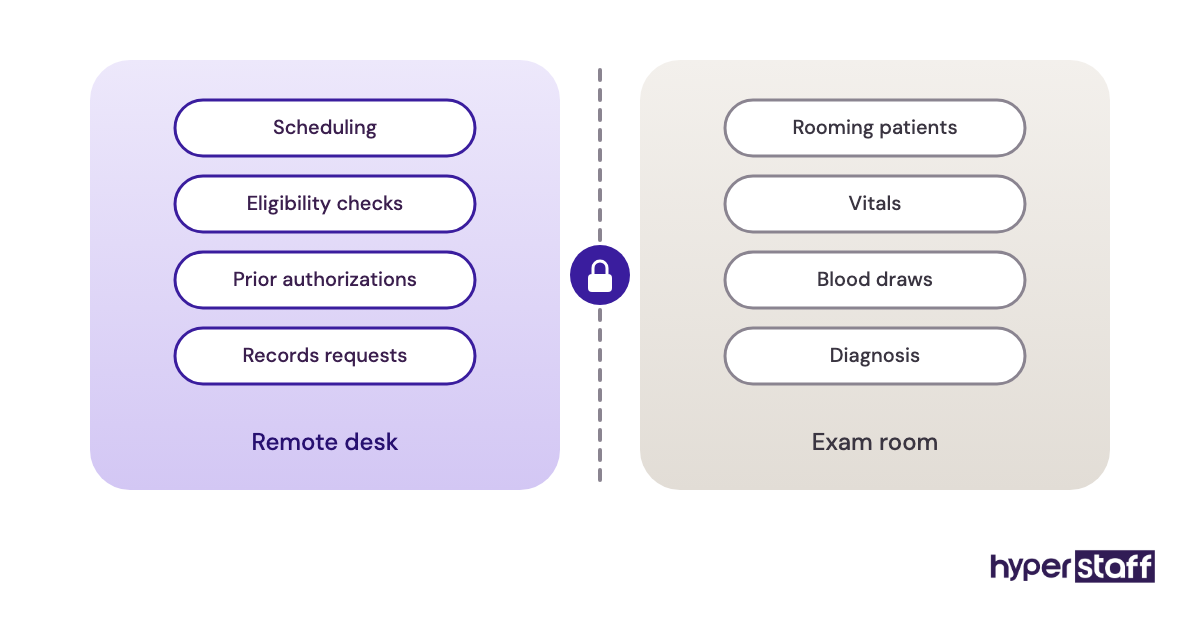
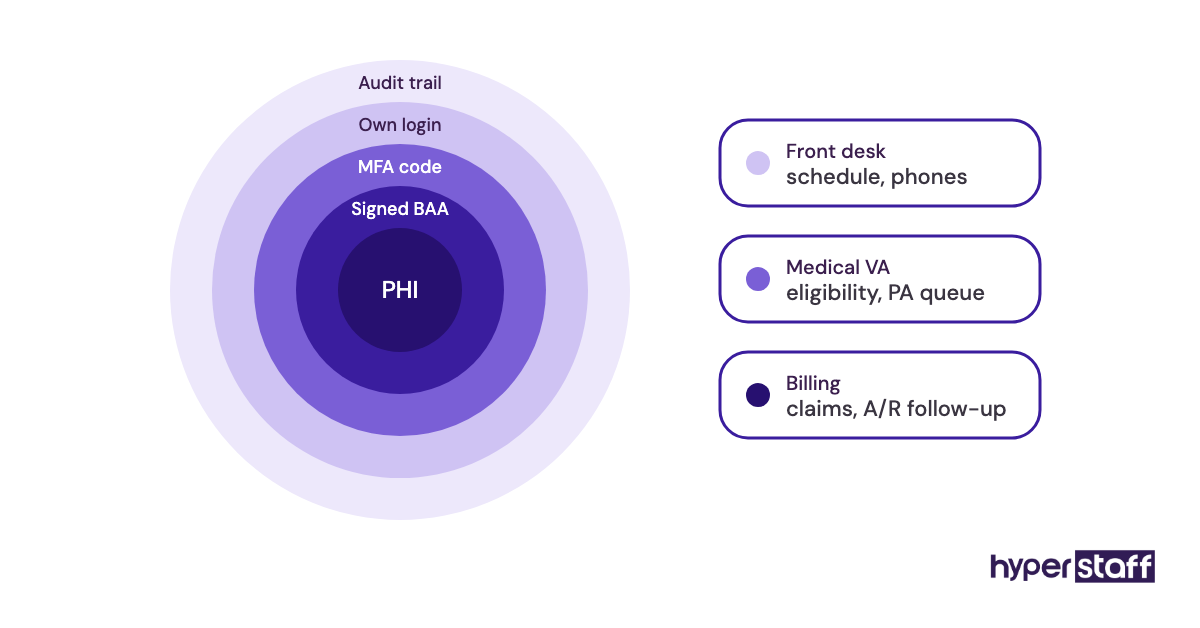
The work is admin, but the setting changes the rules. Every task touches protected health information, so the assistant works under HIPAA, with access limited to what the role needs.
People often picture a medical VA as a remote receptionist. In practice, the role stretches much wider, covering revenue cycle tasks, patient communication, reputation management and practice operations, depending on what the clinic hands over.
Key Medical Virtual Assistant Terms You Should Know
- PHI = protected health information, any patient detail that links a person to their health, care or payment.
- HIPAA = the US federal law setting privacy and security rules for PHI.
- BAA = business associate agreement, the contract a practice signs with any outside party that handles its PHI.
- EHR / EMR = electronic health record system where charts, schedules and notes live.
- Eligibility verification = confirming a patient's insurance is active and what it covers before the visit.
- Prior authorization (PA) = payer approval required before certain drugs, scans or procedures.
- Revenue cycle management (RCM) = the full path from booking to collected payment.
- A/R follow-up = chasing unpaid or denied claims with payers.
- CPT / ICD-10 codes = standard codes for procedures and diagnoses on claims.
- Remote scribe = a person who writes visit notes in the EHR while listening to the encounter.
- Least-privilege access = giving each login only the permissions its tasks require.
Why Do Practices Need Medical Virtual Assistants?
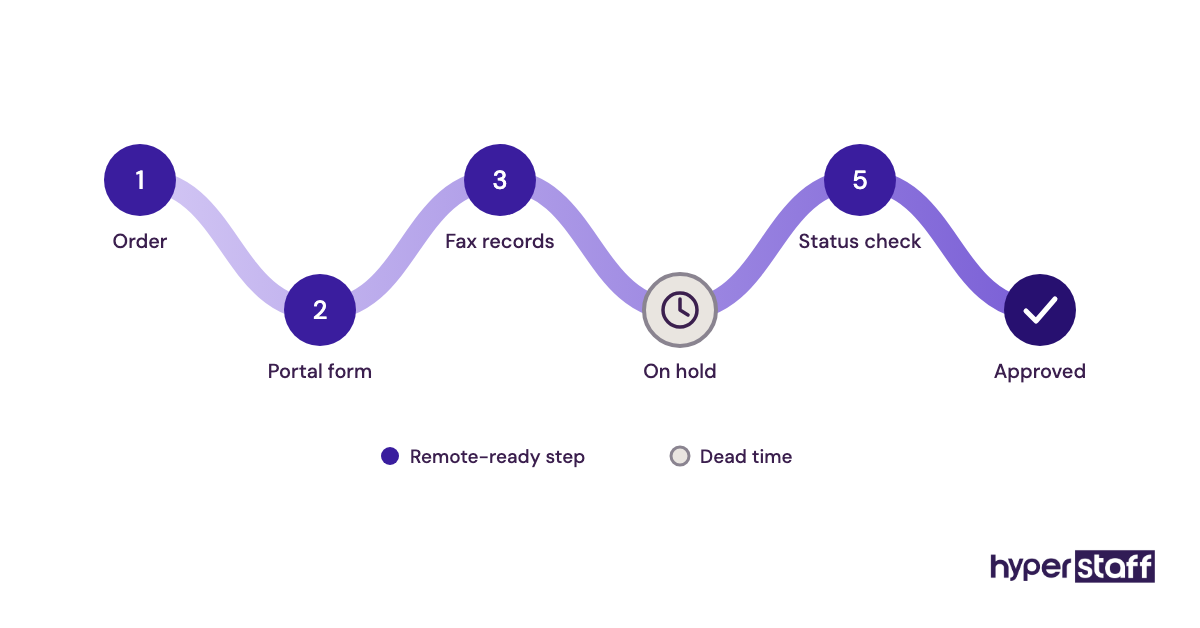
Practices need medical virtual assistants because paperwork now eats a large share of clinic hours. The AMA's prior authorization physician survey found practices complete an average of 40 prior authorizations per physician each week, with physicians and staff spending 13 hours weekly on them.
The same survey found 40% of physicians have staff who work exclusively on prior authorization. That's a full role, and much of it is portal work, faxing and phone holds that can be done remotely.
Hiring locally for that role is getting harder and pricier. The US Bureau of Labor Statistics lists a median annual wage of $45,930 for medical secretaries and administrative assistants, before payroll taxes and benefits.
How Does a Medical Virtual Assistant Work Day to Day?
A medical virtual assistant works through the practice's existing systems, logging into the EHR, phone platform and payer portals with their own credentials. They follow written procedures for each task and hand anything clinical to licensed staff.
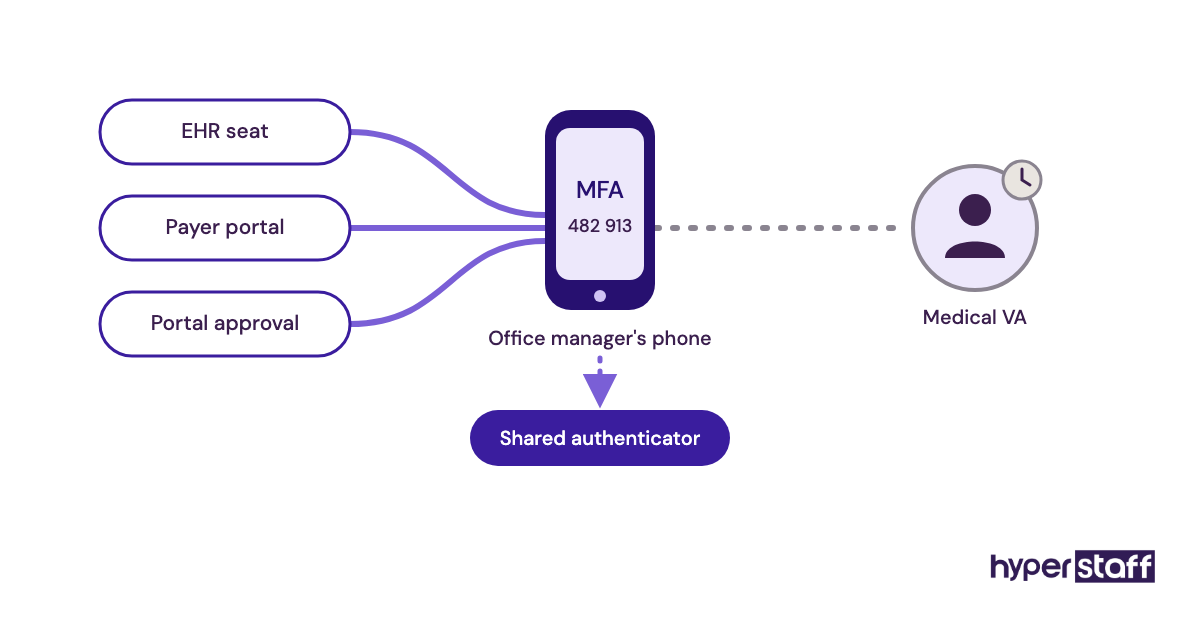
The setup order matters more than most practices expect. Logins are the usual bottleneck: EHR seats, payer portal accounts and multi-factor codes often tie back to one office manager's phone, and that single dependency can stall a new assistant for days.
| Stage | What happens | Typical timing |
|---|---|---|
| Scoping | Task list, hours, systems agreed | Discovery call |
| Placement | Vetted candidate matched | Within 5 business days |
| Access | BAA signed, logins created, MFA set | 1 to 5 days |
| Kickoff | 30-minute call, first tasks assigned | Work starts same day or next morning |
| Shadow phase | Low-risk tasks, reviewed output | First 2 weeks |
| Full scope | Phones, PAs, A/R added | Weeks 3 to 6 |
Types and Forms of Medical Virtual Assistants
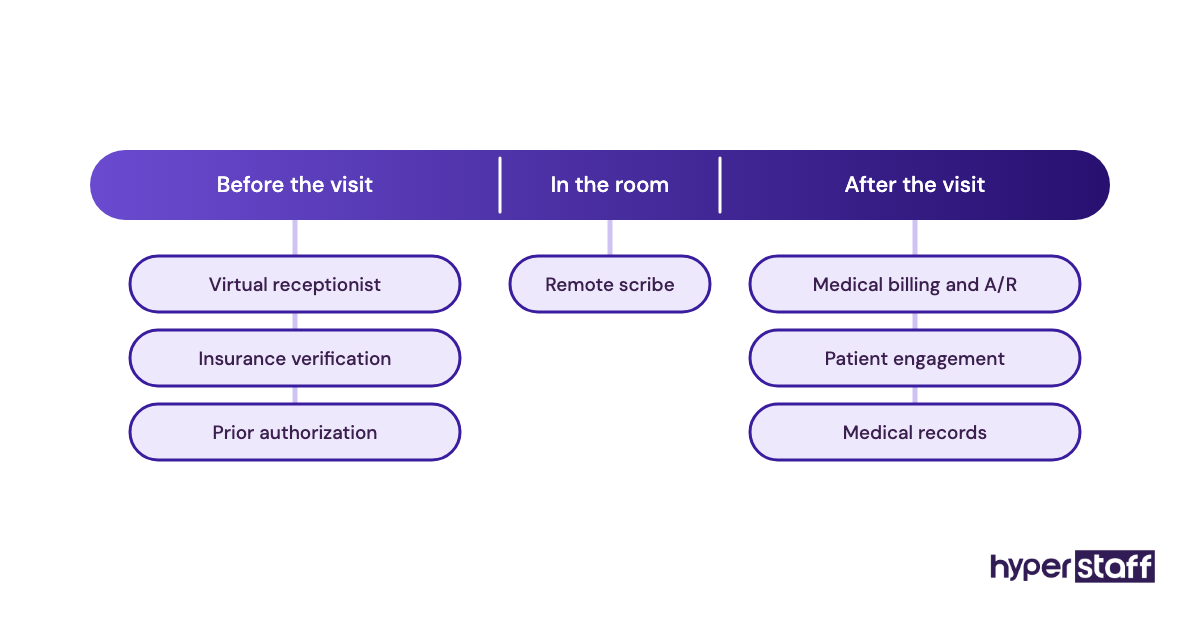
Medical virtual assistants split by function, and most practices start with one type before blending in a second. The table maps the common forms to their work and fit.
| Type | Core work | Systems used | Best fit |
|---|---|---|---|
| Virtual medical receptionist | Calls, scheduling, reminders, cancellations | Phone platform, EHR scheduler | Busy front desks, missed calls |
| Insurance verification VA | Eligibility and benefits checks before visits | Payer portals, clearinghouse | Practices with high denial rates |
| Prior authorization VA | PA submissions, status checks, appeals packets | Payer portals, fax, EHR | Specialty clinics, imaging, oncology |
| Medical billing VA | Charge entry, claim follow-up, A/R | Practice management system | Practices doing billing in-house |
| Remote medical scribe | Real-time visit documentation | EHR, telehealth or audio feed | Providers charting after hours |
| Medical records VA | Records requests, intake forms, chart prep | EHR, secure fax, document storage | Practices with heavy referrals |
| Patient engagement VA | Recalls, follow-ups, review requests | Messaging app, email, EHR | Practices growing patient volume |
| Dental virtual assistant | Scheduling, treatment plan follow-up, dental insurance | Dental practice software | General and specialty dental offices |
How a Medical Virtual Assistant Differs From Related Roles
Three roles get confused with the medical virtual assistant most often: the in-house medical assistant, the general virtual assistant and the outsourced billing company. The lines between them decide what you can delegate.
Medical Virtual Assistant vs. In-Office Medical Assistant
An in-office medical assistant often does clinical tasks like taking vitals, rooming patients and drawing blood, which a remote assistant cannot do. The medical virtual assistant takes the admin half of that job.
The cost and coverage trade-offs are laid out in our breakdown of a medical VA vs in-house staff, which matters if you're deciding between replacing a hire and adding one.
Medical Virtual Assistant vs. General Virtual Assistant
A general virtual assistant may be excellent at inbox and calendar work but has never touched a payer portal. The gap shows up in week one, when a "simple" eligibility check needs plan-level knowledge of deductibles, copays and referral rules.
Healthcare experience also changes how the person handles PHI. A medical VA knows not to paste a patient name into a shared chat or a personal email, a mistake that general assistants make more often than you'd think.
Medical Virtual Assistant vs. Outsourced Billing Company
A billing company takes the whole revenue cycle and usually charges a percentage of collections. A medical virtual assistant works inside your process on an hourly basis, so you keep control of the claims and the data.
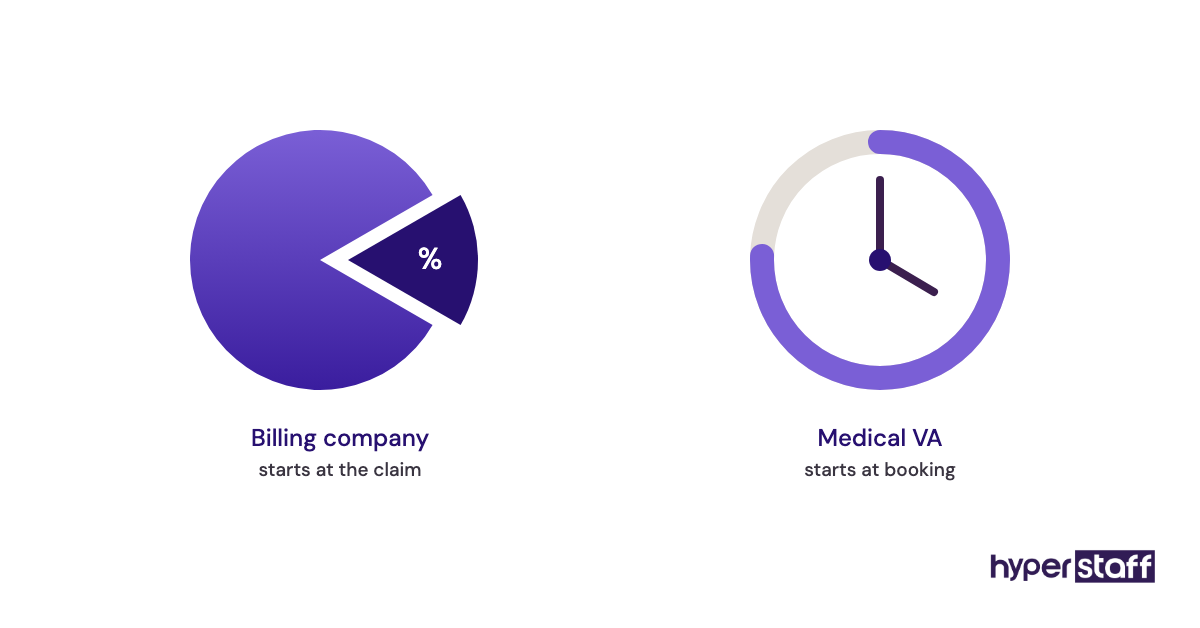
Practitioners disagree here. Some practice managers prefer a billing firm's specialized team, while others want one assistant who also knows the front desk and can fix eligibility problems before a claim is ever filed.
The Benefits of a Medical Virtual Assistant
- Lower labor cost per admin hour than a local hire, with no added office space or equipment.
- Clinical staff get time back for patients instead of payer hold music.
- Coverage across time zones makes early-morning or evening call handling possible.
- Prior authorizations and eligibility checks get done before the visit, which cuts day-of surprises.
- Hours can be scaled up or down in monthly bundles as patient volume shifts.
The Drawbacks of a Medical Virtual Assistant
- No clinical or in-person work, so rooming, vitals and check-in still need someone on site.
- Setup takes real effort: logins, MFA, BAAs and written procedures.
- Patients may notice an accent or unfamiliar phrasing on calls early on.
- A poorly scoped role produces a busy assistant with little measurable effect.
Who Needs a Medical Virtual Assistant?
Practices that need a medical virtual assistant usually share one sign: licensed staff doing unlicensed work. If a nurse spends afternoons on prior auth portals or a provider charts until 9 p.m., the admin load has outgrown the team.
Solo and small practices tend to start with a receptionist-plus-verification role. Multi-provider groups more often add a specialist, a prior auth VA for a specialty clinic, or a remote scribe for providers drowning in notes.
Practices with fewer than 20 patient calls a day and no insurance work rarely need one. A part-time bundle of 40 hours a month can still make sense for recall campaigns and records requests.
Medical Virtual Assistant Examples
The examples below show task setups that tend to work well and setups that tend to fail. They describe common workflow patterns, not specific clients.
Medical Virtual Assistant Good Examples
Insurance Verification 48 Hours Ahead
The assistant checks eligibility and benefits for every scheduled patient two business days before the visit, then flags inactive coverage to the front desk. Problems get fixed by phone with the patient instead of at the check-in window.
Prior Authorization Queue With a Daily Status Note
Every PA request goes into one tracked queue, and the assistant posts a short status update each afternoon. Clinicians stop asking "did that MRI get approved?" because the answer is already written down.
Recall Calls for Overdue Patients
The assistant pulls a monthly list of patients overdue for follow-up visits and works it by phone and text. That list is often the most neglected revenue in a practice, because nobody on site has time for it.
Medical Virtual Assistant Bad Examples
Shared Logins "Just for Now"
The office manager gives the assistant their own EHR password to save a seat license. Audit trails break, and if anything goes wrong, nobody can prove who accessed which chart.
Triage Without a Script
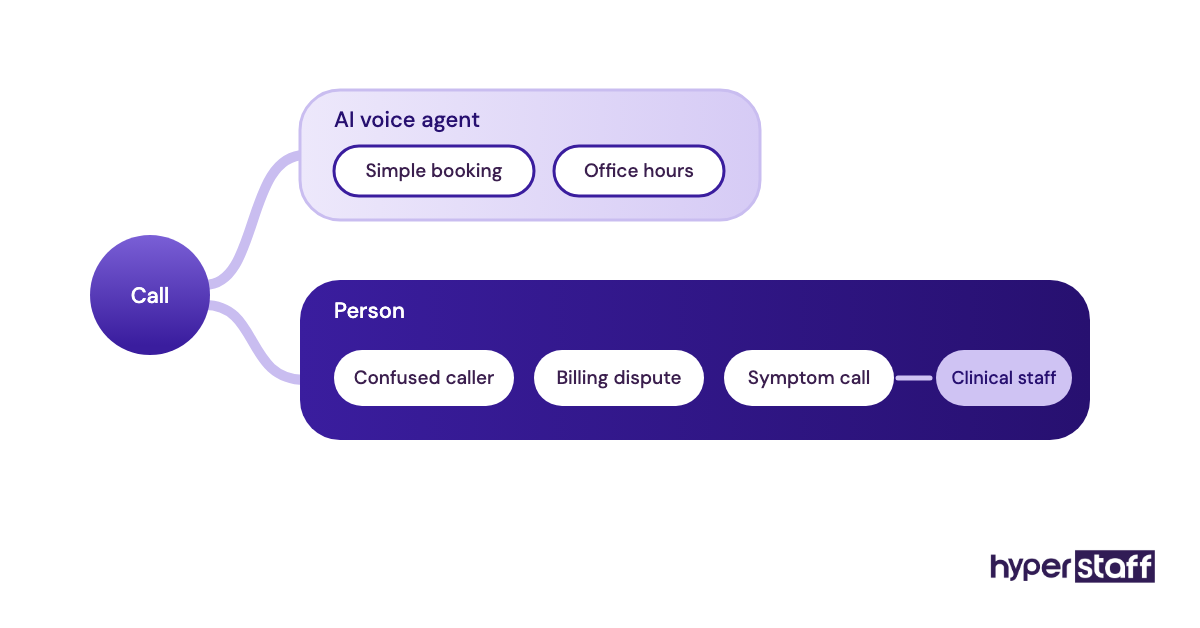
A patient calls with chest pain and the assistant, trying to help, books a routine visit next week. Every symptom call needs a written escalation rule that routes it to clinical staff immediately.
Ten Tasks on Day One
The practice hands over phones, billing, PAs and scribing at once. Quality drops across the board, and the practice decides remote help "doesn't work" when the scope was the real problem.
Creating a Medical Virtual Assistant Plan, Step-by-Step
A medical virtual assistant plan works best in five steps, moving from task inventory to measured results. The order keeps compliance and access ahead of the work itself.
Step #1: List the Tasks and Hours
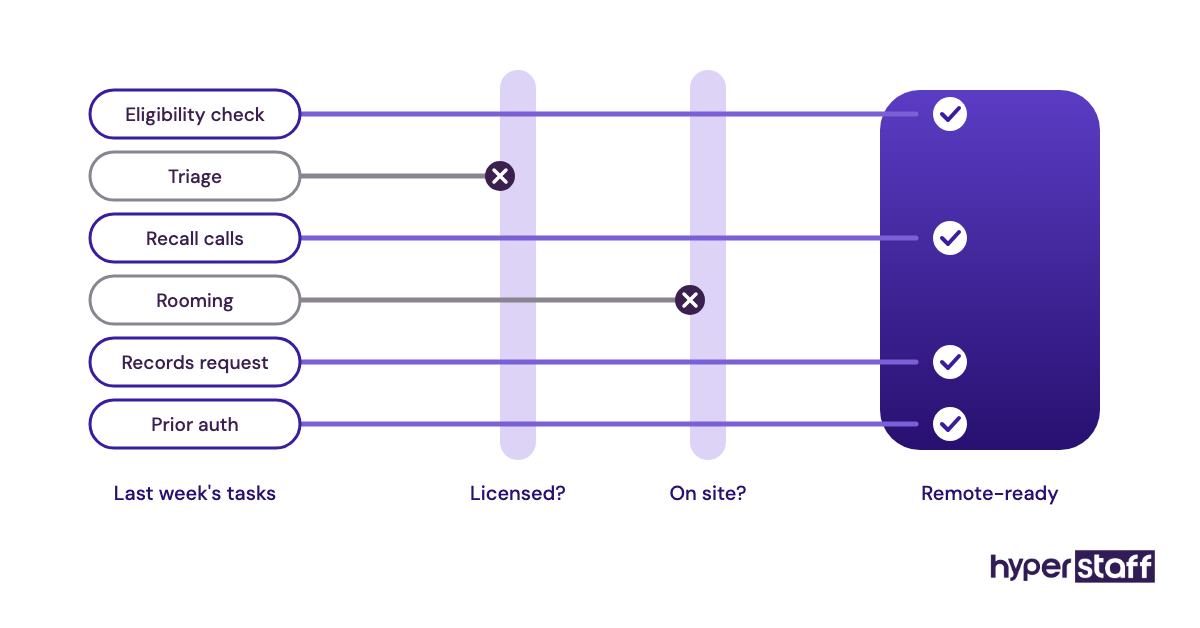
Track one normal week of admin work by task and time. Sort it into "remote-ready" and "needs someone on site," then pick the two or three highest-hour remote tasks to hand over first.
A full inventory of what's typically delegated sits in our list of medical virtual assistant tasks.
Step #2: Sort Out HIPAA and Access
Sign a BAA with the provider of the assistant before any PHI is shared. HHS publishes sample BAA provisions that show what the contract should cover.
Then create individual logins with least-privilege access. Our guide to a HIPAA compliant virtual assistant walks through the controls that matter.
Step #3: Write the Role and Hire
Turn the task list into a role description with the systems, hours and time zone spelled out. A clear medical VA job description also makes screening faster.
During interviews, test the work itself: a mock eligibility check or a recorded scheduling call. Our set of interview questions for medical VAs includes practical tests, and the full process is in how to hire a medical virtual assistant.
Step #4: Onboard in Phases
Start with low-risk, reviewable work like records requests or reminder calls. Add phones and PAs after two weeks of clean output.
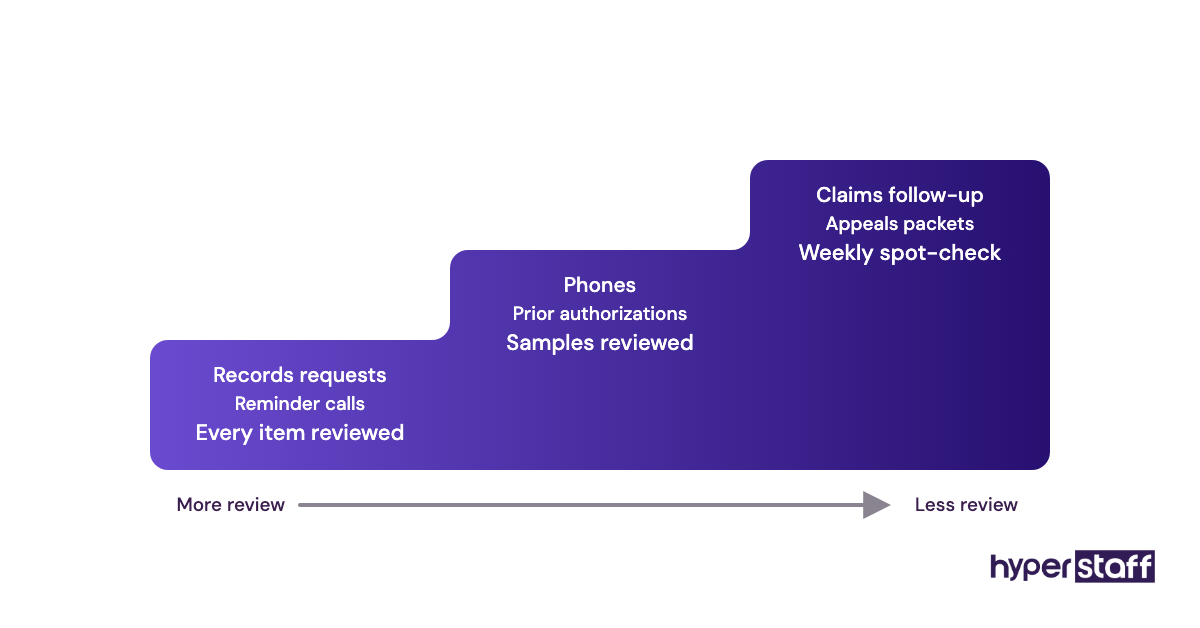
The phase plan for the first 30 days is covered in onboarding a medical virtual assistant.
Step #5: Measure and Expand
Pick two or three numbers per task, such as PA turnaround time or calls answered, and review them weekly for the first month. Expand scope only where the numbers hold.
What Does an Effective Medical Virtual Assistant Strategy Look Like?
An effective medical virtual assistant strategy gives one person a clear lane, written procedures and one point of contact at the practice. The assistant owns outcomes, such as "every PA submitted within 24 hours," instead of a loose list of chores.
Written procedures carry most of the weight. When procedures live in someone's head, a sick day or a replacement resets everything; when they're written and kept current, a new person can pick up the work in days.
Hyperstaff keeps that record in an Operations Vault, holding each client's SOPs, tools and context, and uses it to brief a free replacement in 5 to 7 business days if one is ever needed.
Which Tools and Software Do Medical Virtual Assistants Use?
Medical virtual assistants mostly use the practice's existing EHR and practice management system, plus HIPAA-ready communication, telehealth and password tools. The right stack depends on what the practice already pays for.
- EHR and practice management: athenaOne, eClinicalWorks, Epic and similar. Pricing is quote-based, and each remote user may need a paid seat, so ask your vendor before the start date.
- Spruce Health: patient messaging, phones and team chat in one app. Spruce lists plans at $24 and $49 per user per month, and the virtual assistant counts as a billable user.
- Doxy.me: browser-based telehealth with a free tier and a paid Premium plan that includes a BAA. Current Premium pricing is on Doxy.me's pricing page.
- Paubox: HIPAA compliant email that sends encrypted messages without a patient portal login, priced by sender.
- A business password manager: shared vaults for payer portal credentials, so nobody emails a password.
Our opinion: an all-in-one messaging and phone app like Spruce saves more setup pain than any other single tool. More options are compared in our roundup of medical virtual assistant tools.
9 Proven Medical Virtual Assistant Tips and Best Practices
These medical virtual assistant practices come up again and again in setups that last past the first quarter.
- Give every assistant their own login, never a shared one.
- Write an escalation rule for every symptom or clinical question before phones go live.
- Start with two tasks, not the whole job.
- Record two or three real calls as training examples, with patient consent.
- Name one person at the practice who answers the assistant's questions.
- Overlap at least two working hours with your clinic's day.
- Track one number per task from week one.
- Review a sample of completed work weekly for the first month.
- Update procedures the same day a payer or process changes.
The failure patterns behind most of these rules are covered in common medical VA mistakes.
Overcoming Common Medical Virtual Assistant Challenges
Medical virtual assistant challenges usually come from access, communication and patient trust. Access delays are the most common, and fixing them before day one saves more time than anything else.
Communication gaps shrink with a shared task tracker and a daily written update. Patient trust builds when the assistant introduces themselves by name and team, and handles calls from a consistent script.
Turnover is the risk owners ask about most. Written procedures limit the damage, because a replacement learns from documents instead of from the person leaving.
How to Measure Medical Virtual Assistant Success
Medical virtual assistant success is measured by task outcomes: calls answered, PA turnaround, eligibility checks done before visits, claim denials tied to eligibility, and hours clinical staff got back.
Pick baselines in the week before the assistant starts. Without them, every result becomes a matter of opinion, and the role ends up judged on how busy it looks.
How Long Does a Medical Virtual Assistant Take to Work?
A medical virtual assistant usually handles simple tasks within the first week and reaches full scope in about four to six weeks. Phones and PAs take longest because they depend on payer quirks and practice-specific rules.
The slow part is rarely the assistant. Seat licenses, MFA and portal approvals can add a week, so start those requests the day you sign.
How Much Does a Medical Virtual Assistant Cost?
A medical virtual assistant through Hyperstaff starts at $3 per hour for entry-level work and $12 per hour for experts with 5+ years. A local medical secretary earns a BLS median of about $22 per hour before taxes and benefits.
| Option | Experience | Hourly rate | 80 hrs/month | 160 hrs/month |
|---|---|---|---|---|
| Hyperstaff Essential | 0 to 2 years | From $3 | From $240 | From $480 |
| Hyperstaff Professional | 2 to 5 years | From $6 | From $480 | From $960 |
| Hyperstaff Expert | 5+ years | From $12 | From $960 | From $1,920 |
| In-house medical secretary (wages only) | Varies | About $22 | About $1,770 | About $3,830 |
Paying quarterly saves another 10% on Hyperstaff bundles. A deeper breakdown of fees and hidden costs is in our guide to medical virtual assistant cost.
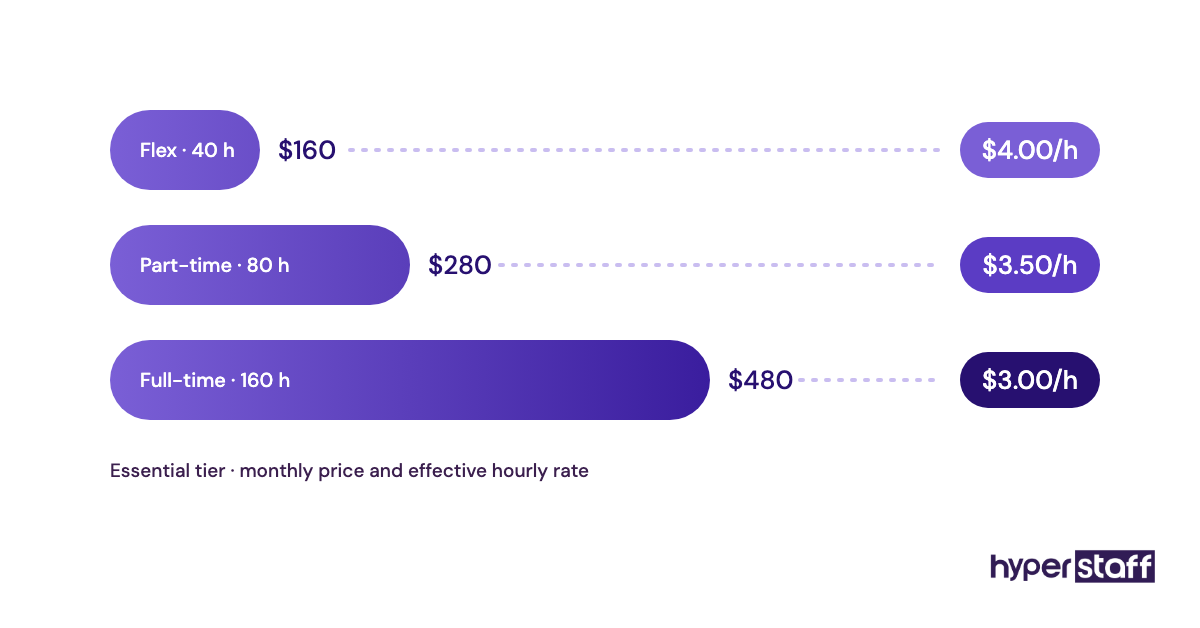
Important: our prices above are typical starting rates, not fixed quotes. Your final cost depends on the tasks, experience level and hours your practice needs.
Is a Medical Virtual Assistant Worth It?
Yes, for most practices with steady insurance and phone work, a medical virtual assistant is one of the highest-return hires available, because it moves paid clinical hours back to patients at a fraction of local admin wages.
Here's the math with published numbers. A full-time Professional-tier assistant at $6 per hour for 160 hours costs $960 a month, against about $3,830 in base wages for a local medical secretary at the BLS median.
That's roughly $2,870 a month in wage difference, before counting payroll taxes, benefits and desk space. Add the EHR seat and phone app, maybe $100 to $200 a month, and the gap is still wide.
The return breaks down when scope is vague or access is never set up properly. Our deeper take on whether a medical VA is worth it covers the cases where it isn't.
How Do You Choose a Medical Virtual Assistant Agency?
Choose a medical virtual assistant agency by checking healthcare experience, HIPAA handling, replacement terms and who you'll actually talk to each week. Ask whether the agency will sign a BAA, and get it in writing before sharing PHI.
Then ask how they test candidates. A good agency runs practical tests on eligibility checks or scheduling calls, not just a résumé review.
Replacement terms deserve a hard look. Ask how fast a replacement arrives and how they'll get up to speed; "we'll find someone" is not an answer. Also ask whether you get one dedicated person or a rotating pool, because a rotating pool means re-explaining your payers every week.
Medical Virtual Assistant Statistics, Trends and Future Predictions
Medical virtual assistant demand tracks two pressures: rising admin load and a shrinking clinical workforce. The figures below come from named sources.
- Practices complete an average of 40 prior authorizations per physician per week, taking 13 hours of physician and staff time (AMA).
- 94% of physicians say prior authorization increases burnout, per the same survey.
- The AAMC projects a US physician shortage of 13,500 to 86,000 within about a decade.
- The median annual wage for medical secretaries and administrative assistants is $45,930.
Our prediction, as an opinion: remote admin roles will specialize further. Generalist "medical VAs" will give way to prior auth specialists, A/R specialists and scribes, because payers keep adding rules faster than one person can track across every function.
How Is AI Changing the Medical Virtual Assistant Role?
AI is changing the medical virtual assistant role by taking over repetitive drafting and transcription, while the human handles payer calls, judgment and patient conversations. Ambient scribing tools, for example, now draft visit notes that a person reviews.
Payers use automation too. The AMA survey found 60% of physicians worry that AI increases, or will increase, prior authorization denials, which means more appeals that need a human to assemble records and argue the case.
Disclaimer: This article is for general information only and is not legal, compliance, medical or financial advice. Pricing, statistics and tool details may change. Consult qualified professionals before making HIPAA or staffing decisions.
Common questions
Do medical virtual assistants need a certification?
No license is required for administrative medical VA work in the US. Many have healthcare admin or billing training, and HIPAA training is standard for anyone touching PHI.
Can a medical virtual assistant work in my EHR?
Yes, if your EHR allows remote users and you give them their own login. Check whether a new user needs a paid seat before the start date.
Can a medical VA handle Spanish-speaking patients?
Yes. Assistants from Latin America often speak Spanish natively, which helps practices with Spanish-speaking patients on scheduling and reminder calls.
Can I hire a medical virtual assistant part-time?
You can. Hyperstaff offers monthly bundles of 40, 80 or 160 hours, so a small practice can start with 40 hours for recalls or records work.
Is a medical virtual assistant safe for patient data?
It can be, with a signed BAA, individual logins, MFA and least-privilege access. The risk comes from shortcuts like shared passwords or personal email.
Book a free 15 min call
We place a pre-vetted specialist in 5 business days, fully managed, from $3/hour.