Personal Virtual Assistant Interview Questions: A Template You Can Copy
A copyable personal virtual assistant interview template with 23 questions, a scoring rubric, a paid trial task and notes on adapting it to your own life and work.
On this page
- What Are Personal Virtual Assistant Interview Questions?
- Key Personal VA Interview Terms You Should Know
- Why Do Interview Questions Matter So Much for a Personal VA?
- How Does a Personal VA Interview Process Work?
- The Personal Virtual Assistant Interview Template
- What Types of Personal VA Interview Questions Should You Ask?
- How Do You Adapt the Interview Template to Your Life?
- How Is a Personal VA Interview Different From Other Assistant Interviews?
- Is a Structured Personal VA Interview Better Than a Casual Chat?
- Personal VA Interview Answer Examples
- 9 Proven Personal VA Interview Tips and Best Practices
- Overcoming Common Personal VA Interview Challenges
- How Do You Measure Whether Your VA Interview Worked?
- How Long Does It Take to Interview and Hire a Personal VA?
- How Much Does a Personal Virtual Assistant Cost?
- Is a Structured Personal VA Interview Worth the Effort?
- How Do You Choose a Personal VA Agency?
- Can AI Help With Personal VA Interviews?
- FAQs
💡 Key Takeaways:
1) The best personal virtual assistant interview questions test judgment, discretion and written communication, because tool knowledge is easy to claim and hard to verify on a video call.
2) A complete personal VA interview runs 45 to 60 minutes, uses the same questions in the same order for every candidate, and is followed by a short paid trial task built from a real week.
3) Scoring each part of the interview from 1 to 4 before the first call keeps you from hiring the most likeable candidate over the most capable one.
The Right Questions Protect Your Most Valuable Hours
Hyperstaff has placed 70+ pre-vetted virtual assistants with 30+ clients across the Philippines, Latin America, India, Eastern Europe and the United States, with placement in 5 business days. Our personal virtual assistant services start from $3/hour and come with a free replacement in 5 to 7 business days, so use the template below with confidence that a wrong fit is fixable.
What Are Personal Virtual Assistant Interview Questions?
Personal virtual assistant interview questions are the prompts you use to test whether a remote assistant can run parts of your private and working life, from your calendar and inbox to travel, bills, errands and family logistics. Strong questions test judgment and discretion, since most candidates can already list the apps they know.
A personal VA sits closer to you than almost any other hire. They may see your bank alerts, your kids' school emails and your medical appointments, so the interview has to probe trust and judgment as hard as it probes skill.
If you're still working out the scope of the role, read up on what a personal virtual assistant does first. Interview questions only work once you know which parts of your life you plan to hand over.
Key Personal VA Interview Terms You Should Know
- Structured interview = the same questions, in the same order, scored the same way for every candidate.
- Behavioral question = asks what a candidate did in a real past situation ("Tell me about a time...").
- Situational question = asks what a candidate would do in a scenario you describe.
- Paid trial task = a short, paid piece of sample work done after the interview.
- Scoring rubric = the written scale you use to rate each answer.
- Time zone overlap = the hours you and your VA are both online.
- NDA = a non-disclosure agreement covering what the VA sees and handles.
- Delegated access = permission to use your email, calendar or accounts without your password.
- Reference check = a call or message to a past client or employer to confirm claims.
- Red flag = an answer that should end the process regardless of other scores.
Why Do Interview Questions Matter So Much for a Personal VA?
Interview questions matter for a personal VA because the interview is your only chance to spot trust and judgment problems before you grant access to your accounts. Once someone holds your calendar, inbox and saved cards, a bad fit takes weeks to unwind.
Tool questions are the easiest to pass and the least useful to ask. Almost any candidate can say they've used Google Calendar, but far fewer can explain what they'd do when two senior people land in the same slot and you're on a plane.
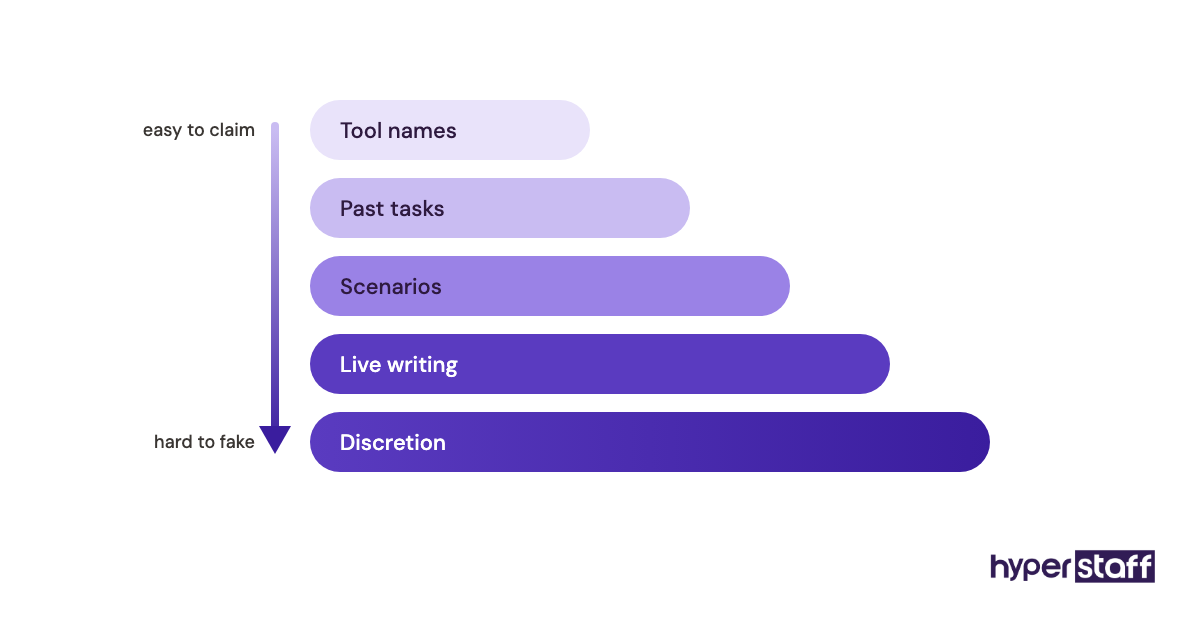
Personal work also has no clean job boundary. A business VA can lean on a process doc, while a personal VA has to decide in the moment whether your sister's birthday dinner outranks a client call you forgot to mention.
Worth knowing: A candidate who shines on video can still struggle with written updates, and most personal VA work happens in writing through email, chat and task notes, so add at least one live written question to every interview and read the answer before you decide anything.
How Does a Personal VA Interview Process Work?
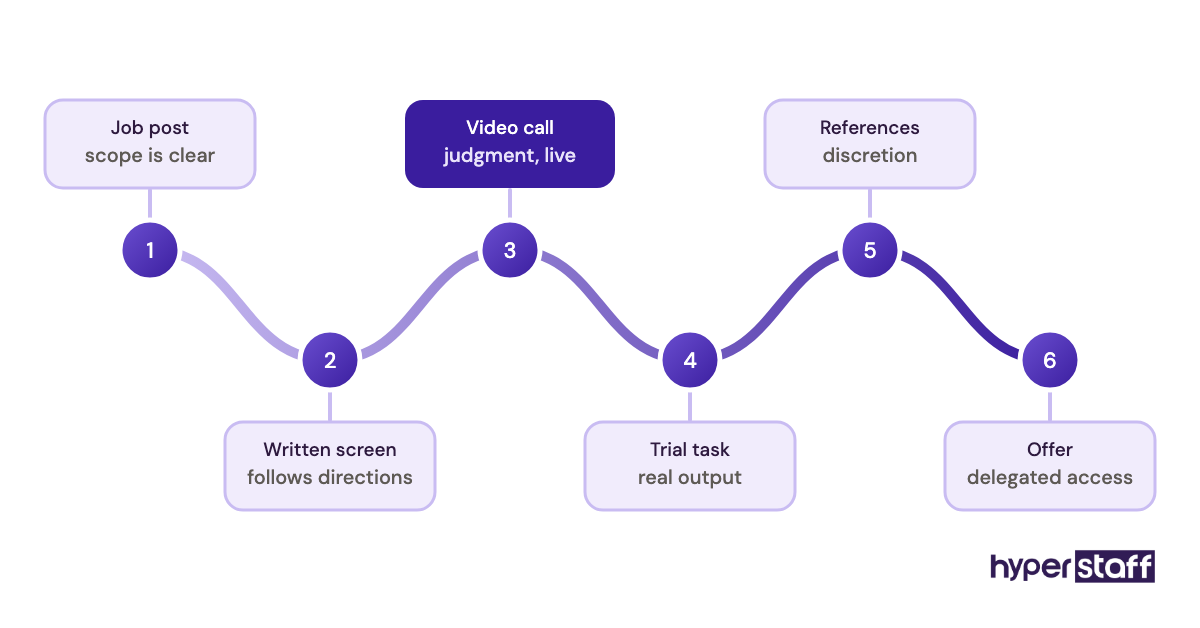
A personal VA interview process moves through six stages: a written job description, a short written screen, a 45 to 60 minute video interview, a paid trial task, a reference check and an offer. Skipping the written stages is the most common shortcut, and it removes your best view of how the person communicates.
- Write the role down. A clear personal VA job description tells candidates which tasks, hours and time zone you expect.
- Send 3 or 4 written screening questions and cut anyone who ignores the instructions.
- Run the video interview with the template below.
- Send a paid trial task the same day, due within 48 hours.
- Check one or two references, focused on reliability and discretion.
- Make the offer and set up delegated access, never shared passwords.
The interview is one stage inside the full process to hire a personal VA. Even so, it's where you learn the most per minute spent.
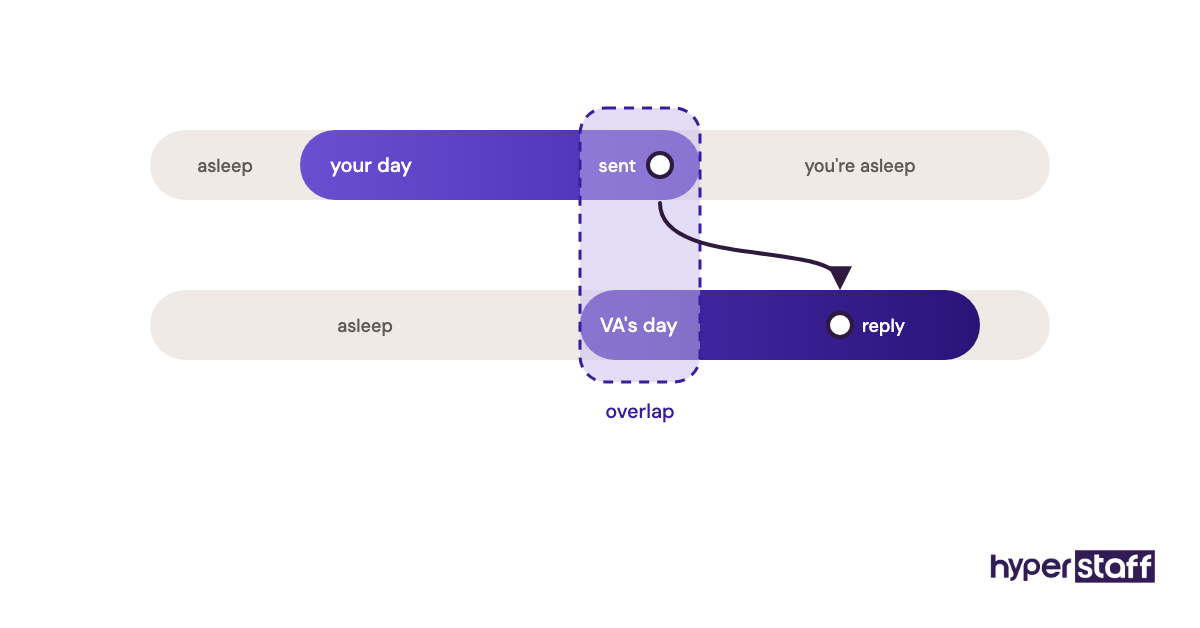
Keep in mind: Time zones stretch every stage, because a candidate in Manila answering an email sent from New York will often reply while you sleep, so plan for about a day of lag between each round and don't read a slow overnight reply as a lack of interest.
The Personal Virtual Assistant Interview Template
The template below is a complete personal virtual assistant interview you can copy into a doc and run in 45 to 60 minutes. It has nine parts, 23 questions, a scoring rubric and a paid trial task, and each part ends with what to listen for.
Personal Virtual Assistant Interview Template
Candidate: __________ | Date: __________ | Interviewer: __________ | Candidate time zone: __________
Part 1: Warm-up (5 minutes)
- Walk me through the last person you supported. What did a normal Monday look like for you?
- What part of that job did you like least, and what did you do about it?
Listen for: specific tasks and named tools, offered without prompting. Score: 1 2 3 4
Part 2: Calendar and scheduling (8 minutes)
- Two meetings land in the same slot and both people matter to me. What do you do in the first 10 minutes?
- How do you protect time I've blocked for family or focused work when someone pushes for it?
- I'm flying from Chicago to London on Tuesday. What would you check on my calendar that week?
Listen for: time zone awareness, asking before moving anything important, confirming changes in writing. Score: 1 2 3 4
Part 3: Inbox and communication (8 minutes)
- On day one my inbox has 4,000 unread emails. How do you sort it?
- When would you reply on my behalf, and when would you flag something to me?
- Type a two-line reply declining a meeting invite for me. (Ask them to write it live in the chat.)
Listen for: a triage system such as labels, filters and a daily summary, plus a short reply in a tone close to yours. Score: 1 2 3 4
Part 4: Personal errands and household (6 minutes)
- Tell me about a time you booked something for someone's family, like a doctor, a school event or a repair.
- A contractor calls you to reschedule and I can't be reached. What do you do?
- How do you keep track of renewals like insurance, car registration and subscriptions?
Listen for: a reminder system with lead time, and clear limits on what they'd agree to without you. Score: 1 2 3 4
Part 5: Travel (5 minutes)
- Find me three nights in Austin under $250 a night near the convention center. Talk me through how you'd choose.
- My flight is cancelled at 9 p.m. my time. What happens next, and how fast?
Listen for: questions about your preferences, loyalty programs and refund rules before they book. Score: 1 2 3 4
Part 6: Confidentiality and money (6 minutes)
- How do you store passwords and sensitive documents for the people you support?
- Have you ever seen something private you weren't meant to see? What did you do?
- Are you comfortable signing an NDA and working inside a password manager I control?
Listen for: a named password manager, no hesitation on the NDA, and zero gossip about past clients. Score: 1 2 3 4
Part 7: Judgment scenarios (8 minutes)
- I give you a deadline you think is unrealistic. What do you say to me?
- You made a mistake that caused me to miss an appointment. How do you tell me?
- Something urgent arrives and I left no instructions. Walk me through your thinking.
Listen for: owning mistakes fast, asking before acting on money or people, and acting alone on small, reversible things. Score: 1 2 3 4
Part 8: Availability and working style (4 minutes)
- Which hours can you overlap with my time zone, and what happens on your public holidays?
- How do you prefer to get instructions: voice notes, written lists or a shared task board?
- How do you let me know a task is finished?
Listen for: exact hours, a backup plan for holidays, and an end-of-day update habit. Score: 1 2 3 4
Part 9: Their questions (5 minutes)
- What would you want to know about me before your first week?
Listen for: questions about your priorities, preferences and boundaries. A candidate with no questions hasn't pictured the job yet. Score: 1 2 3 4
Scoring rubric
1 = vague or generic | 2 = correct but thin | 3 = specific, with a real example | 4 = specific, with a system they'd bring to your work
Hire threshold: average of 3 or higher across all parts, and no score of 1 in Part 6 or Part 7.
Paid trial task (60 to 90 minutes, paid at the candidate's hourly rate)
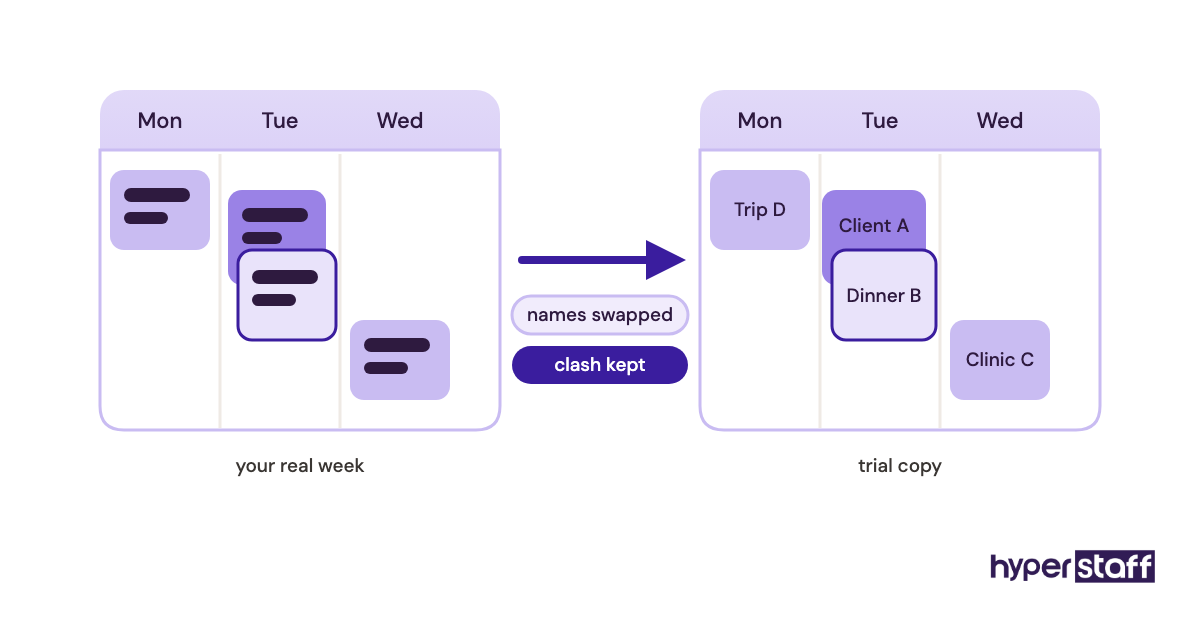
Send a sample week: a messy calendar export, 15 dummy emails and one trip request. Ask for a cleaned-up calendar, an inbox summary with suggested replies and a shortlist of travel options, due within 48 hours.
You won't need every question for every candidate. Treat the 23 as a ceiling, and keep Parts 6 and 7 intact no matter what you cut, since those are where most personal VA hires go wrong.
Use dummy data in the trial task, never your real inbox. A candidate who hasn't signed anything shouldn't see a single real name or account.
What Types of Personal VA Interview Questions Should You Ask?
Seven types of personal VA interview questions cover the full role, and each one tests something the others miss. The table maps each type to the template so you can see where the weight sits.
| Question type | What it tests | Example from the template | Strong answer sign | Template parts |
|---|---|---|---|---|
| Background | Real past scope | "Walk me through a normal Monday" | Names tasks and tools unprompted | 1 |
| Behavioral | What they actually did | "A time you booked for someone's family" | One clear story with an outcome | 4, 6 |
| Situational | Judgment under pressure | "Two meetings in the same slot" | Asks before moving key people | 2, 5, 7 |
| Live skill | Writing and tone | "Type a two-line decline" | Short, polite, no filler | 3 |
| Confidentiality | Discretion and security | "How do you store passwords?" | Names a password manager | 6 |
| Logistics | Hours and reliability | "What happens on your public holidays?" | Exact hours plus a backup plan | 8 |
| Reverse | Curiosity and ownership | "What would you want to know about me?" | Asks about priorities and limits | 9 |
How Do You Adapt the Interview Template to Your Life?
Adapting the template takes about an hour, and it turns a generic interview into one that tests your actual week. Work through the five steps below before you book the first call.
Step #1: List the Work You'll Hand Over
Start with a written list of everything you want off your plate in the first month. A list of common personal VA tasks can jog your memory for the small recurring jobs that people forget, like renewals and gift orders.
Step #2: Cut the Parts That Don't Apply
Remove whole parts rather than single questions. If you never travel, drop Part 5 and give its five minutes to Part 7, where the judgment questions carry more weight anyway.
Step #3: Rewrite the Scenarios With Your Real Situations
Swap the sample scenarios for things that actually happened to you last month. "My son's orthodontist moved his appointment to the same hour as my investor call" tests a candidate far better than a made-up example, and it shows you how they handle your specific mix of family and work.
Step #4: Set Your Scoring Threshold Before the First Call
Decide your hire threshold and your red flags in writing before you meet anyone. Once you've met a warm, funny candidate, the bar tends to move.
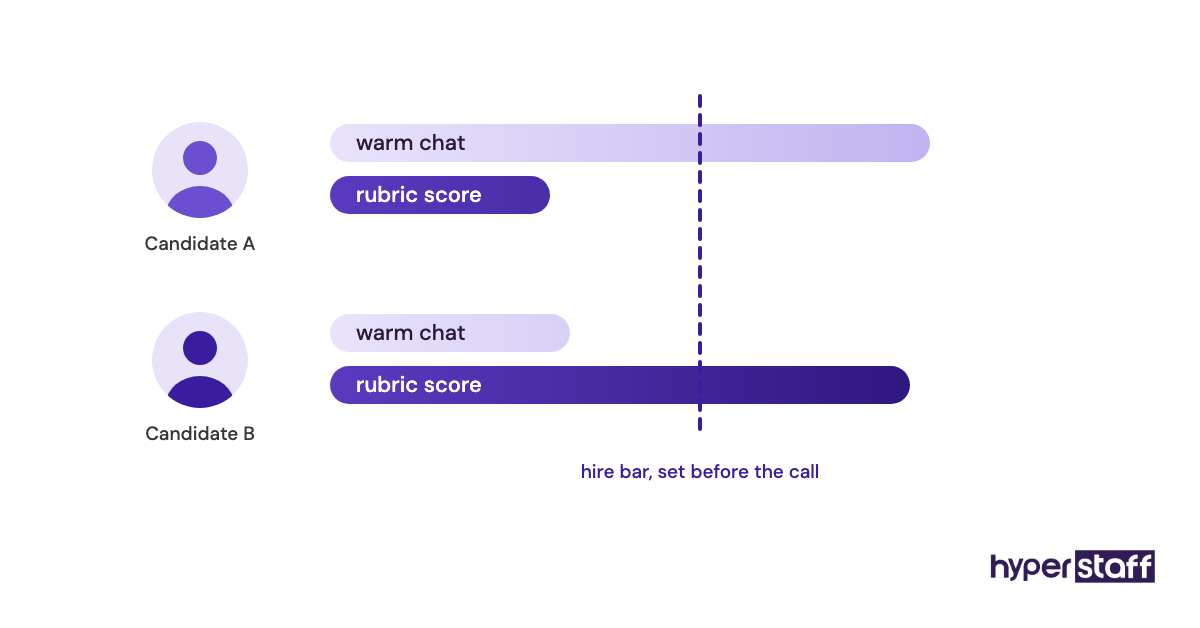
Tip: Run the same questions in the same order for every candidate, and score each part right after the answer rather than at the end of the call, since scores only compare fairly when every person faced the identical interview.
Step #5: Build the Trial Task From a Real Week
Export last week's calendar, swap every real name for a dummy one, and add the trip you're planning next. A trial task built from real patterns shows you how the candidate would cope with your actual chaos.
How Is a Personal VA Interview Different From Other Assistant Interviews?
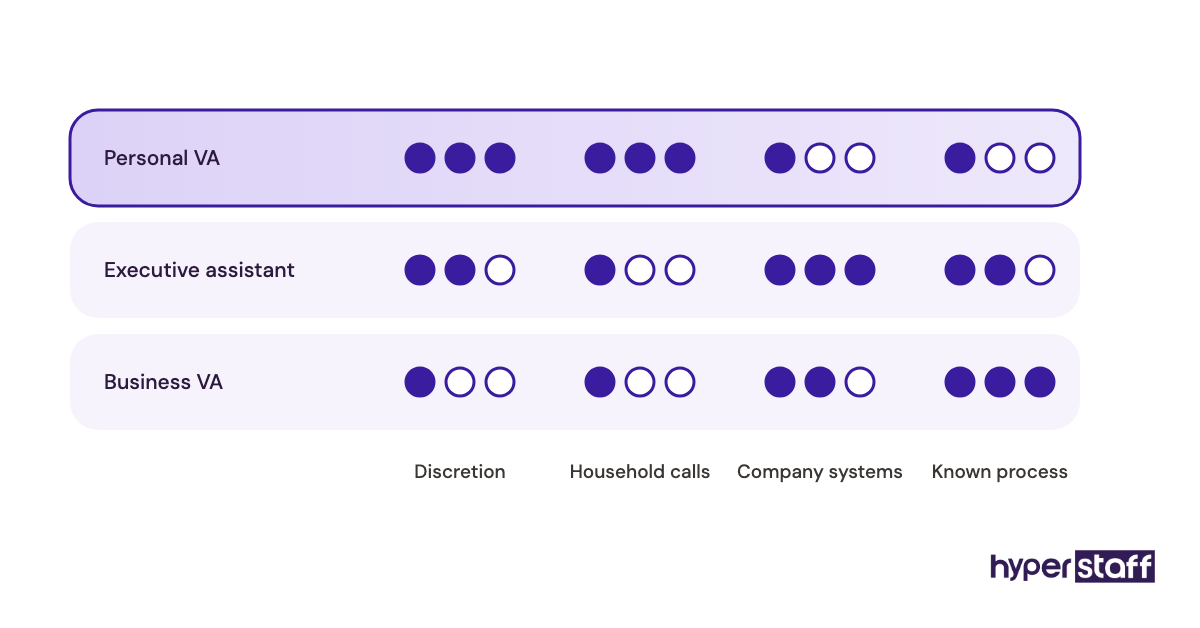
A personal VA interview spends more time on discretion and household judgment than other assistant interviews do. The skills overlap, but the risks and the weighting shift depending on how close the role sits to your private life.
Personal VA Interview vs. Executive Assistant Interview
An executive assistant interview leans toward board meetings, stakeholder management and company systems. A personal VA interview adds family logistics, personal finances and the line between home and work, so Part 4 and Part 6 matter more here.
Personal VA Interview vs. General Business VA Interview
A general business VA interview usually tests a defined process, like data entry or customer support tickets. Personal work has fewer written rules, so you're hiring for judgment in gray areas more than for speed on a known task.
Personal VA Interview vs. In-House Assistant Interview
An in-house assistant interview can lean on body language and a trial day at your desk. A remote interview has to get the same signal through video, writing and a paid task, which is one of the trade-offs covered in this personal VA vs in-house comparison.
Good to know: Executive assistant candidates often apply for personal VA roles and interview well, yet some find household tasks like booking a plumber or tracking a child's school forms less appealing than corporate work, so ask directly how they feel about the personal side of the job.
Is a Structured Personal VA Interview Better Than a Casual Chat?
Yes, a structured interview beats a casual chat for a personal VA hire, because it lets you compare candidates on the same evidence. A casual chat still has a place as a short warm-up, but it shouldn't decide the hire.
The Benefits of a Structured Personal VA Interview
- Every candidate faces the same questions, so scores compare fairly.
- Written scoring keeps a likeable personality from hiding weak answers.
- Red flags in confidentiality surface before anyone gets access.
- The live writing task shows real tone and grammar.
- You can hand the same template to a partner or spouse to run a second round.
The Drawbacks of a Structured Personal VA Interview
- It takes about an hour to prepare the first time.
- Strong candidates sometimes feel boxed in by a scripted call.
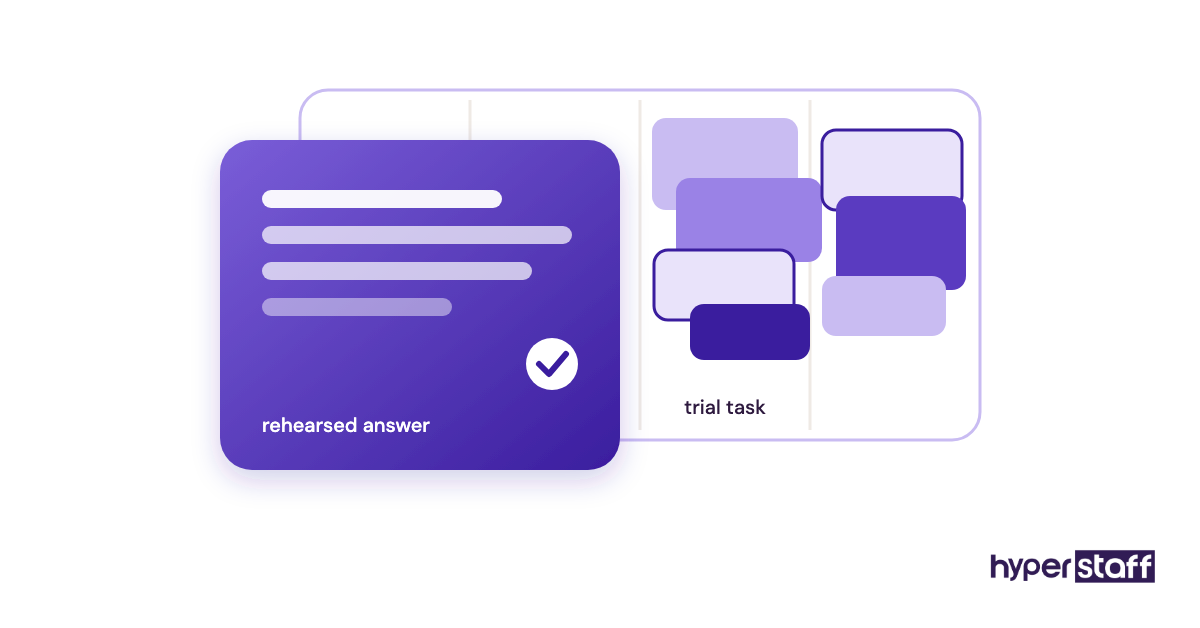
- Scenario answers can be rehearsed by experienced applicants.
The last drawback is why the paid trial task exists. A rehearsed answer falls apart quickly when someone has to clean up a messy calendar on their own.
Personal VA Interview Answer Examples
The examples below show what strong and weak answers sound like for questions in the template. They're sample answers to compare against, written to show the pattern.
Personal VA Interview Good Examples
The Double-Booking Answer
"I'd check which meeting was booked first and who's harder to reschedule, then message you with both options and my suggestion. If I can't reach you within an hour, I'd ask the more flexible person to move, never the one you flagged as a priority."
The answer shows a default, a time limit and respect for your priorities. That combination is what a score of 4 looks like.
The Inbox Triage Answer
"I'd set up filters for newsletters and receipts first, so the 4,000 drops fast. Then I'd sort the rest into reply, waiting and read-later, and send you a 10-line summary each evening."
The Mistake Answer
"I'd message you as soon as I noticed, say what happened in one line, and tell you what I've already done to fix it. Then I'd tell you what I changed so it doesn't happen again."
Personal VA Interview Bad Examples
"I'm a Fast Learner"
Given in reply to a specific scenario, the line dodges the question. A candidate who answers situational questions with personality traits usually hasn't faced the situation.
Gossip About a Past Employer
Any detail about a former client's private life is an instant red flag, however funny the story. If they share it with you, they'll share yours with the next person.
"I'd Just Handle It"
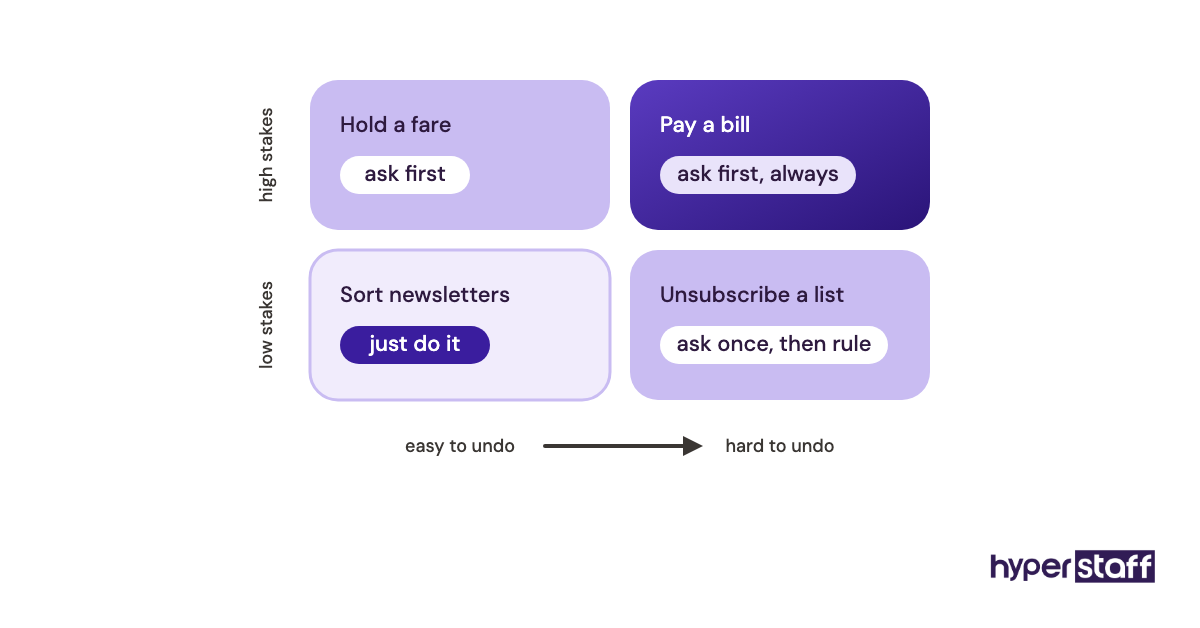
Confidence sounds good until it's your money or your mother's birthday. Many of the classic personal VA mistakes start with an assistant acting on something big without checking first.
9 Proven Personal VA Interview Tips and Best Practices
These personal VA interview tips come from the parts of hiring that most often go wrong.
- Send the written screen before you book any video call.
- Book the interview inside the hours you expect the VA to work, so you test real availability.
- Keep your camera on and ask them to do the same.
- Ask for the two-line written reply live, in the chat, with no time to polish.
- Ask which tools they've used for calendars, notes and passwords, then compare with your own personal VA tool stack.
- Follow every vague answer with "Can you give me a real example?"
- Score each part during the call, not afterwards from memory.
- Pay for the trial task, every time.
- Ask references one direct question: "Would you hire this person again for personal work?"
Overcoming Common Personal VA Interview Challenges
The most common personal VA interview challenge is a weak video or audio connection, which makes a capable candidate sound unsure. Offer one reschedule without penalty, and lean harder on the written answers.
Accents and second-language English trip up some interviewers. Judge clarity in writing, since that's how most of the work arrives, and don't mark down a candidate for an accent you're not used to.
Then there's the polished candidate who answers everything well. Push on Part 7 with a scenario they can't have rehearsed, built from something that happened to you this month.
How Do You Measure Whether Your VA Interview Worked?
You measure a personal VA interview by comparing the scores you gave against how the hire performs in the first 30 to 90 days. If a candidate scored 4 on judgment and then made a big call without asking, your questions in Part 7 need sharper scenarios.
Track three signals in the first month: missed deadlines, how often you correct their writing, and whether they flag problems before you notice them.
A good interview predicts those signals. If it didn't, rewrite the part that missed rather than the whole template.
How Long Does It Take to Interview and Hire a Personal VA?
Hiring a personal VA on your own usually takes 2 to 4 weeks, from posting the role to a signed offer. The interview itself is an hour, while most of the time goes into waiting for replies and trial tasks across time zones.
Through Hyperstaff, placement takes 5 business days, followed by a 30-minute kickoff call, and work starts that day or the next morning.
Plan the first two weeks after the offer as well. A written onboarding plan for your VA is what turns a good interview into a good first month.
How Much Does a Personal Virtual Assistant Cost?
A personal virtual assistant through Hyperstaff costs from $3 to $12 per hour depending on experience, sold in monthly bundles of 40, 80 or 160 hours. An in-house assistant in the US usually costs several times more once wages and employer costs are added.
| Option | Experience | Hourly rate | 80 hours/month | 160 hours/month |
|---|---|---|---|---|
| Hyperstaff Essential | 0 to 2 years | From $3 | From $240 | From $480 |
| Hyperstaff Professional | 2 to 5 years | From $6 | From $480 | From $960 |
| Hyperstaff Expert | 5+ years | From $12 | From $960 | From $1,920 |
| In-house assistant (US) | Varies | About $26–$45 with employer costs | About $2,100–$3,600 | About $4,200–$7,200 |
Paying quarterly saves 10% on Hyperstaff bundles. For a fuller breakdown by region and tier, see this guide to personal virtual assistant cost.
Important: Our rates above are starting averages, not fixed quotes. Your final cost depends on the experience tier, hours and type of work your role needs.
Is a Structured Personal VA Interview Worth the Effort?
Yes, a structured interview is worth the effort, because a few hours of preparation protect you from weeks of handover work lost to the wrong hire. Done well, it's one of the highest-return hours you'll spend in the whole hiring process.
Here's a simple calculation. Preparing, running and scoring the interview takes about 3 hours of your time, and a 90-minute trial task at $6/hour costs $9, so at $100 an hour for your time the total is about $309.
A mismatched hire might cost you 4 weeks of handover at 5 hours a week, which is 20 hours. At the same $100 an hour, that's $2,000 of your time lost before you even restart the search.
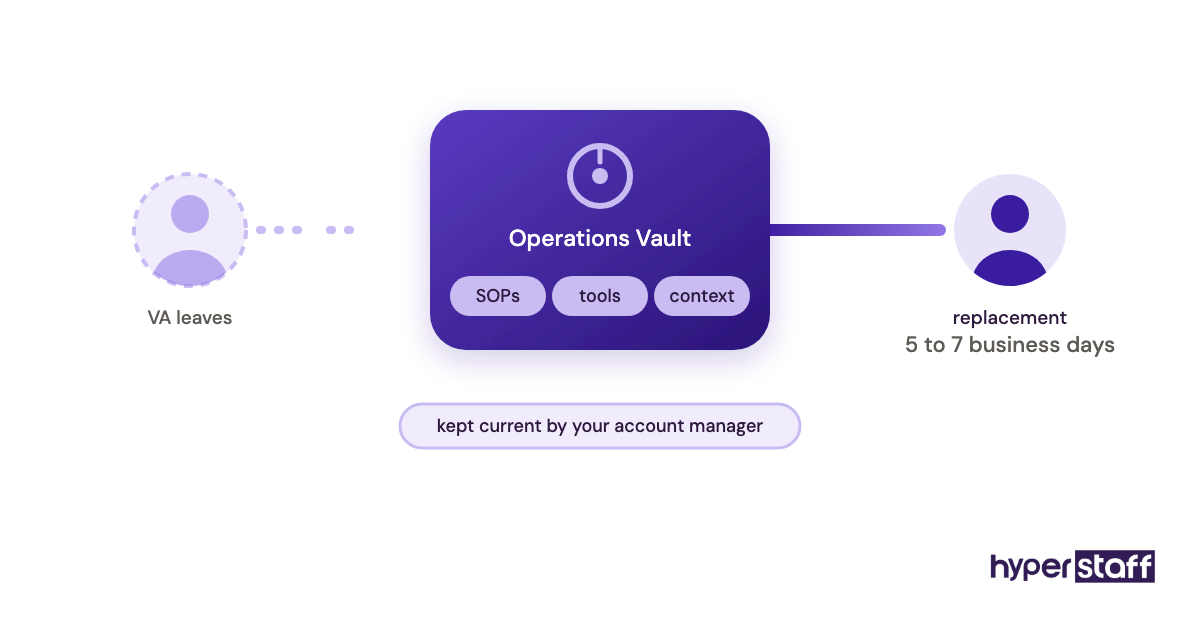
The interview won't catch every problem. A free replacement through Hyperstaff in 5 to 7 business days, briefed from your Operations Vault, limits the damage when one slips through, and this look at whether a personal VA is worth it covers the wider return.
How Do You Choose a Personal VA Agency?
Choose a personal VA agency by asking how it vets candidates, how fast it replaces a bad fit, and who holds your processes if your VA leaves. The answers matter more than the hourly rate, since a cheap agency with slow replacements costs you more in lost weeks.
Ask each agency these questions before you sign:
- What does your vetting cover before I meet a candidate?
- How many business days does a replacement take, and does it cost extra?
- Where are my processes written down, and who keeps them current?
- Will I have one named contact, or a shared support inbox?
- Which regions do your VAs work from, and how much overlap with my time zone can I expect?
- Are there monthly minimums or long contracts?
For reference, Hyperstaff gives every client a dedicated account manager and keeps your SOPs, tools and context in an Operations Vault that's written and maintained for you. The discovery call is free, so you can ask all six questions before committing to anything.
Can AI Help With Personal VA Interviews?
AI can help with personal VA interviews by drafting scenario questions, transcribing calls and summarizing trial tasks, but it shouldn't make the hiring decision. Judgment and trust are exactly what the interview tests, and they're hard to score from a transcript alone.
Practitioners disagree on AI inside trial tasks. Some ban it outright, while others want to see a candidate use ChatGPT or Claude well, and the second camp has the better argument for personal work, since a VA who drafts faster with AI and checks the output carefully saves you real hours.
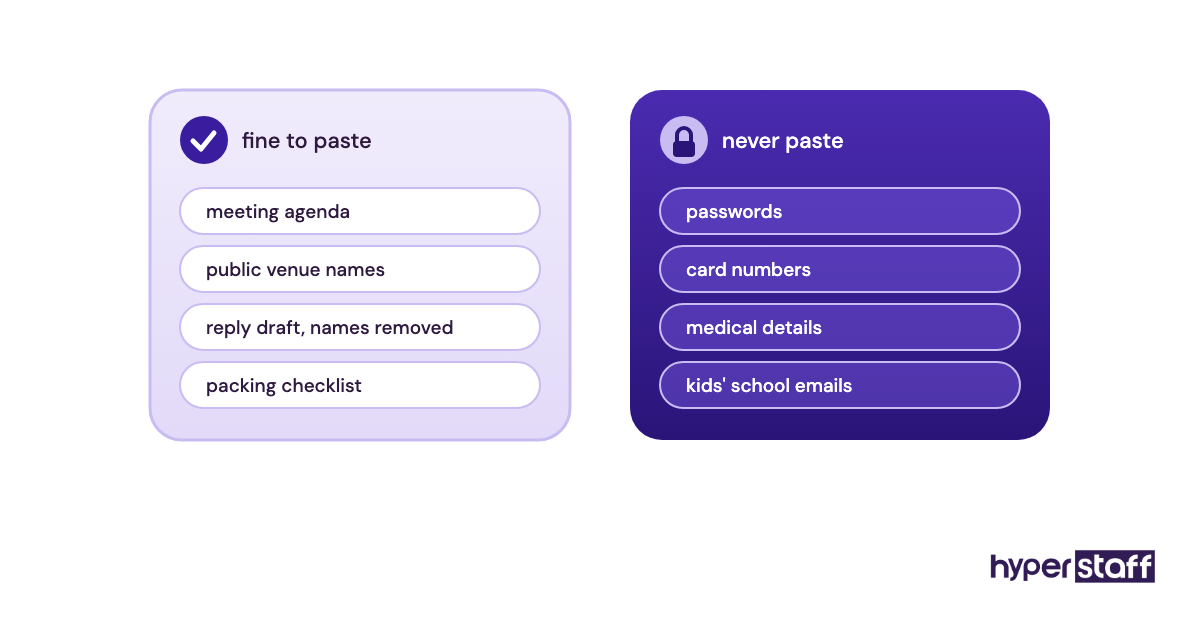
Add one question to Part 8 for this: "Which AI tools do you use, and what would you never paste into one?" The second half of the answer tells you far more than the first.
Heads-up: If you use an AI note-taker to record interviews, tell candidates at the start of the call and get their consent, and keep any recordings out of shared folders since they contain personal details about the applicant.
Disclaimer: This article is for general information only and isn't legal, HR or financial advice. Hiring laws vary by country and state, so check local rules before interviewing or hiring. Hyperstaff isn't liable for decisions made based on this content.
Common questions
How many interview questions should I ask a personal VA?
Around 15 to 23 questions fit a 45 to 60 minute personal VA interview. Fewer questions with follow-ups beat a long list read quickly, so cut whole sections that don't apply to you.
What questions am I not allowed to ask a VA candidate?
Avoid questions about age, religion, marital status, pregnancy, health or nationality, since many countries restrict them in hiring. Stick to the work, availability and how the candidate would handle real tasks.
Should I ask personal VA candidates for a video intro first?
A short recorded video intro can save you time when you have many applicants. Keep it optional or under 2 minutes, though, since strong candidates often skip unpaid busywork.
Do I still need to interview a VA placed by an agency?
A short interview is still worth it, even with pre-vetted candidates. The agency checks skills and reliability, while your call tests fit with your preferences, tone and household.
Is it okay to ask a VA about their other clients?
You can ask how many clients they support and how they split their hours. A candidate who shares names or private details about those clients has answered a different question, and that's a red flag.
Book a free 15 min call
We place a pre-vetted specialist in 5 business days, fully managed, from $3/hour.