Ecommerce Virtual Assistant Interview Questions: A Template You Can Copy
A copyable set of 30 ecommerce virtual assistant interview questions, with a scorecard, a work sample and how to adapt both to your store.
On this page
- What are ecommerce virtual assistant interview questions?
- Key ecommerce VA interview terms you should know
- Why do the right interview questions matter for an ecommerce VA?
- How does an ecommerce VA interview work?
- The copyable ecommerce VA interview question template
- Which question types belong in an ecommerce VA interview?
- How do ecommerce VA interviews differ from other hiring interviews?
- Ecommerce VA vs. general virtual assistant interview questions
- Ecommerce VA vs. in-house ecommerce coordinator interviews
- Ecommerce VA vs. customer service rep interviews
- The benefits of a structured ecommerce VA interview
- The drawbacks of a structured ecommerce VA interview
- Who needs an ecommerce VA interview template?
- What do strong and weak answers look like?
- Good ecommerce VA interview answers
- Weak ecommerce VA interview answers
- Creating your ecommerce VA interview plan, step by step
- Step #1
- Step #2
- Step #3
- Step #4
- Step #5
- What does a strong interview scorecard look like?
- Tools and software for running ecommerce VA interviews
- 9 proven tips for interviewing ecommerce VAs
- Overcoming common ecommerce VA interview challenges
- How do you measure ecommerce VA interview success?
- How long does hiring an ecommerce VA take?
- How much does an ecommerce virtual assistant cost?
- Is a structured ecommerce VA interview worth it?
- How do you choose an agency that screens ecommerce VAs for you?
- Ecommerce VA interviews and AI
- FAQs
Better interview questions protect your store's revenue
One careless refund or a wrong price costs more than a month of VA wages, so the interview is where you protect your margin. Hyperstaff has placed 70+ virtual assistants for 30+ clients, and our ecommerce virtual assistant services start from $3/hour, with pre-vetted candidates placed in 5 business days.
What are ecommerce virtual assistant interview questions?
Ecommerce virtual assistant interview questions are the prompts you use to check whether a remote candidate can run real store work: orders, returns, customer tickets, product listings and inventory. The useful ones ask for proof, like a walkthrough of a past process or a live task.
The role is wider than most job posts admit. Our guide on what an ecommerce virtual assistant is breaks down the full spread, from support inboxes to marketplace listings and weekly sales reports.
A general VA interview checks reliability, English and tool comfort. An ecommerce interview checks one extra thing: whether the person knows that a slip in Shopify or Amazon Seller Central reaches customers within hours.
Key ecommerce VA interview terms you should know
- SKU = stock keeping unit, the unique code for each product variant.
- AOV = average order value, total revenue divided by number of orders.
- RMA = return merchandise authorization, the approval step before a return ships back.
- Chargeback = a payment reversed by the customer's bank, usually after a dispute.
- FBA = Fulfillment by Amazon, where Amazon stores, packs and ships your stock.
- Inventory reconciliation = matching store stock counts against warehouse or 3PL counts.
- Listing optimization = editing titles, bullets, images and keywords so a product ranks and converts.
- Macro = a saved support reply in a helpdesk like Gorgias or Zendesk.
- CSAT = customer satisfaction score, collected after a support ticket closes.
- Structured interview = the same questions, in the same order, scored against the same anchors.
- Work sample = a short, real task the candidate completes after the call.
- Scorecard = the sheet where each interviewer rates answers before talking to anyone else.
Why do the right interview questions matter for an ecommerce VA?
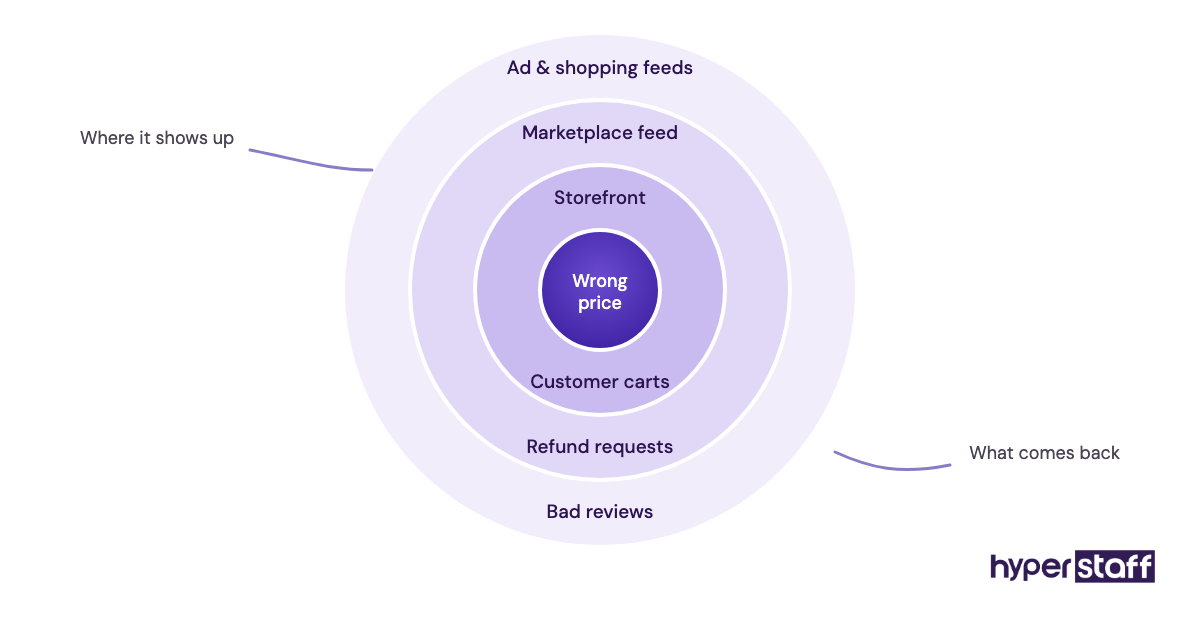
The right interview questions matter because ecommerce mistakes are public and fast. A wrong price, a mis-shipped order or a sharp reply to a one-star review lands in front of customers before you see it.
In our experience screening for ecommerce roles, judgment is the gap that shows up most often. The candidate knows how to issue a refund in Shopify but has no sense of when to stop and ask first.
Open questions like "tell me about yourself" reward confident talkers. Scenario questions reward people who have actually chased a missing tracking number at the end of a shift.
Worth knowing: A candidate who lists ten platforms on a résumé has usually logged into most of them a handful of times, so ask which two they used every day and for how many months.
How does an ecommerce VA interview work?
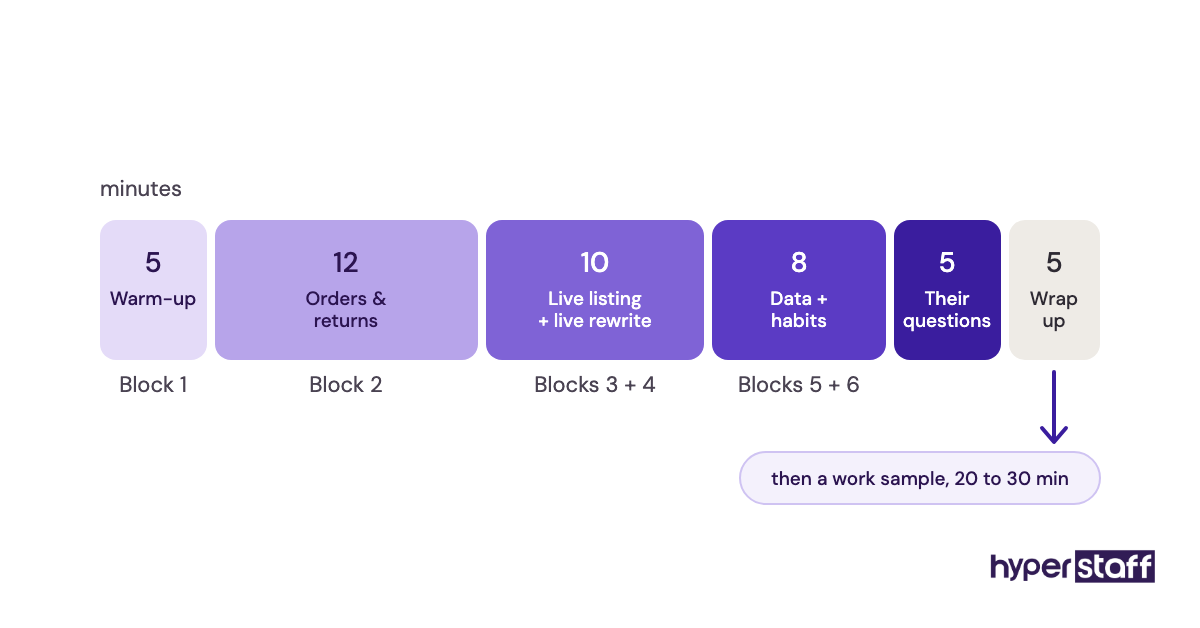
An ecommerce VA interview usually runs in four stages: a written application screen, a 30 to 45 minute video call, a short work sample and a reference check. Some owners add a second call with whoever will manage the VA day to day.
| Stage | Time for you | What it tests | Drop signal |
|---|---|---|---|
| Application screen | 2 to 3 min per applicant | Written English, platform fit | Copy-paste cover note |
| Video interview | 30 to 45 min | Scenarios, judgment, habits | Vague answers on daily tasks |
| Work sample | 15 to 20 min to grade | Real output on your data | Missed obvious errors |
| Reference check | 10 to 15 min | Reliability, past scope | Role smaller than claimed |
Order matters here. Put the work sample after the call, since only candidates who pass the call are worth the grading time.
For the sourcing side, including where to post and how to shortlist, see our walkthrough on how to hire an ecommerce VA.
The copyable ecommerce VA interview question template
The template below holds 30 questions in six blocks, a work sample and a scoring rule. Copy it into a Google Doc, delete what doesn't match your store and keep the order the same for every candidate.
Pair it with a clear ecommerce VA job description so the questions test what the role actually asks for.
Ecommerce Virtual Assistant Interview Template
Block 1: Background and platform depth
- Which ecommerce platforms have you used every day for at least three months? What did you do in each one?
- Walk me through the last store you supported. What did it sell, and roughly how many orders came in per day?
- Which tasks took up most of your week in that role?
- Which part of store operations have you never done but want to learn?
Score 1 to 5. Red flag: can't name order volume or daily tasks.
Block 2: Orders, shipping and returns
- A customer says their package shows as delivered, but they never got it. What are your first steps?
- How do you handle an order where the shipping address looks wrong or incomplete?
- Explain how you'd process a return for a damaged item in Shopify, or in the platform you know best.
- A carrier delay hits 40 orders at once. How do you tell customers, and who hears first?
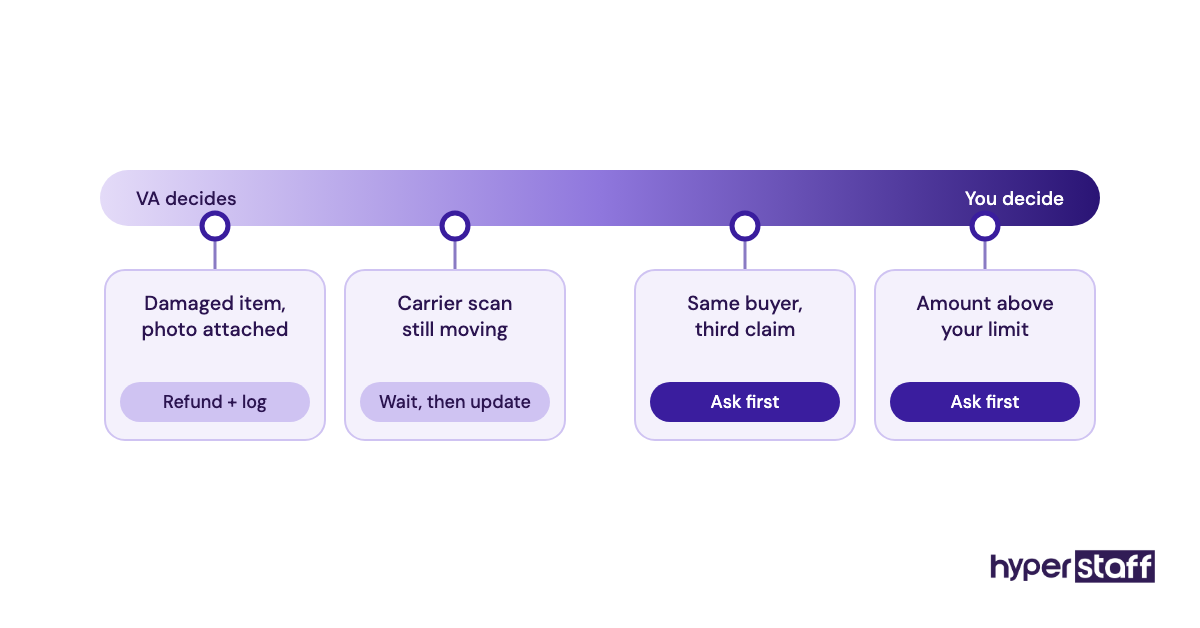
- When would you refund without asking me, and when would you stop and check?
Score 1 to 5. Red flag: refunds anything to "keep the customer happy."
Block 3: Customer support and tone
- Rewrite this angry customer email reply so it's calm and useful. (Use a real one from your inbox with names removed.)
- A customer leaves a one-star review that's partly unfair. What do you do?
- How do you use saved replies or macros without sounding scripted?
- What's the largest ticket backlog you've cleared, and how did you sort it?
- A customer asks for a discount code you're not allowed to give. What do you write back?
Score 1 to 5. Red flag: blames the customer in the rewrite.
Block 4: Product listings and catalog
- Here's one of our product pages. What would you change first, and why?
- How does a title for Amazon differ from a title for Shopify?
- How do you check that a bulk CSV upload didn't break variants, prices or images?
- Which marketplace listing rules have you had to work around?
- How would you find which of our products have missing descriptions or image alt text?
Score 1 to 5. Red flag: only cosmetic changes, nothing about search terms.
Block 5: Inventory, data and reporting
- How do you spot a stock mismatch between the store and the warehouse?
- Which numbers would you put in a weekly report for this store?
- Show me a Google Sheets formula you use often and what it does.
- A best-seller is about to sell out. Who do you tell, and when?
Score 1 to 5. Red flag: no idea where stock numbers come from.
Block 6: Work habits and communication
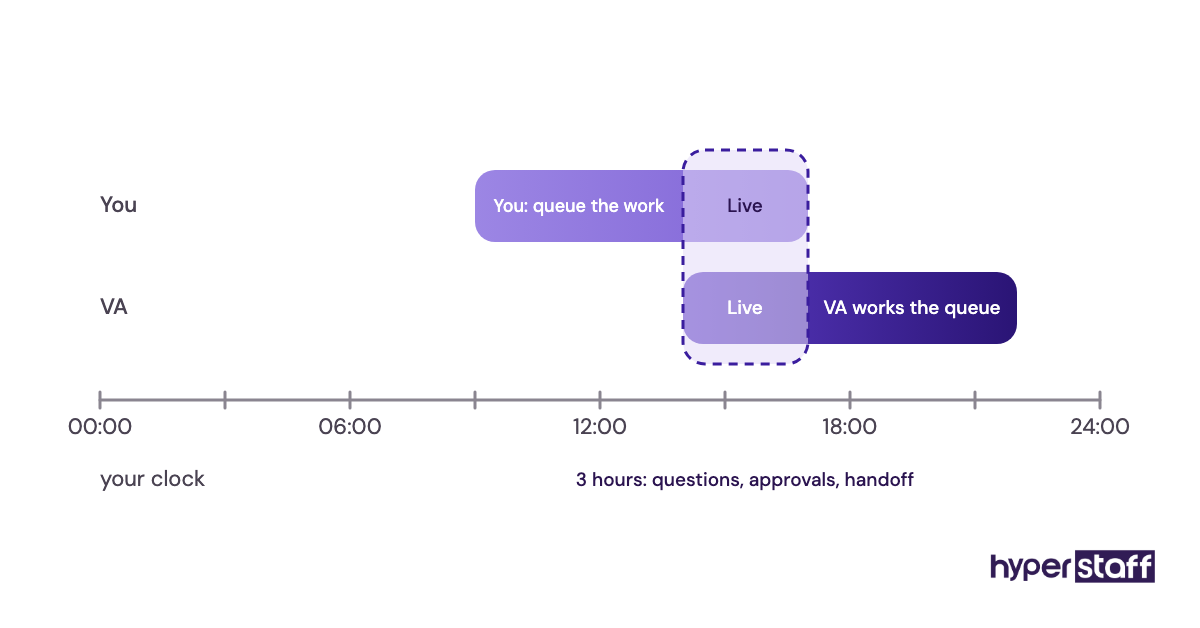
- Your hours overlap ours by three hours. How would you plan your day around that?
- How do you document a task so someone else could do it tomorrow?
- Tell me about a mistake you made in a store. How did you find it, and what did you do next?
- What do you do when my instruction conflicts with a written SOP?
- Which tool do you use to track your own tasks?
- How do you prefer to get feedback?
- What do you want to know about our store?
Score 1 to 5. Red flag: never made a mistake, or no questions at all.
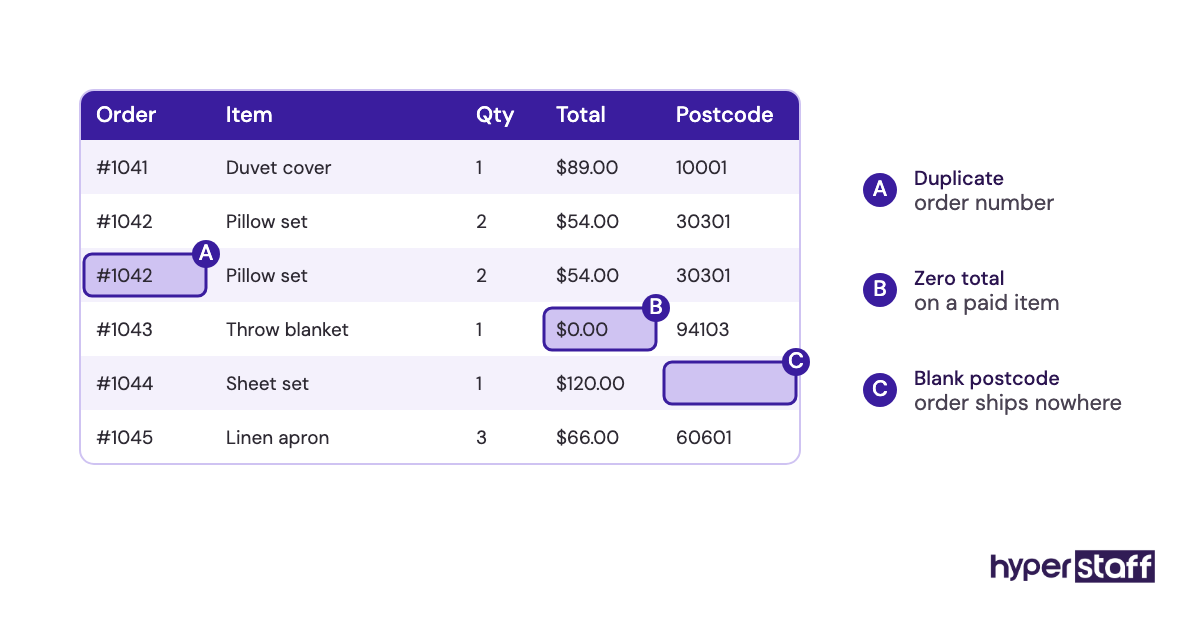
Work sample (sent after the call, 20 to 30 minutes): Answer two real support tickets, fix one product listing and flag anything odd in a 20-row order export.
Hire rule: Average of 3.5 or higher across blocks, no block below 3 and a passing work sample.
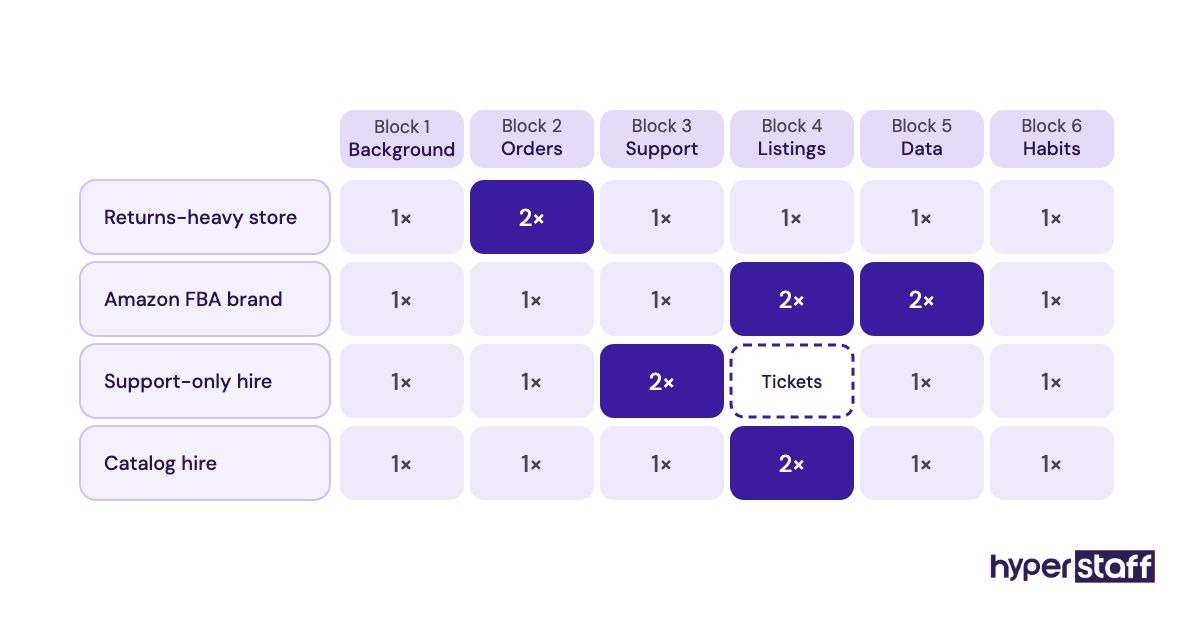
Blocks 2 and 4 carry the most weight for most stores, since that's where money and search traffic sit. A support-only hire can swap Block 4 for extra ticket scenarios pulled from your own inbox.
Which question types belong in an ecommerce VA interview?
An ecommerce VA interview needs at least five question types, because each one catches a different weak spot. The table maps each type to the template blocks above.
| Question type | What it tests | Template example | Weak spot it catches | Limit |
|---|---|---|---|---|
| Platform depth | Daily hands-on use | Q1, Q2 | Padded résumés | Rewards long tenure |
| Scenario | Step-by-step thinking | Q5, Q8 | Tutorial-only knowledge | Can be rehearsed |
| Judgment | When to escalate | Q9, Q27 | Costly solo decisions | Needs your thresholds |
| Live rewrite | Tone, written English | Q10, Q14 | Stiff or rude replies | Short sample |
| Live review | Listing and SEO sense | Q15, Q19 | Surface-level edits | Your page must be real |
| Data | Sheets, stock, reporting | Q20, Q22 | Number avoidance | Harder to judge on calls |
| Behavioral | Past mistakes, habits | Q26, Q25 | Low ownership | Relies on honesty |
| Work sample | Real output | Post-call task | Interview-only talent | Takes grading time |
Match the mix to the work. If you're still deciding what the VA will own, start from this ecommerce VA task checklist and cut any question type that doesn't map to a task.
How do ecommerce VA interviews differ from other hiring interviews?
Ecommerce VA interviews put more weight on live store scenarios than most remote-hire interviews do. Platform judgment counts for more than job titles on the résumé.
Ecommerce VA vs. general virtual assistant interview questions
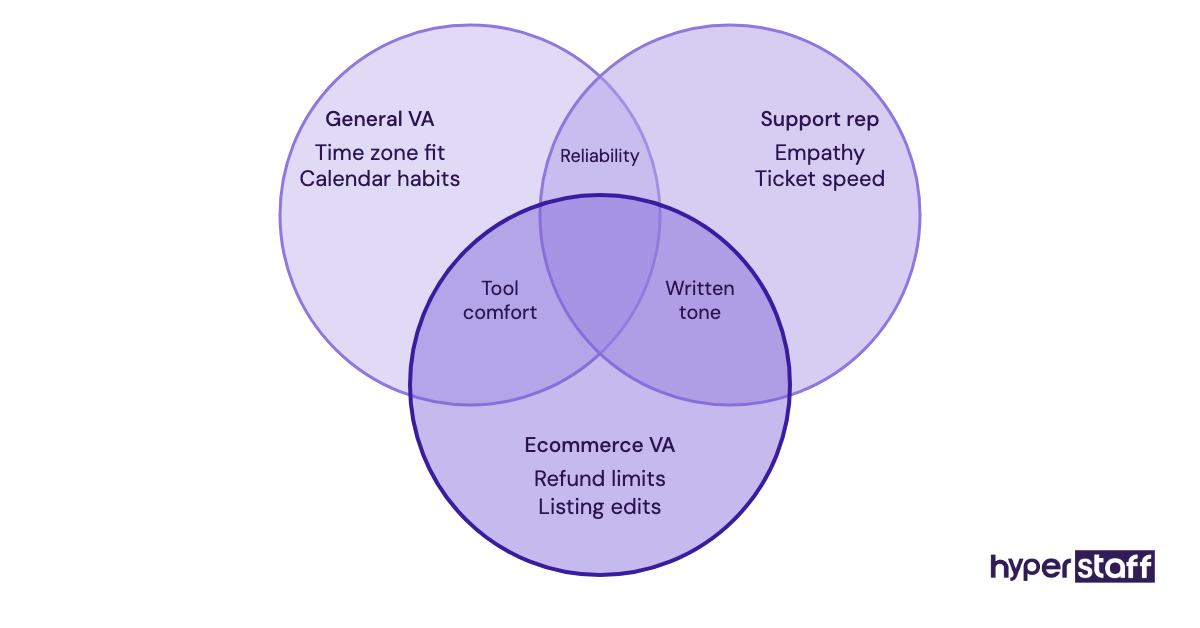
General VA interview questions are broad: communication, reliability, time zone fit and tool comfort. Ecommerce questions keep all of that and add money-touching scenarios such as refunds, price edits and low-stock alerts.
Ecommerce VA vs. in-house ecommerce coordinator interviews
An in-house interview can lean on a trial day with the team. A remote ecommerce VA interview has to prove async habits instead: written updates, clean handoffs and comfort with only a few overlap hours.
Our ecommerce VA vs in-house comparison covers the cost and control side of that choice.
Ecommerce VA vs. customer service rep interviews
A customer service interview goes deep on tone, empathy and ticket speed. An ecommerce VA usually covers support plus listings, orders and reporting, so the interview checks how well the person switches between them.
The benefits of a structured ecommerce VA interview
A structured interview gives you comparable answers and a written reason for every hiring decision.
- Every candidate answers the same questions, so you compare like with like.
- Scenario answers expose people who have only watched tutorials.
- The scorecard records why each candidate passed or failed.
- A co-founder or manager can run the same interview without a briefing.
- Weak spots found in the interview become your first onboarding topics.
The drawbacks of a structured ecommerce VA interview
The costs are mostly upfront time and some stiffness on the call.
- Building the first version takes two to three hours.
- Strong candidates from adjacent roles can score low on platform questions.
- Reading questions word for word can make the call feel scripted.
- Scenarios leak online over time, so rotate them every few hiring rounds.
Who needs an ecommerce VA interview template?
Store owners making their first remote hire get the most from a template, since they have no past interviews to compare against. Brands adding a second or third VA use it to keep the bar the same across hires.
Owners hiring through an agency that pre-vets candidates can run a shorter version. Block 1 and basic English are usually screened already, while Blocks 2, 4 and 6 still matter because only you know your store's rules.
Keep in mind: A Shopify-only store and an Amazon FBA brand need different Block 4 questions, so a template copied from a marketplace seller will test listing rules your VA will never touch.
What do strong and weak answers look like?
Strong answers name steps, limits and who gets told. The answers below are illustrative patterns we wrote to show what each score looks like, tied to questions in the template.
Good ecommerce VA interview answers
A delivered-but-missing package (Q5)
"First I'd check the carrier scan for a photo or GPS point, then ask the customer to check with neighbors and the mail room. If nothing turns up in 48 hours, I'd file a carrier claim and follow your reship or refund policy."
The answer scores well because it has a time limit and points back to policy rather than guessing.
Refund authority (Q9)
"Under whatever amount you set, for clear cases like a damaged item with a photo, I'd refund and log it. Anything above that, or a repeat requester, I'd post in Slack with the order number before touching it."
The candidate asked for a threshold. You want that habit in anyone with access to your payment settings.
A listing fix (Q15)
"Your title starts with the brand name, but shoppers search by product type. I'd move 'linen duvet cover' to the front, add the size range and swap the two images that crop badly on mobile."
Specific, tied to search behavior and phone shoppers. A 5 on Block 4.
Weak ecommerce VA interview answers
Weak answers tend to repeat the same habits after the hire, which is why our list of common ecommerce VA mistakes reads a lot like this section.
The tool list (Q1)
"Shopify, Amazon, eBay, Etsy, WooCommerce, BigCommerce, Walmart and Wix." No tasks, no volume, no time frame.
Ask one follow-up: "What did you do in Shopify last Tuesday?" A long pause tells you most of what you need.
The always-refund answer (Q9)
"I'd just refund it to keep the customer happy." Kind instinct, but it gives away margin with no check on fraud or repeat claims.
The polished, generic rewrite (Q10)
The reply is grammatically perfect and fits any store on earth. It never mentions the order, the product or your policy.
Ask the candidate to change it live so it names the customer's actual problem. People who wrote the first version themselves adjust it in a minute or two.
Creating your ecommerce VA interview plan, step by step
An ecommerce VA interview plan turns the template into a version that fits your store in five steps. Expect two to three hours for the first build and under an hour for later rounds.
Step #1: List what the VA owns in month one
Write down the tasks the VA will run in the first 30 days, not the whole wish list. A month-one list of order processing and support needs a very different interview from one built around catalog work.
Step #2: Cut and reweight the template blocks
Delete blocks that don't match month-one tasks and add questions where the risk sits. A store doing heavy returns should double Block 2; a store launching on Amazon should expand Block 4.
Step #3: Pull scenarios from your own store
Replace sample scenarios with real ones: last week's angry email, a product page you know is weak, an export with a planted error. Real scenarios are far harder to rehearse than generic ones.
Tip: Strip customer names, emails, phone numbers and addresses from any ticket or export before a candidate sees it, because sharing personal data with someone you haven't hired is a privacy problem you created yourself.
Step #4: Build the work sample and grading key
Write down what a passing answer looks like before you send the task. Plant two or three errors in the order export and note them, so grading takes minutes and stays fair.
Step #5: Run the calls and score the same day
Ask the questions in order, take notes and fill in the scorecard within an hour of each call. Scores written the next morning drift toward whoever was most likeable.
What does a strong interview scorecard look like?
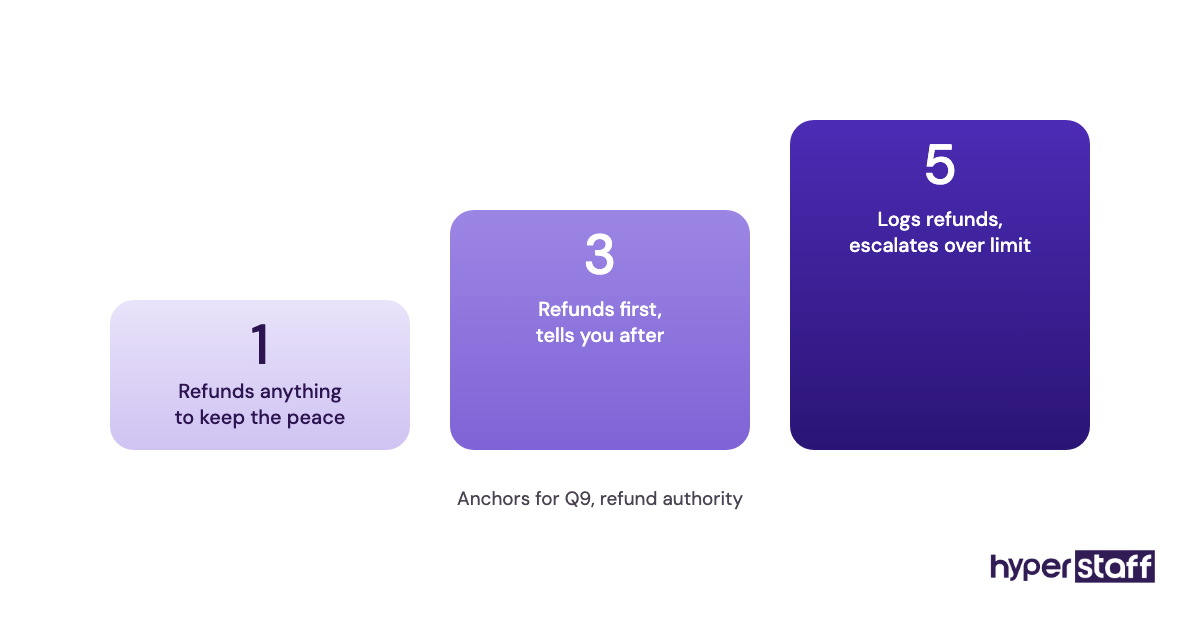
A strong interview scorecard rates each block from 1 to 5 against anchors written before the first call. Without anchors, a "4" means something different every time you use it.
Simple anchors work: 1 means no real experience, 3 means done it with guidance, 5 means done it alone and could teach it. Add a notes column for the exact words a candidate used on Q9 and Q27, since those two answers predict most escalation habits.
Weight the blocks to match the role. For a support-heavy hire, Block 3 might count double; for a catalog hire, Block 4 does.
Tools and software for running ecommerce VA interviews
Running an ecommerce VA interview takes a handful of ordinary tools. Most stores already pay for everything on this list.
- Google Docs or Notion for the question set and scorecard.
- Zoom or Google Meet for the call, recorded only with the candidate's consent.
- Loom so candidates can record a short walkthrough of how they'd do a task.
- A Shopify development store, free through the Shopify Partner program, for hands-on listing tests away from your live store.
- Google Sheets with a cleaned order export for the data task.
- Calendly so candidates book in their own time zone.
We'd skip paid personality tests for this role. They say very little about whether someone can reconcile a stock count or calm down a customer with a late order.
For the software the VA will use once hired, see our roundup of ecommerce VA tools.
9 proven tips for interviewing ecommerce VAs
These tips come from what tends to separate a clean hire from a costly one.
- Send the work sample only to your top three to five candidates.
- Pay for any work sample longer than 30 minutes.
- Ask every question in the same order for every candidate.
- Follow vague answers with "What did you do last Tuesday?"
- Test writing in writing, since most of the job is typed.
- Put the working-hours question in the application form.
- Score within an hour of each call.
- Leave five minutes for the candidate's questions. Strong ones ask about order volume and SOPs.
- Keep your second and third choices warm in case the first hire falls through.
Overcoming common ecommerce VA interview challenges
No-shows are the most frequent problem in remote interviews. A confirmation message the day before, plus a booking link that shows the candidate's own time zone, cuts most of them.
AI-written take-home answers are newer. Add one live element: ask the candidate to edit their answer during the call and explain each change.
Doubts about English level usually settle once you see written work. Judge the replies they'd send customers, since accent rarely matters in a role that's mostly typed.
How do you measure ecommerce VA interview success?
Measure the interview by what the hire does in the first 30 and 90 days. Track order and listing errors, ticket response times and whether the VA escalates the right things.
Then compare those results with each hire's block scores. When a high Block 2 score keeps matching clean order handling, keep the block. When scores and results drift apart, rewrite the questions that misled you.
How long does hiring an ecommerce VA take?
A self-run hire with this template usually takes two to four weeks from job post to first day. Most of that is waiting: applications, scheduling across time zones and work-sample turnaround.
Through Hyperstaff, placement takes 5 business days, and work starts the same day as a 30-minute kickoff call or the next morning. The first few weeks after that decide whether interview strengths show up in real work, and our ecommerce VA onboarding guide covers that phase.
How much does an ecommerce virtual assistant cost?
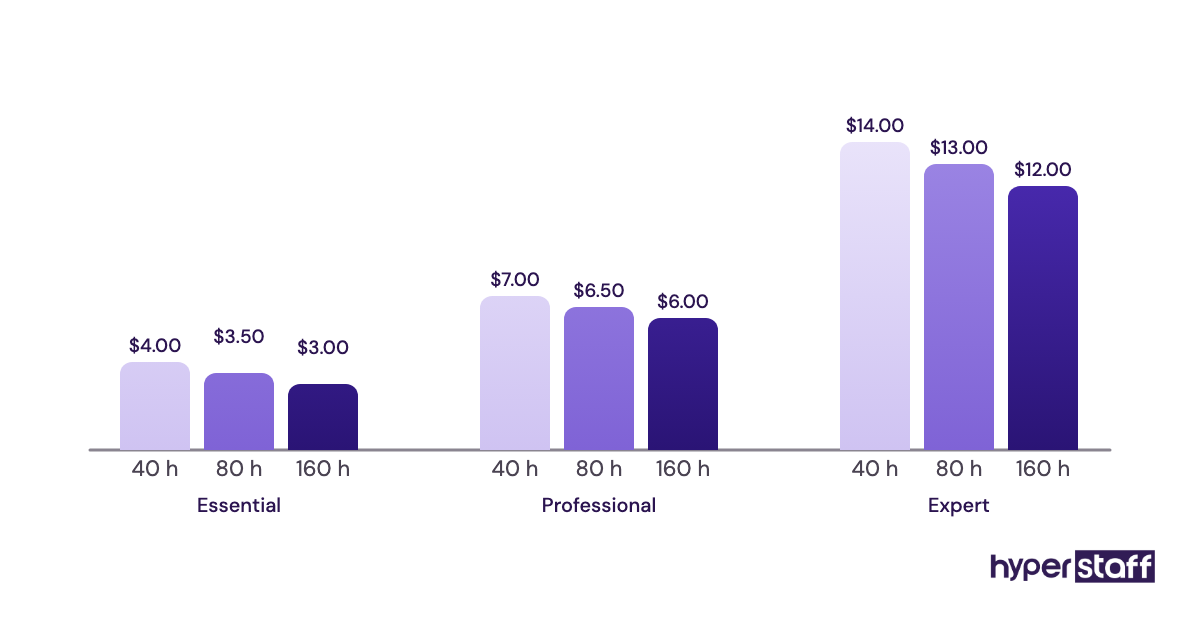
An ecommerce virtual assistant through Hyperstaff costs from $3 to $12+ per hour depending on experience tier, sold in monthly bundles of 40, 80 or 160 hours. A comparable US in-house hire usually costs several times more once payroll taxes and benefits are added.
| Provider and tier | Experience | Hourly rate | 80 hours/month | 160 hours/month | Typical ecommerce work |
|---|---|---|---|---|---|
| Hyperstaff Essential | 0 to 2 years | From $3 | From $240 | From $480 | Order processing, support macros, data entry |
| Hyperstaff Professional | 2 to 5 years | From $6 | From $480 | From $960 | Listings, returns, weekly reports |
| Hyperstaff Expert | 5+ years | From $12 | From $960 | From $1,920 | Catalog management, marketplace operations |
| US in-house ecommerce coordinator | Varies | About $22 to $38 with overhead | About $1,760 to $3,040 | About $3,520 to $6,080 | Same range, plus hiring and equipment costs |
Paying quarterly takes 10% off Hyperstaff bundles. The full breakdown sits in our ecommerce VA cost guide.
Important: Hyperstaff prices above are starting averages, not fixed quotes. Your final rate depends on the tier, the hours you book and the work your store needs.
Is a structured ecommerce VA interview worth it?
Yes. A structured interview is one of the cheapest ways to protect store revenue, because it costs a few hours once and screens out hires who would cost you weeks.
Here's a rough calculation. Building the template takes about 3 hours, and five 45-minute interviews add about 4 more, so roughly 7 hours. At an owner's time valued at $50 an hour, that's about $350.
Now the miss. A wrong Professional-tier hire at 160 hours costs from $960 for the month, plus perhaps 15 hours of your time training and fixing errors ($750). That's about $1,710 before counting a single wrong refund or mispriced product.
No interview catches everything, and some good-on-paper hires still stall in month two. Whether the VA role itself pays off is a separate question, covered in is an ecommerce VA worth it.
How do you choose an agency that screens ecommerce VAs for you?
Choose an agency that tells you exactly how candidates were vetted and what happens if a placement doesn't work. A résumé screen alone leaves Blocks 2 through 5 of this template untested.
Ask these before you sign:
- What did you test, and can I see the results?
- How fast is a replacement, and does it cost anything?
- Who's my point of contact after placement?
- Where do my SOPs live if the VA changes?
- What's the minimum monthly commitment?
For reference, Hyperstaff places pre-vetted candidates from five regions in 5 business days and gives every client a dedicated account manager. A replacement is free and arrives in 5 to 7 business days, briefed from your Operations Vault, where your SOPs, tools and context are written down and kept current.
Ecommerce VA interviews and AI
AI affects ecommerce VA interviews in two ways: candidates can polish written answers with tools like ChatGPT, and VAs on the job will use AI for listings and replies. Your questions should test both.
Ask how they use AI today. A good answer names a task, like first drafts of product descriptions, and explains how they check for wrong sizes, materials or claims before anything goes live.
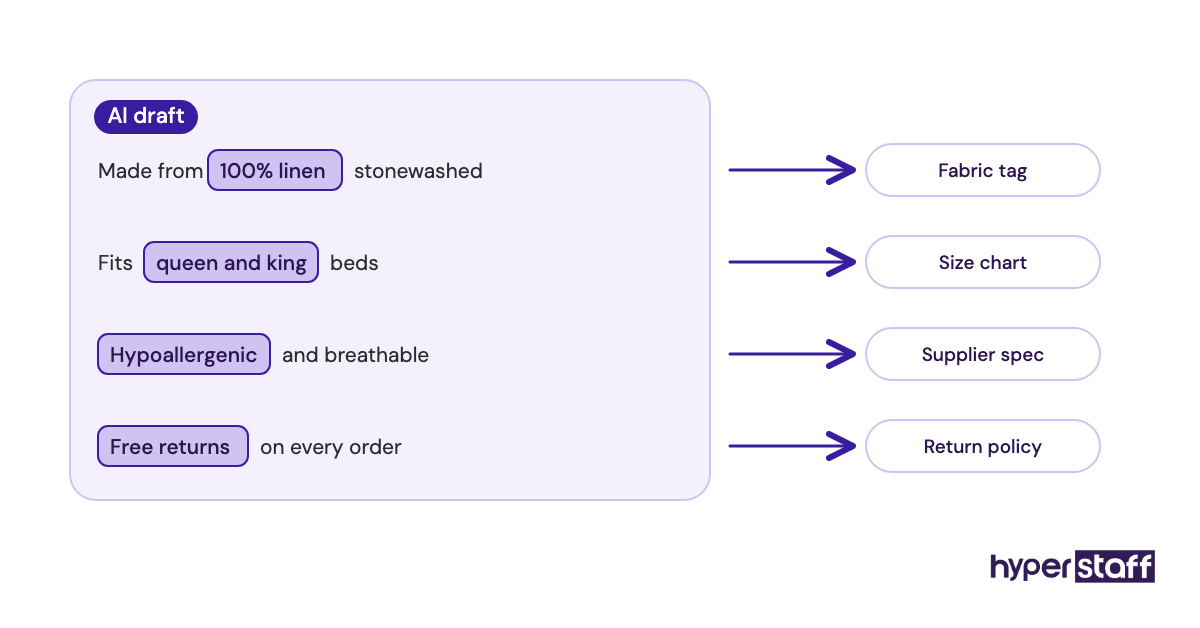
Watch for the opposite habit. A VA who pastes unedited AI replies into tickets will sooner or later promise a customer a refund your policy doesn't allow.
Owners disagree on whether to allow AI in the work sample. We lean toward allowing it and asking candidates to mark where they used it, since that matches how the job actually runs.
Watch for: AI detectors give unreliable results on short text like a support reply, so judge a suspect answer by asking the candidate to rework it live on the call.
Disclaimer: This article is general information, not legal, HR or financial advice. Prices, rates and figures are estimates that may change. Check employment and data privacy rules in your location before hiring.
Common questions
How many interview questions should I ask an ecommerce VA?
Between 15 and 30 questions fits a 30 to 45 minute call. Cut blocks that don't match the role rather than rushing through all 30.
Should I pay for an ecommerce VA test task?
Yes, if it takes longer than about 30 minutes. Paying gets you better effort and keeps strong candidates from dropping out.
What are red flags in an ecommerce VA interview?
Vague answers about daily tasks, refunding everything without checks and claiming zero past mistakes are the big ones. Missing the planted errors in the work sample is another.
Can I interview an ecommerce VA if I don't know Shopify well?
You can. Use scenario and judgment questions, then grade the work sample against a key you wrote in advance, which needs store knowledge more than platform skill.
How long should an ecommerce VA interview be?
Plan 30 to 45 minutes for the call and 20 to 30 minutes for the work sample. Anything over an hour usually means the question set needs trimming.
Book a free 15 min call
We place a pre-vetted specialist in 5 business days, fully managed, from $3/hour.