Executive Virtual Assistant Interview Questions: A Copyable Template
A ready-to-copy executive virtual assistant interview template with 32 questions, scoring anchors and the answers that should end an interview early.
On this page
- What Should Executive Virtual Assistant Interview Questions Test?
- Key Executive VA Interview Terms You Should Know
- Why Do Interview Questions Matter More for an Executive VA?
- How Does the Executive VA Interview Process Work?
- The Executive Virtual Assistant Interview Questions Template
- How Do You Adapt the Template to Your Role? A Step-by-Step Plan
- Types of Executive VA Interview Questions
- How Is an Executive VA Interview Different From Other Hiring Interviews?
- What Are the Benefits of a Structured Interview Template?
- What Are the Drawbacks of a Structured Interview Template?
- Who Needs an Executive VA Interview Template?
- Executive VA Interview Answer Examples
- What Does an Effective Executive VA Interview Strategy Look Like?
- Tools for Running Executive VA Interviews
- 10 Executive VA Interview Tips That Hold Up
- How Do You Overcome Common Interview Challenges?
- How Do You Measure Whether the Interview Worked?
- How Long Does the Executive VA Interview Process Take?
- How Much Does Hiring an Executive VA Cost?
- Is a Structured Executive VA Interview Worth It?
- How Do You Choose an Executive VA Agency?
- How Does AI Change Executive VA Interviews?
- FAQs
💡 Key Takeaways:
1) Executive virtual assistant interview questions should test judgment, discretion, written communication and unsupervised work across time zones, because those skills decide whether the hire saves an executive time or costs it.
2) A strong executive VA interview runs in four stages: a written screen, a live interview of 12 to 15 questions, a short paid work sample and targeted reference checks.
3) Score every answer on the same 1 to 5 scale with written anchors, and treat any weak answer on confidentiality as a reason to stop the process.
Better interview questions protect your billable hours
Hyperstaff has placed 70+ virtual assistants with 30+ clients, and every candidate is pre-vetted before you meet them. If you'd rather start from a screened shortlist, our executive virtual assistant services place a dedicated specialist in 5 business days, with rates from $3/hour and free replacement in 5 to 7 business days.
What Should Executive Virtual Assistant Interview Questions Test?
Executive virtual assistant interview questions should test judgment, discretion, written English and how a candidate works without supervision from another time zone. An executive VA runs part of a leader's week remotely, and the interview has to show how that person thinks once the instructions run out.
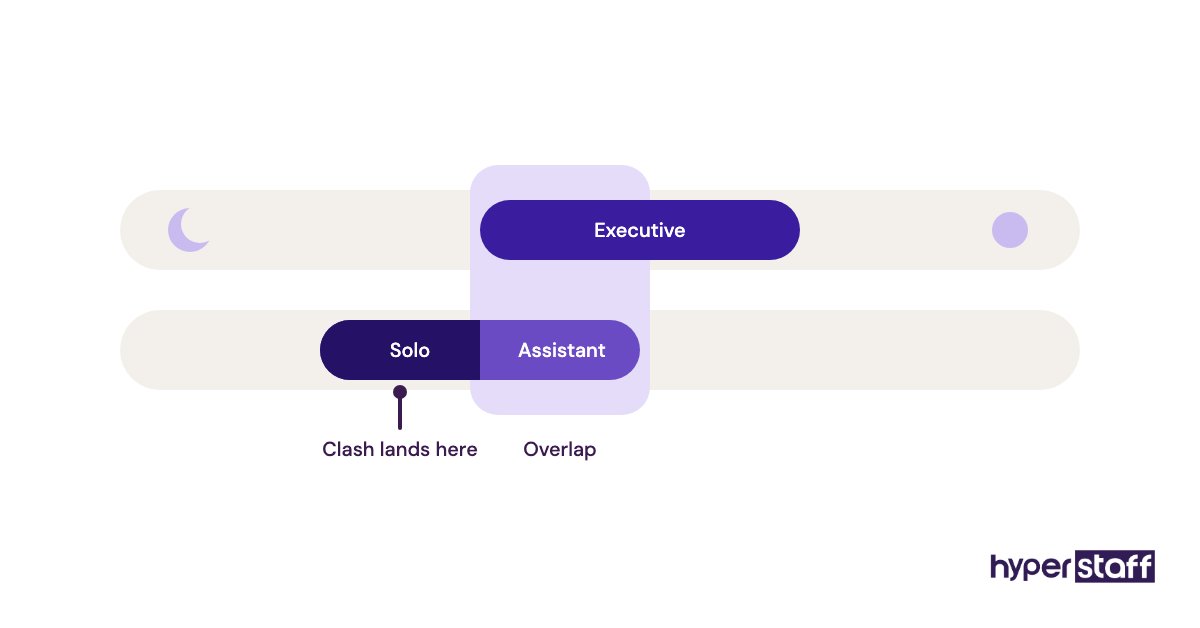
Most hiring managers reuse a general admin script. It checks tool familiarity, then misses the part that decides the hire: whether this person makes the right call on a clashing meeting at 6 a.m. your time without waking you.
The role is wider than inbox and calendar work. Executive VAs also handle travel, board prep, vendor follow-ups, research, light bookkeeping and pieces of operations, so it's worth reading what an executive virtual assistant does before you choose questions.
Key Executive VA Interview Terms You Should Know
- Behavioral question = asks what the candidate did in a real past situation.
- Situational question = sets up a scenario and asks what they would do.
- Work sample = a short task that mirrors real work, scored against a rubric.
- Scorecard = a sheet listing each competency, a 1 to 5 scale and what a 3 and a 5 look like.
- Gatekeeping = deciding who gets the executive's time and who gets redirected.
- Discretion = keeping confidential material, such as salaries or board papers, private.
- Delegated access = permission to send, accept and edit inside an executive's email or calendar.
- Async communication = written updates clear enough that nobody needs a follow-up call.
- Time zone overlap = the hours when both people are online at once.
- Trial period = the first weeks when fit is confirmed on live work.
Why Do Interview Questions Matter More for an Executive VA?
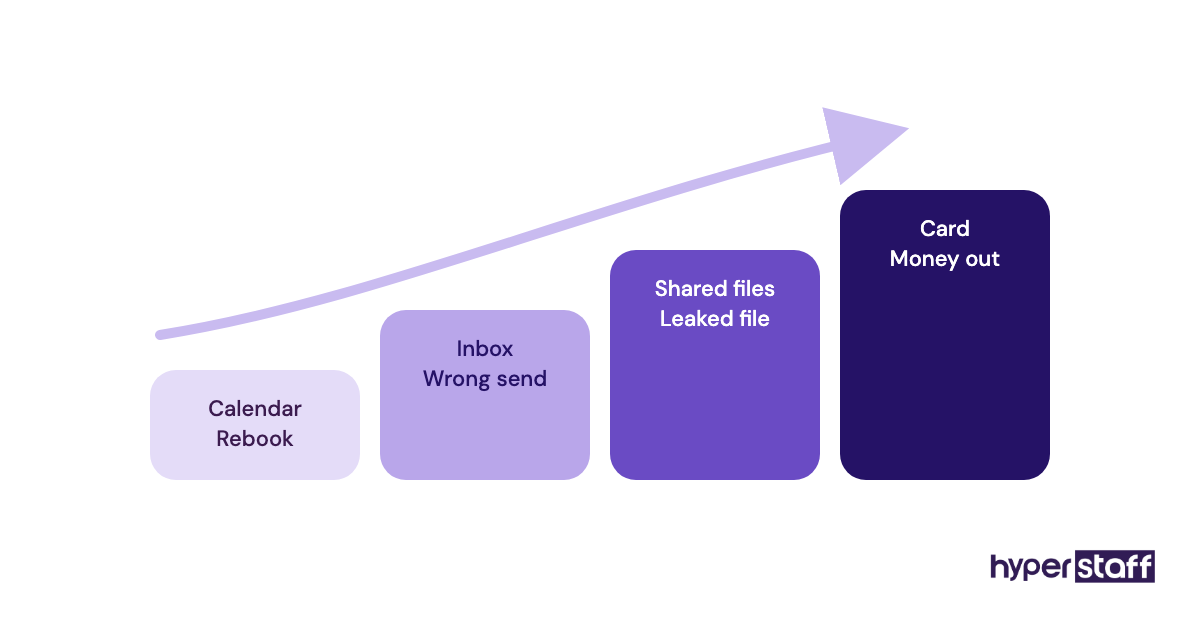
Interview questions matter more for an executive VA because the role comes with delegated access. A weak general VA hire creates rework; a weak executive VA hire can send the wrong email from your account, double-book an investor or forward a salary file to the wrong person.
The difference also shows up in the executive's own hours. An assistant who needs three clarifying messages per task hands back less time than they take.
Interviews for this role tend to fail in one predictable spot. The hiring manager enjoys the video call and skips the written test, yet warmth on camera and clear written English are separate skills, and the job runs on the second one.
Worth knowing: Most of an executive VA's output is written, from email drafts to meeting briefs to end-of-day updates, so a candidate who speaks well but writes long, unclear paragraphs will usually cost you more time than a quieter candidate who writes short, clean updates.
How Does the Executive VA Interview Process Work?
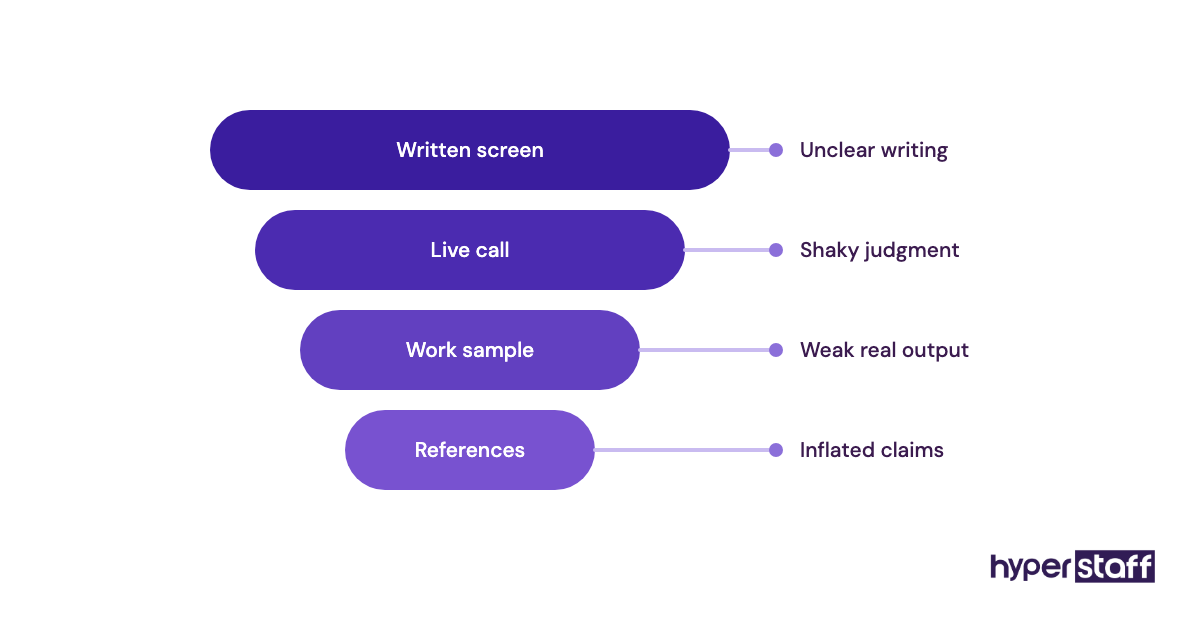
The executive VA interview process usually runs in four stages: a written screen, a live interview, a paid work sample and a reference check. Each stage removes a different kind of poor fit.
The written screen goes first because it's cheap. Five short written answers filter out candidates who can't write clearly before anyone books a call.
The live interview takes 45 to 60 minutes and draws from the template below. The work sample follows within a day or two, and references come last, once you're down to one or two finalists.
The slow part is rarely the interviewing itself. It's the dead time between stages: candidates left waiting three or four days for feedback take other offers, and the strongest ones leave first.
Sourcing and shortlisting happen before any of this, and our guide to hiring an executive virtual assistant walks through that earlier funnel.
The Executive Virtual Assistant Interview Questions Template
The template below holds 32 executive virtual assistant interview questions in seven parts, each with a note on what a strong answer contains. Copy it into a doc, cut it to fit your hour, and score every answer on the same 1 to 5 scale.
Part 1: Written screen (send before any call)
- Describe the last inbox you managed for someone else. Roughly how many emails a day, and how did you sort them?
- Write a two-sentence reply declining a vendor's meeting request on behalf of an executive.
- Which hours can you work in [your time zone], and which of those can stay fixed every week?
- Tell us about a mistake you made at work and what you changed afterward.
- Which email and calendar tools have you used with delegated access?
Look for: short sentences, a real number in answer 1, a polite decline with no over-apologizing in answer 2.
Part 2: Experience and scope
- Walk me through a normal week supporting your most recent executive. What took the most hours?
- Who is the most senior person you've supported, and what did they let you decide alone?
- Which tasks did you take over that weren't in your original job description?
- How did you know your executive was happy with your work?
Look for: named tools, real volumes and decisions the candidate made without asking.
Part 3: Calendar and inbox judgment
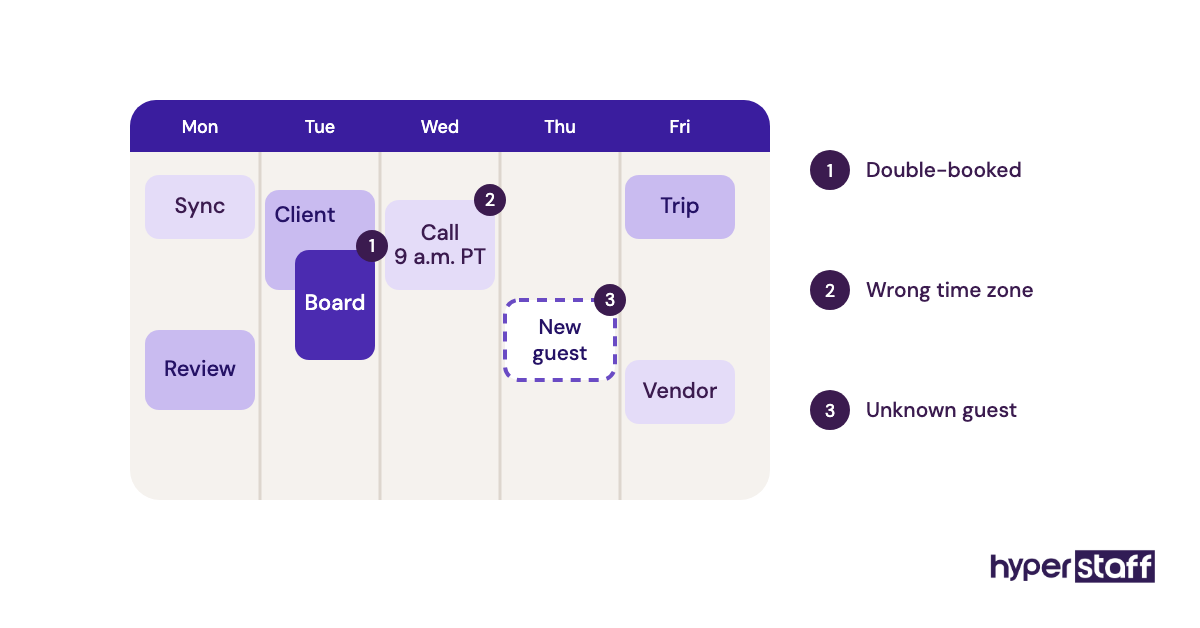
- Two "urgent" meetings land in the same slot. One is from the biggest client, one from a board member, and you can't reach the executive. What do you do?
- An email arrives at 11 p.m. that looks like a wire transfer request from the executive. What's your next step?
- How do you decide which emails the executive sees and which you answer yourself?
- The executive keeps accepting meetings over the focus blocks you set. How do you raise it?
- How would you plan a three-city trip across two time zones, and what would you send the executive before they leave?
Look for: a verification step through a second channel in 11, a clear triage rule in 12, and tact that still names the problem in 13.
Part 4: Discretion and trust
- Tell us about a time you had access to confidential information. How did you handle it?
- A colleague of the executive asks what the executive's compensation review said. What do you say?
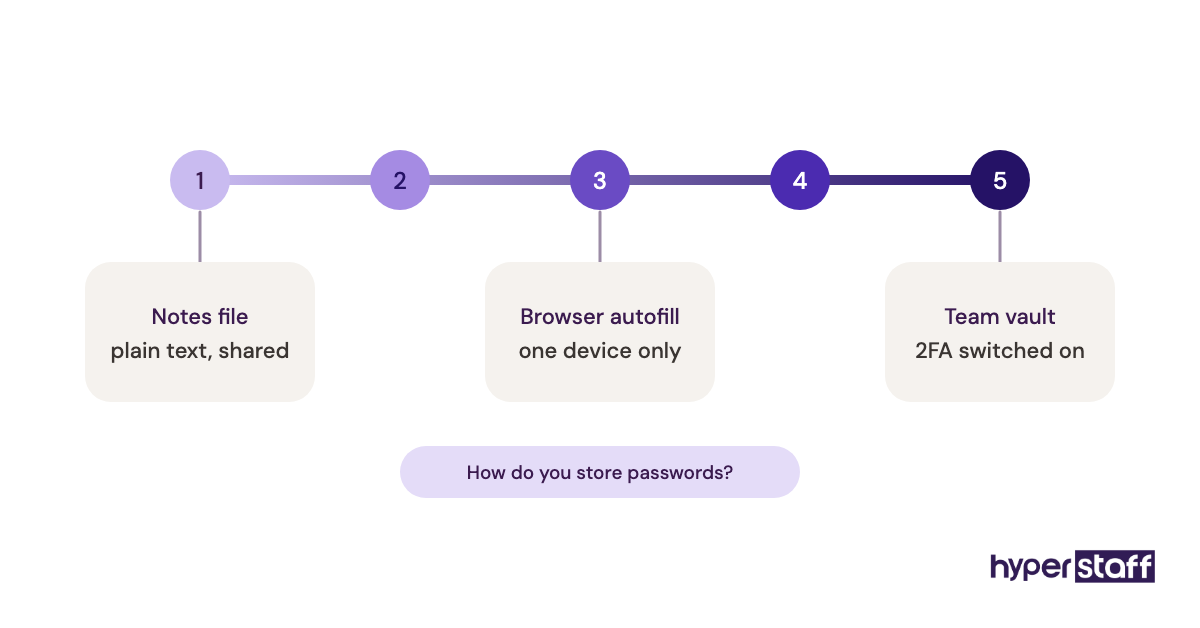
- How do you store passwords and sensitive files you're given?
- You spot a charge on the executive's card you don't recognize. What do you do?
Look for: a named password manager, a polite refusal in 16 and escalation in 18.
Part 5: Communication and async work
- Write a three-line end-of-day update for today, as if this interview were your task.
- How do you get an answer when the executive is in back-to-back meetings all day?
- An instruction is unclear and the deadline is in two hours. What do you do?
- How do you prefer to receive feedback?
Look for: a sensible default decision plus a flag to the executive in 21.
Part 6: Operations and projects
- Describe a process you documented so someone else could follow it.
- Have you run a project or event end to end? What went wrong?
- Which reports or dashboards have you prepared for an executive?
- How do you track deadlines that belong to other people?
Look for: an SOP or checklist they wrote, and honesty about what went wrong.
Part 7: Fit and logistics
- What kind of executive have you found hardest to work with, and why?
- What would make you leave a role in the first six months?
- What's your setup for internet backup, power backup and a quiet workspace?
- Which hours overlap with [executive's time zone], and can you take occasional early or late calls?
- What do you want to be doing in two years?
- What questions do you have for us?
Look for: a real backup plan in 29 and a candid, non-gossipy answer in 27.
Scoring: rate each part from 1 to 5 and write one line of evidence per score. A 1 anywhere in Part 4 ends the process.
A 60-minute live call fits about 12 to 15 questions with follow-ups. Part 1 goes out in writing, Part 4 stays in full, and the rest you choose by role.
Part 6 is the section to rewrite most. Swap its questions for whatever your assistant will really own, and our list of executive virtual assistant tasks makes the gaps easy to spot.
How Do You Adapt the Template to Your Role? A Step-by-Step Plan
Adapting the template takes about two to three hours the first time and under an hour after that. The five steps below turn a generic question bank into an interview that fits one executive.
Step #1: Write the role down before picking questions
Start with a written role description, then choose questions that test the three to five things the job can't get wrong. An executive virtual assistant job description gives you those competencies in plain language.
Skipping this step is why so many interviews drift into small talk. With no written role, every answer sounds roughly fine.
Step #2: Cut the live interview to 12 to 15 questions
Keep all of Part 4, two or three questions from Part 3 and one or two from each other part. Fewer questions with real follow-ups tell you more than 30 questions answered at the surface.
Step #3: Anchor the scorecard before the first call
For each question, write one line on what a 3 looks like and one on what a 5 looks like. Score straight after each call, before you compare notes with anyone.
Tip: Write the scoring anchors before you meet anyone, because once you've spoken with a likeable candidate your idea of a good answer quietly drifts toward whatever they said.
Step #4: Set a short, paid work sample
Keep it to 30 to 60 minutes and base it on a redacted slice of your real week. A cluttered calendar to fix, three emails to answer and a two-day trip to plan will show more than any interview question.
Pay for the task. Unpaid tests put off experienced candidates, and they're the ones you want.
Step #5: Ask references targeted questions
Generic reference calls get generic praise. Ask the former executive two things: "What did you stop double-checking after the first month?" and "What would you still keep an eye on?"
Types of Executive VA Interview Questions
Executive VA interview questions fall into eight types, and each one tests something the others miss. The table maps each type to its stage and how much weight it should carry in your score.
| Question type | What it tests | Example | Stage | Weight |
|---|---|---|---|---|
| Written screen | Clarity, grammar, speed | Decline a meeting in two sentences | Before the call | High |
| Behavioral | Past performance | Describe the last inbox you managed | Live interview | Medium |
| Situational | Judgment under pressure | Two urgent meetings, one slot | Live interview | High |
| Discretion | Confidentiality, ethics | A colleague asks about salary | Live interview | Pass or fail |
| Tool check | Software fluency | Which calendar tools with delegated access | Written or live | Low |
| Work sample | Real output quality | Fix a messy calendar | After the call | High |
| Fit and logistics | Hours, setup, motivation | Internet and power backup | Live interview | Medium |
| Reference | Consistency over time | What did you stop checking? | Final stage | Medium |
How Is an Executive VA Interview Different From Other Hiring Interviews?
An executive VA interview weighs judgment and confidentiality more heavily than most hiring interviews, because the assistant acts in the executive's name. The comparisons below show where the questions shift.
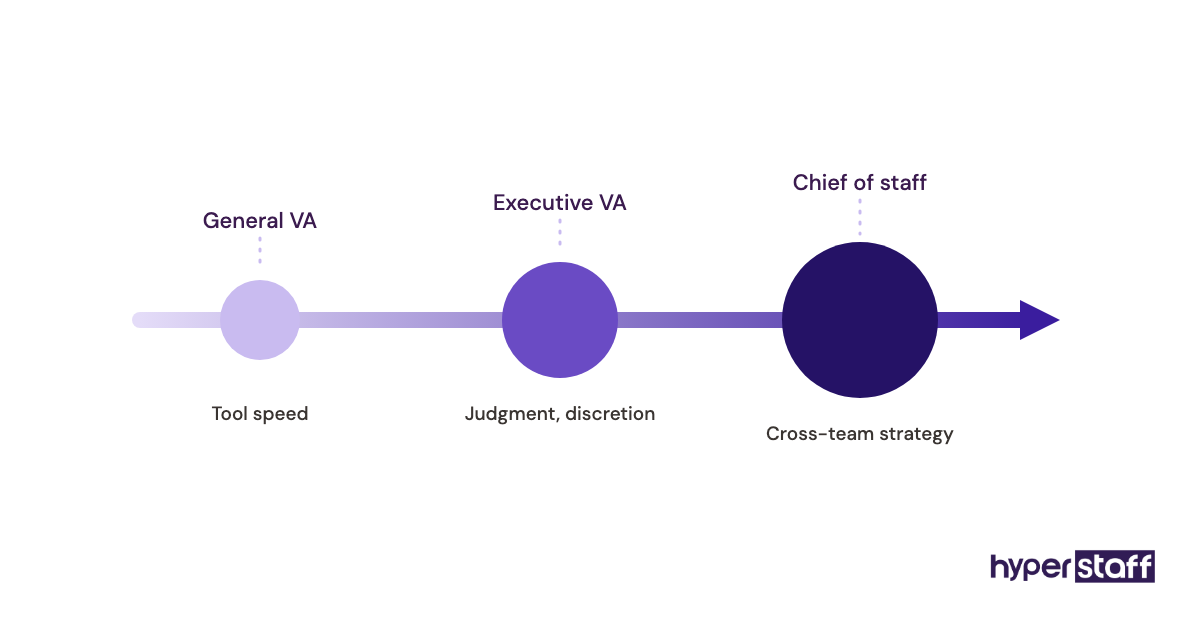
Executive VA interview vs. general virtual assistant interview
A general VA interview leans on task speed and tool skills, since the work is often defined and repeatable. An executive VA interview spends more time on situational judgment, because the work changes daily and often arrives half-explained.
Executive VA interview vs. in-house executive assistant interview
An in-house interview can lean on office presence and how someone handles walk-in requests. A remote interview has to test written async communication, time zone overlap and home setup, which an office hire rarely needs to prove.
The wider cost and control trade-off sits in our executive virtual assistant vs in-house comparison.
Executive VA interview vs. chief of staff interview
A chief of staff interview tests strategy, team leadership and decision rights across departments. Executive VA questions stay closer to execution: protecting the calendar, preparing the executive and closing loops quickly.
What Are the Benefits of a Structured Interview Template?
A structured template makes candidates comparable and pulls hiring decisions away from gut feel.
- Every candidate answers the same questions, so you compare like with like.
- Written scoring anchors cut down on hires made because a call felt friendly.
- Weak written English shows up before you spend a call on it.
- Situational questions surface judgment that résumés hide.
- A second interviewer can join without a long briefing.
What Are the Drawbacks of a Structured Interview Template?
The drawbacks are real but small, and most can be fixed with follow-up questions.
- Scripted calls can feel stiff to experienced candidates.
- Common behavioral questions get rehearsed answers.
- The first setup takes two to three hours.
Who Needs an Executive VA Interview Template?
Anyone hiring an executive VA directly, without an agency screen in front, needs the full template. Founders hiring a first assistant gain the most, because they often have no prior hire to compare against.
The view from an operations or HR lead hiring for several executives is different. They need the scorecard more than the questions, since consistency across five hires matters more to them than depth on one.
If an agency has already screened candidates, a shorter version still earns its place. Keep Parts 3 and 4 and the work sample, and drop most of the written screen.
Executive VA Interview Answer Examples
Answer examples make the scorecard concrete. The good ones below would score a 4 or 5; the poor ones would score a 1 or 2 on the same questions.
Good answer examples
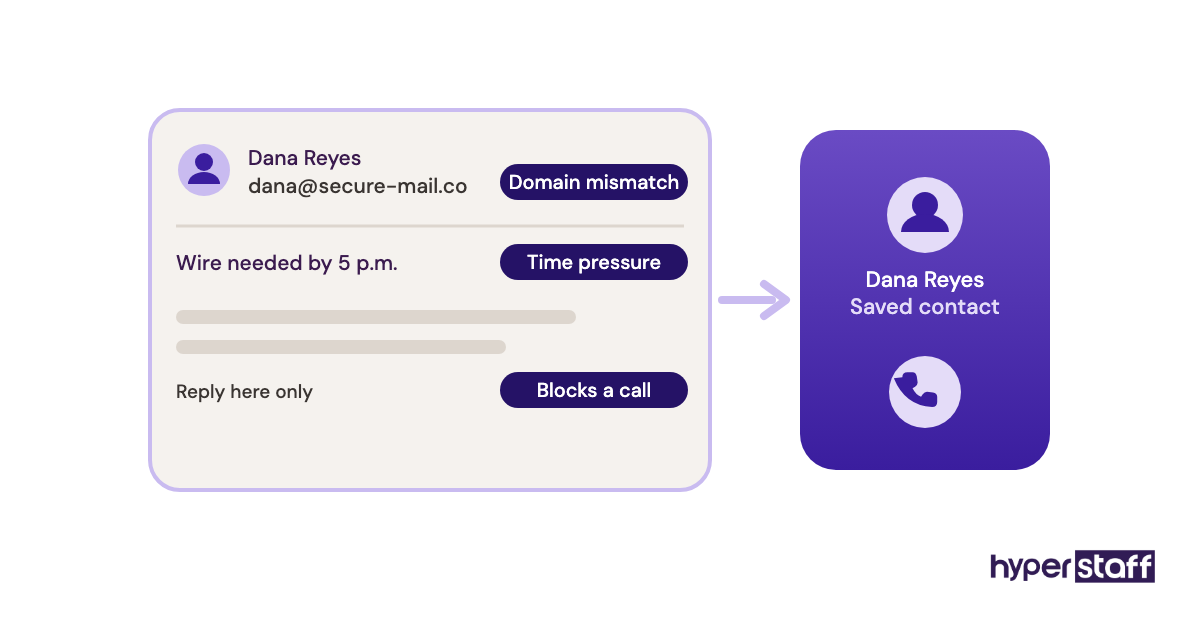
Good answer to the late-night wire transfer email
"I wouldn't send anything. I'd call the executive on the number saved in my contacts, and if I couldn't reach them I'd hold the request and flag it to finance first thing."
The candidate names a second-channel check and a fallback. Both matter, since payment fraud through spoofed executive emails is a known risk for any assistant with delegated access.
Good answer to the double-booked urgent meetings
"I'd check which one has a hard deadline behind it, hold that slot, and offer the other two times within 24 hours. Then I'd leave the executive a short note explaining what I did and how to undo it."
A decision, a reason and an easy reversal. That's the shape you want.
Good answer to "tell us about a mistake"
"I booked a call in the wrong time zone because the invite showed my local time. Now I write both time zones in every invite and confirm the day before."
Poor answer examples
Self-description with no evidence
"I'm very organized and detail-oriented." Every candidate says it, and it scores nothing until a specific example follows.
Waiting for instructions on everything
"I'd just wait until the executive tells me what they want." In a different time zone, waiting can mean a missed deadline, so this answer fails Part 5.
Sharing details about a former executive
A candidate who explains, with names, why their last boss was difficult has just shown you how they'll talk about you. Treat it as a discretion fail, however funny the story is.
What Does an Effective Executive VA Interview Strategy Look Like?
An effective executive VA interview strategy is short, written-first and decided fast. Run the written screen, one live interview with two people, a paid work sample and references, then decide within 48 hours of the last step.
Practitioners split on one point. Some hiring managers skip the work sample for senior candidates, arguing that five years of experience speaks for itself; we'd keep it and shorten it to 30 minutes, because experience and fit with one executive's habits are separate things.
A strategy also needs an owner. When nobody is clearly responsible for moving candidates between stages, the dead time grows and the process stalls.
Keep in mind: The executive who will work with the assistant should sit in on at least one stage, ideally the live interview, because a candidate who suits the hiring manager's style can still clash with the person whose inbox they'll be running.
Most executive virtual assistant mistakes trace back to this stage: a rushed interview, no work sample and a decision made on charm.
Tools for Running Executive VA Interviews
A short stack covers the whole interview process: a form tool for the written screen, a video tool for the live call, a shared doc for the scorecard and a scheduling link. Google Forms or Typeform, Zoom or Google Meet, Google Docs or Notion, and Calendly are all common picks.
Loom is useful for async video answers and for reading tone. It also favors confident speakers, so weight Loom responses lightly against written ones.
The tools you ask about in the interview matter more than the ones you run it on. Our roundup of executive virtual assistant tools lists the software a hired assistant will use day to day.
10 Executive VA Interview Tips That Hold Up
These ten tips sharpen any executive VA interview, whether you use the full template or a short version.
- Send Part 1 in writing before booking any call.
- Ask for a number in every experience answer: emails per day, executives supported, trips booked.
- Follow each situational answer with "And if that didn't work?"
- Run the live interview during the hours the assistant will really work.
- Pay for the work sample.
- Build the work sample from a redacted slice of your own week.
- Score each answer straight after the call, alone.
- Ask references what they stopped double-checking.
- Give candidates a decision date and keep it.
- Decide on discretion first; a weak Part 4 ends the process.
How Do You Overcome Common Interview Challenges?
The most common interview challenges are rehearsed answers, AI-polished written screens and candidates dropping out between stages. Each one has a simple fix.
For rehearsed answers, ask a second and third follow-up. Prepared stories rarely survive "What did the executive say next?"
For polished written screens, add one short writing task during the live call. For dropouts, compress the timeline and tell candidates the decision date on day one.
How Do You Measure Whether the Interview Worked?
Interview success shows up after the hire, in the first 90 days. Track how many corrections the executive makes per week, when the assistant first runs a full week alone and whether they're still in the role at day 90.
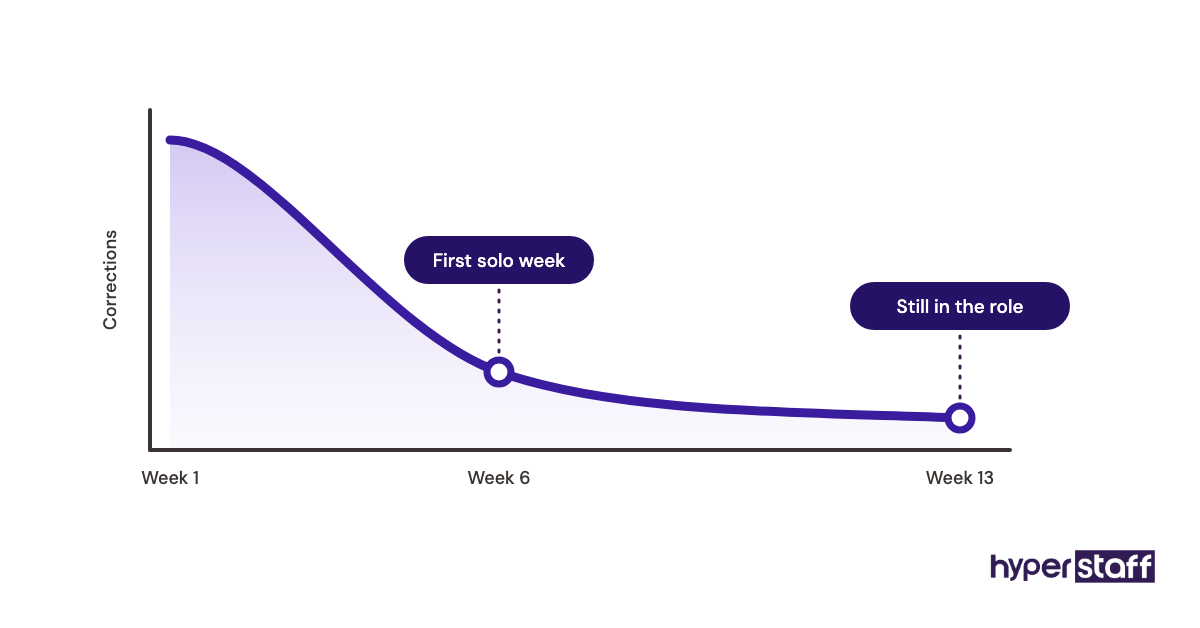
Compare those results with the interview scores. If high scorers keep struggling in one area, the questions for that area need rewriting.
A good interview still needs a good start, so pair it with a plan for onboarding an executive virtual assistant.
How Long Does the Executive VA Interview Process Take?
A direct executive VA interview process usually takes two to four weeks from job post to accepted offer. Most of that time is sourcing and waiting between stages, while the interviews themselves add up to a few hours.
Through an agency, the timeline is shorter because screening is already done. Hyperstaff places a pre-vetted assistant in 5 business days, then a 30-minute kickoff call starts the work that day or the next morning.
How Much Does Hiring an Executive VA Cost?
Hiring an executive VA through Hyperstaff starts at $3 to $12 an hour depending on experience tier, compared with roughly $30 to $45 an hour in base pay for a US in-house executive assistant. The table sets the two side by side, and our executive virtual assistant cost breakdown goes deeper.
| Cost line | In-house executive assistant (US) | Hyperstaff executive VA |
|---|---|---|
| Hourly rate | Roughly $30 to $45 base pay | From $3 (Essential), $6 (Professional), $12 (Expert) |
| Full-time month (160 hours) | Roughly $5,000 to $7,500 base pay | From $480, $960 or $1,920 by tier |
| Employer taxes and benefits | Commonly 20% to 30% on top of salary | Not applicable to an agency placement |
| Part-time options | Limited | Monthly bundles of 40, 80 or 160 hours |
| Time to place | Several weeks of screening | 5 business days |
| If the hire doesn't work out | Restart the search | Free replacement in 5 to 7 business days |
| Payment discount | None | Save 10% paying quarterly |
Important: Hyperstaff prices above are starting averages. Your final cost depends on the experience tier, the hours bundle and the work your assistant takes on, which we confirm with you on a free discovery call.
Is a Structured Executive VA Interview Worth It?
Yes, a structured executive VA interview is worth it, because a few hours of preparation decide whether the assistant gives the executive back ten hours a week or adds ten hours of corrections. Few hiring steps pay back that fast.
Here's an example calculation. Say the executive's time is worth $150 an hour and a well-chosen assistant takes 10 hours a week off their plate: that's about $6,000 a month in reclaimed time against an Expert assistant from $1,920 a month.
A poor hire flips the math. Six weeks of fees, plus the executive's hours spent fixing errors, plus a restarted search, can cost more than the whole first quarter of a good placement.
The deeper return question sits in our piece on whether an executive VA is worth it.
How Do You Choose an Executive VA Agency?
Choose an executive VA agency by how it screens, what happens when a placement fails and who keeps your processes documented. Ask to see the agency's screening questions and whether it uses written tests and situational questions.
Replacement terms deserve a close read. A free replacement only helps if the new assistant can pick up quickly, which depends on how well your processes are written down.
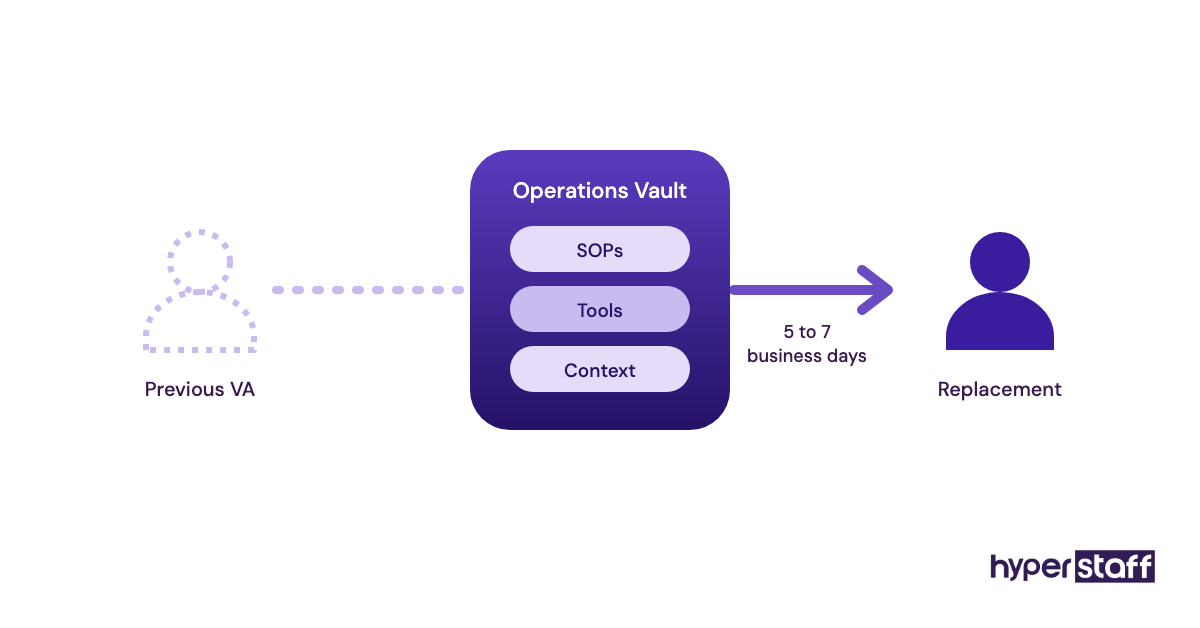
At Hyperstaff, every client gets a dedicated account manager and an Operations Vault: your SOPs, tools and context, written down and maintained for you. A replacement, if you ever need one, is briefed from that vault within 5 to 7 business days.
Region matters for time zone overlap. Hyperstaff places pre-vetted talent from the Philippines, Latin America, India, Eastern Europe and the United States, so overlap can be matched to the executive's working day.
How Does AI Change Executive VA Interviews?
AI changes executive VA interviews in two ways: candidates use it to polish written answers, and the hired assistant will use it in daily work. Your questions need to account for both.
Polished written screens are now common, so the written screen proves less on its own. Add a short live writing task and ask follow-ups about the candidate's own written answers.
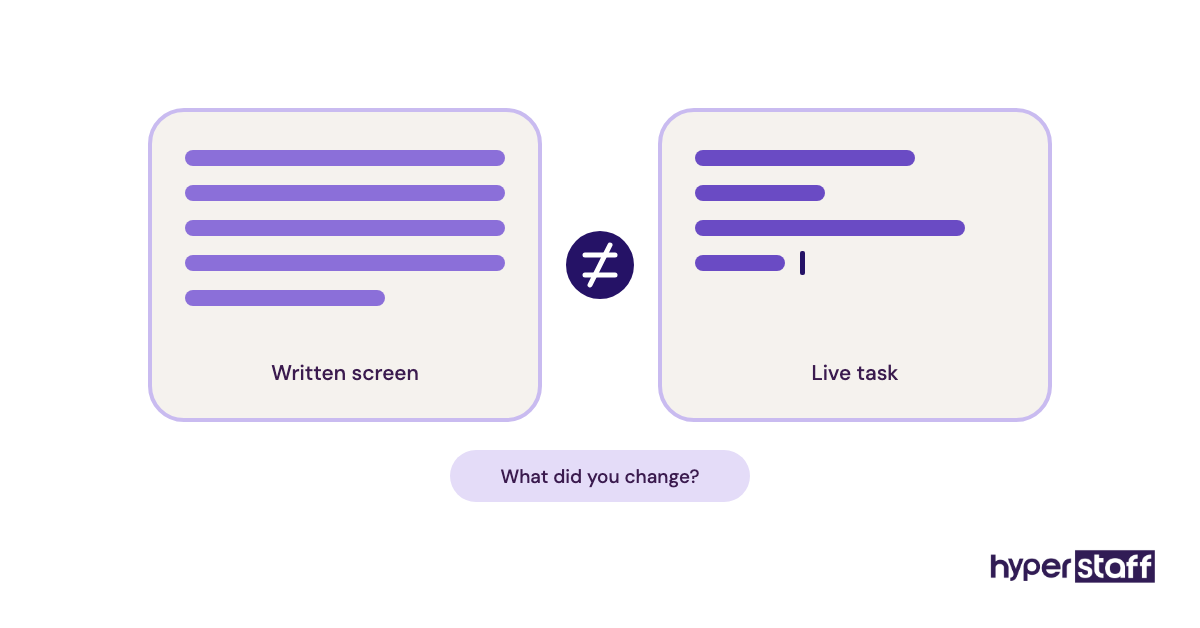
Watch for: A candidate whose written screen reads perfectly but who struggles to write a three-line update live on the call has probably leaned on an AI tool for the screen, which is worth discussing openly before you rule them out.
Hiring managers disagree on AI in the work sample. Some ban it to see raw skill; we'd allow it and ask the candidate to explain what they checked and changed, because that's how the job runs.
A good question to add: "Which AI tools do you use for drafting, and what do you never let them send without review?"
Disclaimer: This article is for general information only and isn't legal, HR or employment advice. Hiring laws, pay rules and contractor rules vary by country and state, so check with a qualified professional before making hiring decisions. Pricing shown is indicative and may change.
Common questions
How many questions should I ask in an executive VA interview?
Ask 12 to 15 questions in a 60-minute live interview, plus five in a written screen beforehand. Fewer questions with real follow-ups tell you more than a long list answered quickly.
Should I pay an executive VA candidate for a test task?
Yes. A paid 30 to 60 minute task attracts experienced candidates and gives you real work to judge. Unpaid tests tend to lose the strongest applicants first.
What are red flags in an executive assistant interview?
Sharing a former employer's private details, vague answers with no numbers, and waiting for instructions on every decision. Any weak answer on confidentiality should end the process.
Can I interview executive VA candidates from an agency myself?
You can with most agencies, and it's worth asking before you sign. Use a shortened version of this template that keeps the judgment and discretion questions.
What should an executive VA candidate ask me in the interview?
Good candidates ask how you prefer updates, which decisions they can make alone and what went wrong with past assistants. A candidate with no questions about how you work is a weak sign.
Book a free 15 min call
We place a pre-vetted specialist in 5 business days, fully managed, from $3/hour.