What Is an Executive Virtual Assistant? Role, Scope and Cost
An executive virtual assistant is a remote specialist who protects a senior leader's time by owning the calendar, inbox, travel and the follow-through between meetings.
On this page
- What Is an Executive Virtual Assistant?
- Key Executive Virtual Assistant Terms You Should Know
- Why Is an Executive Virtual Assistant Important?
- How Does an Executive Virtual Assistant Work?
- Types and Forms of Executive Virtual Assistants
- How an Executive Virtual Assistant Differs From Related Roles
- The Benefits of an Executive Virtual Assistant
- The Drawbacks of an Executive Virtual Assistant
- Who Needs an Executive Virtual Assistant?
- Executive Virtual Assistant Examples
- Creating an Executive Virtual Assistant Plan, Step-by-Step
- What Does an Effective Executive Virtual Assistant Strategy Look Like?
- Executive Virtual Assistant Tools and Software
- 8 Proven Executive Virtual Assistant Tips and Best Practices
- Overcoming Common Executive Virtual Assistant Challenges
- How to Measure Executive Virtual Assistant Success
- How Long Does an Executive Virtual Assistant Take to Work?
- How Much Does an Executive Virtual Assistant Cost?
- Is an Executive Virtual Assistant Worth It?
- How to Choose an Executive Virtual Assistant Agency
- Executive Virtual Assistant Statistics, Trends and Future Predictions
- Executive Virtual Assistants and AI
- FAQs
💡 Key Takeaways:
1) An executive virtual assistant is a remote professional who manages a senior leader's calendar, inbox, travel, meeting prep and follow-ups, and often takes on business work like client communication, reporting and project tracking.
2) The role works when the assistant gets real decision rights, written rules and access to the right tools from week one, and it stalls when it's treated as a task inbox.
3) A full-time offshore executive virtual assistant usually costs a fraction of a fully loaded in-house executive assistant, so the deciding question is how many senior hours a week the role gives back.
Your Calendar Is Quietly Costing You Revenue
Hyperstaff has placed 70+ virtual assistants with 30+ clients, and our remote executive assistance services match you with a pre-vetted specialist in 5 business days, from $3/hour. Your assistant learns one business, yours, and a dedicated account manager keeps your Operations Vault current, so even a replacement starts already briefed on how you work.
What Is an Executive Virtual Assistant?
An executive virtual assistant is a remote professional who protects a senior leader's time by owning their calendar, email, travel, meeting preparation and follow-through. The executive virtual assistant works from another location, usually part-time or full-time, and acts on the leader's behalf inside agreed limits.
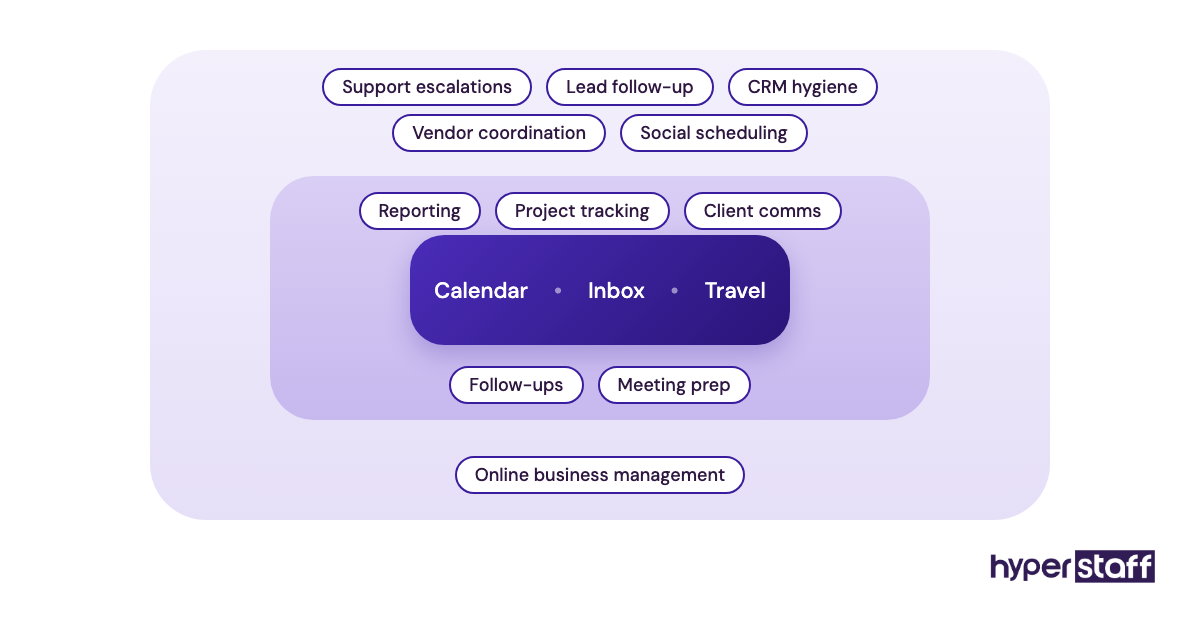
The scope runs wider than inbox and calendar admin. Depending on the business, an executive VA may also handle customer support escalations, lead follow-up, CRM hygiene, social media scheduling, vendor coordination and parts of online business management.
What separates the executive tier from general admin help is judgment. A good EVA decides which meeting moves, which email can wait three days and which one needs a reply in the next hour, without asking each time.
Key Executive Virtual Assistant Terms You Should Know
- EVA = short for executive virtual assistant, a remote assistant supporting a founder, partner or C-level leader.
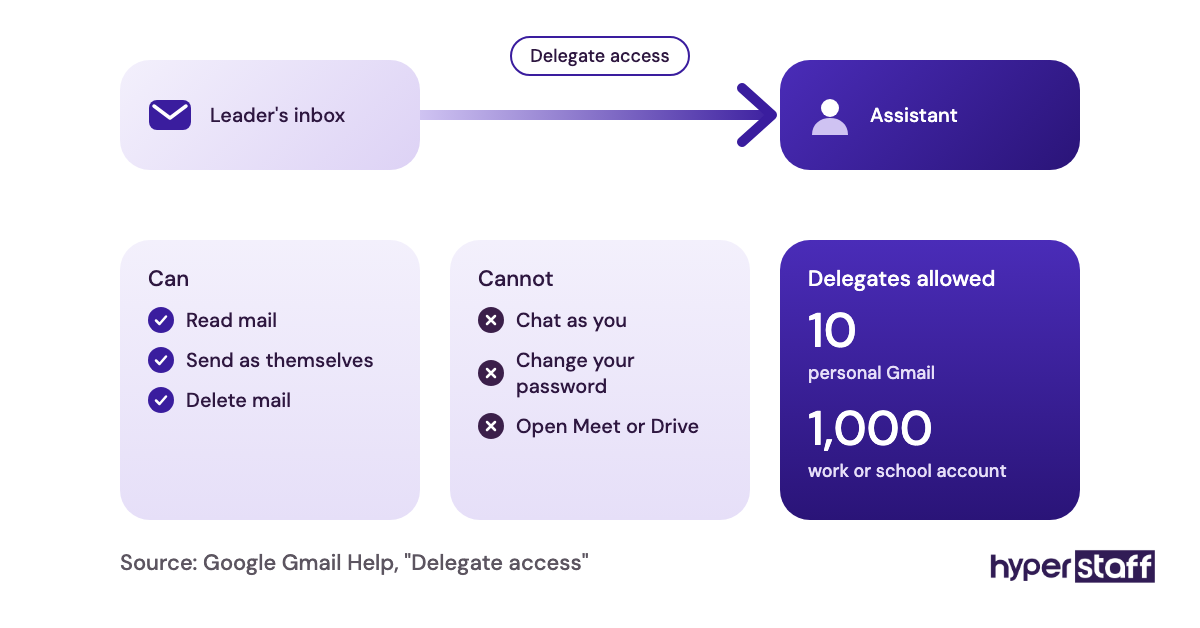
- Delegate access = permission for the assistant to read, send and organize email or calendar events on your behalf.
- Inbox triage = sorting incoming email into reply, delegate, file or delete, usually on a set schedule.
- Calendar architecture = the rules for when meetings can be booked, how long they run and which blocks stay protected.
- Decision rights = the written list of what the assistant can approve, decline or spend without checking first.
- SOP = standard operating procedure, a step-by-step note for a repeating task.
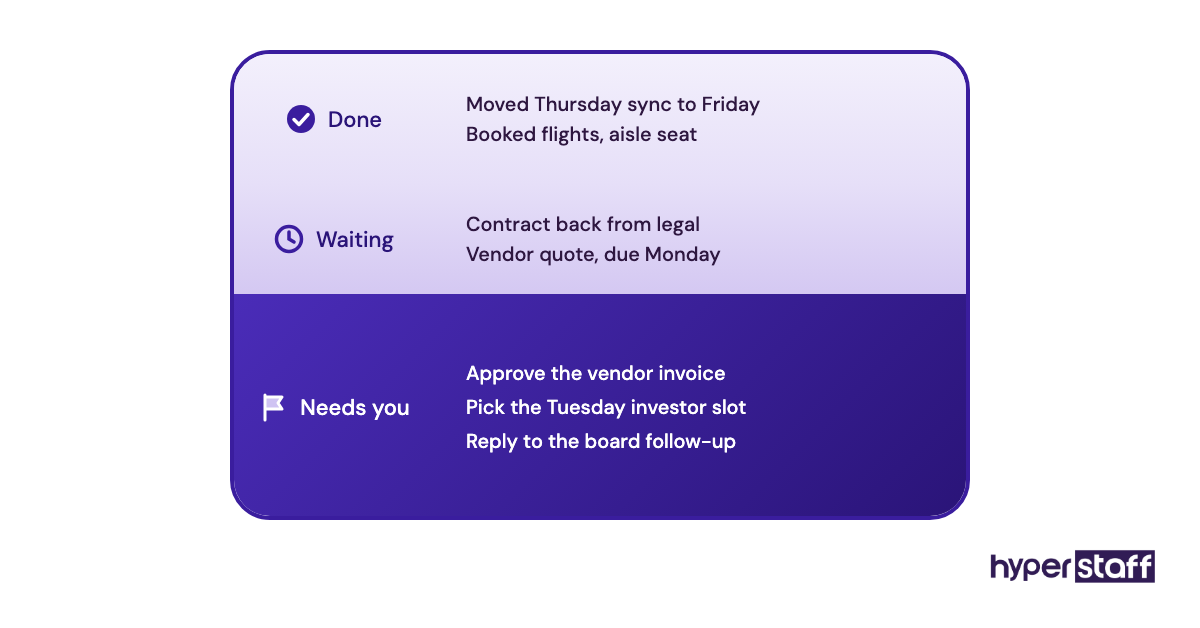
- Daily brief = a short end-of-day or start-of-day summary of what was done, what's waiting and what needs you.
- Hourly bundle = a fixed block of monthly hours, such as 40, 80 or 160, billed at an agreed rate.
- Time zone overlap = the hours both of you are working, used for handoffs and live questions.
- Offshore staffing = hiring talent based in another country, often at a lower cost of living.
- Chief of staff = a senior strategic role that runs priorities and people across a leadership team.
Why Is an Executive Virtual Assistant Important?
An executive virtual assistant matters because a leader's hours are the most expensive and least replaceable hours in a company. Every hour spent rescheduling, chasing invoices or booking flights is an hour not spent selling, hiring or deciding.
The bigger cost is usually invisible. Small admin tasks fragment the day, so a leader with six free hours ends up with twelve thirty-minute gaps and no time to think.
There's also a follow-through problem. Plenty of deals and partnerships die in the gap between "let's talk next week" and someone actually sending the invite, and an EVA closes that gap because tracking loose ends is the job.
How Does an Executive Virtual Assistant Work?
An executive virtual assistant works through shared access to your tools, a set of written rules and a fixed communication rhythm. You grant delegate access to email and calendar, agree on decision rights, and the EVA works through a daily list while reporting back in a brief.
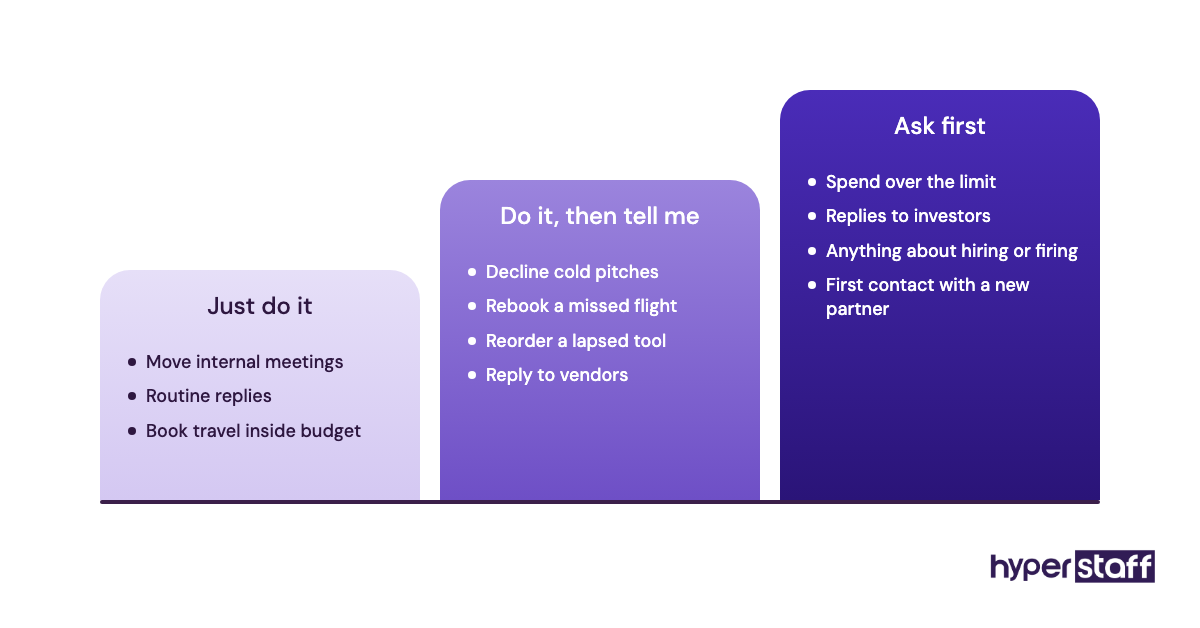
The handoff happens in phases, because nobody should get full inbox control on day one. Here's the order we see work most often.
| Phase | Typical timing | What the EVA owns | What you still do |
|---|---|---|---|
| Kickoff | Day 1 | Tool access, reading your SOPs | 30-minute call, priorities |
| Shadowing | Week 1 | Calendar booking, travel research | Approve drafts before they go out |
| Supervised control | Weeks 2 to 3 | Inbox triage, routine replies | Spot checks, daily brief review |
| Full ownership | Weeks 4 to 8 | Calendar, inbox, follow-ups, vendors | Weekly sync, edge-case calls |
| Expansion | Month 3 onward | Reporting, projects, client comms | Set goals, review outcomes |
Most of the friction sits in the shadowing phase. Leaders tend to underestimate how many of their habits are unwritten, and the first two weeks surface them one by one.
Types and Forms of Executive Virtual Assistants
Executive virtual assistants come in several forms, set mainly by hours, dedication and where they're sourced. The right type depends on how much of your week is admin and how much context the work needs.
| Type | Typical hours | Best fit | Main trade-off |
|---|---|---|---|
| Dedicated full-time EVA | 160 hours a month | Founders and CEOs with heavy calendars | Highest monthly spend of the remote options |
| Dedicated part-time EVA | 40 to 80 hours a month | Leaders with steady but lighter admin | Less coverage for urgent same-day work |
| Pooled or shared assistant | Pay per task or hour | One-off errands and research | A new person each time, little context |
| Freelance marketplace EVA | Varies | Buyers comfortable vetting and managing | No backup if the freelancer leaves |
| Agency-placed EVA | 40 to 160 hours a month | Teams that want vetting and replacement | Agency margin sits inside the rate |
| Hybrid specialist EVA | 80 to 160 hours a month | Leaders who also need marketing or CRM work | Harder to find, takes longer to vet |
| Chief-of-staff style EVA | 160 hours a month | Leaders running several teams | Needs senior experience and pay to match |
How an Executive Virtual Assistant Differs From Related Roles
An executive virtual assistant sits between general admin support and strategic leadership roles. The differences come down to who they support, how much judgment they exercise and where they work.
Executive Virtual Assistant vs. General Virtual Assistant
A general virtual assistant usually works through a task list for a team or a business owner. An EVA supports one senior person and acts as their stand-in, so the work leans on discretion and context more than speed.
Confidentiality is the other split. An EVA reads board emails, salary threads and investor updates, which is why trust and track record matter more in vetting than typing speed or software skills.
Executive Virtual Assistant vs. In-House Executive Assistant
An in-house executive assistant sits in your office, can handle physical tasks and joins hallway conversations. A remote EVA does the same desk work at a lower cost, but can't sign for packages or set up a meeting room.
The cost gap is large, and we've broken it down fully in our guide to an executive VA versus in-house hire. For leaders who already work remotely, the physical-presence advantage often turns out to be worth very little.
Executive Virtual Assistant vs. Chief of Staff
A chief of staff runs priorities across a leadership team, sits in strategy meetings and often manages people. An EVA runs the leader's time and logistics.
Some experienced EVAs grow into chief-of-staff work over a year or two. Hiring for that from day one is a different, more senior search, and it's priced accordingly.
The Benefits of an Executive Virtual Assistant
- Senior hours return to revenue work, hiring and decisions.
- Monthly cost sits well below a fully loaded in-house salary.
- Follow-ups happen on schedule, so fewer leads and promises slip.
- Time zone differences can give you overnight coverage on admin.
- Hours scale up or down with bundles instead of a new hire.
The Drawbacks of an Executive Virtual Assistant
- The first month takes real effort from you to document preferences.
- No physical presence for in-office errands or events.
- Sharing inbox access needs proper security setup.
- Limited live overlap can slow urgent questions.
Who Needs an Executive Virtual Assistant?
Leaders who spend more than about a day a week on scheduling, email and coordination usually need an executive virtual assistant. That includes founders, agency owners, partners in professional firms, sales leaders and executives running remote teams.
A simple test works well. Track one normal week, and if 8 to 10 hours went to work someone else could do with clear rules, the role pays for itself quickly.
Two perspectives differ here. A solo founder usually needs an EVA who can also run CRM follow-ups and social scheduling, while a leader inside a larger company often wants a narrower role focused on calendar and stakeholder management because other teams already own the rest.
Executive Virtual Assistant Examples
The patterns below come from how the role tends to play out in practice. The good ones share written rules, and the bad ones share vague ownership.
Executive Virtual Assistant Good Examples
The Two-Pass Inbox Triage
The assistant clears the inbox twice a day, labels everything, replies to routine threads and leaves the leader a short "needs you" folder. The leader opens email to five decisions, not ninety messages.
The Pre-Meeting Brief
Before each external call, the EVA drops a half-page note into the calendar invite with who's attending, the last email exchanged and the open question. It takes the assistant about ten minutes and saves the leader from scrolling threads two minutes before joining.
The Follow-Up Tracker
Every promise made in a meeting goes into a shared list with an owner and a date. The EVA chases each item on schedule, so commitments stop depending on someone's memory.
Executive Virtual Assistant Bad Examples
The Assistant With No Decision Rights
Every reschedule and every reply needs approval, so the leader ends up managing the assistant instead of the work. Within a month, both sides decide the hire "didn't work."
Passwords Sent Over Chat
Logins get shared in Slack messages and texts, with no record of who has access to what. When the assistant changes, nobody knows which accounts to lock.
The "Just Figure It Out" Onboarding
The assistant gets tool access and a vague brief, then gets blamed for guessing wrong. We see this failure more than any other, and it's covered in detail in our list of common executive VA hiring mistakes.
Creating an Executive Virtual Assistant Plan, Step-by-Step
A good executive virtual assistant plan moves from audit to handoff in five steps. Skipping the first two is the most common reason the role disappoints.
Step #1: Audit a Normal Week
Log everything you do for five working days, in 30-minute blocks. Mark each item as "only me," "me for now" or "anyone with rules."
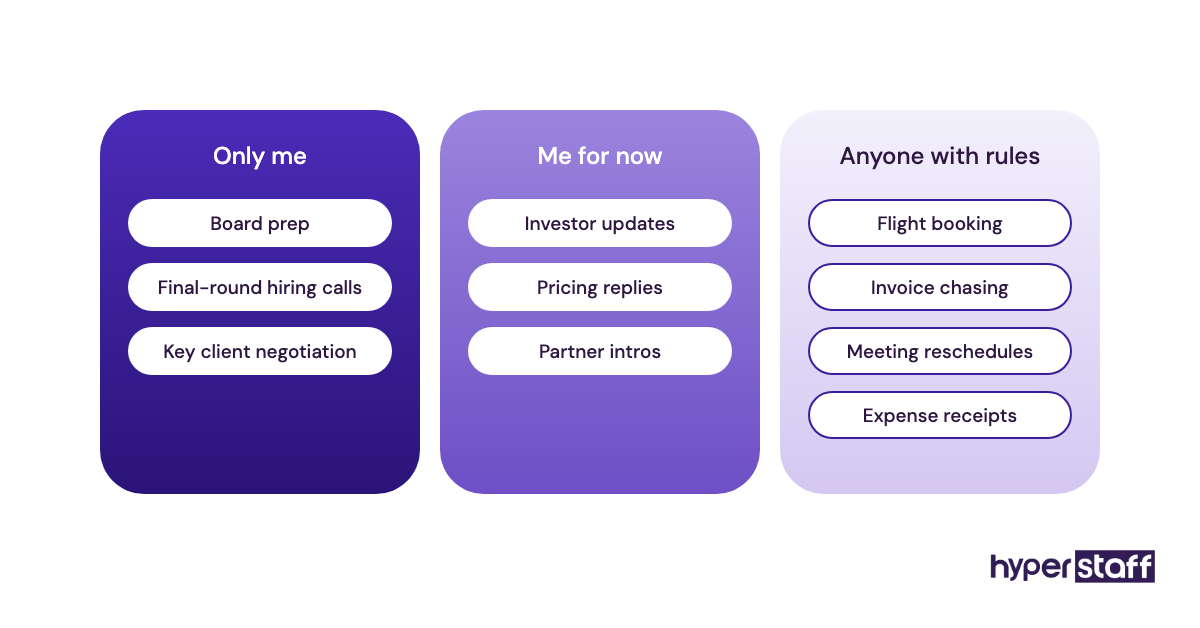
The third bucket becomes the role. Our checklist of tasks to hand an executive VA is useful for spotting items you didn't think to log.
Step #2: Write the Role Down
Turn the audit into a scope, hours and a list of decision rights. A clear executive assistant job description also decides which experience tier you actually need.
Step #3: Hire for Judgment
Screen for written English, discretion and how candidates handle conflicting priorities. Scenario questions reveal more than résumés, and our set of EVA interview questions gives you a starting bank.
The full sourcing process, from freelance platforms to agencies, sits in our walkthrough on hiring an executive virtual assistant.
Step #4: Onboard in Stages
Start with calendar and travel, move to inbox triage in week two, then hand over follow-ups and vendors. Each stage gets its own SOP before it changes hands.
Our guide to onboarding a remote executive assistant lays out the first 30 days in more depth.
Step #5: Set the Review Rhythm
Agree on a daily brief and a 20-minute weekly sync. At the 30-day mark, review what's working and widen decision rights where trust is earned.
What Does an Effective Executive Virtual Assistant Strategy Look Like?
An effective executive virtual assistant strategy gives the assistant ownership of outcomes, such as "the calendar never double-books," rather than a pile of tasks. The EVA knows the leader's priorities for the quarter and filters requests against them.
Three pieces hold it together in practice. Written decision rules, one communication channel for anything urgent, and a living SOP library that the assistant updates whenever something changes.
Practitioners genuinely disagree on one point: whether an EVA should reply as themselves or as the leader. Replying as yourself is more transparent, while ghostwriting as the leader keeps relationships feeling personal, and the right call usually depends on how much of the leader's network expects to hear from them directly.
Executive Virtual Assistant Tools and Software
Executive virtual assistant tools fall into a few groups: email and calendar, password management, scheduling, task tracking, documentation and communication. Most leaders already pay for half of them.
- Google Workspace or Microsoft 365 for email and calendar, using Gmail delegation or Outlook delegate access.
- 1Password or Bitwarden for shared vaults, so logins never travel over chat.
- Calendly for external booking links tied to your calendar rules.
- Asana, Trello or ClickUp for follow-ups and project tracking.
- Notion or Google Docs for SOPs and the decision-rules document.
- Slack for quick questions during overlap hours.
- Loom for recording a task once instead of explaining it on a call.
Our earned opinion: a shared password manager is the one tool worth adding even if you skip the rest. Delegate access through Gmail or Outlook is the other non-negotiable, because logging in with the leader's own password breaks two-factor alerts and leaves no audit trail.
A fuller comparison sits in our roundup of the best executive assistant software.
8 Proven Executive Virtual Assistant Tips and Best Practices
These habits separate EVA setups that last from ones that fizzle after a quarter.
- Write decision rights down before the first day, including a spending limit.
- Hand over the calendar first, since mistakes there are visible and easy to fix.
- Use one urgent channel and agree that everything else can wait for the daily brief.
- Record a Loom the second time you explain any task.
- Share logins only through a password manager.
- Protect at least one daily overlap hour for live questions.
- Review the role at 30 and 90 days, and widen scope deliberately.
- Give feedback within a day, because a correction a week later rarely sticks.
Overcoming Common Executive Virtual Assistant Challenges
The most common executive virtual assistant challenge is under-delegation. Leaders hand over small tasks, keep the important ones, and then judge the role on the small tasks.
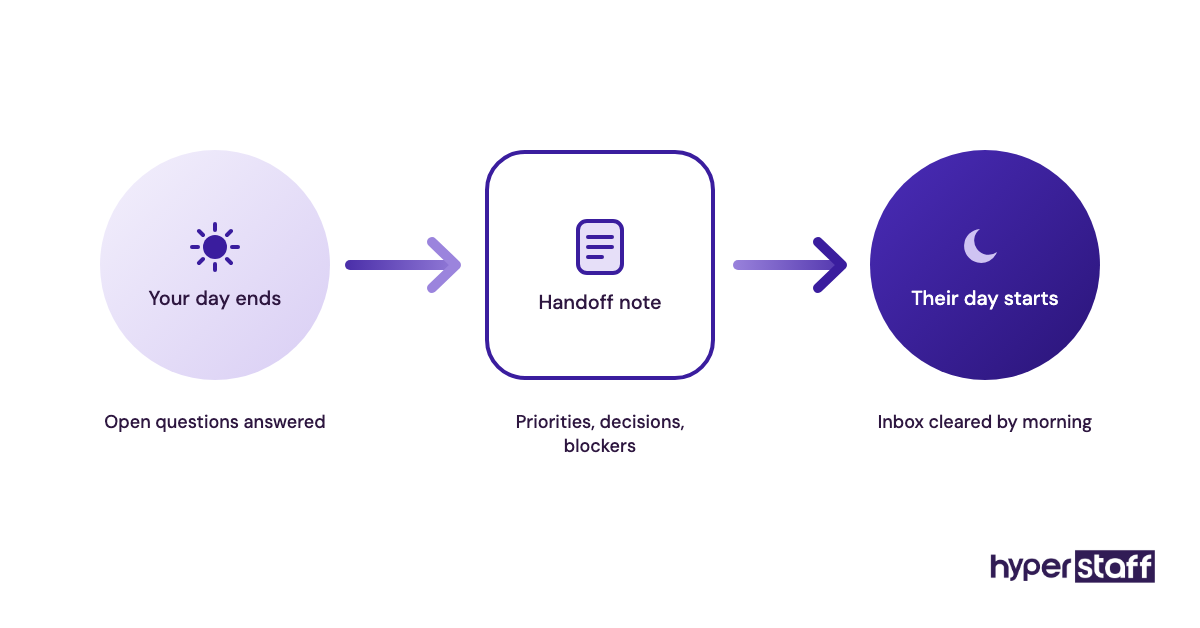
Time zone gaps come second. Fix them with a written handoff note at the end of your day, so the assistant can work overnight without waiting for answers.
Trust is slower to fix. Start with low-risk access, add permissions in stages and review the activity logs your email and password tools already keep.
How to Measure Executive Virtual Assistant Success
Executive virtual assistant success shows up first as hours returned to the leader each week. Track that number against your week-one audit.
Supporting signals help too. Count inbox items reaching you daily, double-bookings per month, and follow-ups closed on time.
A softer test matters as much: how often you get pulled into something the assistant should have handled. If that count keeps dropping after the first month, the role is working.
How Long Does an Executive Virtual Assistant Take to Work?
An executive virtual assistant usually takes two to four weeks to handle routine calendar and inbox work alone. Full ownership, including judgment calls, tends to arrive between weeks six and eight.
Expect a dip in week two. The assistant is doing more, you're still checking everything, and it briefly feels like extra work.
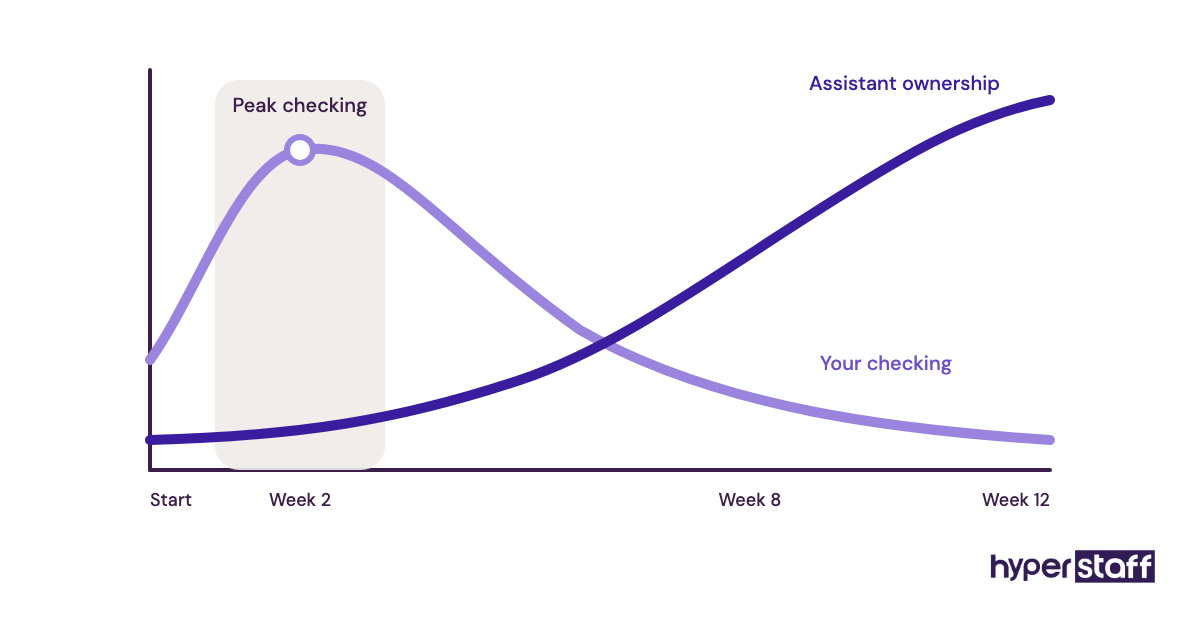
The payoff compounds from month three. Each SOP written early removes a question later, so the assistant gets faster while your check-ins get shorter.
How Much Does an Executive Virtual Assistant Cost?
An executive virtual assistant costs anywhere from a few dollars to over $70 an hour, depending on location, experience and how they're hired. Offshore agency placements sit at the low end, and US-based freelancers or agencies sit at the high end.
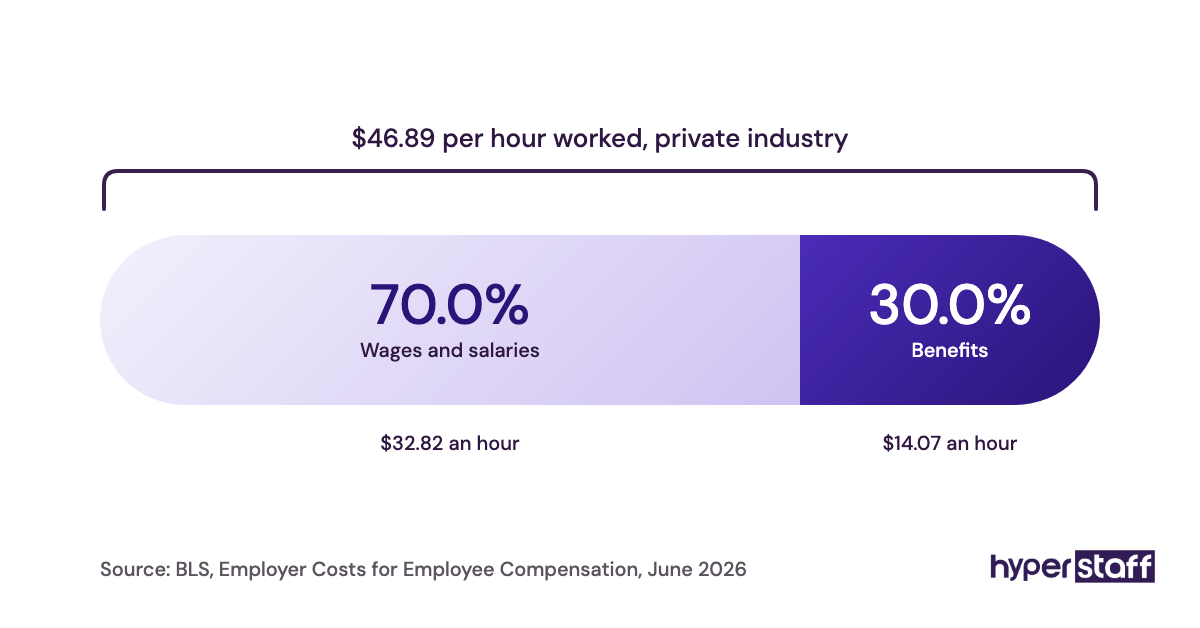
For comparison, the US Bureau of Labor Statistics lists a median annual wage of $76,590 for executive secretaries and executive administrative assistants. Benefits make up 30.0% of private-industry compensation costs, which puts the fully loaded cost of that median hire near $109,000 a year.
| Provider | Experience | Hourly rate | Full-time monthly cost |
|---|---|---|---|
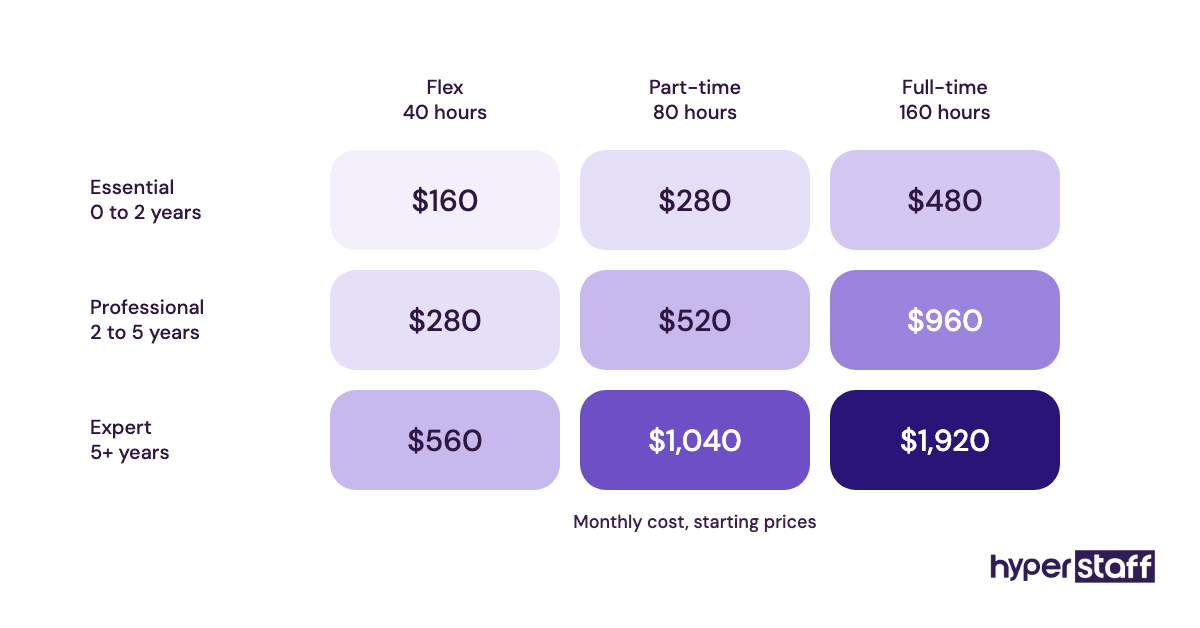
| Hyperstaff Essential | 0 to 2 years | From $3 | From $480 (160 hours) |
| Hyperstaff Professional | 2 to 5 years | From $6 | From $960 (160 hours) |
| Hyperstaff Expert | 5+ years | From $12 | From $1,920 (160 hours) |
| Hyperstaff Expert, paid quarterly | 5+ years | From $10.80 | From $1,728 (10% saved) |
| US-based freelance EVA | Varies | $25 to $75 | $4,000 to $12,000 |
| US-based VA agency | Varies | $35 to $65 | $5,600 to $10,400 |
| In-house US executive assistant | Median | About $37 wage, about $53 loaded | About $9,100 loaded |
Our detailed breakdown of executive VA pricing explains how bundles, tiers and hidden costs change these numbers.
Important: Hyperstaff prices above are typical starting averages, not fixed quotes. Your final rate depends on the experience level, hours and type of work your role needs.
Is an Executive Virtual Assistant Worth It?
Yes, for most leaders an executive virtual assistant is one of the highest-return hires they'll make, once the setup is done properly. The math works because the assistant costs a small fraction of what the leader's own hour is worth, and every hour handed over goes back to work only the leader can do.
Here's a sample calculation. A founder who values their time at $150 an hour hands off 10 hours a week, about 43 hours a month, which is roughly $6,450 of senior time each month.
An 80-hour monthly bundle at the Professional tier starts at $480. Even if only half of the returned hours turn into revenue work, the return sits above six times the cost.
The honest caveat: the first month costs you time, not just money. We go deeper on when the numbers don't work in our piece on whether an EVA is worth it.
How to Choose an Executive Virtual Assistant Agency
Choose an executive virtual assistant agency on vetting depth, replacement terms and how they keep your context if someone leaves. The hourly rate matters, but a cheap placement that churns costs more in lost onboarding.
Ask each agency these questions directly:
- How are candidates screened for written English and discretion?
- Will the assistant be dedicated to you, or split across clients?
- How fast is a replacement, and who briefs the new person?
- Is there a named account manager?
- Can hours move between bundles as needs change?
For reference, Hyperstaff places dedicated specialists in 5 business days, replaces them free in 5 to 7 business days, and briefs replacements from your Operations Vault. Every client gets a dedicated account manager.
Executive Virtual Assistant Statistics, Trends and Future Predictions
The clearest executive assistant statistic comes from the BLS, which projects 0% employment change for executive secretaries and executive administrative assistants over its ten-year projection window. In-house headcount for the role is flat, even as demand for the work itself stays steady.
Benefits remain a large share of hiring cost, at 30.0% of private-industry compensation in the latest BLS employer cost data. That gap is a big part of why remote and offshore placements keep growing.
A few trends are visible from inside the work:
- Leaders hire EVAs earlier, often before their first full-time operations hire.
- Hybrid roles mixing executive support with CRM, marketing or customer support work are becoming the norm.
- Part-time bundles of 40 to 80 hours are a common first step before going full-time.
- Offshore talent from the Philippines, Latin America, India and Eastern Europe covers more senior work than it did a few years ago.
Our prediction, and it's an opinion: the executive tier keeps growing while pure task-based VA work shrinks. Software now handles plenty of single tasks, but it still doesn't decide which of two investors gets the Tuesday slot.
Executive Virtual Assistants and AI
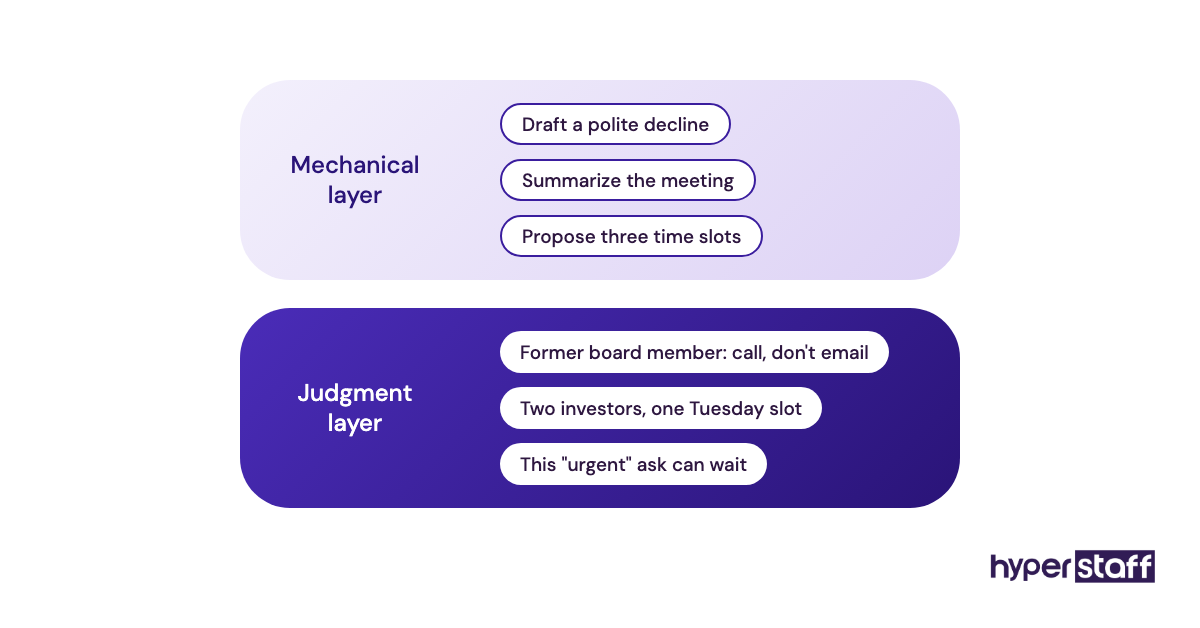
AI tools now draft emails, summarize meetings and propose meeting times, and a good executive virtual assistant uses them daily. The tools speed up the mechanical layer of the job.
Judgment is where AI still falls short. It can write a polite decline, but it doesn't know that this particular sender is a former board member who should get a call instead.
We're openly uncertain about how far this goes over the next few years. Our current view is that AI raises the bar for EVAs: assistants who use it well handle more leaders' worth of work, and assistants who only do mechanical tasks face real pressure.
Disclaimer: This article is for general information only and isn't legal, financial or employment advice. Costs, rates and third-party data may change, so verify details and consult a qualified professional before making hiring decisions.
Common questions
Can an executive virtual assistant work in my time zone?
Yes, most can shift hours to give you several hours of live overlap. Many leaders prefer partial overlap anyway, since overnight work means a cleared inbox waiting in the morning.
Is it safe to give an executive VA access to my email?
It's safe when access runs through Gmail delegation or Outlook delegate permissions and a password manager. Those keep your own password private and log what the assistant does, and you can revoke access in minutes.
Does an executive virtual assistant work for more than one person?
It depends on the arrangement. Freelancers often juggle several clients, while dedicated placements work only for you, so ask before you sign.
Is a part-time executive virtual assistant enough?
For many leaders, 40 to 80 hours a month covers calendar, inbox and follow-ups. Move to full-time when you start adding projects, reporting or client communication to the role.
What skills should an executive virtual assistant have?
Strong written English, discretion, calendar and inbox management, and comfort with tools like Google Workspace or Microsoft 365. The skill that matters most is prioritizing well when two urgent requests land at once.
Book a free 15 min call
We place a pre-vetted specialist in 5 business days, fully managed, from $3/hour.