How to Hire an Amazon Virtual Assistant Without Wasting Months
A practical, step-by-step guide to scoping, vetting, paying and onboarding an Amazon virtual assistant who can run real parts of your seller account.
On this page
- What Does Hiring an Amazon Virtual Assistant Involve?
- Key Amazon VA Hiring Terms You Should Know
- Why Does Hiring the Right Amazon VA Matter?
- How Does Hiring an Amazon Virtual Assistant Work?
- Types of Amazon Virtual Assistants You Can Hire
- How Hiring an Amazon VA Differs From Related Options
- The Benefits of Hiring an Amazon Virtual Assistant
- The Drawbacks of Hiring an Amazon Virtual Assistant
- Who Needs to Hire an Amazon Virtual Assistant?
- Amazon VA Hiring Examples
- Creating an Amazon VA Hiring Plan, Step-by-Step
- What Does an Effective Amazon VA Hiring Strategy Look Like?
- Amazon VA Hiring Tools and Software
- 8 Proven Amazon VA Hiring Tips and Best Practices
- Overcoming Common Amazon VA Hiring Challenges
- How to Measure Amazon VA Hiring Success
- How Long Does Hiring an Amazon VA Take to Work?
- How Much Does It Cost to Hire an Amazon Virtual Assistant?
- Is Hiring an Amazon Virtual Assistant Worth It?
- How to Choose an Amazon Virtual Assistant Agency
- Amazon VA Hiring Statistics, Trends and Future Predictions
- Hiring an Amazon VA and AI
- FAQs
💡 Key Takeaways:
1) To hire an Amazon virtual assistant, define one clear scope first (listings, PPC, inventory or seller support), then test candidates on a real task inside your own account before you commit.
2) Give your Amazon VA their own login through Seller Central User Permissions, never your owner credentials, and grant only the permissions their scope needs.
3) A good Amazon VA hire usually takes 2 to 6 weeks to find and 30 to 90 days to fully ramp, so plan for that window and write your processes down before the first day.
Hire once, then let your Amazon store compound
Hyperstaff places pre-vetted Amazon virtual assistant services specialists from five regions, with rates starting at $3/hour and placement in 5 business days. We've placed 70+ virtual assistants across 30+ clients, and every client gets a dedicated account manager plus an Operations Vault that keeps your SOPs and tools written down for whoever does the work.
What Does Hiring an Amazon Virtual Assistant Involve?
Hiring an Amazon virtual assistant means finding a remote specialist who runs defined parts of your seller account, such as listings, advertising, inventory or customer messages, and giving them the access, processes and targets to do it well. The hiring work covers scoping, sourcing, testing, paying and onboarding that person.
If you're still working out what the role covers day to day, our guide on what an Amazon virtual assistant is breaks it down. This post assumes you know you want one and need to get the hire right the first time.
Key Amazon VA Hiring Terms You Should Know
- Seller Central = Amazon's dashboard for third-party sellers, where listings, orders, inventory and ads live.
- User Permissions = the Seller Central setting that gives a team member their own login with chosen access levels.
- ASIN = Amazon's unique product ID, used to track every listing.
- FBA = Fulfillment by Amazon, where Amazon stores, packs and ships your stock.
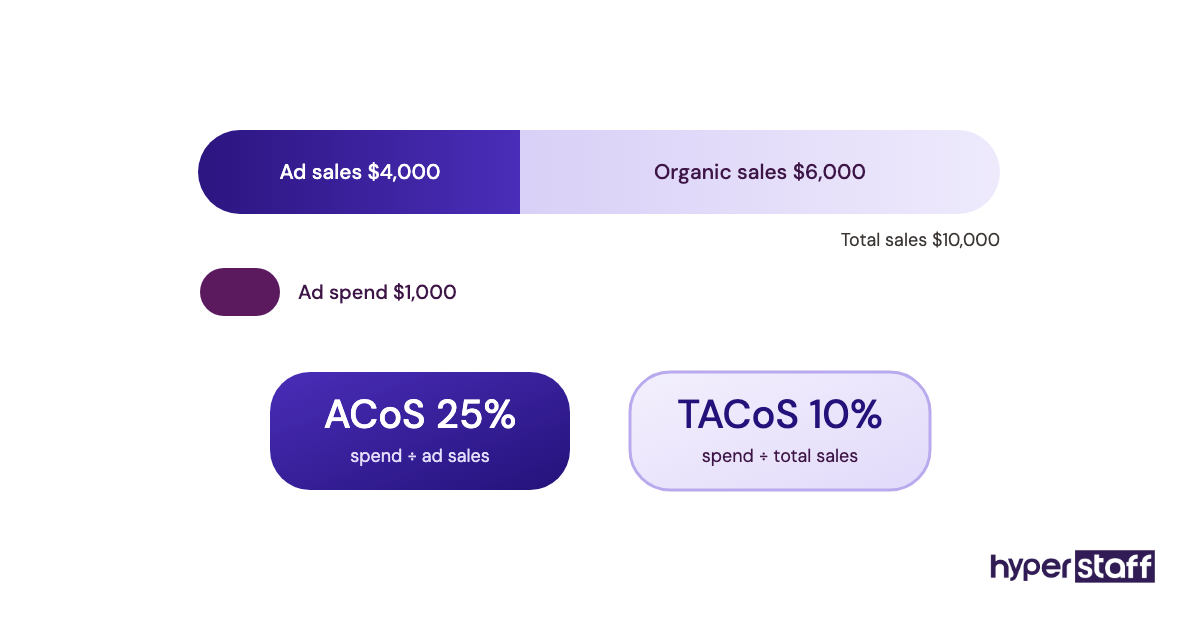
- ACoS = advertising cost of sale, ad spend divided by ad-driven revenue.
- TACoS = total ad spend divided by total revenue, a cleaner read on ad dependence.
- Brand Registry = Amazon's program that unlocks A+ Content, brand protection and brand analytics.
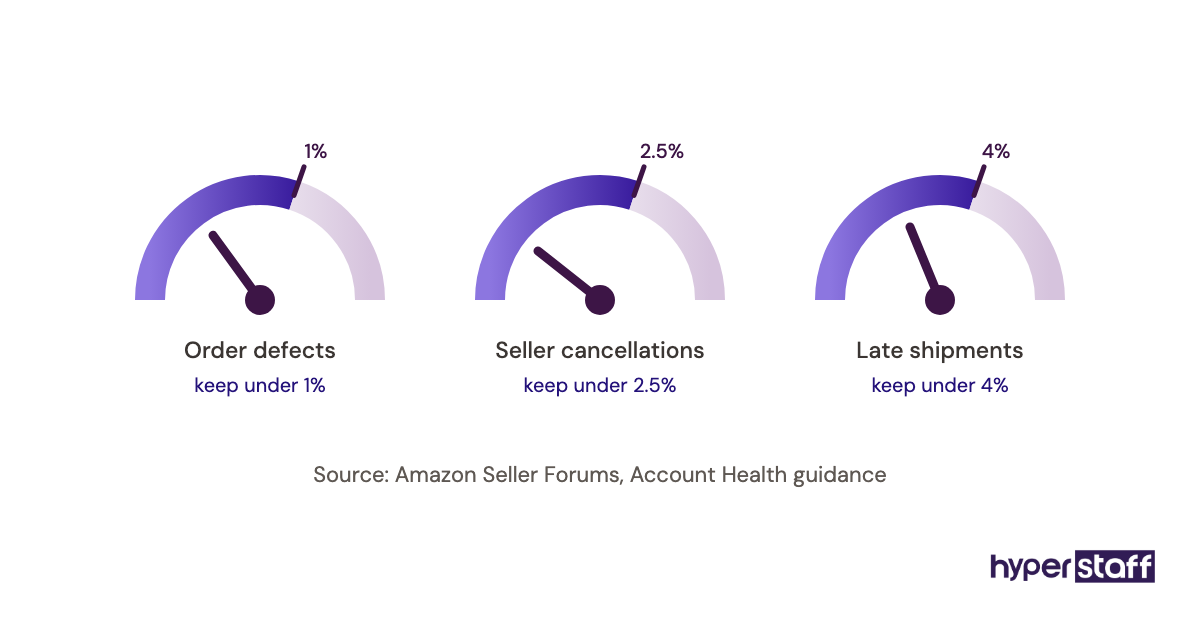
- Account Health = Amazon's scorecard of policy compliance and performance metrics.
- SOP = a standard operating procedure, the written steps for a repeatable task.
- Paid trial = a short, paid test project done before a long-term commitment.
Why Does Hiring the Right Amazon VA Matter?
Hiring the right Amazon VA matters because this person touches the parts of your business that Amazon polices hardest: listing accuracy, ad spend and Account Health. A careless edit can suppress a listing, and an unwatched campaign can burn a month of margin in a week.
The wrong hire costs more than their wages. You pay for the cleanup, the lost rank while a listing sits suppressed, and the weeks spent hiring again.
The right hire works the other way. A specialist who checks stranded inventory, search term reports and buyer messages every day catches small problems while they're still cheap.
How Does Hiring an Amazon Virtual Assistant Work?
Hiring an Amazon virtual assistant works in five stages: scope the role, source candidates, test them on real work, agree terms, then onboard with written processes and limited access. Most sellers rush the scope and the test, which is where nearly every bad hire starts.
The table below shows a realistic timeline for each stage when you hire on your own.
| Stage | Typical time | Main output |
|---|---|---|
| Scope the role | 1 to 3 days | Task list, hours, budget |
| Source candidates | 1 to 3 weeks | Shortlist of 5 to 10 |
| Interview and test | 1 to 2 weeks | 1 to 2 finalists |
| Offer and contract | 2 to 5 days | Signed terms, NDA |
| Onboarding | 2 to 4 weeks | Working SOPs, first wins |
Sourcing is where the dead zone sits. Job posts on marketplaces fill with applicants in a day, but sorting real Seller Central experience from copied resumes can take far longer than the posting itself.
Types of Amazon Virtual Assistants You Can Hire
Amazon virtual assistants come in a handful of distinct types, and each needs a different test and a different skill check. The full spread of Amazon virtual assistant tasks is wide, so pick the type that matches your biggest bottleneck.
| VA type | Core tasks | Best test task | Typical experience tier |
|---|---|---|---|
| Listing specialist | Titles, bullets, backend keywords, images briefs | Rewrite one live listing | Essential to Professional |
| PPC specialist | Campaign builds, bids, negative keywords | Audit a search term report | Professional to Expert |
| Inventory and FBA coordinator | Restock planning, shipments, stranded stock | Build a 60-day reorder sheet | Professional |
| Customer service VA | Buyer messages, returns, review requests | Answer 5 real buyer messages | Essential |
| Account health VA | Policy notices, suppressed listings, cases | Draft a case to Seller Support | Professional to Expert |
| Product research VA | Niche checks, competitor tracking | Score 3 product ideas | Professional |
| Generalist Amazon VA | Mix of admin, listings and messages | One day of mixed tasks | Essential to Professional |
How Hiring an Amazon VA Differs From Related Options
Hiring a dedicated Amazon VA sits between doing everything yourself and handing the account to an outside firm. The three options below are the ones sellers weigh most often.
Amazon VA vs. Freelancer on a Marketplace
A dedicated Amazon VA works set hours on your account only, while a marketplace freelancer usually splits time across several sellers. Freelancers suit one-off jobs like a listing rewrite.
For daily work, split attention shows up fast. Messages wait overnight, and context gets lost between projects.
Amazon VA vs. Full-Service Amazon Agency
A full-service agency owns strategy and execution and usually charges a monthly retainer, a percentage of sales, or both. An Amazon VA executes your plan under your direction, at a fraction of that cost.
Practitioners genuinely disagree here. Some sellers want an agency's playbook in year one, while others prefer to keep strategy in-house and hire hands.
Amazon VA vs. In-House Hire
An in-house ecommerce coordinator costs a full local salary plus benefits, equipment and payroll overhead. A remote Amazon VA costs a fraction of that and can start within days.
The trade-off is proximity and local market knowledge. Our comparison of an Amazon virtual assistant vs in-house staff covers when the local hire still wins.
The Benefits of Hiring an Amazon Virtual Assistant
- Daily account checks happen even when you're busy with suppliers or product launches.
- Labor costs run far below a local hire for the same hours.
- Time zone differences can give you overnight coverage on buyer messages.
- Repeatable tasks get written into SOPs, so knowledge stays in the business.
- You free your own hours for sourcing, cash flow and brand decisions.
The Drawbacks of Hiring an Amazon Virtual Assistant
- Onboarding takes real time from you in the first few weeks.
- Account access carries risk if permissions are set too wide.
- Strategy still sits with you unless you hire at the Expert level.
- Time zone gaps can slow urgent decisions.
Who Needs to Hire an Amazon Virtual Assistant?
Sellers who spend more than 10 to 15 hours a week on repeatable Seller Central tasks usually need to hire an Amazon virtual assistant. Common signs are a growing catalog, ad campaigns nobody reviews weekly, and buyer messages answered late.
Brand owners and private label sellers get the most from a dedicated hire because their work repeats. Wholesale and arbitrage sellers benefit too, though their tasks lean toward sourcing checks and shipment prep rather than listing work.
Very new sellers are the exception. Until you've done a task yourself a few times, you can't write the SOP, and you can't judge whether the VA did it well.
Amazon VA Hiring Examples
Good and bad Amazon VA hires follow recognizable patterns. The cases below are hiring patterns we see repeatedly, described without client names.
Good Amazon VA Hiring Examples
Hiring for One Bottleneck First
A seller whose ad spend is drifting hires a PPC-focused VA only, with a written target ACoS. The scope is narrow enough to judge in 30 days.
Testing Inside a Real Account
The finalist gets a paid task on a live, low-risk ASIN with limited permissions. You see how they actually work in Seller Central instead of how they describe it.
Writing SOPs Before Day One
The seller records short screen videos of each task before the hire starts. The VA ramps in weeks instead of months, and a replacement could pick up the same files.
Bad Amazon VA Hiring Examples
The "Do Everything" Job Post
One posting asks for listings, PPC, graphics, research and bookkeeping at an entry-level rate. Nobody does all of that well, and the seller can't tell which part is failing. Our list of common Amazon VA mistakes covers this one in depth.
Sharing the Owner Login
The seller hands over the main email and password because setting up permissions felt slow. That exposes billing, bank details and account deactivation risk to someone who started last week.
Hiring From Screenshots
A candidate shows dashboards with big sales numbers, and the seller hires on that alone. Screenshots prove nothing about who did the work, which is why a live test matters.
Creating an Amazon VA Hiring Plan, Step-by-Step
An Amazon VA hiring plan turns a vague need into five concrete steps, each with an output you can check. Skip one and the next gets harder.
Step #1: Write the Scope and Job Description
List every task the VA will own, how often it happens, and what "done well" looks like. A clear Amazon virtual assistant job description filters out most poor fits before you read a single resume.
Include the hours per week and the tools they must already know. Vague posts attract vague candidates.
Step #2: Choose Where to Source
Your main options are freelance marketplaces, Amazon seller communities, referrals and staffing agencies. Marketplaces give volume, while agencies give pre-vetted shortlists and replacement cover.
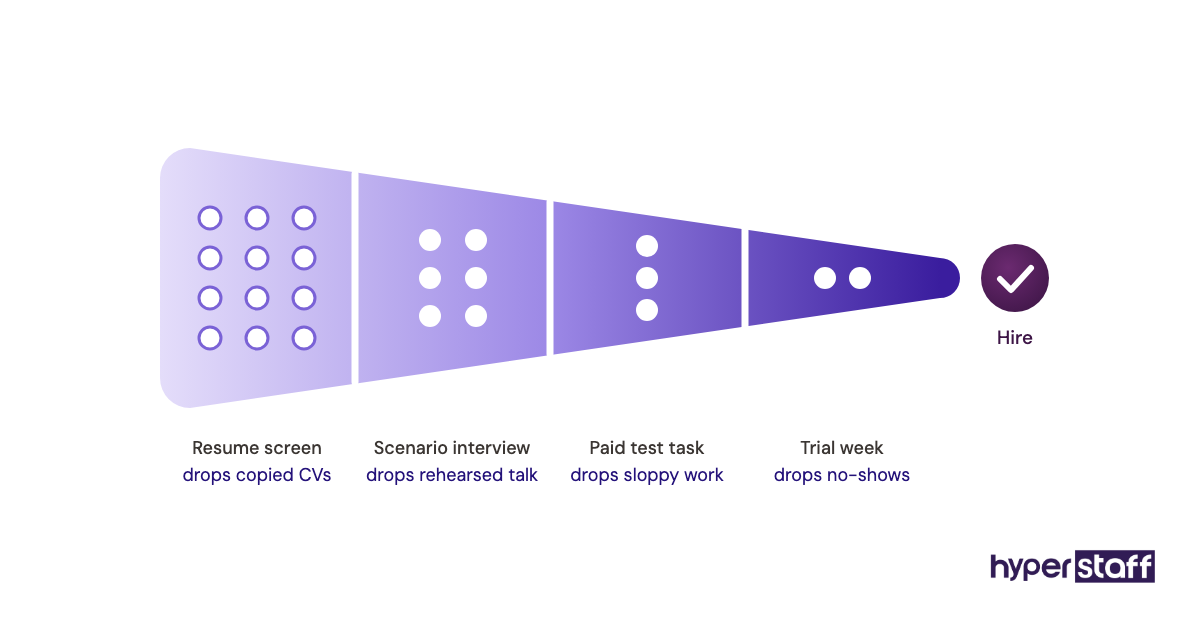
Step #3: Interview for Judgment
Ask candidates to walk through what they'd do when a listing gets suppressed or ACoS jumps overnight. Answers that name specific Seller Central reports beat answers about being "detail oriented."
Our set of Amazon VA interview questions gives you questions sorted by role type.
Step #4: Run a Paid Test Task
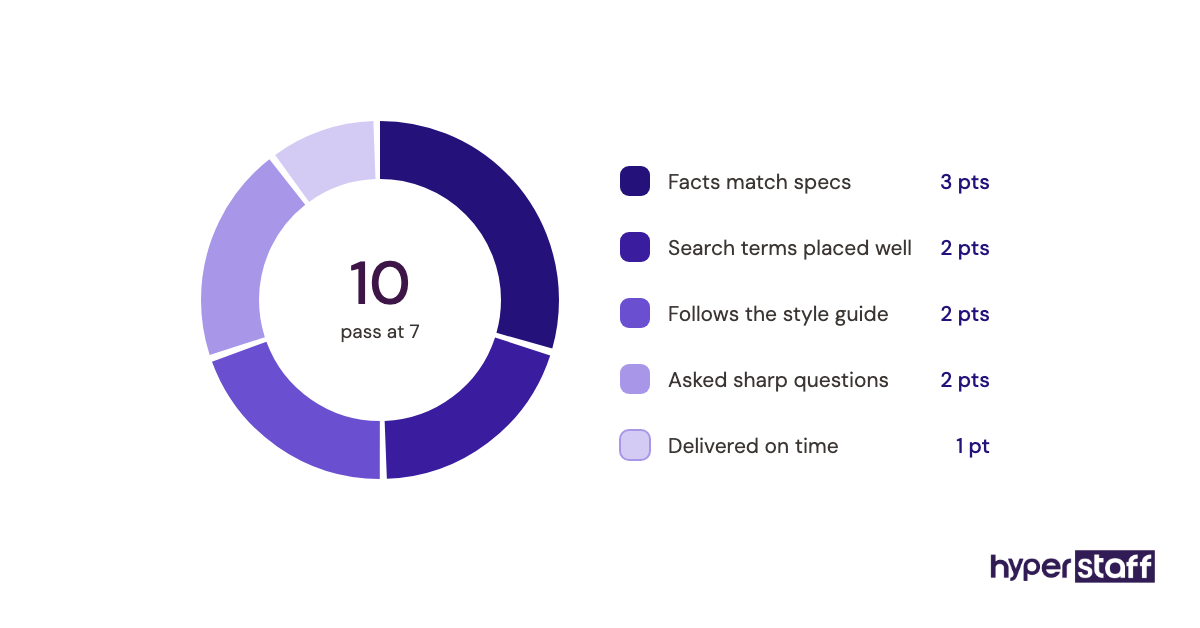
Pay finalists for 2 to 4 hours of real work, such as auditing one search term report or rewriting one listing. Grade the output against the standard you wrote in step one.
Peer opinion splits on test length. Some sellers prefer a full paid week, which reveals reliability but costs more per candidate.
Step #5: Onboard With Limited Access
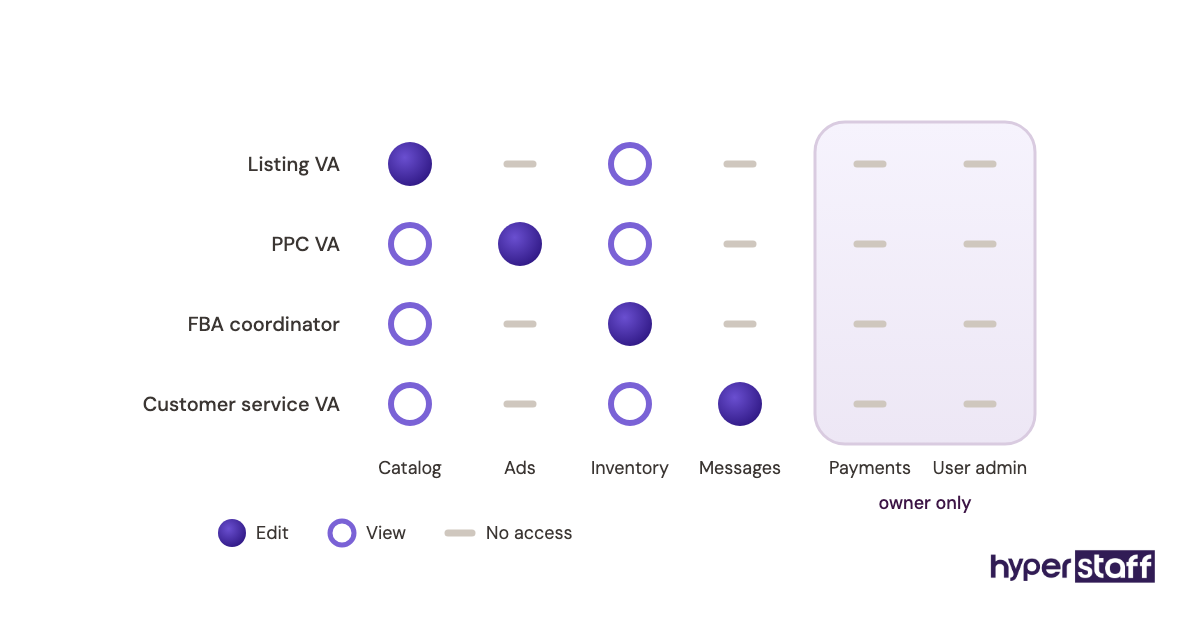
Create a Seller Central user with only the permissions the role needs, then share SOPs and a 30-day task plan. Expand access as trust builds.
Our step-by-step guide to onboarding an Amazon virtual assistant covers the first 30 days in detail.
What Does an Effective Amazon VA Hiring Strategy Look Like?
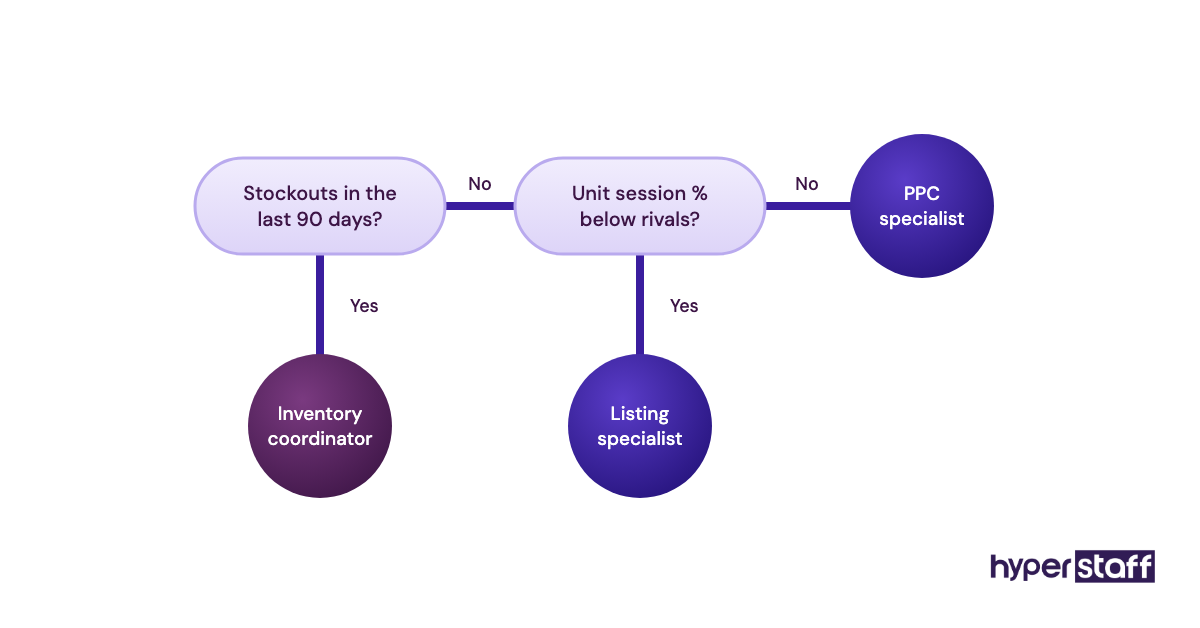
An effective Amazon VA hiring strategy matches the hire to your most expensive bottleneck, tests on real work, and protects the account through permissions and written processes. It plans for replacement from day one.
Sequencing matters more than most sellers expect. Hiring a PPC specialist before your listings convert well means paying someone to send traffic to pages that don't sell.
We'd usually fix listings first, then ads, then inventory planning. Sellers with strong listings and chaotic stock levels should reverse that order, because stockouts wreck ranking faster than weak copy does.
Amazon VA Hiring Tools and Software
The tools you use to hire and manage an Amazon VA fall into two groups: what you use to vet and onboard them, and what they'll use daily. Our roundup of Amazon virtual assistant tools goes deeper on the daily stack.
Seller Central is the base for everything, and its User Permissions page is your most important hiring tool. Amazon's Professional selling plan costs $39.99 a month plus selling fees, according to Amazon's seller pricing page.
Helium 10 and Jungle Scout are the two research and keyword suites most Amazon VAs list on their resumes. Ask which one they've used on a live account, and for what, since familiarity with the dashboard is different from reading the data well.
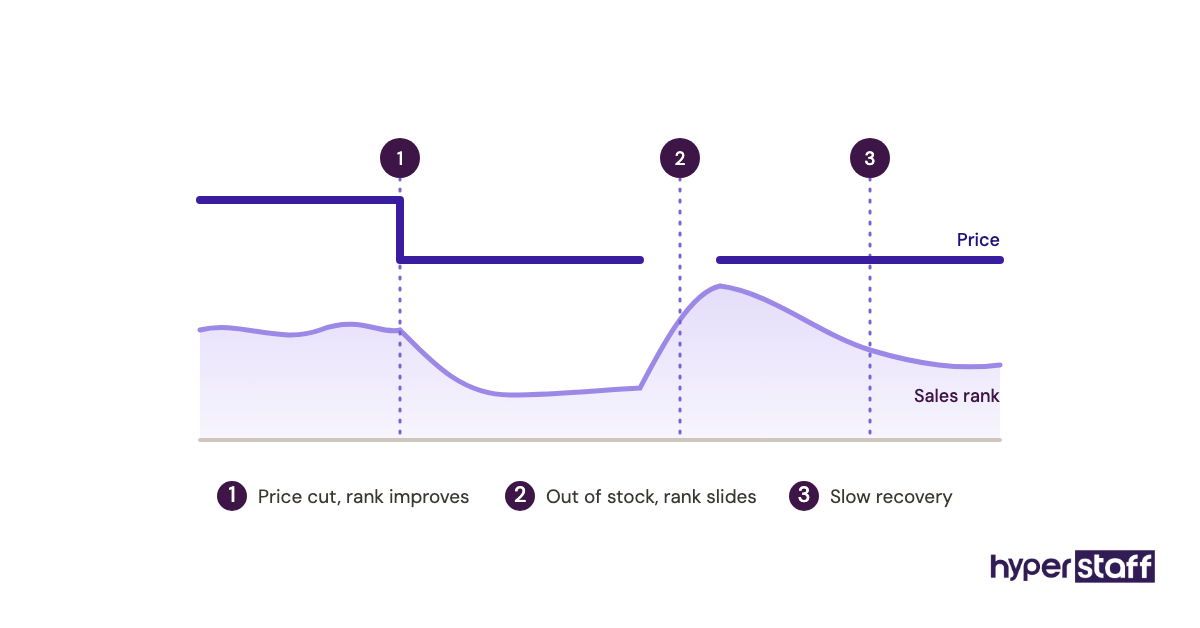
Keepa is useful in interviews. Hand a candidate a Keepa price and rank chart and ask what happened to that product; the good ones read it in under a minute.
For onboarding, Loom works well for recording task walkthroughs, and a project tool like ClickUp, Asana or Trello holds the daily checklist. Pick one and stick with it.
For password-protected tools outside Seller Central, a shared vault such as 1Password or Bitwarden keeps credentials out of chat messages. Check each tool's current plans on its site, since tiers change often.
8 Proven Amazon VA Hiring Tips and Best Practices
These tips come from the patterns that separate hires who last from hires who don't.
- Hire for one role first and expand the scope after 60 days of good work.
- Ask for specific reports they've used, by name, in Seller Central.
- Always pay for test tasks, because unpaid tests attract weaker candidates.
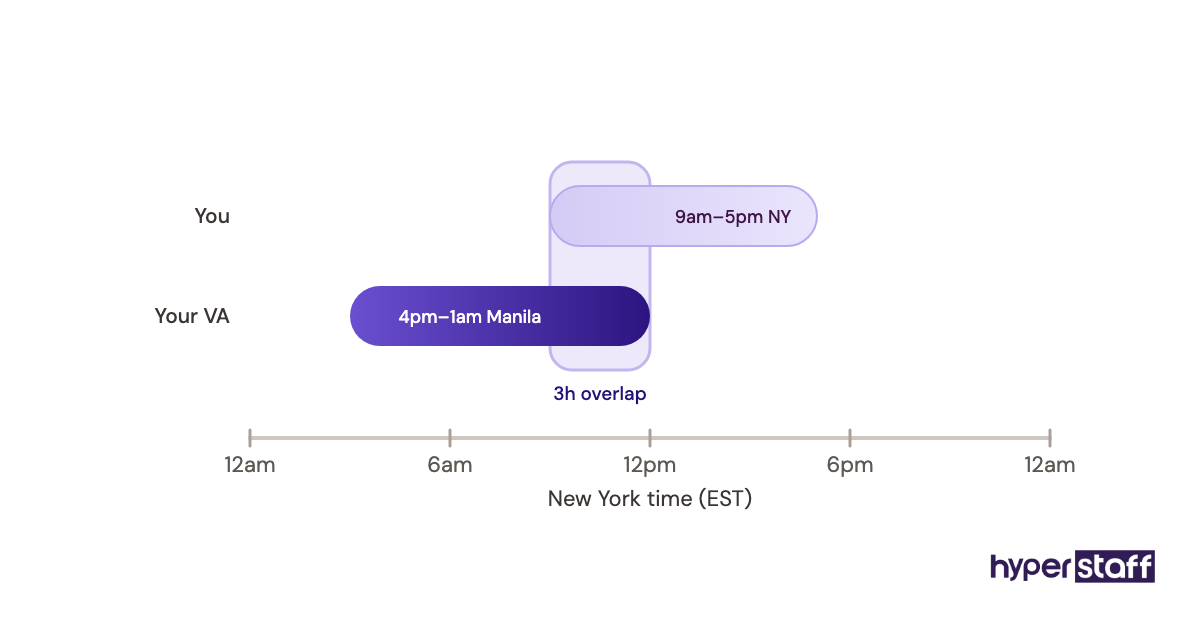
- Require at least 2 to 4 hours of daily overlap with your working day.
- Set up User Permissions before day one so access isn't rushed.
- Write targets as numbers, like ACoS range or reply time, instead of "manage ads."
- Have the VA update SOPs as they learn, so the documents stay current.
- Schedule a weekly 20-minute review for the first two months, then move to biweekly.
Overcoming Common Amazon VA Hiring Challenges
The most common Amazon VA hiring challenge is telling real Seller Central experience apart from rehearsed answers. A live, paid test task on your own account solves most of it.
Turnover is the second. Freelancers with several clients drop the lowest payer first, so a dedicated arrangement and written SOPs reduce both the chance and the pain of losing someone.
Communication gaps come third. Short recorded videos beat long written briefs for most Amazon tasks, and a fixed overlap window stops questions from waiting a full day.
How to Measure Amazon VA Hiring Success
Measure Amazon VA hiring success with task-level numbers tied to the role, checked at 30, 60 and 90 days. A listing VA is judged on conversion and suppressed listings, while a PPC VA is judged on ACoS and TACoS.
Track your own hours too. If you aren't getting back at least 10 hours a week by day 60, the scope or the SOPs need work.
Reliability counts as much as output. Missed check-ins and late reports in month one rarely improve by month three.
How Long Does Hiring an Amazon VA Take to Work?
Hiring an Amazon VA usually takes 2 to 6 weeks on your own, and the hire takes 30 to 90 days to work at full pace. Simple roles like customer messages ramp fastest, while PPC and inventory planning need more time.
The first two weeks feel slow. You're answering questions and checking work, so expect your own time to rise before it falls.
Through an agency, placement can drop to days. Ramp time still depends on how well your processes are written.
How Much Does It Cost to Hire an Amazon Virtual Assistant?
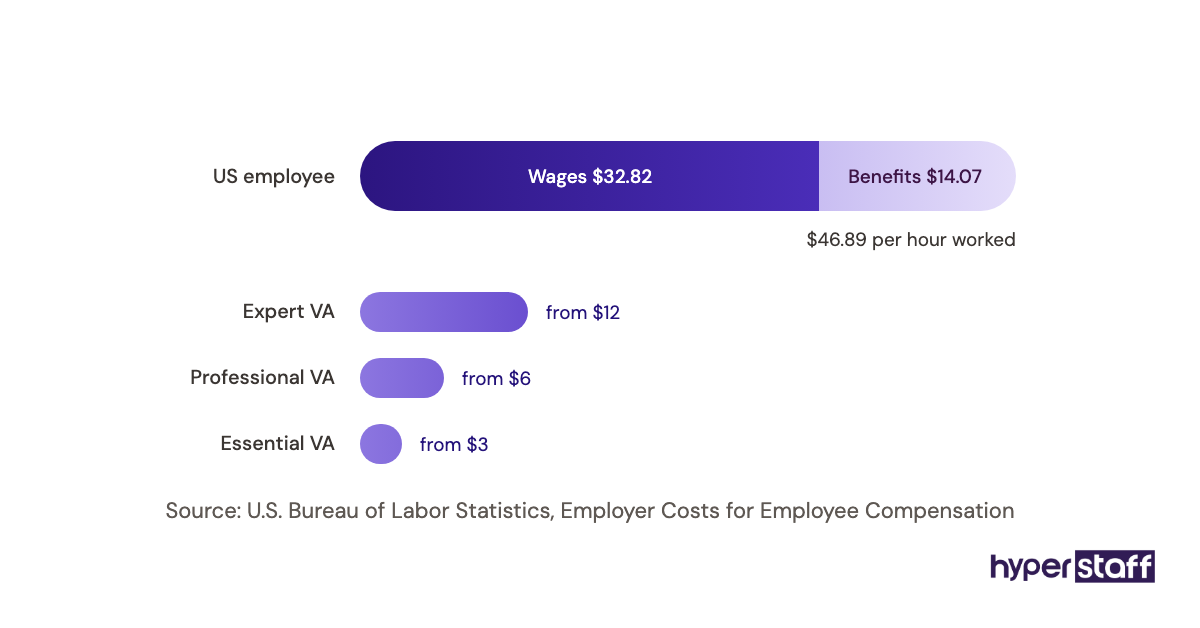
Hiring an Amazon virtual assistant costs roughly $3 to $15 an hour offshore and $20 to $40 an hour for a US-based in-house hire, before benefits and overhead. Your total depends on skill level, hours and region, and our full guide to Amazon virtual assistant cost breaks the numbers down further.
| Experience level | Hyperstaff rate | Typical US in-house hire | Monthly at 80 hours (Hyperstaff) |
|---|---|---|---|
| Essential (0 to 2 years) | From $3/hour | $18 to $25/hour plus benefits | From $240 |
| Professional (2 to 5 years) | From $6/hour | $25 to $35/hour plus benefits | From $480 |
| Expert (5+ years) | From $12/hour | $35 to $50/hour plus benefits | From $960 |
| Bundles | 40, 80 or 160 hours/month | Full-time salary only | Pay quarterly, save 10% |
Important: Hyperstaff rates shown are starting averages, not fixed quotes. Your final price depends on the role, experience level, hours and region you choose.
Is Hiring an Amazon Virtual Assistant Worth It?
Yes, hiring an Amazon virtual assistant is one of the highest-return moves a growing seller can make, provided you scope the role tightly and document the work. Done right, it buys back your hours at a fraction of their value and keeps your account checked every day.
Here's a simple calculation. Say you spend 20 hours a week on listings, messages and restock checks, and you value your own time at $50 an hour, which is about $4,000 a month in owner time.
A Professional-tier VA at $6 an hour for 80 hours a month costs about $480. Even if you keep 4 hours a week for review, you free up around 16 hours weekly for sourcing and growth.
The return isn't instant. Month one often costs you extra time, and the payoff shows in months two and three. Our breakdown of whether an Amazon VA is worth it covers the cases where it isn't.
How to Choose an Amazon Virtual Assistant Agency
Choose an Amazon virtual assistant agency by checking how it vets Amazon skills, how fast it replaces a VA who doesn't fit, and who keeps your processes documented. Ask to see the test candidates passed.
A dedicated VA who works only on your account is a must for daily Seller Central work. Rotating pools reset context every time someone changes.
Ask about replacement terms in writing. At Hyperstaff, a replacement arrives in 5 to 7 business days, briefed from your Operations Vault so you aren't starting from zero.
Check pricing transparency too. Clear hourly tiers and monthly bundles make it easy to compare, while vague "custom quotes" often hide markups.
Amazon VA Hiring Statistics, Trends and Future Predictions
Amazon VA hiring is growing alongside third-party selling, which now accounts for roughly six in ten units sold in Amazon's store according to Amazon's own quarterly reporting. More independent sellers means more demand for specialists who know Seller Central.
Specialization is the clearest trend. Sellers increasingly hire separate listing, PPC and account health VAs instead of one generalist, especially once revenue supports more than one role.
Our prediction: the generalist Amazon VA won't disappear, but the role will shift toward reviewing AI-drafted work and handling exceptions. We're less certain how fast that happens, since Amazon changes its tools faster than most sellers adopt them.
Hiring an Amazon VA and AI
AI changes what you hire an Amazon VA to do, more than whether you hire one. Amazon now offers generative AI tools inside Seller Central that draft listing content, and its Rufus shopping assistant reads listing details to answer buyer questions.
That raises the bar for listing accuracy. A VA who checks AI-drafted bullets against real product specs protects you from claims that trigger returns or policy flags.
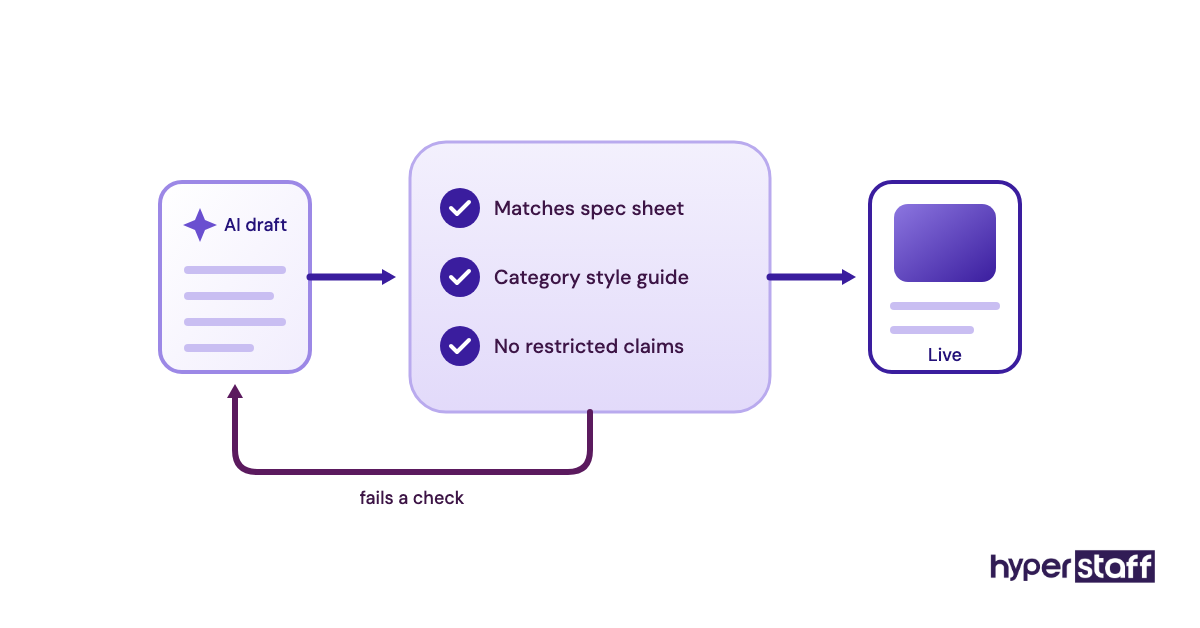
When hiring, ask candidates how they use AI tools and how they check the output. The best answers describe a review step, and the weakest describe pasting drafts straight into a live listing.
Disclaimer: This article is for general information only and does not constitute legal, financial or tax advice. Amazon policies, fees and tools change, so confirm current terms with Amazon and qualified advisors before making business decisions. Hyperstaff is not responsible for outcomes based on this content.
Common questions
Where can I find an Amazon virtual assistant?
You can find one on freelance marketplaces, in Amazon seller communities, through referrals, or through a staffing agency. Marketplaces give the most applicants, while agencies give pre-vetted candidates and replacement cover.
Should I give my Amazon VA my Seller Central password?
No. Add them as a user through Seller Central User Permissions so they get their own login and only the access their role needs.
Can I hire an Amazon VA part-time?
You can hire part-time, and many sellers start at 40 or 80 hours a month. Part-time works best for listings and messages, while daily PPC management benefits from more hours.
What skills should an Amazon virtual assistant have?
Look for hands-on Seller Central experience, comfort with spreadsheets, clear written English, and knowledge of the reports tied to their role. Tool familiarity with Helium 10 or Jungle Scout helps but matters less than judgment.
How do I know if my Amazon VA is doing a good job?
Set number-based targets at hiring, such as reply time, ACoS range or suppressed listings, and review them at 30, 60 and 90 days. Steady progress and reliable check-ins are the clearest signs.
Book a free 15 min call
We place a pre-vetted specialist in 5 business days, fully managed, from $3/hour.