Is a Real Estate Virtual Assistant Worth It? The Honest Math
A real estate virtual assistant pays off when the hours it frees go back into leads and clients, and here is how to run that math for your own business.

On this page
- What Does "Worth It" Mean for a Real Estate Virtual Assistant?
- Key Real Estate VA Terms You Should Know
- Why Does a Real Estate Virtual Assistant Matter to Your Income?
- How Does a Real Estate Virtual Assistant Work Day to Day?
- Types of Real Estate Virtual Assistants
- How Does a Real Estate VA Differ From Related Roles?
- What Are the Benefits of a Real Estate Virtual Assistant?
- What Are the Downsides of a Real Estate Virtual Assistant?
- Who Needs a Real Estate Virtual Assistant Most?
- Real Estate Virtual Assistant Examples: When It Pays and When It Doesn't
- Creating a Real Estate Virtual Assistant Plan, Step by Step
- What Does an Effective Real Estate VA Setup Look Like?
- Which Tools Does a Real Estate Virtual Assistant Use?
- 9 Proven Tips for Getting Real Value From a Real Estate VA
- Overcoming Common Real Estate VA Challenges
- How Do You Measure Whether Your Real Estate VA Is Paying Off?
- How Long Does a Real Estate Virtual Assistant Take to Pay Off?
- How Much Does a Real Estate Virtual Assistant Cost?
- Is a Real Estate Virtual Assistant Worth It?
- How Do You Choose a Real Estate Virtual Assistant Agency?
- Real Estate Virtual Assistant Statistics, Trends and Future Predictions
- Real Estate Virtual Assistants and AI
- FAQs
💡 Key Takeaways:
1) A real estate virtual assistant is worth it when the monthly fee is lower than the value of the agent hours it frees, and those hours go into leads, showings and listings.
2) The biggest return usually comes from fast lead follow-up and transaction tracking, because a slow reply or a missed contract deadline costs far more than an hour of admin.
3) A VA rarely pays off when the agent has no written processes, closes only a handful of deals a year, or expects the assistant to do licensed work.
Turn Lost Follow-Ups Into Closed Commissions
Hyperstaff has placed 70+ virtual assistants with 30+ clients, and our real estate virtual assistant services match you with a pre-vetted specialist in 5 business days, from $3 an hour. One person learns your pipeline, your CRM and your clients, and if the fit is wrong, a free replacement starts within 5 to 7 business days.
What Does "Worth It" Mean for a Real Estate Virtual Assistant?
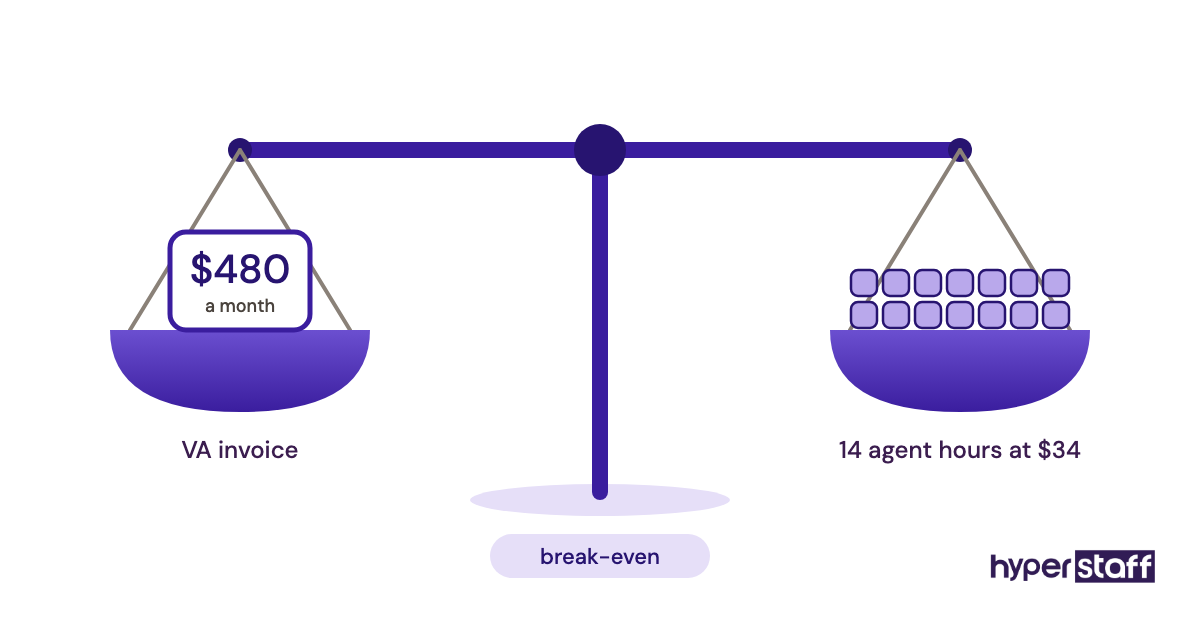
A real estate virtual assistant is worth it when the cost of the remote help is lower than the income those freed hours produce. The test is a monthly comparison: the VA's invoice on one side, and on the other, the agent hours that move from admin back to buyers, sellers and follow-up.
A real estate VA is a remote team member who handles the admin, marketing, CRM upkeep, lead follow-up and transaction paperwork behind each deal. For the full role breakdown, start with what a real estate VA is.
Worth is personal math. A solo agent closing five deals a year and a team closing fifty get very different answers from the same $480 invoice.
Key Real Estate VA Terms You Should Know
- Real estate virtual assistant (REVA) = a remote specialist who handles admin, marketing, CRM and transaction tasks for agents and teams.
- Transaction coordinator (TC) = the person who tracks a deal from accepted offer to closing, including deadlines, disclosures and signatures.
- ISA (inside sales agent) = a caller who qualifies and nurtures leads, then books appointments for the agent.
- Speed to lead = the time between a new inquiry arriving and the first human reply.
- CRM = the contact database, such as Follow Up Boss, where every lead, note and task lives.
- Fully loaded cost = an employee's wages plus benefits, payroll taxes, equipment and desk space.
- Hourly bundle = a fixed block of monthly hours bought ahead from a staffing provider.
- Opportunity cost = the income an agent gives up by spending an hour on admin.
- SOP = a written standard operating procedure that shows exactly how a task gets done.
- Licensed activity = work only a licensed agent may do under state rules, such as negotiating terms or giving price opinions.
- Fair housing compliance = following the Fair Housing Act in ads, listing copy and every client message.
Why Does a Real Estate Virtual Assistant Matter to Your Income?
A real estate virtual assistant matters because an agent's sellable hours are limited and admin eats them first. NAR's latest Member Profile, as summarized by HousingWire, puts the typical Realtor's median gross income at $59,200 on roughly 35 hours a week.
Spread over a 50-week year, that comes to about $34 per working hour. Every hour spent formatting a CMA template or chasing a lender for a document is an hour billed at that rate to the lowest-value work in the business.
Lead response is the second reason. A Harvard Business Review study of online sales leads found that companies trying to reach a lead within an hour were nearly seven times as likely to qualify it as those who waited longer.
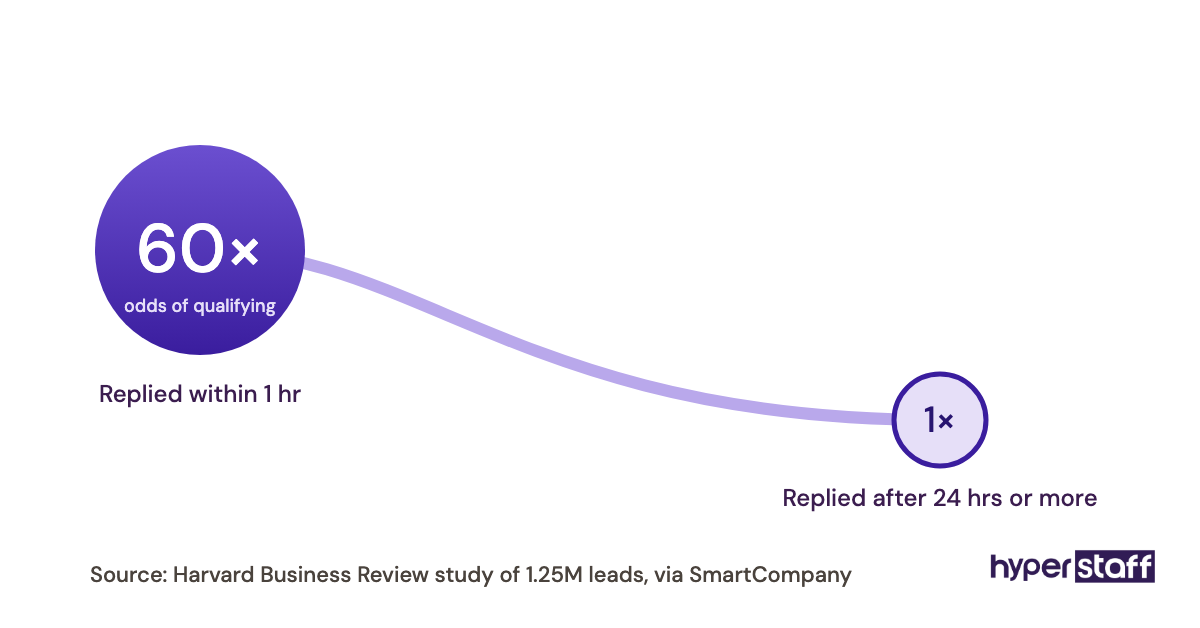
Agents in a showing or at a closing table can't answer a portal inquiry in ten minutes. A VA watching the inbox can, and in our view that single job pays for the role more often than all the admin combined.
How Does a Real Estate Virtual Assistant Work Day to Day?
A real estate virtual assistant works remotely inside the agent's own systems: the CRM, a shared inbox, the calendar, the transaction platform and the design tools. The agent sets priorities, the VA works a daily task list, and both check in through chat, a short call or a recorded video.
A normal day might cover new lead replies, CRM notes, showing confirmations, a listing flyer, social posts and a check of every open file against its contract dates. The full list is in our guide to real estate VA tasks.
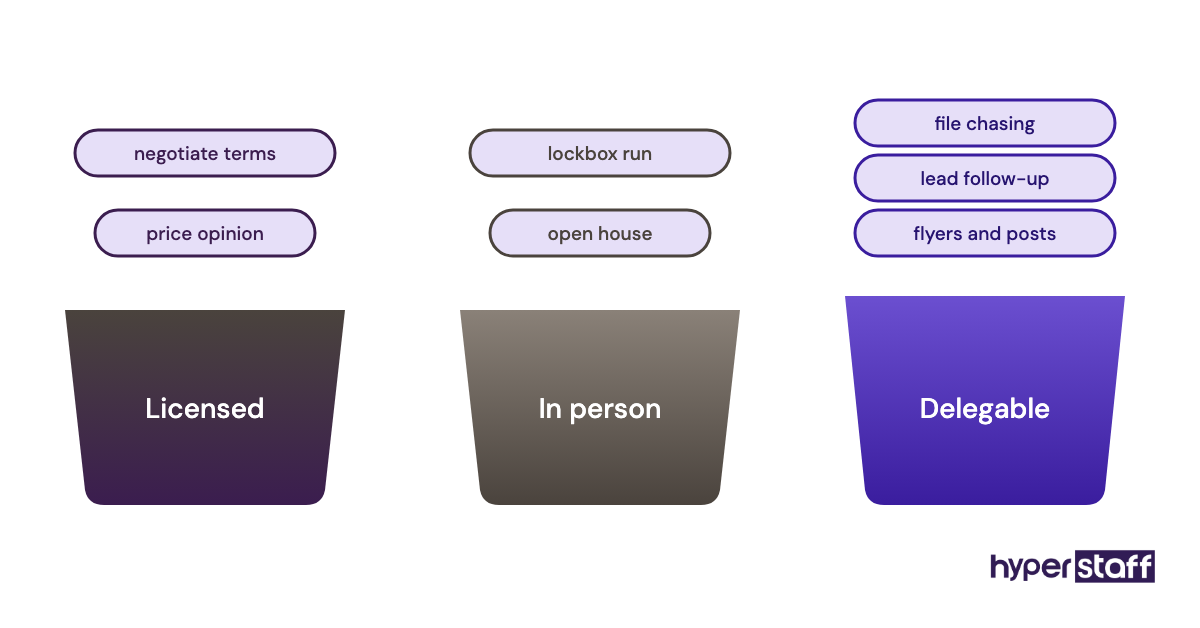
The agent keeps anything that requires a license. State rules differ, but unlicensed assistants generally can't negotiate, show property, interpret contracts or give opinions on price.
With Hyperstaff, setup is one 30-minute kickoff call. Work starts that day or the next morning, and your SOPs, tools and context go into an Operations Vault that we write down and maintain for you.
Types of Real Estate Virtual Assistants
Real estate virtual assistants split by function, and the type you pick decides how fast the role pays off. Admin help saves time, while lead and transaction roles protect revenue directly.
| Type | Core work | Best fit | Typical tier | Pays off through |
|---|---|---|---|---|
| Admin VA | Inbox, calendar, CRM entry, scheduling | Solo agents | Essential | Freed agent hours |
| Lead follow-up VA | Portal replies, texts, nurture emails | Agents buying leads | Professional | More qualified appointments |
| Transaction coordination VA | Deadlines, disclosures, signatures, lender updates | Agents with 10+ deals a year | Professional or Expert | Fewer missed dates |
| Listing coordinator VA | MLS input prep, photo scheduling, flyers | Listing-heavy agents | Professional | Faster listing launches |
| Marketing VA | Social posts, newsletters, Canva graphics | Brand-building agents | Essential or Professional | Steady sphere contact |
| ISA-style calling VA | Qualifying calls, appointment booking | Teams with large lead flow | Professional or Expert | Booked appointments |
| Bookkeeping VA | Expense logs, commission tracking | Teams and small brokerages | Professional | Clean books at tax time |
| Property management VA | Tenant messages, maintenance tickets, rent reminders | Investors and PM firms | Essential or Professional | Faster tenant response |
How Does a Real Estate VA Differ From Related Roles?
A real estate VA differs from related roles mainly in scope and employment model. Most other roles do one slice of the job on-site or on a per-file basis, while a dedicated VA covers several slices for a fixed monthly block of hours.
Real Estate Virtual Assistant vs. In-House Assistant
An in-house assistant is an employee, so the agent pays wages, benefits and payroll taxes and supplies the desk. The BLS lists a median of $48,310 a year for secretaries and administrative assistants, before any of those extras.
An in-house hire wins for in-person tasks like lockbox runs and office reception. Our full breakdown of the VA vs in-house trade-offs covers the rest.
Real Estate Virtual Assistant vs. Transaction Coordinator
A transaction coordinator usually charges per closed file and only touches the contract-to-close stretch. A VA trained on transaction coordination does that same tracking and also fills the slow weeks with CRM, marketing and lead work.
Per-file TCs suit agents with lumpy volume. Once you're above roughly one closing a month, a VA's fixed hours tend to cover more ground for the money.
Real Estate Virtual Assistant vs. ISA
An ISA is a dedicated phone role measured on booked appointments, often paid partly on commission. A VA can run follow-up texts and calls, but a full calling seat needs scripts, a dialer and compliance training, and it's a job of its own.
What Are the Benefits of a Real Estate Virtual Assistant?
The main benefit is that an agent buys back selling hours at a fraction of their own hourly value.
- Lead inquiries get a reply within minutes during the VA's working hours.
- Contract dates are tracked by someone whose job is the calendar.
- Monthly cost is fixed and far below an employee's fully loaded cost.
- Hours scale up in listing season and back down in slow months.
- Processes get written down, which makes adding a second agent easier.
- The CRM stays clean, so past clients get remembered at the right moments.
What Are the Downsides of a Real Estate Virtual Assistant?
The honest downside is that a VA adds management work before it removes any.
- The first two to four weeks cost the agent time in training and review.
- Time zones can delay replies outside the VA's shift.
- Licensed and in-person tasks still sit with the agent.
- Shared logins and client data need proper access controls.
Who Needs a Real Estate Virtual Assistant Most?
Agents who already have more leads and files than hours need a real estate virtual assistant most. A brand-new agent with two deals in the pipeline usually needs prospecting time, and admin help won't create that.
The view from a team lead looks different again. For them, a VA is often the cheapest way to standardize how five agents log leads and track files.
| Situation | Usual bottleneck | Start with | Hours per month |
|---|---|---|---|
| New agent, under 6 deals a year | Lead volume | Hold off, or marketing only | 0 to 40 |
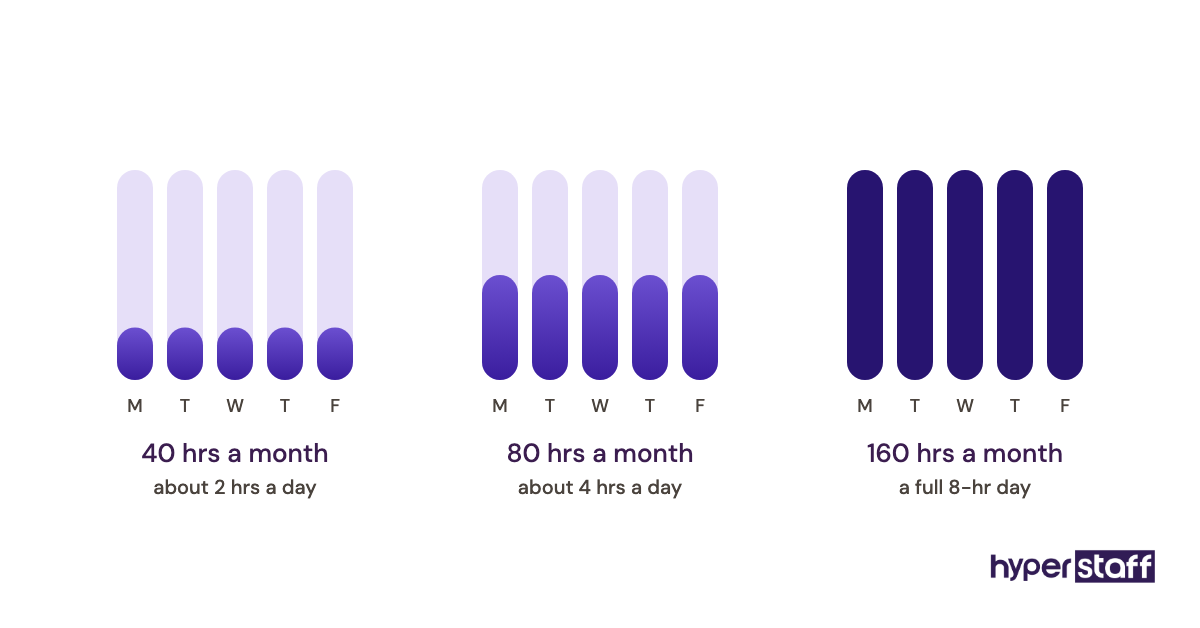
| Solo agent, 10 to 25 deals | Admin and follow-up | Admin plus lead follow-up | 40 to 80 |
| Listing-heavy agent | Launch prep and seller updates | Listing coordinator | 80 |
| Team of 3 to 8 agents | File tracking, CRM discipline | Transaction coordination | 160 |
| Investor or property manager | Tenant and vendor messages | Property management VA | 80 to 160 |
Real Estate Virtual Assistant Examples: When It Pays and When It Doesn't
The same VA can be a great investment or wasted money, and the difference sits almost entirely in what the role is pointed at. The setups below show both sides.
Good Examples of a Real Estate VA Paying Off
Answering Portal Leads Within the Hour
An agent buying portal leads routes every new inquiry to a shared inbox the VA watches. The VA replies with a short personal text, logs the lead in the CRM and books a call on the agent's calendar.
The leads were already paid for. The VA's job is to stop them going cold, which is where the seven-times qualification gap from the HBR research shows up in real money.
Tracking Every File From Contract to Close
A VA builds a checklist per deal with the inspection, appraisal, financing and closing dates, then emails the lender and title company on a set rhythm. The agent gets one daily summary instead of digging through threads.
Preparing a Listing Launch
Before a listing goes live, the VA books the photographer, drafts the MLS remarks for the agent to approve, builds the flyer and schedules the social posts. Launch prep that used to stretch across a week of evenings fits into the VA's normal shift.
Bad Examples Where a VA Loses Money
Cold Calling With No Script or DNC Check
Handing a new VA a purchased phone list and a dialer on day one is a fast way to burn leads and invite complaints. Any calling program needs scripts and a scrub against the National Do Not Call Registry before the first dial.
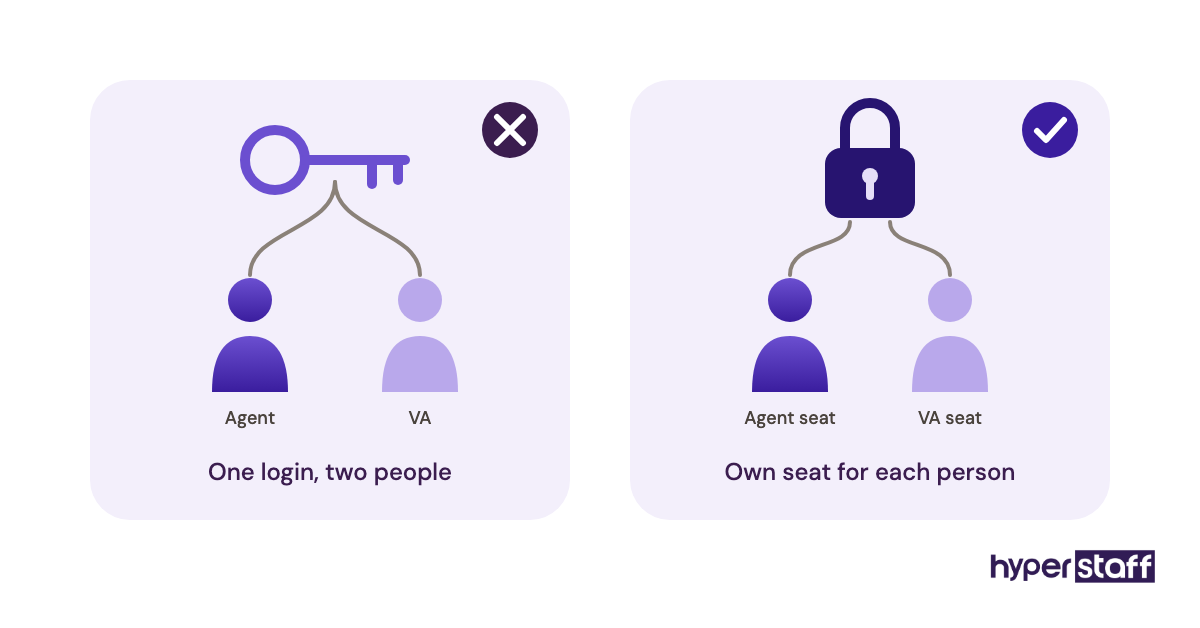
Sharing the Agent's MLS Login
Most MLSs ban credential sharing and offer separate assistant access instead. Giving a VA your own login risks fines or a suspended account, and the fix costs nothing.
Buying 10 Hours a Week With No SOPs
A VA with a few hours and no written process spends most of them asking questions. More traps like this are in our list of common real estate VA mistakes.
Creating a Real Estate Virtual Assistant Plan, Step by Step
A real estate VA plan is five decisions made in order, starting with where your hours actually go. Skipping the first step is why so many agents hire for the wrong job.
Step #1: Log a Week of Your Own Hours
Write down every task for five working days with the minutes it took. Mark each one as licensed, in-person or delegable.
Step #2: Turn the Delegable List Into a Role
Group the delegable tasks into one clear role with outcomes attached. Our real estate VA job description template gives you a starting structure.
Step #3: Pick the Tier and the Hours
Match experience to risk. Data entry and posting suit an Essential-tier VA, while transaction coordination and lead conversations justify Professional or Expert.
Step #4: Hire and Onboard
Interview for judgment and written English, then give the VA access, SOPs and a first-week task list. The steps are laid out in our guides on hiring a real estate VA and onboarding a real estate VA.
Step #5: Review at 30 and 90 Days
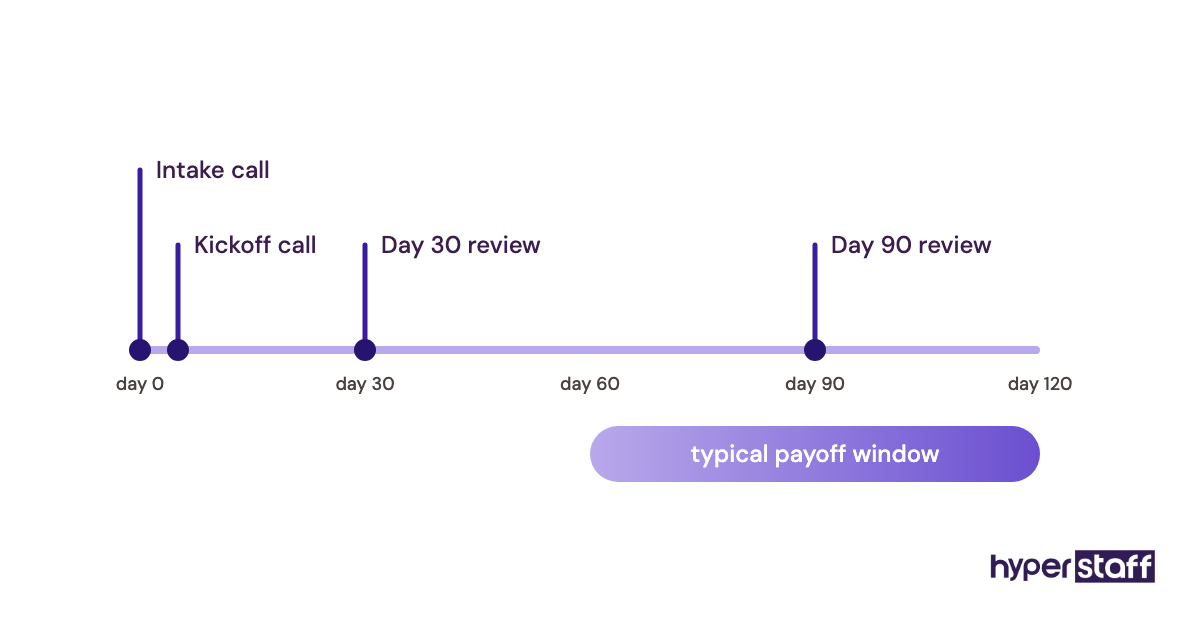
At day 30, check accuracy and response times. At day 90, compare the cost against the hours you got back and any change in appointments or files closed.
What Does an Effective Real Estate VA Setup Look Like?
An effective real estate VA setup has one owner for the CRM, written SOPs for every repeated task and a fixed daily handoff. The VA knows what "done" looks like for each job, and the agent reviews outcomes instead of steps.
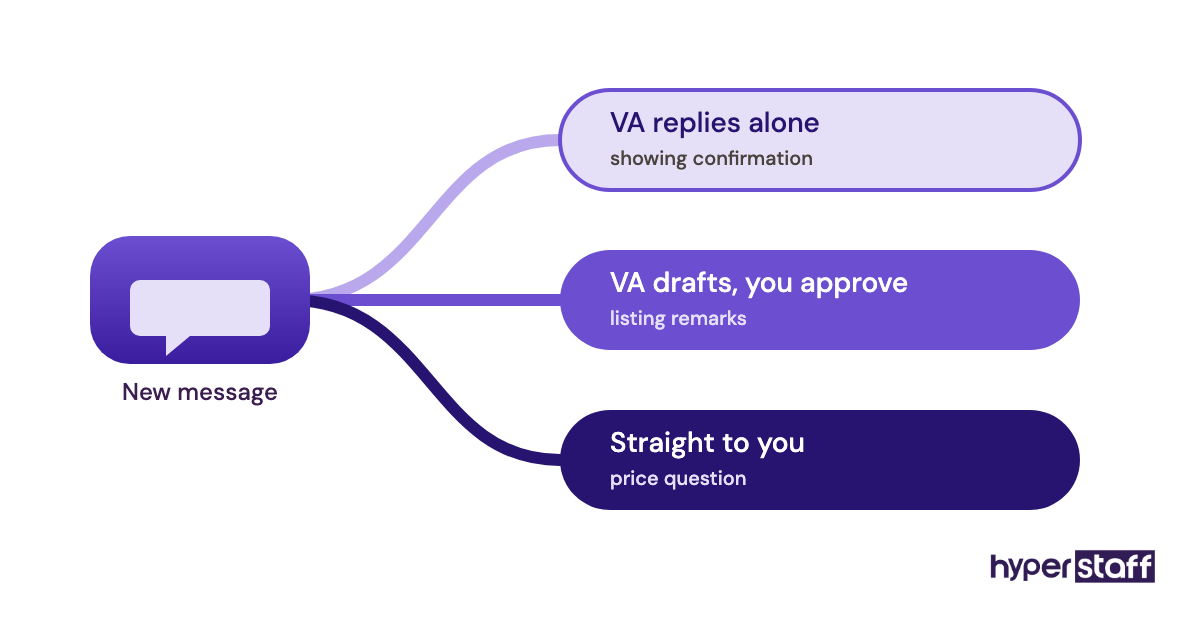
Boundaries matter as much as tasks. The VA should know which messages to answer alone, which ones to draft for approval and which go straight to the agent, like an offer question or a price discussion.
Weekly, a 15-minute review of the pipeline, open files and next week's listings keeps both of you aligned. Practitioners split on daily standups: some agents want a five-minute call every morning, others prefer a written end-of-day report, and both work if they stick.
Which Tools Does a Real Estate Virtual Assistant Use?
A real estate virtual assistant mostly uses the agent's existing stack, plus a few tools for access and handoffs. Follow Up Boss is a common CRM, and its published pricing runs from $69 per user a month on the Grow plan ($58 billed yearly), so budget for an extra seat.
Scheduling usually sits in Calendly, which is free for basic use, with paid seats from $10 to $16 a month on yearly billing per Calendly's plans. Transaction files tend to live in dotloop or SkySlope, often chosen by the brokerage.
Canva covers flyers and social graphics, Google Workspace handles shared email and documents, and Loom records the SOP videos. A password manager like 1Password lets you share logins without ever showing the password itself.
Our opinion: the CRM matters more than any other tool, because a VA working a messy database just produces faster mess. The wider list is in our roundup of real estate VA tools.
9 Proven Tips for Getting Real Value From a Real Estate VA
These tips come from the patterns that separate VA roles that pay for themselves from roles that get cancelled without much fuss.
- Start with lead follow-up or file tracking, since both protect revenue.
- Write the SOP before the task is handed over, even if it's a rough list.
- Give the VA its own logins wherever the software allows it.
- Set a reply-time target for new leads during the VA's shift.
- Approve all listing copy and ads until the VA has a track record.
- Keep one place for tasks, not a mix of texts, emails and sticky notes.
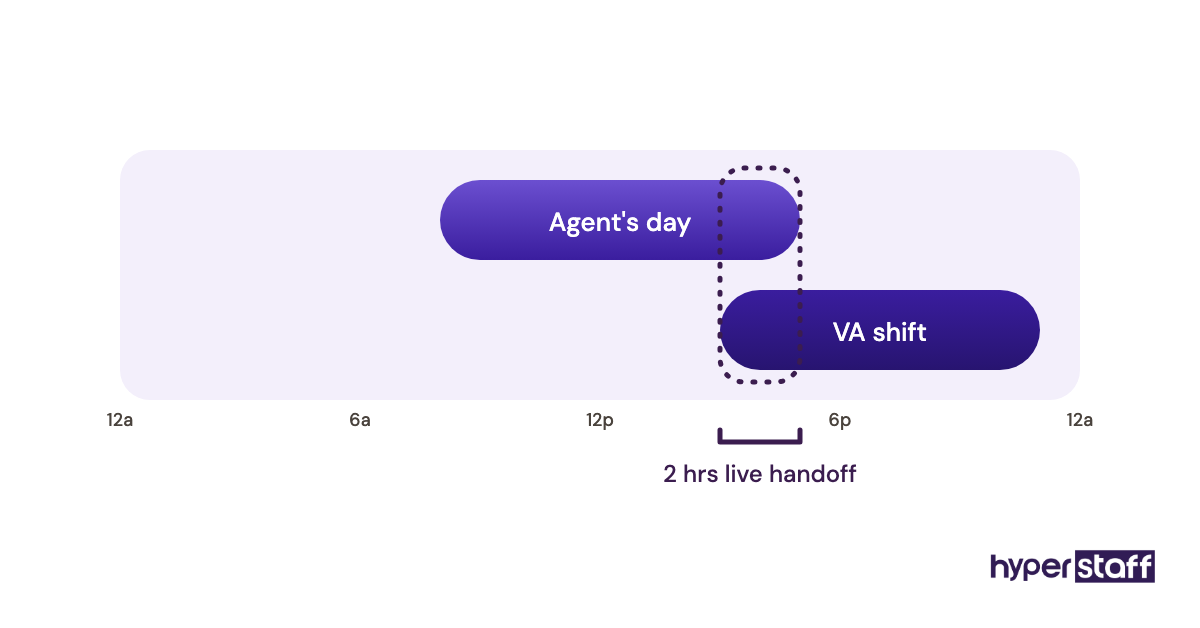
- Overlap at least two working hours with the VA each day.
- Add hours only after the current hours are fully used.
- Review the numbers at 90 days and cut tasks that never paid off.
Overcoming Common Real Estate VA Challenges
Most real estate VA challenges come down to time zones, access and drift. Time zones are handled by shift choice: many offshore VAs work US hours, and a two-hour overlap covers most handoffs.
Access problems shrink with separate logins, a password manager and permissions set per tool. If a VA leaves, you remove one user instead of changing every password you own.
Quality drift shows up around month three, when early attention fades. A short weekly review and updated SOPs keep standards where they started.
How Do You Measure Whether Your Real Estate VA Is Paying Off?
Measure a real estate VA with four numbers: agent hours freed per week, median lead response time, appointments booked and contract deadlines missed. Record each one for a month before the VA starts so you have a baseline.
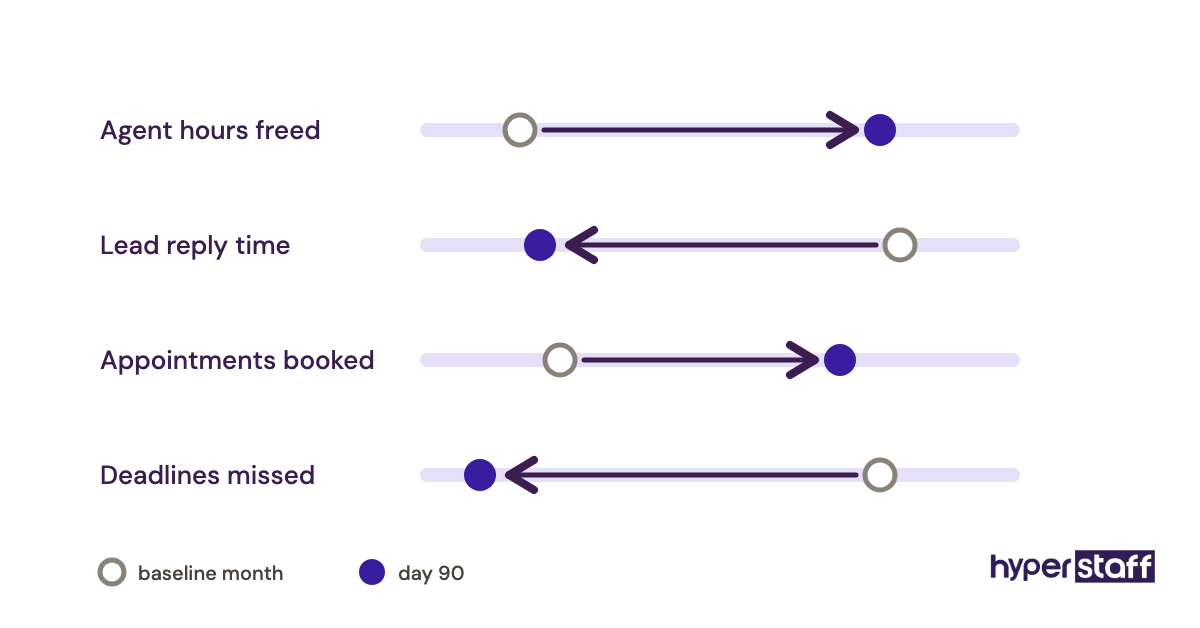
Then compare at 90 days. If freed hours went into prospecting and appointments rose, the role is working; if the hours vanished into other admin, fix the agent's calendar before judging the VA.
How Long Does a Real Estate Virtual Assistant Take to Pay Off?
A real estate virtual assistant usually takes 60 to 120 days to pay off in closed deals. Time savings appear in the first few weeks, but real estate sales cycles are long.
The sequence goes like this: week one is access and SOPs, weeks two to four are supervised work, and month two is the first stretch of independent output. Then comes a dead zone, since a lead answered faster today may not go under contract for months.
How Much Does a Real Estate Virtual Assistant Cost?
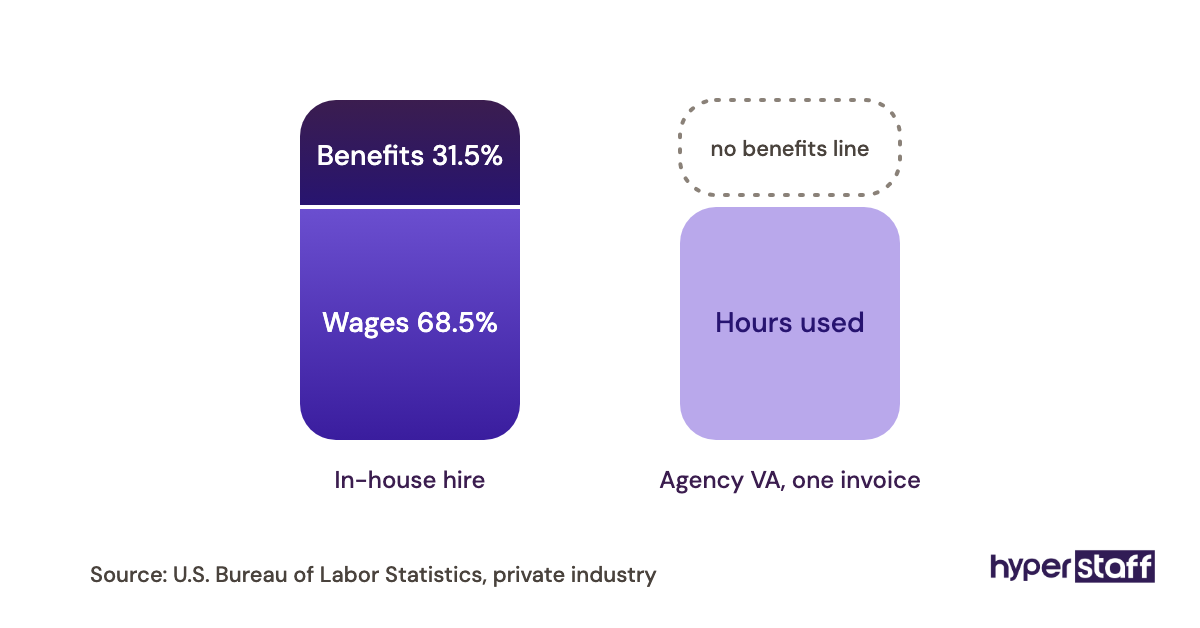
A real estate virtual assistant costs from $3 to $12+ an hour at Hyperstaff, depending on experience, compared with roughly $34 an hour for an in-house administrative assistant once benefits are counted. The in-house figure combines the BLS median of $48,310 with benefits making up about 31% of total compensation, and our real estate VA cost breakdown goes deeper.
| Option | Experience | Hourly rate | 80 hours a month | 160 hours a month |
|---|---|---|---|---|
| Hyperstaff Essential | 0 to 2 years | From $3 | From $240 | From $480 |
| Hyperstaff Professional | 2 to 5 years | From $6 | From $480 | From $960 |
| Hyperstaff Expert | 5+ years | From $12 | From $960 | From $1,920 |
| In-house admin assistant | Varies | About $34 loaded | About $2,700 | About $5,800 |
Hyperstaff sells monthly bundles of 40, 80 or 160 hours, and paying quarterly saves 10%. Every client also gets a dedicated account manager.
Important: Hyperstaff prices shown here are typical starting rates, not fixed quotes. Your final cost depends on the tasks, the experience level needed and the hours your business actually uses.
Is a Real Estate Virtual Assistant Worth It?
Yes, a real estate virtual assistant is worth it for most producing agents, and it can be one of the best-returning hires in the business when the freed hours go back into clients. A Professional-tier VA at $6 an hour for 80 hours costs $480 a month, and if that VA takes 60 hours of admin and follow-up off an agent whose time is worth about $34 an hour, the agent gets roughly $2,040 of selling time back for $480.
The bigger number is the deal you'd otherwise lose. One extra closing from a lead that got answered in ten minutes instead of the next evening covers many months of VA fees.
The math breaks when the hours don't go anywhere useful. If an agent has no leads to work, a VA just makes the lull faster, and the honest call is to wait.
How Do You Choose a Real Estate Virtual Assistant Agency?
Choose a real estate VA agency on four things: how it vets candidates, whether you get one dedicated person, what happens if the fit is wrong and how your processes are kept when someone leaves. Price matters, but replacement terms and documented SOPs protect you more.
Ask to interview the candidate yourself, with real scenarios like a late appraisal or a buyer asking about price. Our list of real estate VA interview questions gives you ones that test judgment.
Hyperstaff places one dedicated specialist from a pre-vetted bench in 5 regions: the Philippines, Latin America, India, Eastern Europe and the United States. If it doesn't work out, the replacement is briefed from your Operations Vault, so you don't start training from zero.
Real Estate Virtual Assistant Statistics, Trends and Future Predictions
Real estate employment is growing slowly, which puts more weight on each agent's productivity. The BLS projects 2% job growth for real estate brokers and sales agents over the next decade, slower than the average for all jobs.
NAR data puts typical agent income at $59,200 on about 35 hours a week, and agents with that time budget can't afford to spend a third of it on paperwork. Fast lead response keeps its value too, as the HBR findings on qualification rates show.
Our predictions are opinions, so treat them that way. We expect more teams to replace per-file coordinators with one VA trained on transactions, and we expect AI drafting to shift VA work from writing toward checking, sending and following up.
Real Estate Virtual Assistants and AI
AI tools now draft listing descriptions, summarize long email threads and suggest follow-up messages in seconds. A real estate VA's role moves toward running those tools, checking the output and getting it to the right person at the right time.
AI output still needs a human check. Generated listing copy can slip into phrasing that describes who a home suits rather than what the home is, and that is fair housing risk under the Fair Housing Act.
Chatbots can answer a portal lead at 2 a.m., but in our experience buyers notice canned replies quickly. A VA who reviews the bot's conversations the next morning and follows up personally gives you both speed and a real person.
Disclaimer: This article is for general information only and isn't legal, tax or financial advice. Real estate licensing rules, MLS policies and costs vary by state and change over time, so check with your broker, state commission or a qualified advisor before acting.
Common questions
Is a real estate VA worth it for a new agent?
Usually not in the first months. A new agent's bottleneck is lead volume, so a small marketing block of 40 hours makes more sense than full-time admin help.
Can I hire a real estate virtual assistant part-time?
You can. Many agents start with 40 or 80 hours a month and add hours once the first tasks run smoothly.
Do I pay benefits or payroll taxes for a real estate VA?
Not when you hire through an agency, since the agency handles the VA's employment. You pay one invoice for the hours used, which is a large part of why a VA costs less than an employee.
Is it safe to give a real estate VA my client data?
It's safe when access is controlled. Use separate logins, a password manager and role-based permissions in your CRM, and remove access the same day someone leaves.
Will an offshore real estate VA work US hours?
Most can, since offshore VAs commonly work US business hours. Agree on the shift and at least two overlap hours before the start date.
Book a free 15 min call
We place a pre-vetted specialist in 5 business days, fully managed, from $3/hour.