What Is a Real Estate Virtual Assistant? Roles, Tasks and Costs
What a real estate virtual assistant does, what they can't legally do, what they cost and how to set one up so the hire pays for itself.

On this page
- What is a real estate virtual assistant?
- Key real estate virtual assistant terms you should know
- Why does a real estate virtual assistant matter?
- How does a real estate virtual assistant work day to day?
- Types and forms of real estate virtual assistants
- How does a real estate VA differ from related roles?
- What are the benefits of a real estate virtual assistant?
- What are the drawbacks of a real estate virtual assistant?
- Who needs a real estate virtual assistant?
- Real estate virtual assistant examples
- Creating a real estate virtual assistant plan, step by step
- What does an effective real estate VA setup look like?
- Real estate virtual assistant tools and software
- 10 proven tips for working with a real estate virtual assistant
- How do you overcome common real estate VA challenges?
- How do you measure real estate virtual assistant success?
- How long does a real estate virtual assistant take to work?
- How much does a real estate virtual assistant cost?
- Is a real estate virtual assistant worth it?
- How do you choose a real estate virtual assistant agency?
- Real estate virtual assistant statistics, trends and future predictions
- Real estate virtual assistants and AI
- FAQs
💡 Key Takeaways:
1) A real estate virtual assistant is a remote team member who handles admin, lead follow-up, listing prep and transaction tracking for agents, teams and brokerages.
2) In most US states, an unlicensed VA can't show homes, negotiate offers or give contract advice. The role supports licensed work and leaves those tasks to the agent.
3) Most VAs run their assigned tasks alone within two to four weeks. The hire pays off when it frees the agent's hours for listings, showings and sphere calls.
Win more deals by handing off the busywork
Hyperstaff has placed 70+ virtual assistants with 30+ clients, and our dedicated real estate virtual assistants start within 5 business days at rates from $3 an hour. Each one learns your listings, your CRM and your voice, then stays with you. If the fit is ever wrong, you get a free replacement.
What is a real estate virtual assistant?
A real estate virtual assistant is a remote team member who handles the admin, marketing and client communication behind an agent's or brokerage's deals. They log into your CRM, inbox and calendar from wherever they are, and they keep listings, leads and closings moving while you're with clients.
Day to day, what a real estate virtual assistant does falls into five areas: lead follow-up, listing prep, transaction tracking, calendar control and marketing. The mix depends on the role, and our full real estate virtual assistant tasks list breaks each one down.
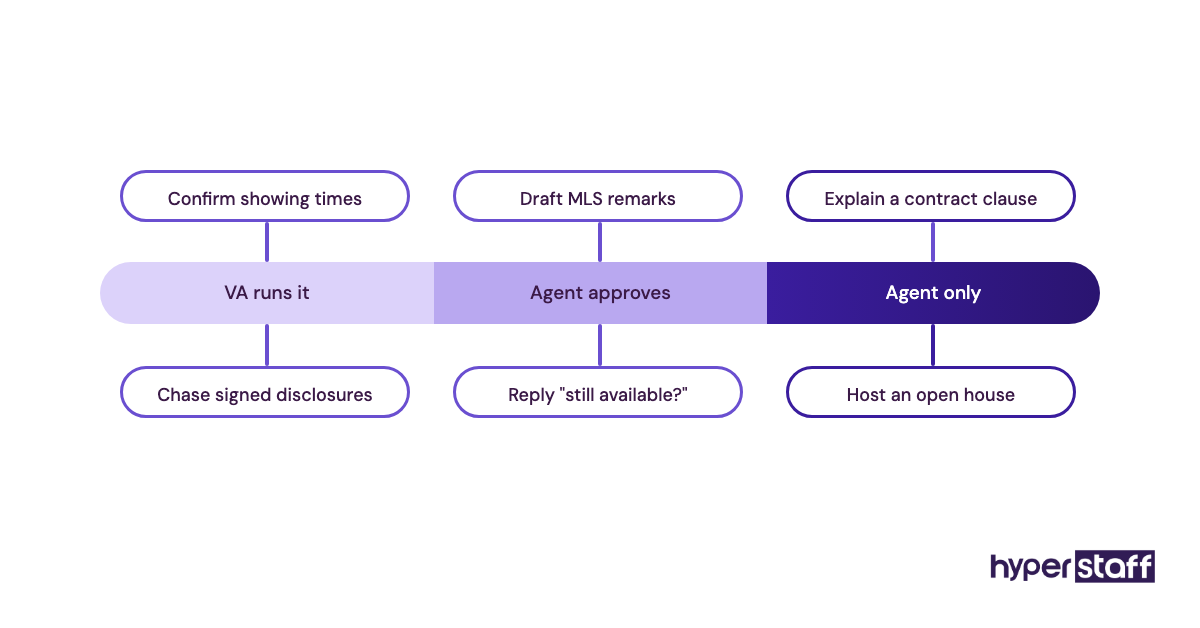
Licensing draws a hard line around the role. In most US states, an unlicensed assistant can't show homes, negotiate offers or interpret contract terms for a consumer, so a real estate VA supports the licensed work and leaves those tasks to the agent.
Key real estate virtual assistant terms you should know
- Transaction coordinator (TC) = the person who tracks a deal from accepted offer to closing and chases deadlines, documents and signatures.
- ISA (inside sales agent) = a phone role that qualifies and nurtures leads, then books appointments for the agent.
- CRM = the contact database where every lead, note and follow-up task lives.
- MLS = the multiple listing service where listings are entered and searched. Each local MLS sets its own access rules.
- Speed to lead = the time between a new inquiry arriving and the first human reply.
- Drip campaign = an automated series of emails or texts that keeps cold leads warm over months.
- Listing launch = everything between a signed listing agreement and a live listing: photos, copy, MLS entry and social posts.
- Buyer representation agreement = the written agreement a buyer signs with an agent before touring. A VA often sends and tracks it.
- SOP = a standard operating procedure, the written how-to a VA follows for a task that repeats.
- Lead source = where a lead came from (portal, sign call, sphere, open house), tracked so you know which sources pay.
Why does a real estate virtual assistant matter?
A real estate virtual assistant matters because an agent's yearly income rests on a small number of deals, and a dropped follow-up can cost one of them. The typical Realtor closed 9 transaction sides and earned a median gross income of $59,200, according to NAR's latest member profile.
At nine sides, losing one deal to a slow reply or a missed contingency date takes away about 11% of the year's income. Costs keep rising too: the same NAR figures put median business expenses at $9,530, up from $8,010.
We've placed 70+ virtual assistants, and the agents who gain most from one are the ones whose follow-up starts slipping at 5 or 6 active clients. A VA lifts that ceiling before it limits the year.
How does a real estate virtual assistant work day to day?
A real estate virtual assistant works through a defined task list, inside your own accounts, on a schedule that overlaps your business hours. You give them access to the CRM, email, calendar and file storage. They work the queue and report back daily.
In a typical week, the day runs in a rough order: lead replies and CRM cleanup in the morning, listing and marketing work midday, then transaction check-ins and the next day's calendar in the afternoon.
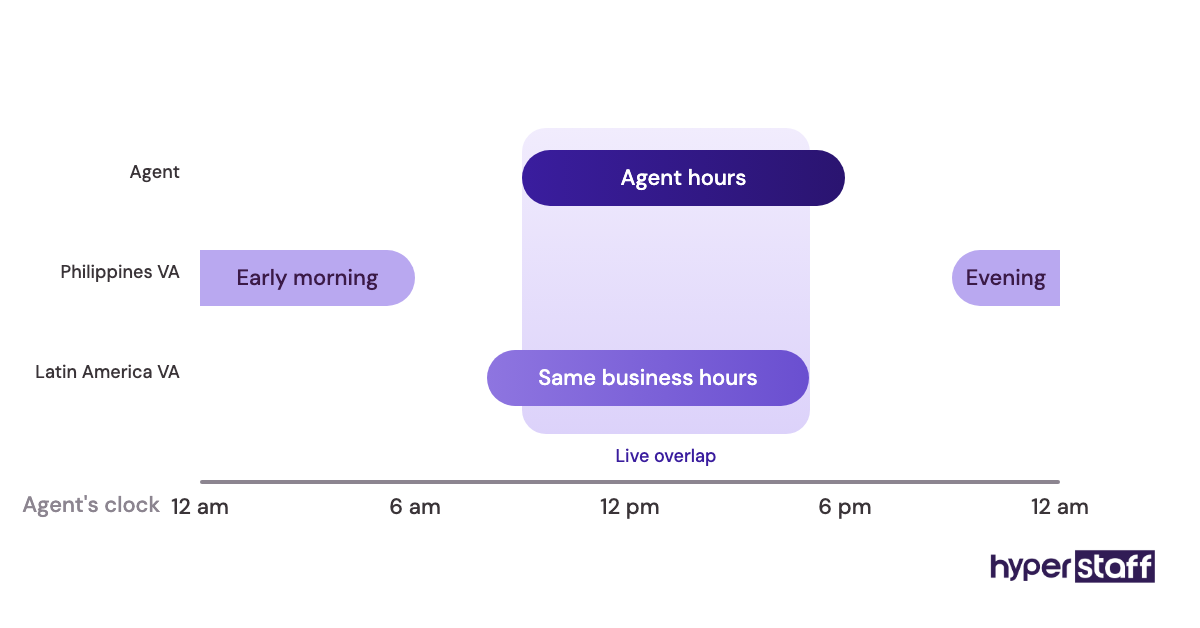
Time-zone overlap shapes the role as much as skill does. A VA in the Philippines can cover your evenings and early mornings, while a VA in Latin America works during US business hours. Choose the region based on the job.
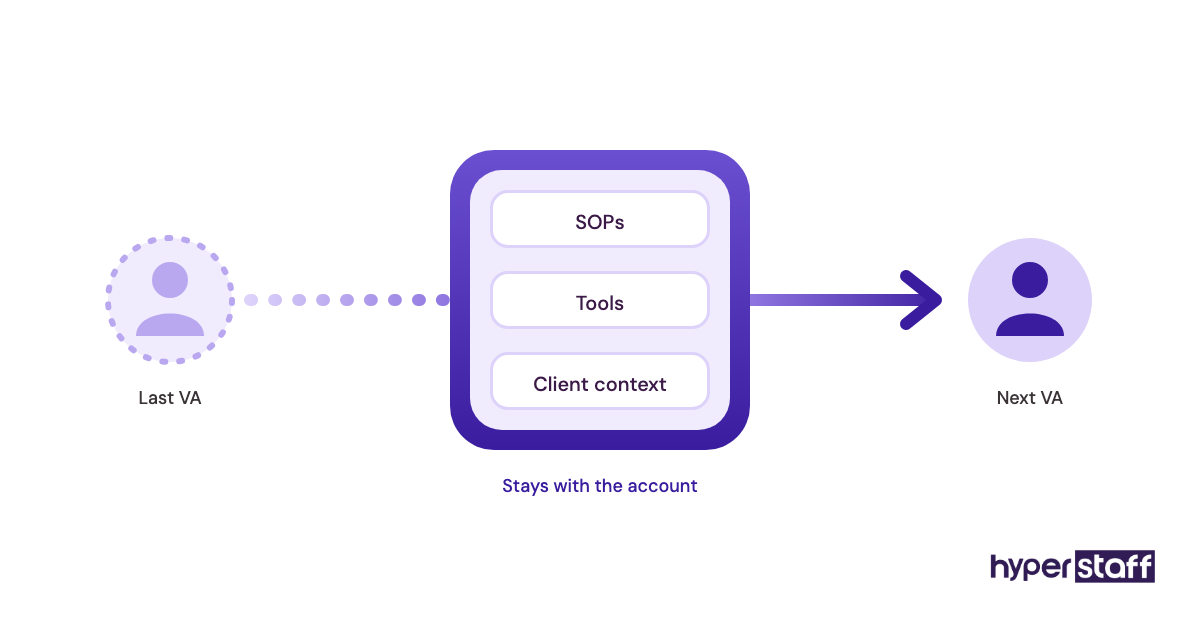
At Hyperstaff, setup starts with a 30-minute kickoff call, and work begins that day or the next morning. Everything you explain goes into your Operations Vault, the written record of your SOPs, tools and context. A replacement can then pick up where the last person stopped.
The standard advice is to hand over SOPs on day one. Most agents don't have written SOPs, though, so the first two weeks double as documentation time. That's normal.
Types and forms of real estate virtual assistants
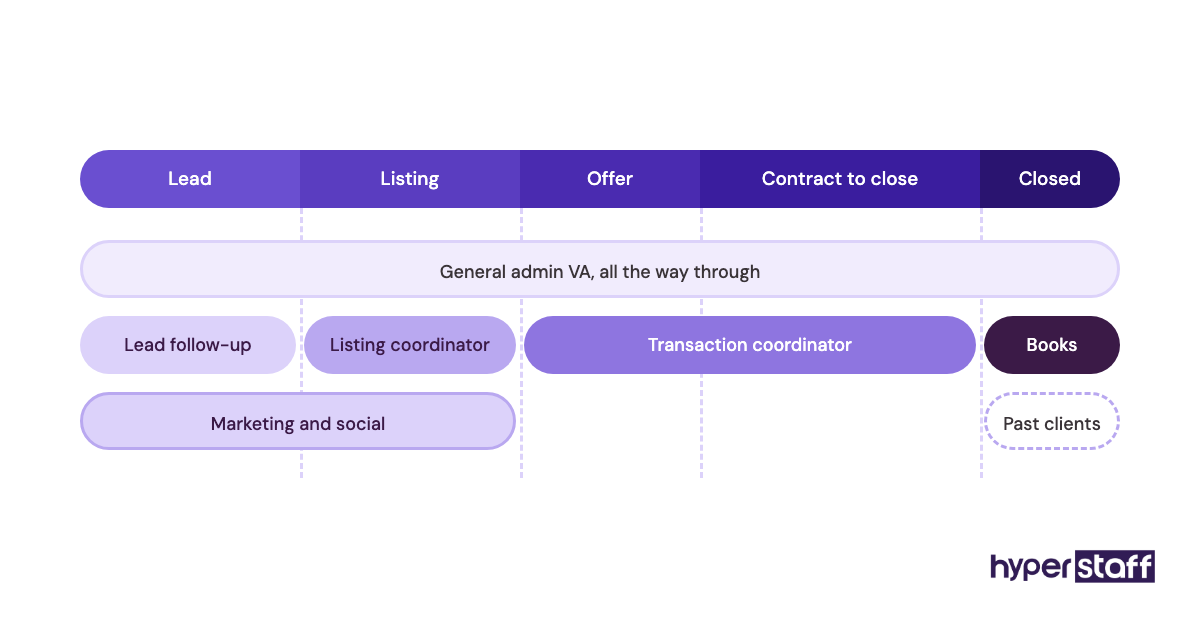
Real estate virtual assistants are grouped by the part of the deal they own. Most solo agents start with a general admin VA and move to specialist roles later. Teams usually hire by role from the start.
| Type | Core tasks | Best fit | Typical tier | Licensing note |
|---|---|---|---|---|
| General admin VA | Inbox, calendar, CRM updates, document filing | Solo agents, first hire | Essential | No license needed |
| Lead follow-up / ISA VA | Lead replies, call and text nurture, appointment booking | Agents buying portal leads | Professional | Do Not Call rules apply |
| Transaction coordinator VA | Deadline tracking, document collection, party updates | Agents with several active files | Professional to Expert | Some states allow licensed TCs to do more |
| Listing coordinator VA | Photo booking, MLS draft entry, listing copy | Listing-heavy agents and teams | Professional | Agent approves MLS entries |
| Marketing and social VA | Social posts, newsletters, Canva graphics, ad setup | Agents building a sphere | Essential to Professional | Fair housing rules apply to ads |
| Property management VA | Maintenance tickets, tenant messages, owner reports | Property managers | Professional | Screening follows fair housing law |
| Bookkeeping VA | Commission tracking, expense logs, reconciliation | Teams and brokerages | Expert | No license needed |
How does a real estate VA differ from related roles?
A real estate virtual assistant often gets confused with the transaction coordinator, the inside sales agent and the licensed assistant. Each role differs in scope, licensing and pay structure.
Real estate virtual assistant vs. transaction coordinator
A transaction coordinator owns one stage, contract to close, and is often paid per file. A real estate VA can cover TC work alongside lead and listing tasks, which suits agents who close too few deals to keep a dedicated TC busy.
Some TCs hold a license, and some states let licensed TCs take on more work. Check with your state commission before assuming a VA can replace one.
Real estate virtual assistant vs. inside sales agent
An ISA is a phone role measured on booked appointments, and many ISAs are paid partly on results. A VA can do ISA-style calling, but cold calling brings in telemarketing law, so check every list against the National Do Not Call Registry first.
Team leads disagree on this one. Some keep one person on the phones full time because callers improve with volume, while others fold calling into a VA's day. For a solo agent under roughly 15 deals a year, we'd fold it in.
Real estate virtual assistant vs. licensed or in-house assistant
Depending on state rules, a licensed assistant can do things a VA legally can't, such as answering contract questions or hosting open houses. An in-house assistant is also physically there for signing appointments and walk-ins.
The main trade-off is cost. A US administrative assistant earns a median $23.23 an hour before payroll taxes and benefits, according to the Bureau of Labor Statistics, and our real estate VA vs in-house comparison walks through the full numbers.
What are the benefits of a real estate virtual assistant?
Most of the benefits show up as hours returned to licensed, income-producing work.
- Faster lead replies, including evenings and weekends when the VA works in another time zone.
- More hours for licensed work such as showings, listing appointments and negotiations.
- Lower cost than in-house staff, with rates from $3 an hour and no desk to provide.
- Cleaner records, because someone updates the CRM every day.
- Flexible hours in monthly blocks of 40, 80 or 160.
What are the drawbacks of a real estate virtual assistant?
The drawbacks are real, and most of them can be managed.
- Licensing limits: a VA can't show homes, negotiate or give contract advice.
- Setup time: expect two to four weeks before the VA works without checking in.
- Access risk: sharing logins carelessly can break MLS rules.
- Response lag on same-hour requests if your working hours barely overlap.
Who needs a real estate virtual assistant?
Solo agents closing roughly 8 to 25 deals a year usually get the clearest return from a real estate virtual assistant. At that volume, the admin is heavy enough to bury them, but the business is too small for full-time office staff.
Brokerages, property managers and investors use VAs in different ways. A brokerage might want help with recruiting and compliance files. A property manager needs maintenance tickets logged, and an investor wants skip-traced lists cleaned and deal sheets filled in.
Newer agents are the edge case. If you close two or three deals a year, a 40-hour monthly block focused on marketing makes more sense than full-time admin help.
Real estate virtual assistant examples
The setups below are common ways agents structure the role, along with the details that make each one succeed or fail.
Good examples of a real estate virtual assistant setup
A listing launch the VA owns end to end
The VA handles every step from the signed listing agreement to the live listing: booking the photographer, drafting MLS remarks for your review, writing social posts and sending the seller an update email. The agent only approves the copy and the price.
Speed-to-lead coverage in the evening
A VA working a later shift replies to portal and website leads within minutes, logs each one in the CRM and books a call on your calendar. A lead that comes in at 9 p.m. gets a reply before competing agents start their day.
A contract-to-close tracker
Once an offer is accepted, the VA builds a deadline sheet for inspection, appraisal and financing dates, then emails the lender, title company and other agent for a status update twice a week. Missed contingency dates are where deals fall apart unnoticed, so this ranks among the most valuable tasks a VA can run.
Bad examples of a real estate virtual assistant setup
Sharing your MLS login
Most MLSs prohibit credential sharing, and a fine or suspension would cost more than the VA. Ask your MLS whether it offers assistant access, and give the VA a separate CRM seat for everything else.
Letting the VA answer pricing or contract questions
Say a buyer texts to ask whether they should waive the inspection, and a VA who wants to help replies. In most states, that reply counts as unlicensed advice. The fix is a written list of question types the VA forwards to you without answering.
Hiring for "everything"
A job post listing 30 tasks gets a VA who does all of them badly in month one. Start with the two or three tasks that cost you the most hours, and read through these common real estate VA mistakes before you post the role.
Creating a real estate virtual assistant plan, step by step
A real estate virtual assistant plan takes about a week to put together and saves a month of confusion later. Work through these five steps in order.
Step #1: Track one week of your own time
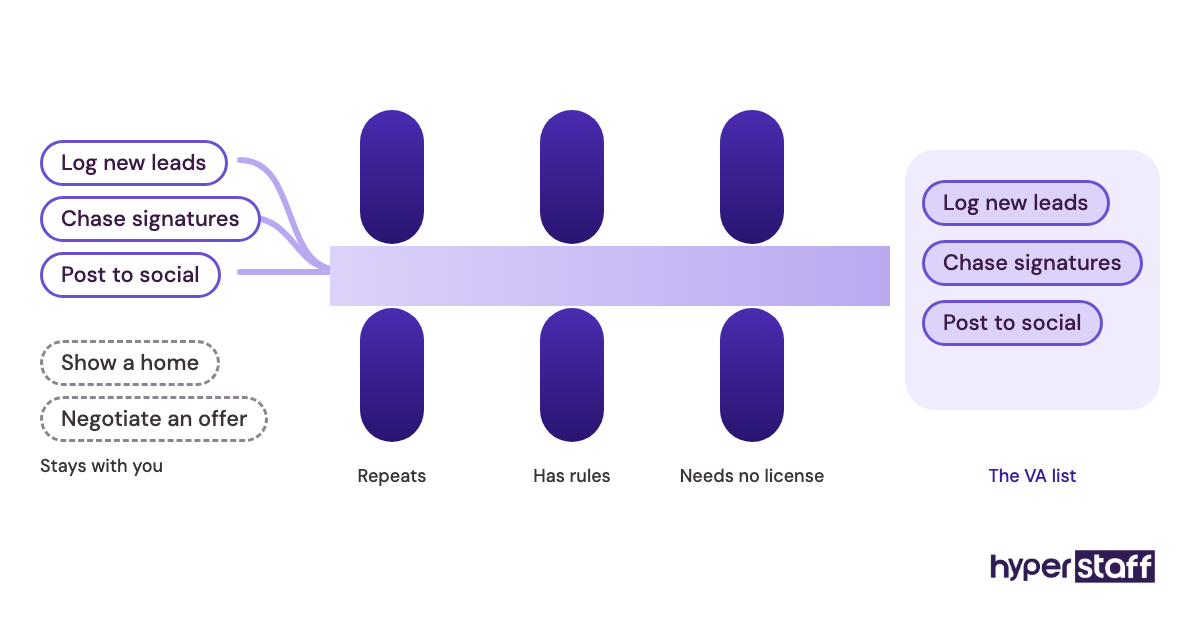
Log every task for five working days, along with the minutes each one took. Anything that repeats, follows rules and doesn't need a license goes on the VA list.
Step #2: Choose the role and write the job description
Group those tasks into one role, such as admin, TC, lead follow-up or marketing, and write it up using this real estate VA job description template. Set the hours at the same time: 40, 80 or 160 a month.
Step #3: Screen candidates with real tasks
Give each candidate a paid test, such as entering a sample listing into a CRM or writing a text to a cold lead. Combine it with these real estate VA interview questions, and one round will show you who can do the work.
Step #4: Set up access and SOPs before day one
Create separate logins, set up a shared password manager and record screen videos for the first five tasks. The guide to onboarding a real estate VA covers the order to do it in.
Step #5: Hold a 30-day review
Score the VA against the metrics you set in Step #2. If the first tasks are running reliably, add one new task area. Expanding too early is the most common reason a good hire looks bad by month two.
What does an effective real estate VA setup look like?
An effective real estate virtual assistant setup has a fixed weekly rhythm, one owner for each task and numbers you review together every week. For a solo agent, 80 hours a month (about 20 a week) could split like this.
| Task area | Hours per week | Output you should see |
|---|---|---|
| Lead follow-up and CRM | 6 | Same-day replies, notes logged on every lead |
| Listing and marketing | 5 | Listing launch tasks done, 2 to 3 social posts |
| Transaction tracking | 4 | Deadline sheet current, weekly party check-ins |
| Calendar and inbox | 3 | Next day's showings confirmed |
| Reporting | 2 | Friday summary of leads, appointments and open files |
The split will shift with the market. In a slow season, move hours from transaction work to sphere follow-up, because that's where the next deals come from.
Real estate virtual assistant tools and software
A real estate virtual assistant works inside your software, so your tools decide how much they can do without you. The core stack is a CRM, a scheduler, e-signature and transaction software, a design tool and a password manager.
Follow Up Boss is the CRM we'd pick for most small teams, because a VA can easily run its lead routing and action plans. The Grow plan costs $69 per user a month ($58 billed yearly), and Pro is $499 a month for 10 users, according to Follow Up Boss pricing.
Calendly handles showing and consultation bookings. It's free for basic use, and paid seats run $10 to $16 a month on yearly billing, according to Calendly's plans. For transaction files, dotloop and DocuSign are the usual picks, and Canva covers listing graphics, so check their current plans directly.
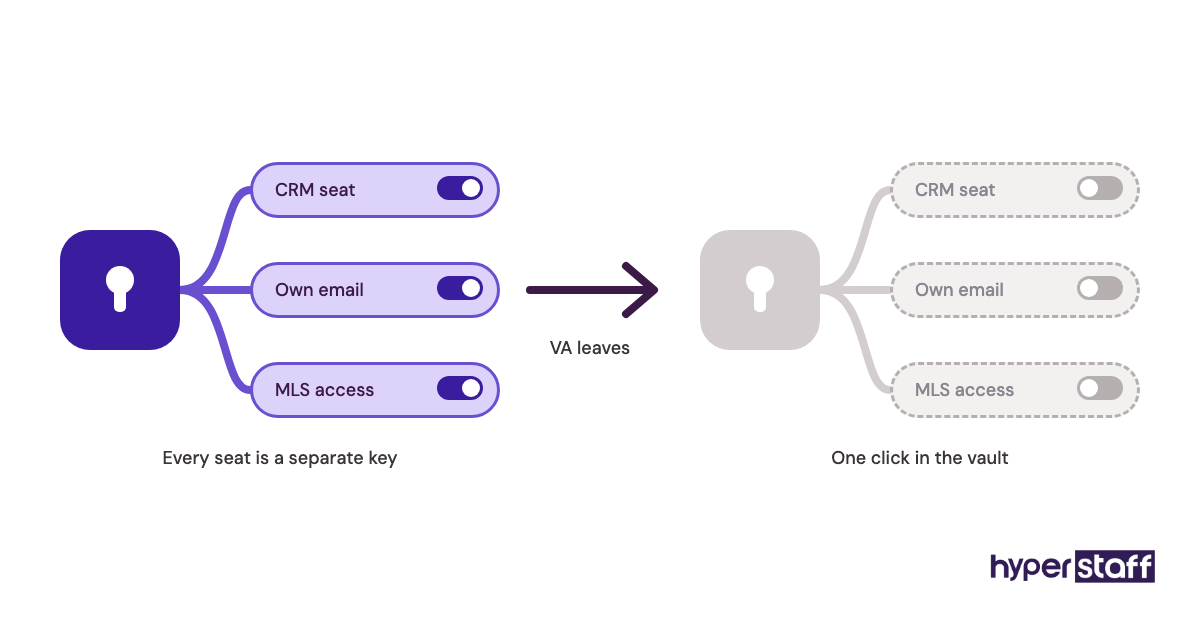
From our experience setting up VA accounts, a password manager such as 1Password or Bitwarden matters more than any tool above. It lets you revoke access in one click when a VA changes, and our full real estate VA tools list compares the rest.
10 proven tips for working with a real estate virtual assistant
These habits separate VA hires that last from the ones that fade out in month two.
- Hand over the tasks that cost you the most hours first, even if they aren't the ones that annoy you most.
- Give the VA their own email address and CRM seat.
- Write a "forward to me" list of questions the VA never answers.
- Overlap at least two working hours a day with your schedule.
- Hold a 15-minute check-in daily for the first two weeks, then switch to weekly.
- Record screen-share videos instead of writing long SOPs.
- Put lead response-time targets in writing.
- Approve all public copy, including MLS remarks and ads, until the VA has your voice down.
- Add one new task area at a time.
- Keep all SOPs in one place so a replacement can start fast.
How do you overcome common real estate VA challenges?
Most real estate virtual assistant problems trace back to unclear access, vague instructions or slow feedback. Fix access first: set up separate logins and a password manager, and write a list of what the VA may and may not send to clients.
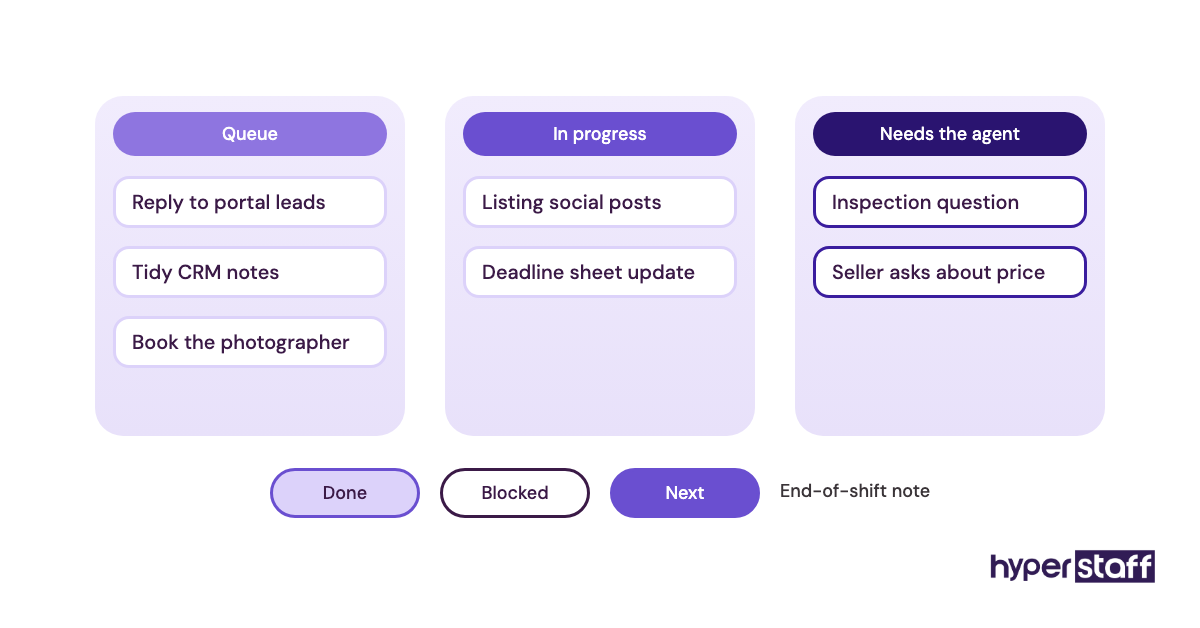
Communication gaps come next. A shared task board plus a short note at the end of each shift usually closes them within two weeks.
Turnover is the expensive problem, because a departing VA takes your context with them. Hyperstaff keeps that context in your Operations Vault and provides a free replacement in 5 to 7 business days.
How do you measure real estate virtual assistant success?
Measure a real estate virtual assistant on output you can count: lead reply time, appointments booked, listings launched on schedule and missed deadlines on active files. Choose a few of these and review them each week.
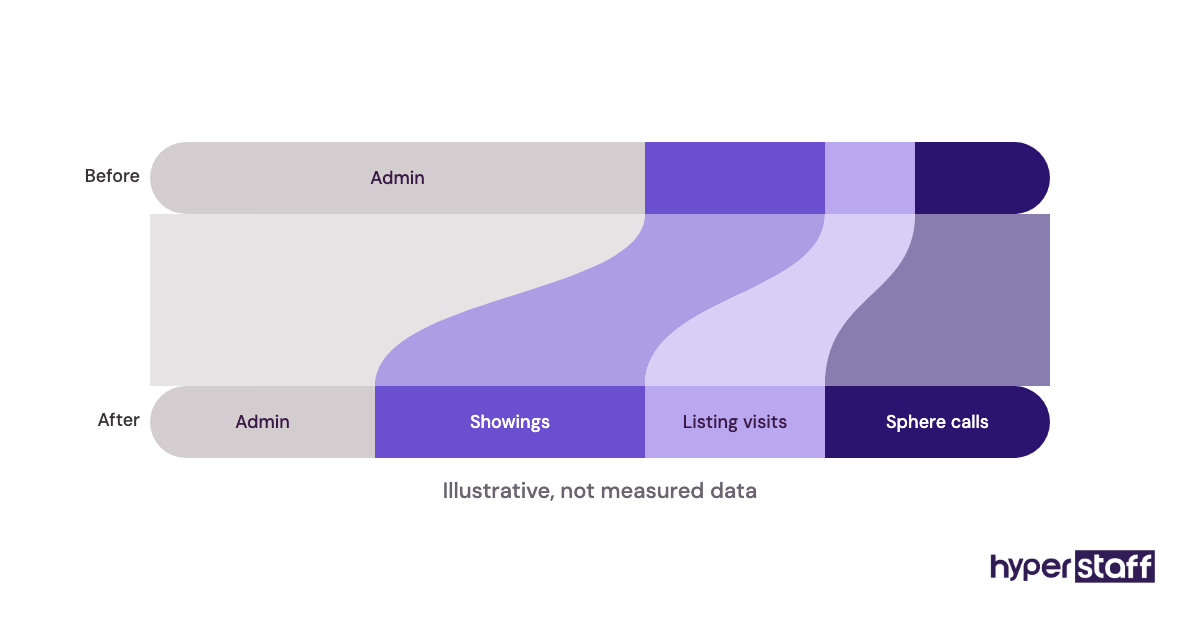
The real test is your own calendar. If you're spending more hours on showings, listing appointments and sphere calls than before the hire, the VA is working. If you aren't, you handed over the wrong tasks.
How long does a real estate virtual assistant take to work?
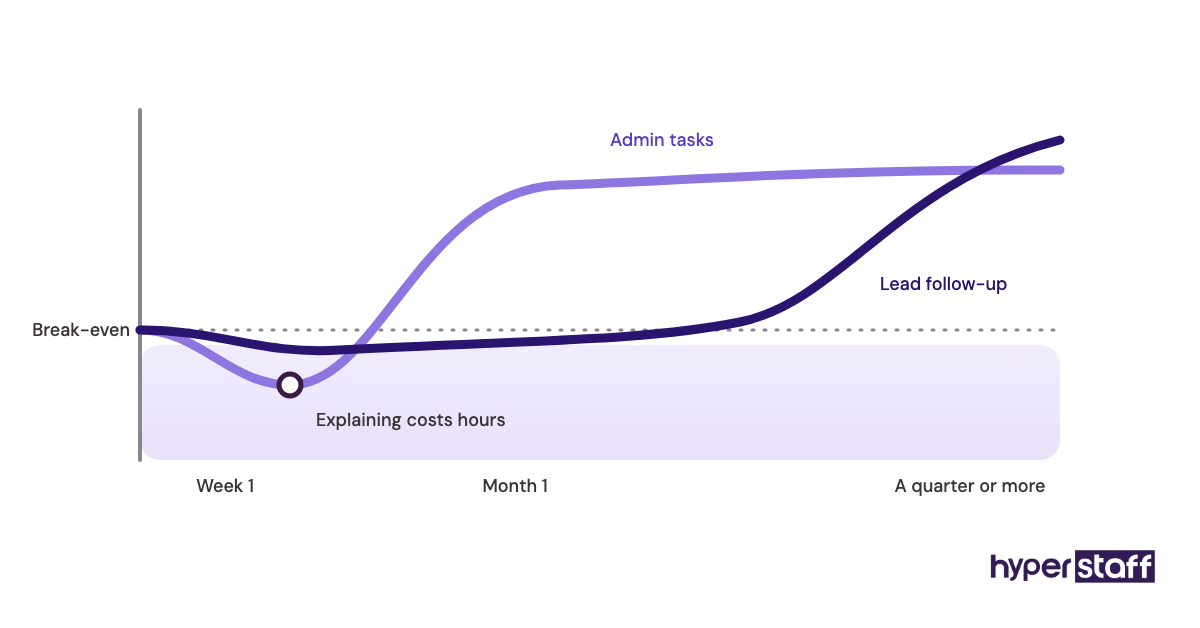
A real estate virtual assistant usually needs two to four weeks to run assigned tasks without daily help, and about 60 to 90 days to show up in your closing numbers. Hyperstaff places a VA within 5 business days, and work starts the day of the kickoff call or the next morning.
Expect a dip in week one, when you'll spend more time explaining than you save. Real estate's long sales cycle also adds a wait, because a lead the VA nurtures this month may not close for a quarter or more. Judge lead work later than admin work.
How much does a real estate virtual assistant cost?
A real estate virtual assistant costs roughly $3 to $25 an hour, depending on region, experience and whether you hire through an agency or a freelance marketplace. Hyperstaff rates start at $3 an hour for Essential, $6 for Professional and $12 for Expert.
Paying quarterly saves 10% on those rates. Our real estate VA cost breakdown covers fees, tool costs and the hidden extras.
| Option | Hourly rate | 80 hours / month | 160 hours / month | Notes |
|---|---|---|---|---|
| Hyperstaff Essential (0 to 2 years) | From $3 | From $240 | From $480 | Admin, CRM updates, scheduling |
| Hyperstaff Professional (2 to 5 years) | From $6 | From $480 | From $960 | Lead follow-up, listing coordination |
| Hyperstaff Expert (5+ years) | From $12 | From $960 | From $1,920 | Transaction coordination, marketing |
| Freelance VA (marketplaces) | About $8 to $25 | About $640 to $2,000 | About $1,280 to $4,000 | You handle vetting and replacement |
| In-house admin assistant (US) | About $23 + payroll costs | About $1,860 + taxes and benefits | About $3,720 + taxes and benefits | Based on BLS median of $23.23/hour |
Important: The Hyperstaff prices above are starting rates and averages, not fixed quotes. Your actual cost depends on the role, tier, hours and region you choose, and we confirm it on a free discovery call.
Is a real estate virtual assistant worth it?
Yes. For most producing agents, a real estate virtual assistant is one of the highest-return hires available, as long as the tasks are chosen well. If the VA's hours help you win even one extra deal a year, the hire pays for itself.
Here's an example using NAR's medians. $59,200 in gross income across 9 sides works out to about $6,580 per side. A Professional-tier VA at 80 hours a month costs from $480, or $5,760 a year.
One extra closed side covers the whole year, and anything beyond that is profit on top of the hours you get back. That math only works if the VA has the right tasks, though. A VA stuck on low-value work won't produce the extra deal, which is why our analysis of whether a real estate VA pays off starts with your time log.
How do you choose a real estate virtual assistant agency?
Judge a real estate virtual assistant agency on how it vets candidates, its replacement terms and its real estate experience. Ask how candidates are tested, how fast a replacement arrives and who documents your processes if the VA leaves.
Watch out for pool models, where a different person picks up your tasks each day. Real estate work depends on knowing your clients, your listings and your voice, and a rotating pool has to relearn all of it every shift.
Hyperstaff places one dedicated specialist from pre-vetted talent in the Philippines, Latin America, India, Eastern Europe and the United States. Every client also gets a dedicated account manager. Our guide on how to hire a real estate VA lists the questions to ask any provider.
Real estate virtual assistant statistics, trends and future predictions
Agent headcount is falling slightly, and more of the market is shifting toward teams. NAR membership stood at 1,439,163 in its latest count, down from 1,463,352 a year earlier, per the same NAR report.
About 21% of Realtors now work on a team, and teams close a median of 32 sides. Teams hire by role, which drives demand for specialist VAs such as TCs and listing coordinators.
Repeat business is growing too: the typical member earned 28% of business from past clients, up from 20%. Sphere follow-up is slow, steady work, and a VA is well suited to it.
The BLS projects 2 percent growth in real estate agent and broker jobs over the next decade, which is slower than average. Fewer agents competing for the same deals makes each lead worth more.
Our prediction, held with moderate confidence, is that more agents will hire VAs into defined roles, and that pay will rise for VAs who can run a CRM and a transaction file without supervision. We're less sure how quickly AI will absorb entry-level admin, because that depends on how fast brokerages approve the tools.
Real estate virtual assistants and AI
AI tools already draft listing descriptions, summarize calls and answer basic lead questions, and a good real estate virtual assistant uses them to work faster. More of the VA's job becomes checking that output, because a draft can sound confident and still be wrong.
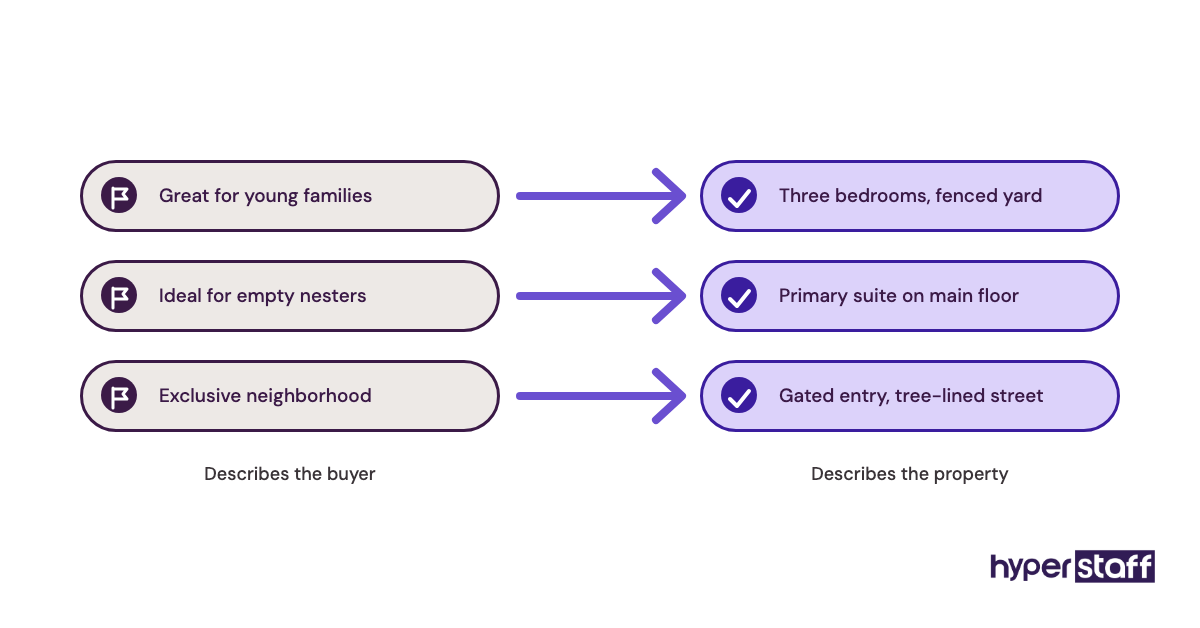
Fair housing is the biggest risk. The Fair Housing Act applies to listing and ad copy no matter who or what wrote it, so a VA should check AI drafts for wording that describes people instead of the property.
An AI chat widget can reply to a lead at 2 a.m., but it's worse than a person at telling a serious relocating buyer from a curious neighbor. The setup we'd recommend: AI sends the first reply, then the VA qualifies the lead and books the call.
Disclaimer: This article is general information, not legal, tax or licensing advice. Licensing and telemarketing rules vary by state and change over time, so check with your state real estate commission or an attorney before assigning tasks. Prices and third-party details may change.
Common questions
Can a real estate virtual assistant make cold calls for me?
Yes, as long as every list is checked against the National Do Not Call Registry and your state's calling rules first. Many agents give calling to a Professional-tier VA with a script they've approved.
Do I need to be a broker to hire a real estate VA?
No. Agents can hire a VA directly. Some brokerages restrict who can access their systems, though, so check with your broker first.
Is my client data safe with a real estate virtual assistant?
It can be, if you control access. Use separate logins, a password manager and role-based CRM permissions, and remove access the day the VA leaves.
How many hours a month does a real estate VA need?
Most solo agents start at 40 or 80 hours a month. Move up to 160 once the VA is fully booked and you have a second task area ready to hand over.
Can a real estate virtual assistant help a property manager?
Yes. Property management VAs log maintenance requests, send rent reminders, pre-screen applications against your written criteria and send owners updates. Fair housing law applies to that screening just as it does to yours.
Book a free 15 min call
We place a pre-vetted specialist in 5 business days, fully managed, from $3/hour.