Real Estate Virtual Assistant Interview Questions (With a Copyable Template)
A complete, copyable interview script for hiring a real estate virtual assistant, with live tests, scoring and the answers that should worry you.

On this page
- What Are Real Estate Virtual Assistant Interview Questions?
- Key Real Estate VA Interview Terms You Should Know
- Why Do the Right Interview Questions Matter?
- How Does a Real Estate VA Interview Work?
- The Complete Real Estate Virtual Assistant Interview Template
- Types and Forms of Real Estate VA Interview Questions
- How a Real Estate VA Interview Differs From Related Hiring
- The Benefits of a Structured Interview Template
- The Drawbacks of a Structured Interview Template
- Who Needs a Real Estate VA Interview Template?
- Real Estate VA Interview Answer Examples
- Creating a Real Estate VA Interview Plan, Step-by-Step
- What Does an Effective Interview Strategy Look Like?
- Tools and Software for Running the Interview
- 9 Proven Real Estate VA Interview Tips and Best Practices
- Overcoming Common Real Estate VA Interview Challenges
- How to Measure Real Estate VA Interview Success
- How Long Does Hiring a Real Estate VA Take?
- How Much Does a Real Estate VA Cost?
- Is a Structured Real Estate VA Interview Worth It?
- How to Choose a Real Estate VA Agency
- Real Estate VA Interviews and AI
- FAQs
💡 Key Takeaways:
1) Real estate virtual assistant interview questions work best in five blocks: screening, real estate knowledge, lead handling, judgment and a live test done during the call.
2) A short live task, such as logging a lead from a voicemail into a CRM, tells you more about a candidate than any answer about past experience.
3) Score every answer against a written rubric before you compare candidates, so the most confident speaker doesn't win by default.
Hire the right assistant, close more deals
The interview decides whether your assistant gives you hours back or creates cleanup work, which is why Hyperstaff screens candidates before you ever meet them. Our real estate virtual assistant services have placed 70+ pre-vetted assistants with 30+ clients, usually within 5 business days, at rates from $3/hour.
What Are Real Estate Virtual Assistant Interview Questions?
Real estate virtual assistant interview questions are a structured set of prompts that test whether a remote candidate can handle the admin, lead and transaction work of an agent or team. Good ones check real estate knowledge, CRM skill, written English and judgment under pressure.
Most agents underestimate how wide the job is. If you're still mapping what a real estate VA does, the role can cover listing input, lead follow-up, transaction coordination, social media and **customer support** for past clients, so your questions need to cover the parts you'll actually hand over.
Key Real Estate VA Interview Terms You Should Know
- Behavioral question = a prompt asking how the candidate handled a real past situation.
- Situational question = a "what would you do if" scenario set in your business.
- Live test = a short task the candidate completes while you watch on screen share.
- Scoring rubric = a written 1 to 5 scale for each question, agreed before interviews start.
- CRM = the contact database where leads, notes and follow-up tasks live.
- MLS input = entering listing data and photos into the Multiple Listing Service.
- Transaction coordination = tracking contract deadlines from accepted offer to closing.
- Speed to lead = the minutes between a new inquiry and the first reply.
- ISA = inside sales agent, a role focused on calling and qualifying leads.
- Licensed activity = work your state reserves for licensees, such as negotiating terms.
Why Do the Right Interview Questions Matter?
The right interview questions matter because a remote assistant works with your leads, your clients and your contract dates without you in the room. A weak hire costs you missed follow-ups and deadline slips long before it shows up as a performance problem.
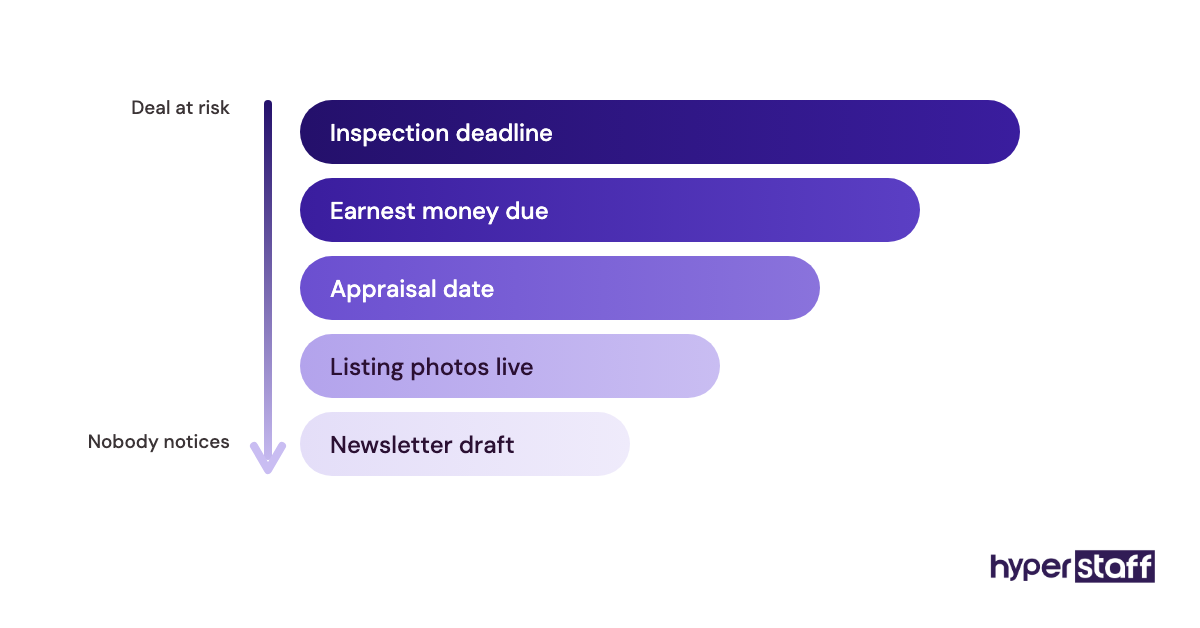
Generic VA questions miss the **real estate failure points**. A candidate can be excellent at inbox work and still not know that an inspection deadline outranks a newsletter draft.
Worth knowing: Candidates who've worked for one agent often know only that agent's CRM and habits, so ask which parts of their past job they set up themselves and which they inherited, because the answer shows whether they can build a process or only follow one.
How Does a Real Estate VA Interview Work?
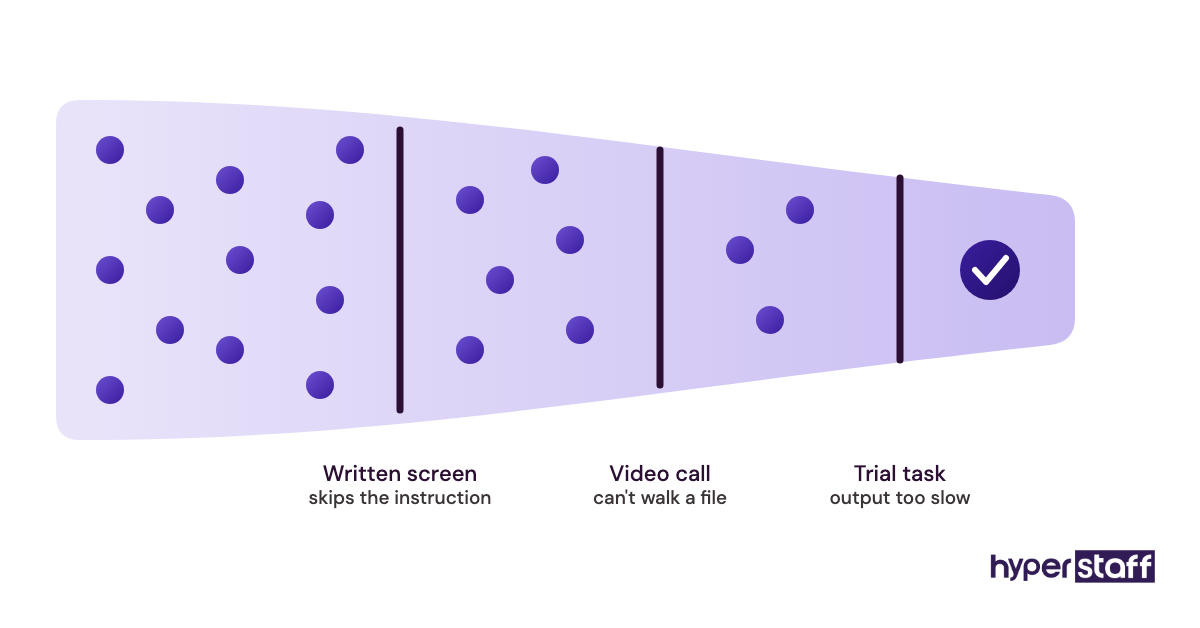
A real estate VA interview usually runs in three rounds: a written screen, a 45 to 60 minute video interview and a paid or unpaid trial task. Each round removes a different kind of bad fit.
The written screen catches weak English and people who don't read instructions. The video call tests knowledge and judgment, and the trial shows what a normal workday output looks like. Our guide on how to hire a real estate VA covers sourcing and offers around these rounds.
The Complete Real Estate Virtual Assistant Interview Template
Copy the template below into a doc, delete the blocks that don't match the role and keep the timings. It's built for a 50-minute video call, with the live tests near the end once the candidate has warmed up.
Before you trim it, list the tasks you'll hand over in week one. Any block that doesn't map to one of those tasks can go.
Part 1: Screening (8 minutes)
- Walk me through the last agent or team you supported. What did a normal Tuesday look like?
- Which real estate CRMs have you used daily, and what did you do inside them?
- Which hours can you cover in our time zone, and how do you handle a weekend open house week?
- What's your backup if your power or internet goes down mid-shift?
Part 2: Real estate knowledge (10 minutes)
- Explain the steps between an accepted offer and closing, as you understand them.
- Which listing fields do you double-check before an MLS entry goes live, and why?
- How would you track earnest money, inspection and appraisal deadlines for 6 files at once?
- Which tasks would you refuse to do without a licensed agent involved?
Part 3: Lead handling and client communication (10 minutes)
- A new portal lead arrives at 9:40 pm our time. Walk me through your first 10 minutes.
- Write a two-line text to a buyer lead who went silent 3 weeks ago.
- A seller emails, upset that their listing photos aren't live yet. What do you reply?
- How do you decide which leads get a call and which get an email?
Part 4: Judgment and working style (7 minutes)
- I send you three urgent tasks at 8 am. How do you decide the order, and what do you tell me?
- Tell me about a mistake you made in a file. How was it caught, and what did you change afterwards?
- What do you need from us in your first week to work without asking questions all day?
Part 5: Live tests on screen share (12 minutes)
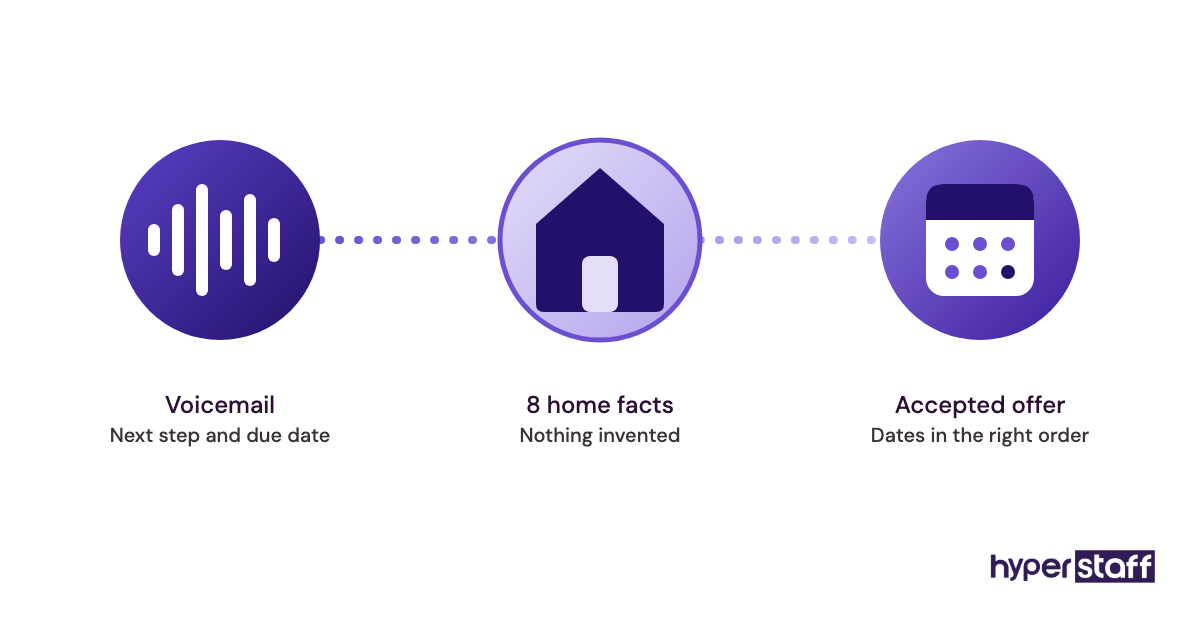
- Here's a voicemail transcript. Log the lead in this CRM with a next step and a due date.
- Here are 8 bullet facts about a home. Write a 120-word listing description.
- Here's a contract acceptance date. Build the deadline calendar to closing.
Part 6: Close (3 minutes)
- What questions do you have about our listings, team or tools?
- If we offered you the role today, when could you start and what would stop you?
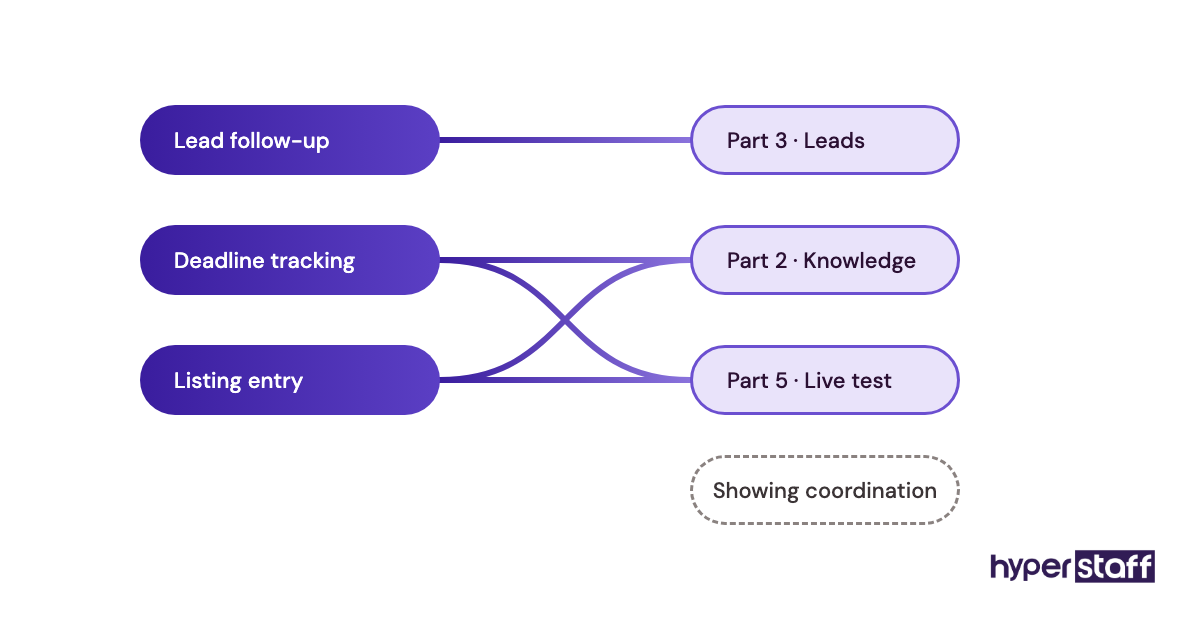
Adapt the template by role, not by candidate. A buyer-side team swaps question 6 for showing coordination, while a team that wants **transaction coordination** should spend twice as long on questions 7 and 18.
Keep the same questions in the same order for every person you interview. Changing them mid-search makes scores impossible to compare.
Types and Forms of Real Estate VA Interview Questions
Real estate VA interview questions fall into seven types, and each one tests a different risk. The table shows what each type reveals and where it misleads.
| Question type | Example | What it reveals | Where it misleads | Time to spend |
|---|---|---|---|---|
| Screening | Which CRMs have you used? | Basic fit, hours, tools | Tool names get listed, not skill | 5–8 min |
| Knowledge | Steps from offer to closing | Industry understanding | Can be memorized | 8–10 min |
| Behavioral | Tell me about a file mistake | Honesty, learning habits | Polished stories | 5 min |
| Situational | Late-night lead scenario | Judgment, speed to lead | Ideal answers, not real habits | 8 min |
| Writing sample | Two-line follow-up text | Tone, English, brevity | AI help in take-home versions | 3–5 min |
| Live test | Log a lead in the CRM | Real working speed | Nerves slow good people | 10–15 min |
| Logistics | Backup internet plan | Reliability | Rarely, if you verify | 2–3 min |
How a Real Estate VA Interview Differs From Related Hiring
A real estate VA interview differs from other hiring because it tests remote work habits and real estate process knowledge in the same call. The closest comparisons each drop one of those two halves.
Real Estate VA Interview vs. In-House Assistant Interview
An in-house interview leans on presence and culture, while a remote one has to test **written communication** and self-management much harder. Our breakdown of a virtual assistant versus an in-house hire covers the cost and control trade-offs behind that choice.
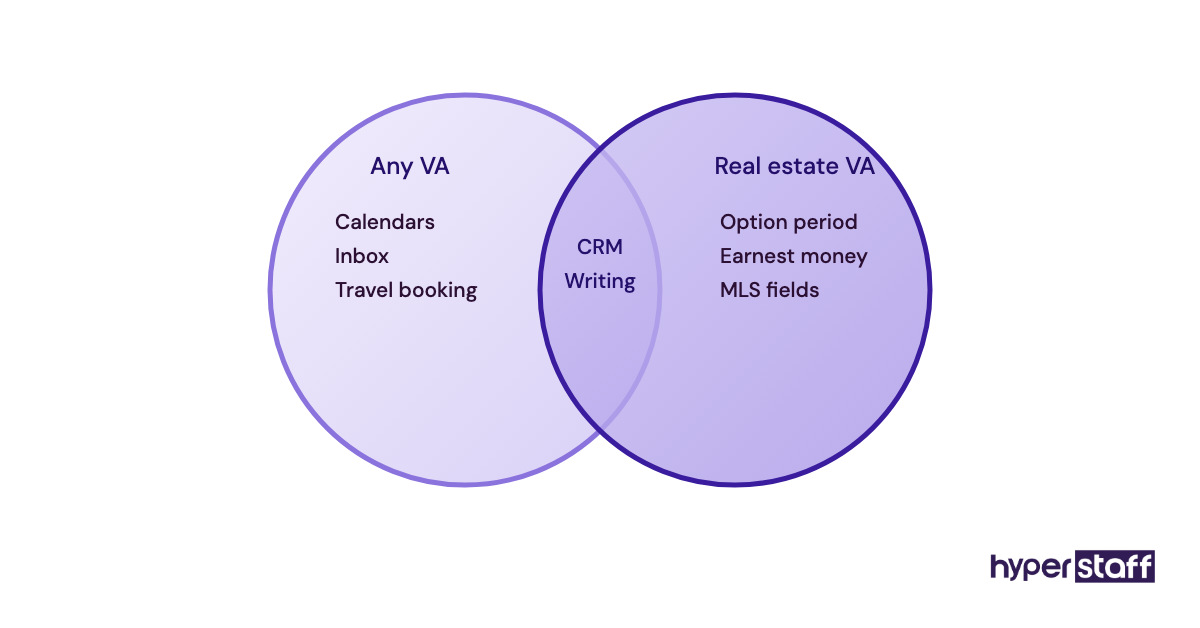
Real Estate VA Interview vs. General VA Interview
A general VA interview checks calendars, email and tools. It won't catch a candidate who doesn't know what an option period is, and that gap shows up on your first contract.
Real Estate VA Interview vs. ISA Interview
An ISA interview is mostly a phone audition: call scripts, objection handling and talk time. Admin-focused real estate VAs need less of that and more file accuracy, so only borrow ISA role-plays if your assistant will make outbound calls.
The Benefits of a Structured Interview Template
A structured template gives you comparable scores, faster decisions and fewer hires based on charm.
- Every candidate faces the same questions, so scores mean something.
- Live tests expose skill gaps that a résumé hides.
- Interviews stay inside 50 minutes instead of drifting.
- A second team member can run the call without you.
- Notes become the first draft of the new hire's onboarding plan.
The Drawbacks of a Structured Interview Template
The template has a few real costs, and most of them come from using it too rigidly.
- Strong candidates can feel boxed in by fixed questions.
- Setting up a sandbox CRM for live tests takes an hour or two.
- Rubrics need updating when the role changes.
Who Needs a Real Estate VA Interview Template?
Solo agents hiring their first assistant need the template most, because they have no hiring process to fall back on. Teams of 3 to 10 agents need it for a different reason: several people interview, and without one script they each hire for different things.
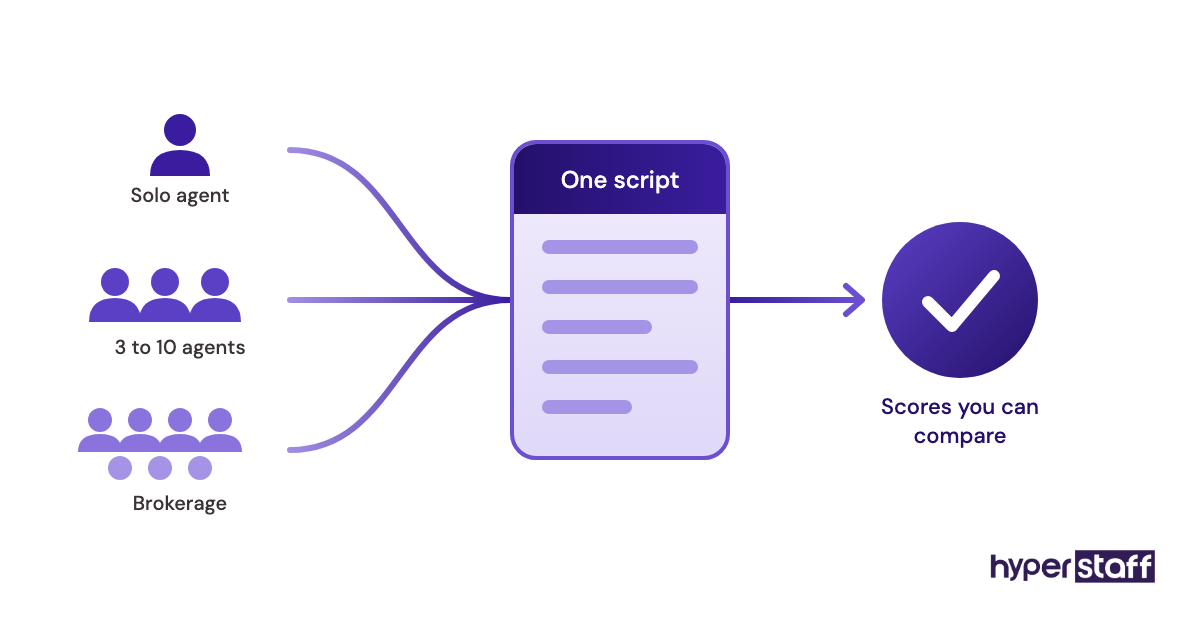
Brokerages that hire assistants for many agents get the most value from the **scoring rubric**. It keeps standards the same across offices and interviewers.
Real Estate VA Interview Answer Examples
The answer examples below show the patterns that separate a strong candidate from a risky one. Listen for specifics, order of operations and how the candidate talks about mistakes.
Good Answer Examples
Late-Night Lead Answer
"I'd reply by text within five minutes with the agent's name and one question about their timeline, then log the lead in the CRM with a call task for 9 am. If the property is one of our listings, I'd attach the showing link." Notice the **sequence**: reply, log, set a task.
Deadline Tracking Answer
"I'd build every date from the acceptance date into a shared calendar on day one, with a reminder three days before each deadline. Then I'd send the agent a Monday summary of what's due that week." The candidate is thinking in systems.
Mistake Answer
"I once entered the wrong square footage on an MLS listing. The agent caught it after a buyer's agent asked, and I started checking every listing against the tax record before submitting." A clear cause, a clear fix.
Bad Answer Examples
"I'm a Fast Learner" Answer
A candidate who answers knowledge questions with "I'll learn it quickly" is telling you they don't know it. That can be fine for an Essential-tier role if you have time to train, but price it in.
Licensed Activity Answer
"Sure, I can negotiate repair requests with the other agent." Rules vary by state, but negotiating terms is broadly reserved for licensees, so any candidate who volunteers for it has a **compliance gap** you'll have to manage. Our list of common real estate VA mistakes covers more of these traps.
No-Mistake Answer
"I've never really made a mistake in a file." Everyone who has handled real files has made one. The answer suggests either very little experience or low self-awareness.
Keep in mind: A nervous candidate who freezes on the first live test but recovers on the second is often a better hire than a smooth talker who never gets tested, so judge the recovery as much as the first attempt.
Creating a Real Estate VA Interview Plan, Step-by-Step
An interview plan turns the template into a hiring process you can repeat. The five steps below take roughly a week from start to first interview.
Step #1: Write the Role Before the Questions
Start from a written real estate VA job description with the tasks, hours and tools listed. Every interview question should trace back to a line in it.
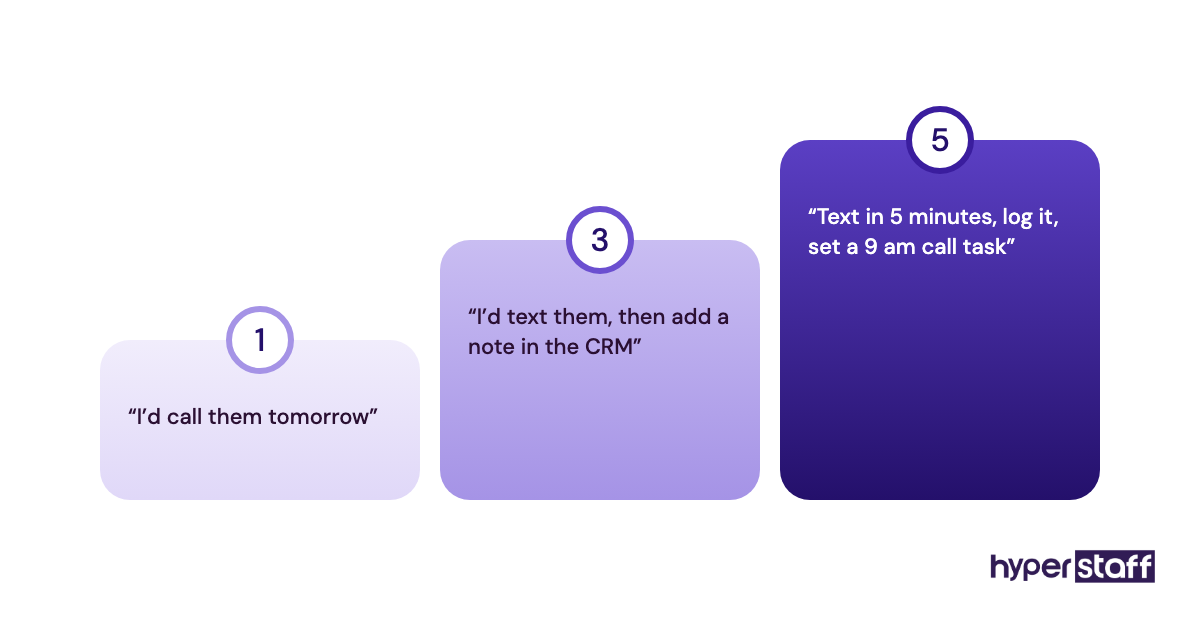
Step #2: Build the Scoring Rubric
Write what a 1, 3 and 5 answer sounds like for each question. Do it before you meet anyone, or the first candidate becomes your benchmark.
Step #3: Set Up the Live Tests
Create a sandbox CRM login, a fake voicemail transcript and a sample contract with personal details removed. **Never use live client data** in a test.
Step #4: Run the Written Screen
Send three short written questions with one deliberately specific instruction, such as "start your reply with your time zone." Candidates who miss it rarely get better on the call.
Step #5: Interview, Score and Trial
Score each call within 10 minutes of hanging up. Offer a short paid trial to your top one or two candidates before making the final call.
What Does an Effective Interview Strategy Look Like?
An effective real estate VA interview strategy weighs proof over claims: about half the score should come from live tests and the trial task. Talk is cheap in interviews, and typing into a CRM under observation isn't.
Practitioners disagree on paid trials. Some agents skip them to move faster; we'd rather add two days than discover in month two that the assistant can't keep a **closing calendar** straight.
Tools and Software for Running the Interview
The interview needs a video tool, a scheduler, a sandbox CRM and somewhere to keep scores. Most agents already pay for everything required.
Zoom or Google Meet both work for the call, as long as screen share is on. Calendly or Google Calendar booking pages cut the back-and-forth over time zones, and Loom is useful for a short async question round before the live call.
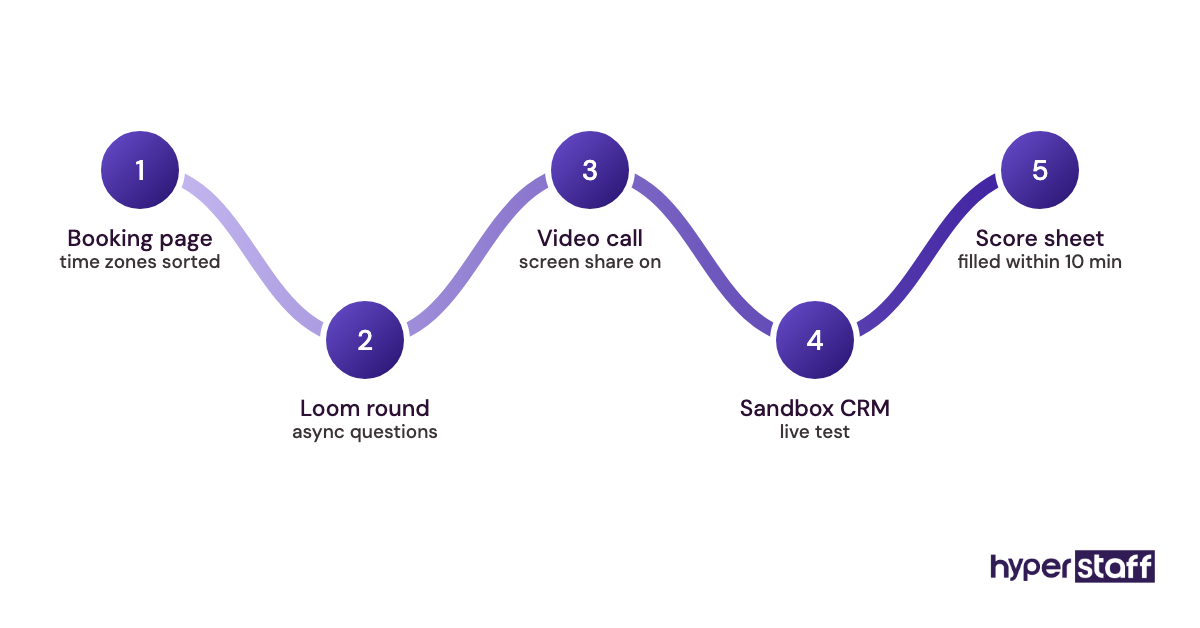
For live tests, use a trial account of the CRM your team runs, such as Follow Up Boss, Lofty or kvCORE, so you're testing the real interface. Our roundup of real estate VA tools covers the wider stack your hire will use daily.
9 Proven Real Estate VA Interview Tips and Best Practices
These tips come from the patterns that separate good remote hires from expensive ones.
- Put the live test in every interview, even for experienced candidates.
- Ask for one specific detail on every past-job claim: a CRM name, a file count, a deadline.
- Interview at the hours the assistant will actually work.
- Keep cameras on for both sides.
- Let the candidate ask questions; their questions show what they've noticed about your business.
- Check written English in the screen and spoken English on the call separately.
- Score immediately and alone before discussing with anyone else.
- Tell candidates the live test is coming so nerves don't distort it.
- Use the interview notes to shape your plan for onboarding a real estate VA.
Overcoming Common Real Estate VA Interview Challenges
The most common challenge is rehearsed answers, and the fix is follow-up questions. When a candidate says they "managed transactions," ask how many at once and which deadline they found hardest to track.
Time zones are the second problem. Book interviews inside the working window you need, because a candidate who can't make a 9 am call your time probably can't cover 9 am shifts either.
Connection drops happen. One drop is normal; a second without a backup plan answers question 4 for you.
How to Measure Real Estate VA Interview Success
Interview success shows up in the first 90 days, not on hiring day. Track whether the hire's live-test score matched their real work, how many tasks needed redoing in month one and whether they stayed past month three.
If high scorers keep underperforming, a rubric question is measuring the wrong thing. Fix that question before the next search.
How Long Does Hiring a Real Estate VA Take?
Hiring a real estate VA on your own usually takes 2 to 6 weeks, depending on how fast you screen and whether you run a paid trial. Posting and screening eat most of that time.
Through Hyperstaff, placement takes 5 business days because candidates are pre-vetted. After a 30-minute kickoff call, work starts that day or the next morning.
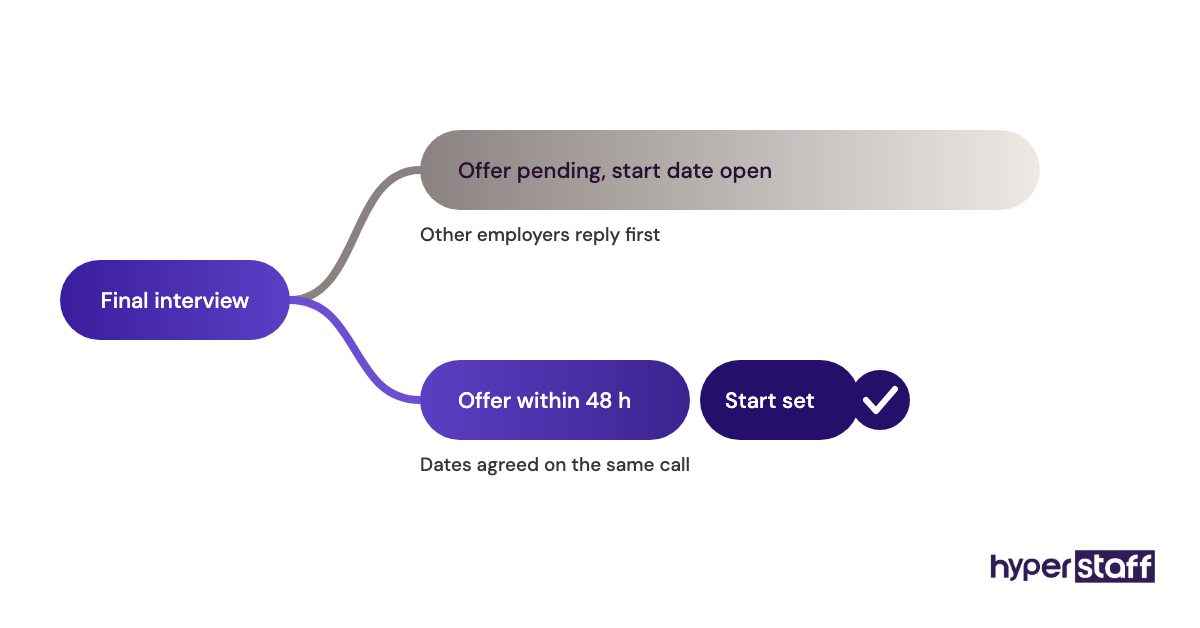
Plan for this: The dead zone between offer and start is where good remote candidates take other jobs, so send a written offer within 48 hours of the final interview and agree a start date on the same call.
How Much Does a Real Estate VA Cost?
A real estate VA from Hyperstaff costs from $3 to $12+ per hour depending on experience tier, compared with roughly $18 to $30 per hour plus overhead for an in-house assistant. For a fuller breakdown, see our guide to real estate virtual assistant cost.
| Option | Experience | Hourly rate | 80 hours/month | 160 hours/month |
|---|---|---|---|---|
| Hyperstaff Essential | 0 to 2 years | From $3 | From $240 | From $480 |
| Hyperstaff Professional | 2 to 5 years | From $6 | From $480 | From $960 |
| Hyperstaff Expert | 5+ years | From $12 | From $960 | From $1,920 |
| In-house assistant (typical) | Varies | $18–$30 + taxes, benefits | $1,700–$3,000 | $3,400–$6,000 |
Important: Hyperstaff prices shown are typical starting averages, not fixed quotes. Your final cost depends on the role, experience tier and hours your business needs.
Is a Structured Real Estate VA Interview Worth It?
Yes, a structured interview is worth it, and it's one of the cheapest ways to protect your commission income. Two or three hours of setup decides whether your assistant handles leads and deadlines you'd otherwise drop, or becomes another person you have to check on.
Here's a simple calculation with assumed numbers. A Professional-tier assistant on an 80-hour bundle costs from $480 a month; if better follow-up saves even one deal a year with a $7,500 commission, the hire pays for itself many times over.
The flip side matters too. A bad hire costs the weeks spent training them, plus whatever slipped while you did. For the broader case, read whether a real estate VA is worth it for your volume.
How to Choose a Real Estate VA Agency
Choose a real estate VA agency by asking how it screens, what happens when a hire doesn't work out and who manages the relationship. Pre-vetting saves you the first two interview rounds, but you should still run Part 5 of the template yourself.
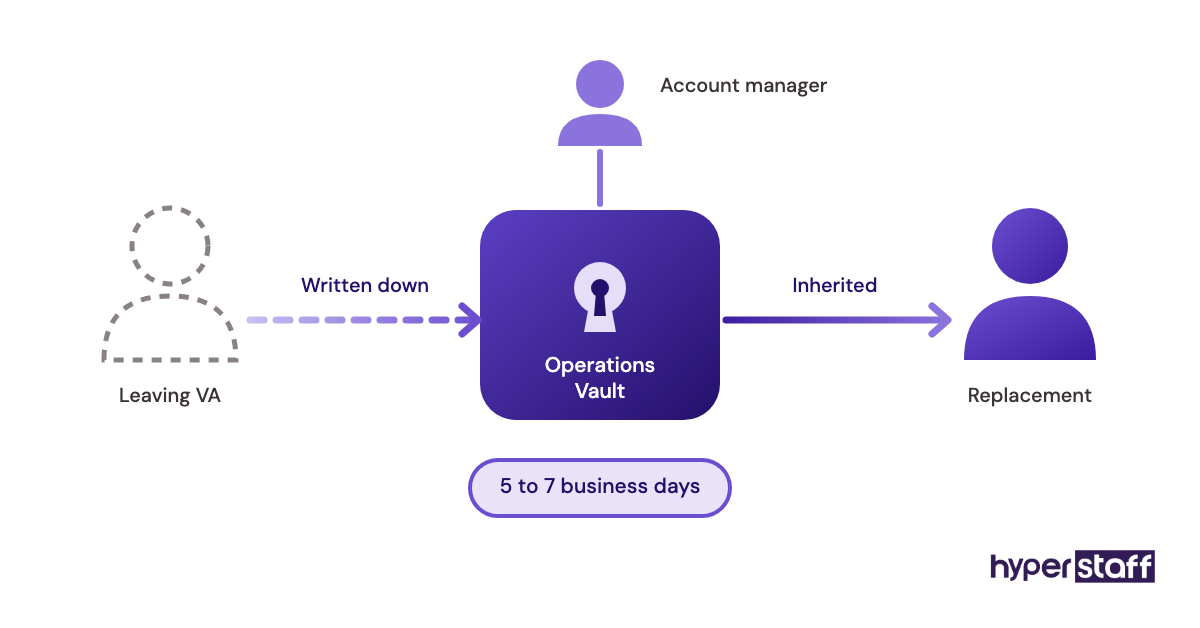
Ask for the replacement terms in writing. At Hyperstaff, a free replacement arrives in 5 to 7 business days, briefed from your **Operations Vault**, where your SOPs, tools and context are written down and maintained, and every client has a dedicated account manager.
Real Estate VA Interviews and AI
AI has changed real estate VA interviews mostly by making take-home written answers less reliable. Candidates can polish a listing description or follow-up text with a chatbot in seconds, so written tests done live on screen share carry more weight than ever.
AI is useful on your side too. A note-taker can transcribe calls so you score from the record instead of memory, though you should tell candidates the call is recorded.
Ask candidates how they use AI tools at work. The strong answer names a specific use, such as drafting listing copy, and describes how they check the output before an agent sees it.
Disclaimer: This article is for general information only and isn't legal, employment or real estate licensing advice. Rules on licensed activities and hiring vary by state and country, so confirm requirements with your broker or a qualified professional. Pricing shown is indicative and subject to change.
Common questions
How many interview questions should I ask a real estate VA?
Around 15 to 20 questions fits a 50-minute call, including two or three live tests. More than that and you rush the answers that matter.
Should I pay for a real estate VA trial task?
Yes, pay for any trial longer than an hour. Paid trials attract serious candidates and give you real output to judge.
What red flags should I watch for in a real estate VA interview?
Watch for vague answers about past CRMs, no backup internet plan and willingness to do licensed work. Missing written instructions in the screen is another early warning.
Can I interview a real estate VA without knowing real estate admin myself?
You can, as long as you use a rubric with sample strong answers. Lean on the live tests, since you can judge the result even without knowing every step.
Do I still need to interview if an agency sends a pre-vetted real estate VA?
A short interview is still smart. Focus on fit, hours and one live test with your own CRM, since the agency has already covered the basics.
Book a free 15 min call
We place a pre-vetted specialist in 5 business days, fully managed, from $3/hour.