Small Business Virtual Assistant Cost: Rates, Retainers and Hidden Fees
Hourly rates, monthly retainers and per-task costs for a small business virtual assistant, plus the hidden fees that change the real price.
On this page
- What do small business virtual assistant retainers cost?
- What does a small business virtual assistant cost per task?
- Hyperstaff Cost vs. Other Virtual Assistant Agencies
- Hyperstaff retainer costs
- Hyperstaff cost by deliverable
- Which pricing models do virtual assistant providers use?
- Agency, freelancer or in-house: which costs less for a small business?
- How much does a small business virtual assistant cost by country?
- What drives small business virtual assistant costs?
- #1 Cost Driver
- #2 Cost Driver
- #3 Cost Driver
- #4 Cost Driver
- Does AI lower small business virtual assistant cost?
- The Hidden Costs of a Small Business Virtual Assistant
- How much should you budget for a small business virtual assistant?
- How do you calculate small business virtual assistant ROI?
- How do you compare virtual assistant agency pricing?
- Red Flags in Agency Pricing
- When to Walk Away
- How can you cut virtual assistant costs without losing quality?
- Step 1
- Step 2
- Step 3
- Step 4
- Step 5
- Is a small business virtual assistant worth the investment?
- FAQs
Spend less per hour, keep more revenue
Hyperstaff places pre-vetted remote specialists from $3 an hour, drawn from five regions including the Philippines, Latin America and India. We've placed 70+ virtual assistants with 30+ clients, and our virtual assistant services for small businesses fill a role in five business days, with a dedicated account manager beside you from the kickoff call.
What do small business virtual assistant retainers cost?
A small business virtual assistant retainer runs about $200 to $600 a month for 40 hours through an offshore agency and $1,200 to $3,000 for the same hours through a US agency. The figures below are averages, so read them as a starting range.
Most freelancers on Upwork's virtual assistant cost page charge $10 to $20 an hour, with experienced assistants billing more. US-based assistants usually charge $30 to $75 an hour, a range BELAY publishes in its own FAQ.
| Hours per month | Offshore agency | Freelancer | US agency | Best fit |
|---|---|---|---|---|
| 10 | $50–150 | $100–350 | $300–750 | Overflow tasks |
| 20 | $100–300 | $200–700 | $600–1,500 | Inbox and calendar |
| 40 | $200–600 | $400–1,400 | $1,200–3,000 | One core function |
| 80 | $400–1,200 | $800–2,800 | $2,400–6,000 | Two functions |
| 160 | $800–2,400 | $1,600–5,600 | $4,800–12,000 | Full-time role |
Retainers of 10 to 20 hours look cheap, but they rarely buy a dedicated person, because nobody can make a living on 10 hours from one client. At that level your work queues behind other clients, and reply times stretch.
What does a small business virtual assistant cost per task?
Per-task cost for a small business virtual assistant ranges from about $10 for one written SOP to $500 or more for a full CRM cleanup. The numbers are averages built from typical hours per job, with the Agency column at offshore staffing rates and In-House at a loaded US admin wage.
| Deliverable | Freelancer | Agency | In-House | Turnaround |
|---|---|---|---|---|
| Inbox triage, 1 week | $50–175 | $25–75 | ~$165 | Same day, ongoing |
| Calendar and scheduling, 1 month | $100–350 | $50–150 | ~$330 | Ongoing |
| Monthly bookkeeping entry and reconciliation | $80–420 | $40–180 | $265–400 | 3–5 days after month end |
| Customer support, 100 email tickets | $80–280 | $40–120 | ~$265 | 24-hour first reply |
| Lead list, 100 verified contacts | $60–350 | $30–150 | $200–330 | 2–4 days |
| CRM cleanup, 1,000 records | $100–525 | $50–225 | $330–500 | 3–5 days |
| Social scheduling, 12 posts a month | $60–210 | $30–90 | ~$200 | 1 week |
| Invoice processing, 50 invoices | $40–140 | $20–60 | ~$135 | 1–2 days |
| Product listings, 50 uploads | $80–280 | $40–120 | ~$265 | 3–4 days |
| One written SOP | $20–105 | $10–45 | $65–100 | 1–2 days |
In-house figures start from the $23.23 median hourly wage for secretaries and administrative assistants in the BLS Occupational Outlook Handbook. Benefits make up 30% of private-industry compensation in the BLS employer compensation survey, which puts the loaded cost near $33 an hour.
VA work covers customer support, lead generation, digital marketing and operations, so per-task prices spread widely. Our small business virtual assistant tasks checklist shows what else a role can absorb.
Hyperstaff Cost vs. Other Virtual Assistant Agencies
Hyperstaff's published rates start at $3 an hour for Essential, $6 for Professional and $12 for Expert, sold in 40, 80 or 160-hour monthly bundles. The table sets those starting rates against Time etc's published plans, the US agency range and a loaded in-house hire.
| Option | Hourly rate | 40 hrs/month | 160 hrs/month | Talent base | You save |
|---|---|---|---|---|---|
| Hyperstaff Essential (0–2 yrs) | From $3 | From $120 | From $480 | 5 regions | 92% |
| Hyperstaff Professional (2–5 yrs) | From $6 | From $240 | From $960 | 5 regions | 84% |
| Hyperstaff Expert (5+ yrs) | From $12 | From $480 | From $1,920 | 5 regions | 68% |
| Time etc, 40-hour plan | $37 | $1,480 | Custom plan | US-based | Baseline |
| US agency range | $30–75 | $1,200–3,000 | $4,800–12,000 | US-based | n/a |
| In-house US admin, loaded | ~$33 | ~$1,330 | ~$5,310 | Your payroll | n/a |
The You Save column compares each Hyperstaff tier's starting rate with Time etc's $37 effective hourly rate on its 40-hour plan. Most of the gap is regional wage levels, so the real test is output per hour, and that only shows after a trial month.
Hyperstaff retainer costs
Hyperstaff retainers come in bundles of 40, 80 or 160 hours, and paying quarterly takes 10% off. This table uses the Professional tier's starting rate of $6 an hour.
| Bundle | Monthly (from) | Paid quarterly, per month |
|---|---|---|
| 40 hours | $240 | $216 |
| 80 hours | $480 | $432 |
| 160 hours | $960 | $864 |
Hyperstaff cost by deliverable
Hyperstaff bills by the hour, so a deliverable costs its typical hours times the tier rate. These estimates use the Professional starting rate of $6.
| Deliverable | Typical hours | Cost (from) |
|---|---|---|
| Inbox triage, 1 week | 5 | $30 |
| Monthly bookkeeping entry | 8–12 | $48–72 |
| 100 support tickets | 8 | $48 |
| 100 verified leads | 6–10 | $36–60 |
| CRM cleanup, 1,000 records | 10–15 | $60–90 |
| 50 product listings | 8 | $48 |
Important: Our prices above are averages, not fixed quotes. Your final cost depends on the work itself, the tier you choose and how many hours the role needs each month.
Which pricing models do virtual assistant providers use?
Virtual assistant providers price in five common ways, and each one shifts forecasting risk between you and them.
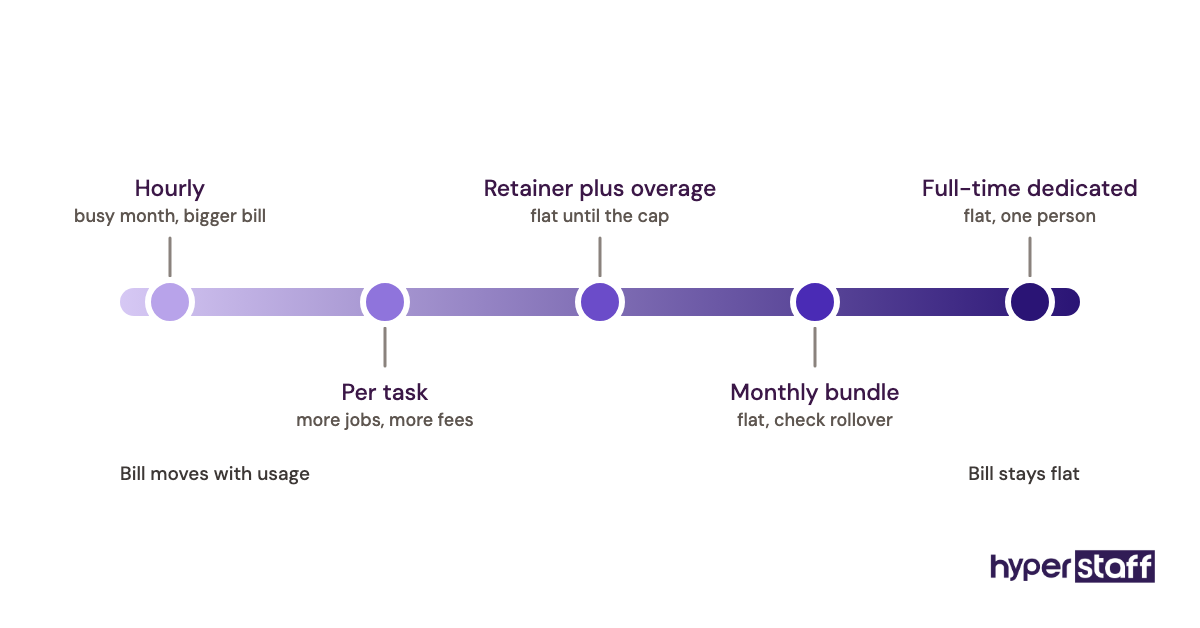
- Hourly: pay per tracked hour. Flexible, hard to forecast.
- Monthly bundle: fixed hours, fixed fee. Rollover rules vary.
- Full-time dedicated: 160 hours, one person, lowest hourly rate.
- Per task: flat fee per deliverable. Suits one-off projects.
- Retainer plus overage: base hours, higher rate past the cap.
Agency, freelancer or in-house: which costs less for a small business?
A good staffing agency is usually the fastest way for a small business to scale, because it hands you a vetted person plus a replacement plan. Freelancers cost less to start but leave the hiring, vetting and backfilling to you.
In-house staff give you full control at roughly $33 an hour once benefits count. Our virtual assistant vs in-house comparison covers when a payroll hire still makes sense.
How much does a small business virtual assistant cost by country?
A small business virtual assistant costs about $4 to $12 an hour in the Philippines or India and $30 to $75 in the US, with UK, EU and Australian rates closer to the US end. All figures are typical ranges in US dollars.
| Region | Typical hourly | 160 hrs/month | Overlap with US hours |
|---|---|---|---|
| Philippines | $4–12 | $640–1,920 | Night shift |
| India | $4–12 | $640–1,920 | Night shift |
| Latin America | $8–20 | $1,280–3,200 | Same workday |
| Eastern Europe | $10–25 | $1,600–4,000 | US mornings |
| United Kingdom | $20–40 | $3,200–6,400 | US mornings |
| Western EU | $20–40 | $3,200–6,400 | US mornings |
| Australia | $25–45 | $4,000–7,200 | US evenings |
| United States | $30–75 | $4,800–12,000 | Full |
Latin America costs more than Asia mostly because of time-zone overlap, since its assistants work your day without a night shift. Philippine and Indian assistants often cover US hours anyway, and some providers add a few dollars an hour for it.
What drives small business virtual assistant costs?
Country and experience tier set the base rate. Four less obvious factors move it from there: live coverage, the number of tools in the role, authority to act in your name and the state of your documentation.
#1 Cost Driver: Live coverage of your business hours
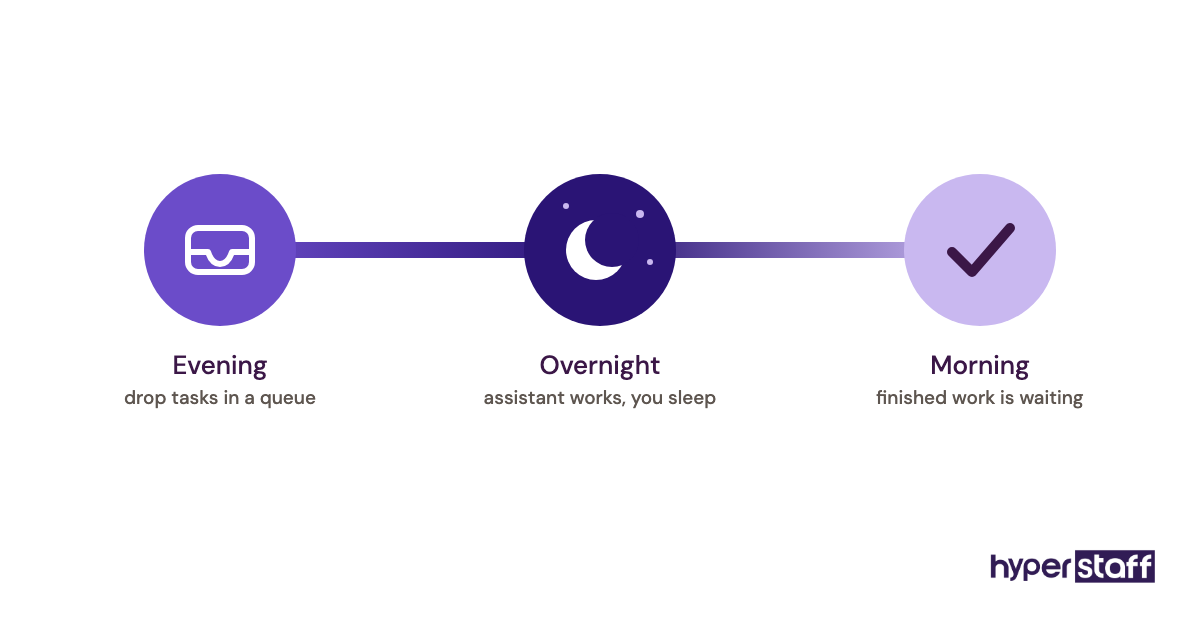
Live coverage costs more than async work because the assistant has to be online during your day. Inbox cleanup and bookkeeping can run overnight and be finished by morning, which is often the cheapest setup available.
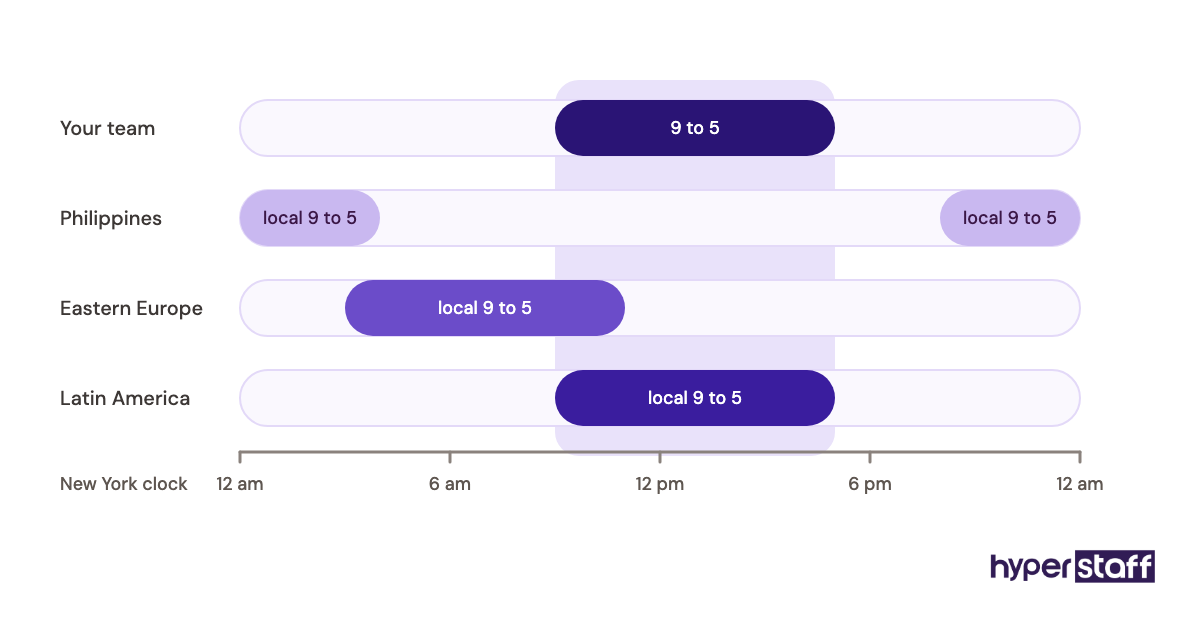
Phone answering and live chat can't wait. We've found that splitting a role into async work plus a short live window trims the hours that carry a shift premium.
#2 Cost Driver: How many tools the role touches
Each extra system pushes a hire up a tier. An assistant working only in Gmail and a calendar fits Essential; one moving between QuickBooks, HubSpot, Shopify and a help desk needs Professional or Expert judgment.
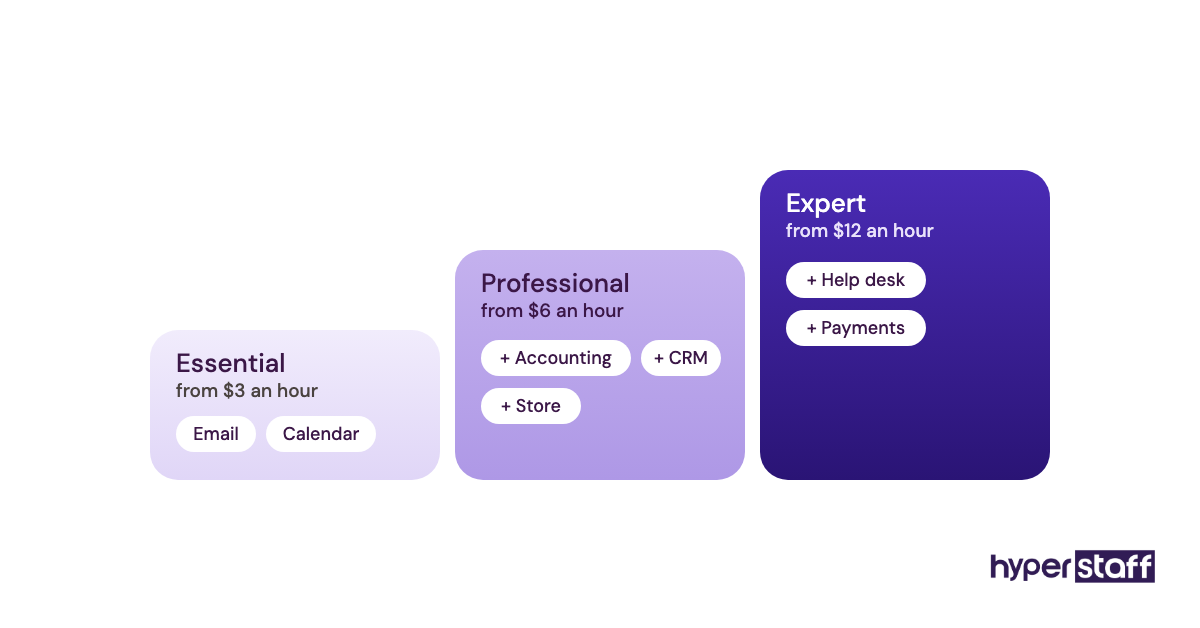
Trimming overlap in your stack can keep a role at the lower tier. Our guide to small business virtual assistant tools shows which ones earn their seat.
#3 Cost Driver: Authority to act in your name
Permission to send emails, issue refunds or pay bills raises the rate more than task difficulty does. You're paying for judgment, and judgment lives in the higher tiers.
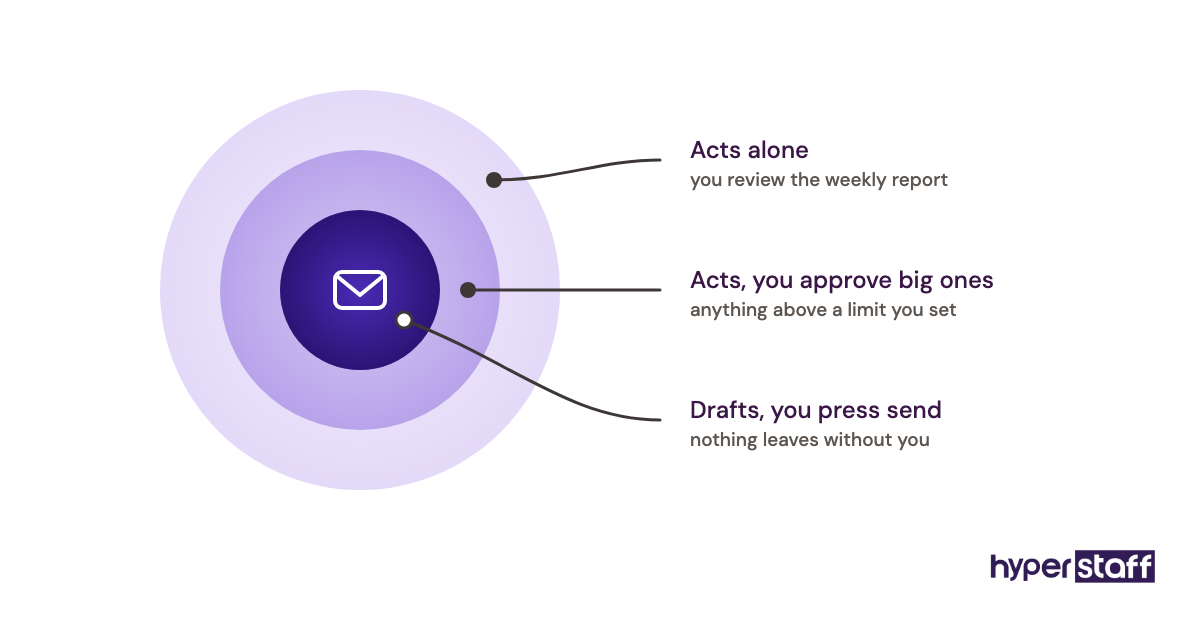
Owners split on this one. Some keep payments to themselves and hire Essential, while others give payables to a senior assistant and win back several hours a week, and for a busy owner the second option often comes out ahead.
#4 Cost Driver: The state of your documentation
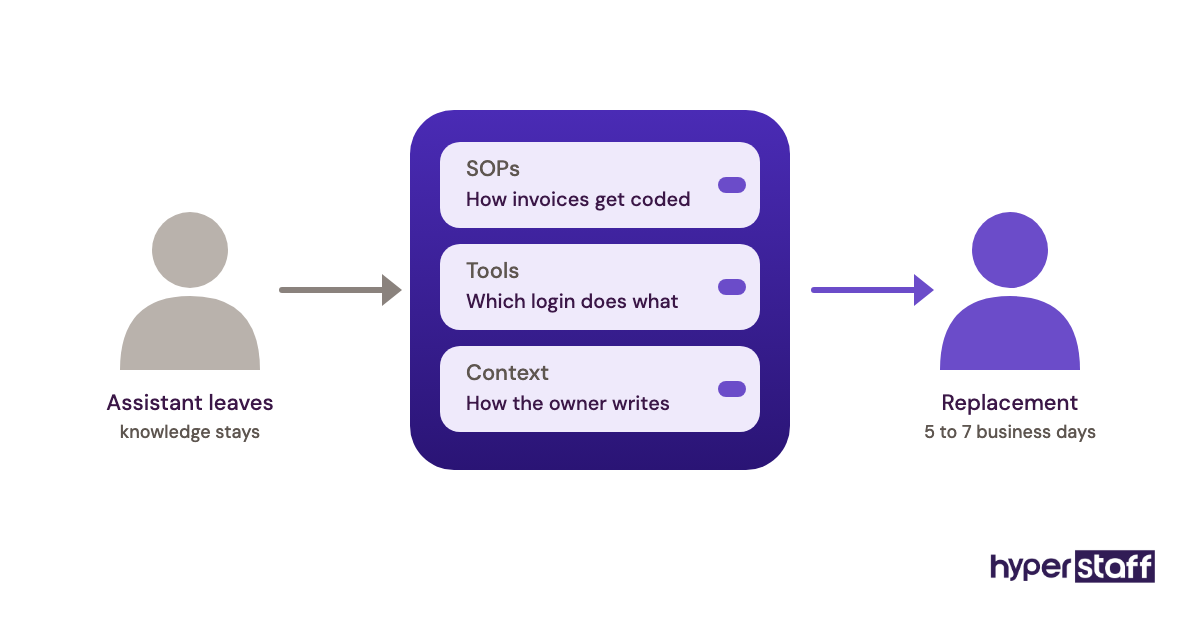
Undocumented processes cost you hours every month until someone writes them down. An assistant who has to ask how invoices get coded bills for that question, and the next assistant will too.
Hyperstaff keeps an Operations Vault of your SOPs, tools and context for that reason. It's also what lets a replacement get briefed in 5 to 7 business days.
Does AI lower small business virtual assistant cost?
AI cuts the hours a small business virtual assistant spends on drafting, summarizing and data cleanup. The monthly bill usually stays flat, because owners fill the freed hours with work that sat untouched before.
AI drafts still need checking. An assistant using ChatGPT or Claude to write customer replies has to read every one, so the time moves from typing to review.
Software adds to the bill as well. Seats for AI writing tools, meeting note takers and automation platforms like Zapier go on your card, and they multiply across a team.
Our view is that AI makes an Essential-tier assistant more capable at routine work. It makes the Expert tier worth more, because someone still has to decide what the output should say.
The Hidden Costs of a Small Business Virtual Assistant
The hidden costs of a virtual assistant sit outside the hourly rate, and they hit hardest in month one.
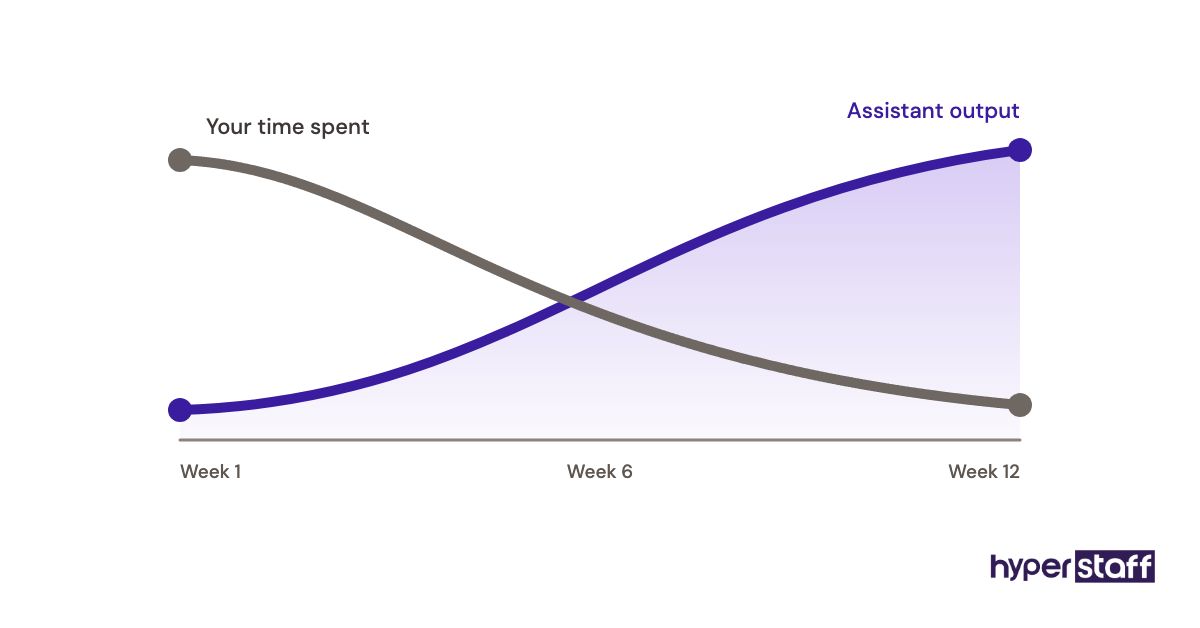
- Your training time. Our guide to onboarding a small business VA shortens it.
- Extra software licenses.
- Marketplace client fees on freelancers.
- Weeks without help after someone quits.
- Rework from vague instructions.
- Currency and transfer fees.
How much should you budget for a small business virtual assistant?
Budget about $250 to $1,000 a month for a part-time offshore assistant and $1,000 to $2,500 for a full-time one. US-based help starts near $4,800 a month for full-time hours.
Start with 40 hours if the work isn't written down yet. The first two to three weeks go to learning your systems, so month-one output runs below month three.
Move to 80 or 160 hours once the assistant clears their queue with time to spare. A clear small business VA job description lets you scope those extra hours before you buy them.
How do you calculate small business virtual assistant ROI?
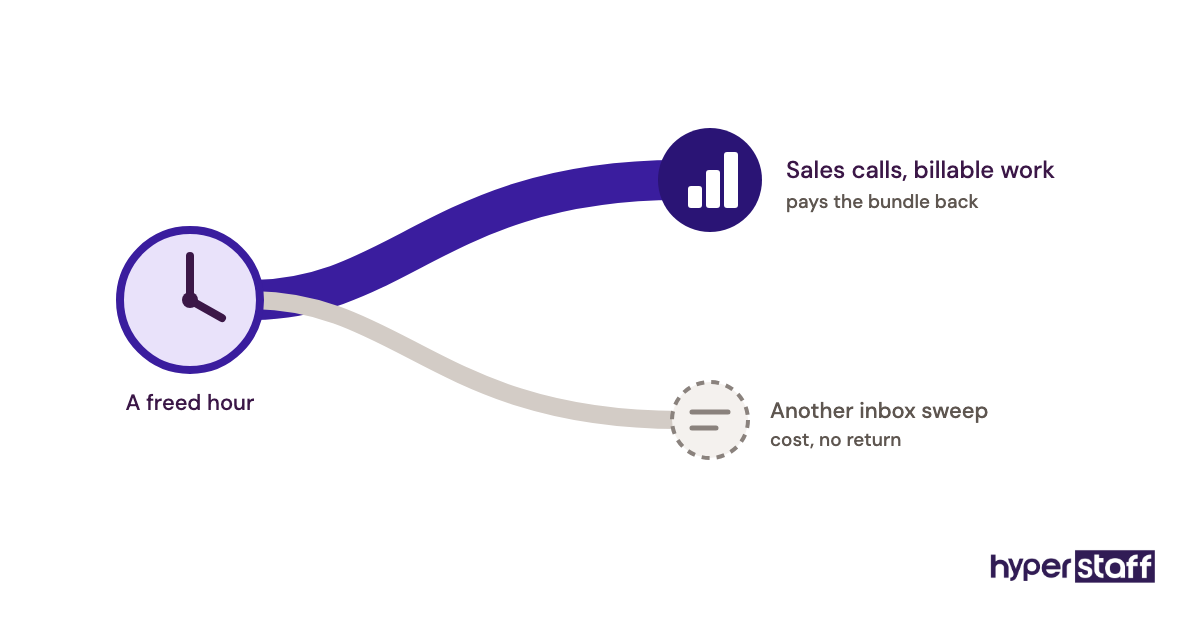
Small business virtual assistant ROI equals the value of the hours you get back, plus any revenue the assistant drives, minus the full monthly cost. Put a dollar value on your own hour first, since that number decides the rest.
- Count the weekly hours you'll hand off.
- Multiply by what your time earns on sales or delivery.
- Add revenue the VA touches, such as booked calls or recovered invoices.
- Subtract the monthly cost plus hidden costs.
With round numbers, an owner whose time is worth $75 an hour and who hands off 10 hours a week recovers about $3,250 a month. A 40-hour Professional bundle from $240 covers those hours.
Recovered hours only pay off when you spend them on revenue work. Fill them with more admin and you'll see the cost with none of the return.
How do you compare virtual assistant agency pricing?
Compare virtual assistant agency pricing on effective cost per productive hour, after rollover rules, replacement terms and fees are counted. A low rate with expiring hours can cost more than a higher rate that rolls over.
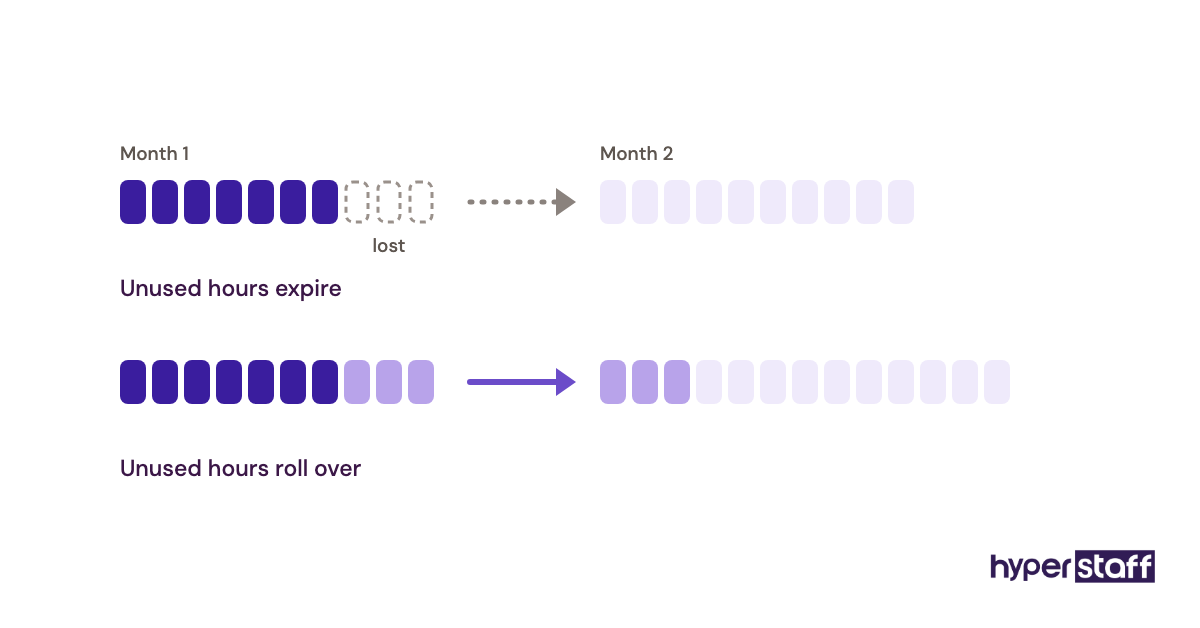
Ask every agency who your assistant will be, what happens to unused hours, how fast a replacement arrives, who pays for software and how much notice you must give. Get the answers in writing.
Our guide to hiring a small business virtual assistant covers vetting in order. Once you have a shortlist, these small business VA interview questions test whether the person matches the price.
Red Flags in Agency Pricing
- No named assistant before you pay
- Hours that expire every month
- Non-refundable setup or matching fees
- Annual lock-ins or long notice periods
- Buyout fees to hire your assistant directly
When to Walk Away
Walk away when an agency can't say who will do the work or how a replacement gets briefed. Rotating pools are a common reason output drops in month two, because each new person starts from zero.
Leave too if the same mistake shows up twice after a written correction. Our list of common small business VA mistakes helps you tell whether the fault sits with the assistant or the brief.
How can you cut virtual assistant costs without losing quality?
You can cut virtual assistant costs by matching each task to the cheapest tier that can do it well and by committing to more hours only after the fit is proven.
Step 1: Split the role by skill level
List every task, then mark which ones need judgment. Routine work goes to an Essential-tier assistant from $3 an hour, while judgment-heavy tasks stay with a higher tier or with you.
Step 2: Record each task once before handing it off
Record your screen doing the task and talk through it as you go. A 10-minute recording replaces an hour of live training and becomes the first page of your SOP library.
Step 3: Move async work off your hours
Anything that doesn't need a live reply can go into an overnight queue. Async work avoids shift premiums and leaves finished output waiting at the start of your day.
Step 4: Prepay only after two clean months
Commit to quarterly billing once the assistant has cleared two months without repeat errors. At Hyperstaff that saves 10%, about $96 a month on a 160-hour Professional bundle.
Step 5: Audit the hours every quarter
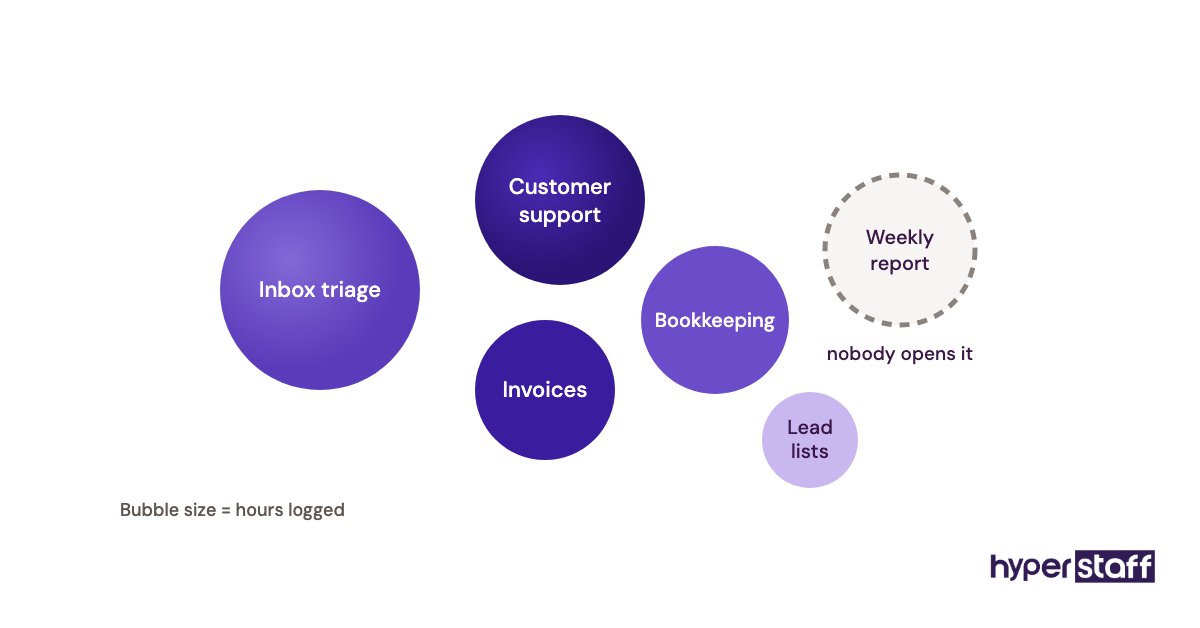
Pull the time logs each quarter and cut tasks that no longer earn their hours. A weekly report nobody reads can quietly eat five hours a month.
Is a small business virtual assistant worth the investment?
Yes. For most small businesses, a virtual assistant is one of the highest-ROI hires available, because a bundle costing a few hundred dollars frees hours the owner can sell or bill.
For the cases where it doesn't pay off, read our take on is a virtual assistant worth it. If the role still feels vague, start with what a small business VA does.
Disclaimer: This article is general information, not financial, tax or legal advice. Prices are estimates that change over time, third-party figures come from the sources cited, and Hyperstaff sets final pricing for each engagement.
Common questions
Can I hire a small business virtual assistant for just a few hours a month?
You can, but below 20 hours a month you'll usually share the assistant with other clients and wait longer for replies. Hyperstaff's smallest bundle is 40 hours, enough to keep one person focused on your business.
Do I pay payroll taxes on an offshore virtual assistant?
Usually no. Hiring through an agency means you pay an invoice while the agency handles the assistant's pay and local obligations. Confirm your own tax treatment with an accountant.
Do virtual assistants charge more to work US hours?
Some do. Assistants in Asia covering a US day work a night shift, and certain providers add a premium for it. Latin American assistants share most of your workday, so the premium rarely applies.
What happens to unused virtual assistant hours?
It depends on the provider. Time etc rolls unused hours into the next month on its 20-hour plan and above, while other agencies let them expire, so ask before you sign.
Is a $3 an hour virtual assistant too cheap to trust?
A $3 rate on its own isn't a warning sign. It reflects local wage levels and entry-level experience, which suits routine tasks with clear instructions. Give judgment-heavy work to a more experienced tier.
Book a free 15 min call
We place a pre-vetted specialist in 5 business days, fully managed, from $3/hour.