Small Business Virtual Assistant Interview Questions: A Template You Can Copy
A complete interview script for hiring a small business virtual assistant, with role-specific questions, a scorecard, a paid trial brief and guidance on adapting it to your business.
On this page
- What Is a Small Business Virtual Assistant Interview?
- Key VA Interview Terms You Should Know
- Why Do Interview Questions Matter So Much When Hiring a VA?
- How Does the VA Interview Process Work?
- What Types of Questions Should a VA Interview Include?
- The Small Business Virtual Assistant Interview Template
- How to Adapt the Template, Step-by-Step
- Step #1
- Step #2
- Step #3
- Step #4
- Step #5
- How Does a VA Interview Differ From Other Hiring Interviews?
- VA Interview vs. In-House Employee Interview
- VA Interview vs. Freelancer Screening
- VA Interview vs. Agency-Vetted Shortlist
- Pros and Cons of a Structured VA Interview
- The Benefits of a Structured Interview
- The Drawbacks of a Structured Interview
- Who Needs a Structured VA Interview Template?
- Small Business VA Interview Answer Examples
- Good Answer Examples
- Bad Answer Examples
- 9 Proven VA Interview Tips and Best Practices
- Overcoming Common VA Interview Challenges
- How Do You Know Your VA Interview Worked?
- How Long Does It Take to Interview and Hire a VA?
- How Much Does It Cost to Hire a Small Business VA?
- Is a Structured VA Interview Worth the Effort?
- How Do You Choose a VA Agency That Interviews for You?
- How Should AI Change Your VA Interview Questions?
- FAQs
Hire right once and protect your margins
Hyperstaff has placed 70+ virtual assistants with 30+ clients, and every candidate we put forward is pre-vetted before you ever see a profile. If you'd rather skip the screening work entirely, our small business virtual assistant services place a vetted specialist in 5 business days, with rates from $3/hour.
What Is a Small Business Virtual Assistant Interview?
A small business virtual assistant interview is a structured remote conversation, usually 45 to 60 minutes on video, where an owner tests whether a candidate can run real tasks in the business without close supervision. The questions cover role skills, judgment, written communication and practical fit, such as time-zone overlap and backup internet.
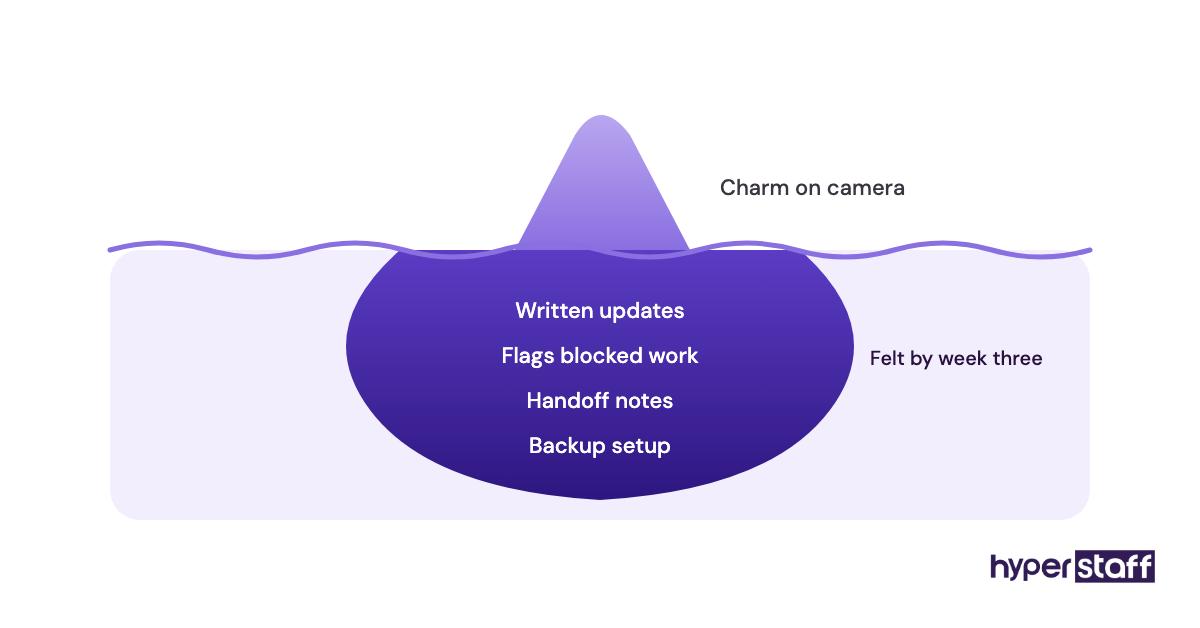
Most owners run it like an office job interview, and that's where it goes wrong. A remote assistant works mostly alone and mostly in writing, so the interview has to test independent judgment and clear updates more than charm on camera.
If the role is still fuzzy, read up on what a small business virtual assistant does before writing a single question. The template below assumes you already know which tasks you're handing over.
Key VA Interview Terms You Should Know
- Structured interview = every candidate gets the same questions, in the same order, scored the same way.
- Behavioral question = asks what the candidate actually did in a past situation.
- Situational question = asks what the candidate would do in a scenario taken from your business.
- Scorecard = a sheet that rates each answer, usually 1 to 4, against criteria written before the first call.
- Paid trial task = a short piece of real work, paid at the role's rate, used to compare finalists.
- Time-zone overlap = the hours when you and the assistant are both working and can reply in real time.
- Async communication = updates by message, email or recorded video that don't need both people online.
- SOP = a standard operating procedure, the written steps for a recurring task.
- Escalation = the point where an assistant stops and asks the owner instead of deciding alone.
- Red flag = an answer pattern that predicts trouble, such as blaming every past client.
- Reference check = a short call or message with a past client to confirm what the candidate claimed.
Why Do Interview Questions Matter So Much When Hiring a VA?
Interview questions matter because most small businesses hire a single assistant, and a bad pick touches every task that person owns. The real cost is the training weeks you lose, followed by a restart with the next candidate.
Free-form calls also reward the wrong trait. Confident talkers win them.
The reserved candidate who writes careful status updates often loses that same call, even though written clarity decides most of a remote assistant's working day. A fixed question set with a scorecard puts both candidates on equal footing.
Worth knowing: Many of the problems owners list as common small business VA mistakes trace back to an interview that never asked how the candidate handles a blocked task, a missed deadline or an unclear instruction.
How Does the VA Interview Process Work?
The interview process for a small business virtual assistant runs in five or six stages, from a written screen to a paid trial, and usually takes one to three weeks end to end. Each stage filters out a different kind of mismatch, so a skipped stage tends to surface later as a problem in week three of the job.
| Stage | Typical length | Format | What it filters out |
|---|---|---|---|
| Written application screen | 5 to 10 min per applicant | 2 short written answers | Weak writing, copy-paste applications |
| Short video screen | 15 to 20 min | Video call | Availability gaps, poor connection, rate mismatch |
| Structured interview | 45 to 60 min | Video call with scorecard | Shaky judgment, thin role skills |
| Paid trial task | 2 to 4 hours | Async, real work | Candidates who interview well but deliver poorly |
| Reference check | 10 to 15 min each | Call or message | Inflated claims |
| Offer and first-week plan | 1 to 3 days | Written offer | Mismatched expectations on hours and scope |
The written screen does more work than owners expect. Two questions answered in writing will cut a long applicant list hard before anyone books a call.
For the wider sequence, including where to post the role and how to compare offers, see our guide on how to hire a small business virtual assistant.
What Types of Questions Should a VA Interview Include?
A complete small business virtual assistant interview mixes about eight question types, and each one catches something the others miss. Behavioral and situational questions carry the most weight; logistics questions are quick pass-or-fail filters.
| Question type | What it tests | Example | Red-flag answer |
|---|---|---|---|
| Background | Relevant past work | Walk us through your last support role | Only job titles, no tasks |
| Behavioral | Proven habits | Tell us about a deadline you missed | "Never happened" |
| Situational | Judgment in your business | A customer wants a refund outside policy | Decides alone with no note |
| Role skills | Hands-on ability | How do you clean a messy contact list? | Generic steps, no tool named |
| Tool fluency | Daily vs. occasional use | Which tools have you used daily? | Lists 20 tools at one level |
| Communication | Update and escalation habits | When do you flag a blocked task? | "When it's finished" |
| Logistics | Hours, overlap, backup setup | What happens if your internet drops? | No backup plan at all |
| Trial task | Real output quality | Short paid task from your backlog | Missed brief, no questions asked |
The Small Business Virtual Assistant Interview Template
The template below is a complete interview script you can copy into a doc and run as is. It fits a 45 to 60 minute video call, with the paid trial handled separately afterward.
Pick one role block in Part B and skip the rest. Replace the scenarios in Part C with situations that have actually happened in your business, because invented scenarios get rehearsed-sounding answers.
SMALL BUSINESS VIRTUAL ASSISTANT INTERVIEW SCRIPT
Candidate: ________ | Role: ________ | Date: ________ | Interviewer: ________
Part A: Background (8 to 10 minutes)
- Walk us through the last role where you supported a business owner directly. What did a normal Monday look like?
- Which tasks in that role did you own without being asked?
- Why are you looking for a new client now?
- How many hours a week can you commit, and which hours overlap with our time zone?
Part B: Role skills (10 to 15 minutes, choose ONE block)
Admin and operations:
- How do you manage an inbox that gets 100+ emails a day for someone else?
- Describe how you've kept a shared calendar clean when three people book into it.
- What's the first thing you'd write down when taking over a recurring task with no SOP?
Customer support:
- How do you reply to an angry customer when you don't yet know who's at fault?
- Which help desk or ticketing tool have you used daily, and how did you tag tickets?
- What do you do when the same question comes in ten times in one week?
Lead generation and sales support:
- How do you build and verify a prospect list for a narrow niche?
- Walk us through how you'd update a CRM after a sales call you didn't attend.
Digital marketing:
- How do you schedule a month of social posts, and who approves them?
- Show us a post, email or graphic you made and tell us what you'd change now.
- Which numbers would you report to us weekly, and why those?
Bookkeeping support:
- How do you match receipts to transactions, and what do you do with the ones that don't match?
- Which accounting software have you used, and what were you allowed to change in it?
Part C: Judgment scenarios (10 to 15 minutes)
- A customer emails at 9 pm your time asking for a refund outside our policy, and we're offline. What do you do?
- You notice two invoices with the same number. What's your next step?
- We give you three urgent tasks and you only have time for two. How do you choose, and what do you tell us?
- You made a mistake that a customer has already spotted. Walk us through your first hour.
- The written instructions for a task don't match how the tool actually works. What do you do?
Part D: Communication and work habits (8 to 10 minutes)
- How do you track your own tasks during the week? Share your screen if you can.
- When a task is blocked, how long do you wait before telling us?
- What should a weekly update from you include?
- Which tools have you used every day, and which have you only touched a few times?
Part E: Fit and logistics (5 minutes)
- What's your backup plan if power or internet drops during your hours?
- What does a client do that makes your work easier?
- What questions do you have for us?
Part F: Scorecard (fill in right after the call)
Score each from 1 (weak) to 4 (strong): Written and spoken clarity ___ | Role skills ___ | Judgment in scenarios ___ | Update and escalation habits ___ | Availability and setup ___ | Total ___ / 20
Any red flags (blame, vague answers, no backup plan): ________
Part G: Paid trial task brief (send to the top 2 or 3 candidates)
Task: one real, low-risk job from our backlog | Time limit: 2 to 4 hours | Pay: the role's hourly rate | Deliver: the finished work plus a 3-line note on what you did, what you assumed and what you'd ask before doing it again.
How to Adapt the Template, Step-by-Step
Adapting the template takes about two hours of prep, and most of that time goes into the scenarios and the trial task. Work through these five steps before you book the first candidate.
Step #1: List the Tasks Before Touching the Questions
Write down every task the assistant will own in the first 90 days, then circle the four or five that matter most. Our checklist of small business virtual assistant tasks is a fast way to spot ones you've forgotten.
Those circled tasks decide which Part B block you use. They also belong in the posting, so pull them into a VA job description and keep the interview and the ad saying the same thing.
Step #2: Rebuild Part C From Your Own Inbox
Scan your last month of email and messages for moments that needed a judgment call. A late refund request, a double-booked meeting or a supplier who stopped replying all make better scenarios than anything generic.
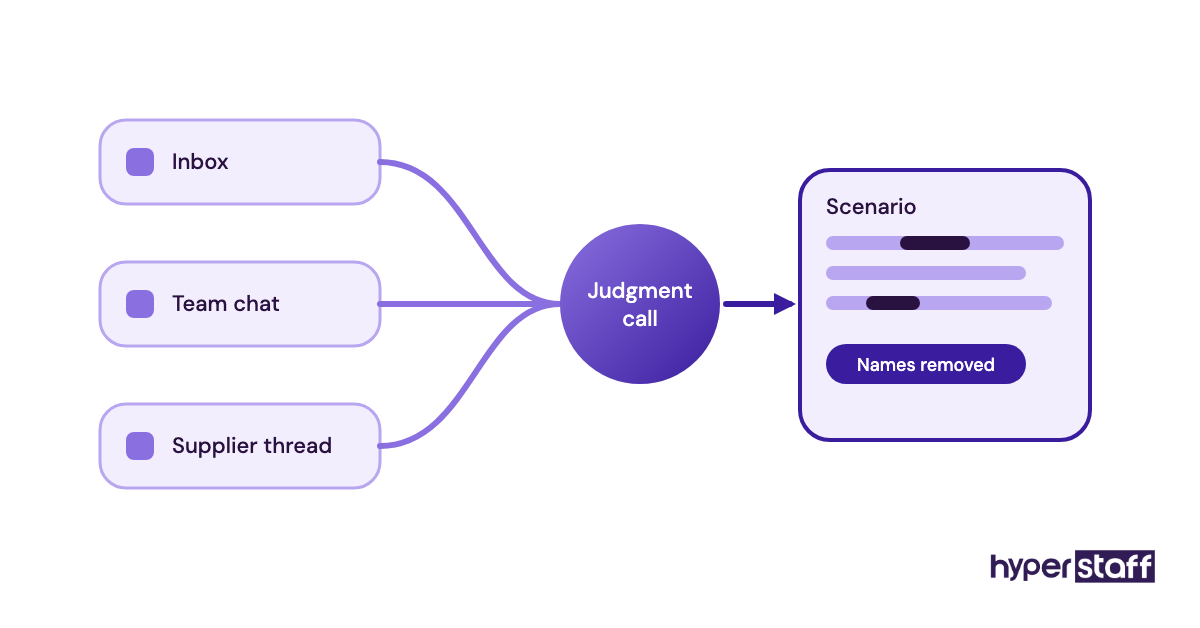
Keep the details real but strip out names and figures. Candidates answer real situations with far more texture.
Step #3: Write the Scorecard Before the First Call
Decide what a 4 looks like for each criterion before you hear any answers. Once you've met a likeable candidate, it's very hard to define "strong" without bending it toward them.
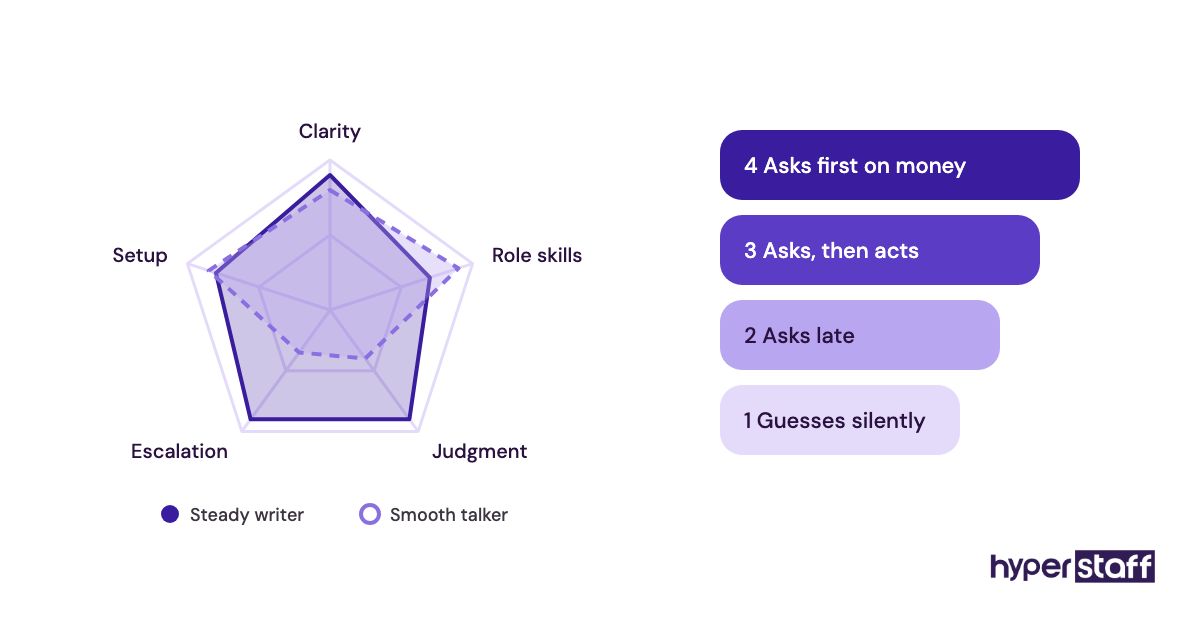
One line per score level is enough. "Asks before acting on money questions" is a usable description of a 4 for judgment.
Step #4: Design a Trial Task You'd Actually Pay For
The best trial task is real work from your backlog that's small, low-risk and finishable in two to four hours. Cleaning 50 rows of a contact list, drafting three customer replies or tidying a messy folder all fit.
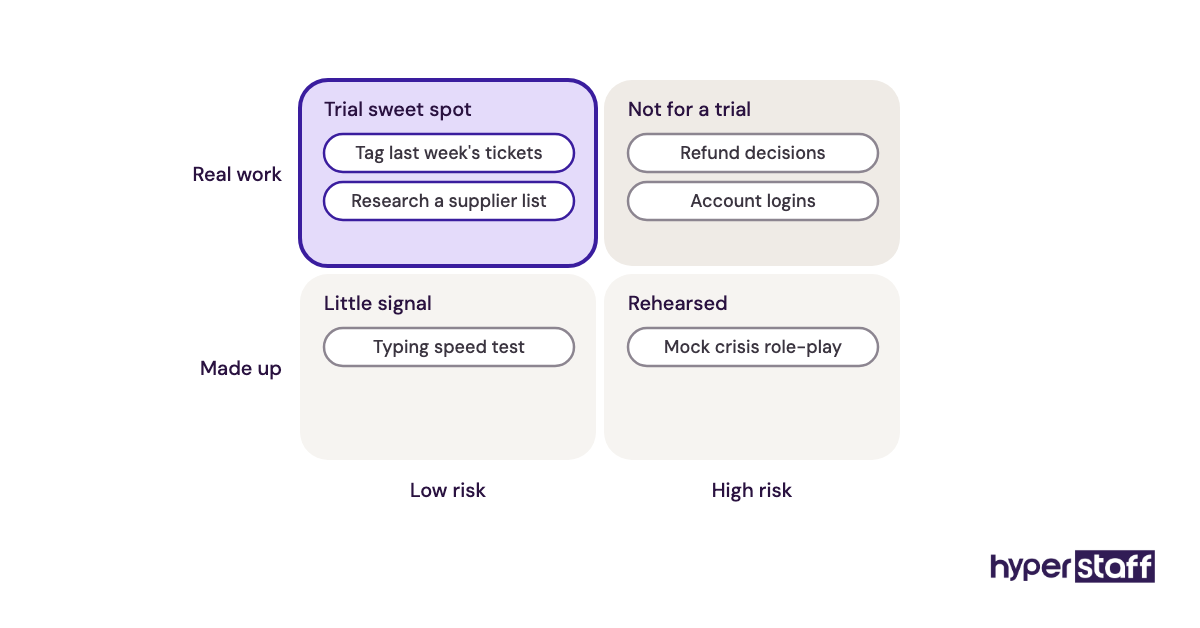
Tip: Leave one small detail in the trial brief slightly unclear on purpose, then watch whether the candidate asks about it or guesses silently, because that single choice predicts how they'll handle vague instructions on a busy Tuesday.
Step #5: Check References and Plan Week One
Ask each reference two questions only: what the candidate did best, and what they'd want the candidate to improve. Specific answers mean a real working relationship; vague praise means a friend.
Then draft the first-week plan before the offer goes out. Our guide to onboarding a small business virtual assistant covers the access, SOPs and check-ins that week needs.
How Does a VA Interview Differ From Other Hiring Interviews?
A VA interview leans harder on written communication, async habits and judgment without supervision than most hiring interviews do. The closest comparisons are an in-house hire, a freelancer screen and an agency shortlist, and each changes what you need to test yourself.
VA Interview vs. In-House Employee Interview
An in-house interview can lean on how someone acts in a shared office, and a manager can correct course daily in person. A VA interview has to predict behavior you'll mostly see through messages, so escalation habits get more weight. The wider trade-offs are in our comparison of a small business VA vs. an in-house hire.
VA Interview vs. Freelancer Screening
Freelancer screening checks whether someone can deliver one defined project. A VA interview tests whether someone can own ongoing work, learn the business and keep going without a fresh brief each time.
VA Interview vs. Agency-Vetted Shortlist
An agency shortlist arrives with skills, English and setup already checked. Your interview then shrinks to fit: the Part C scenarios, a short trial and a gut check on working style.
Pros and Cons of a Structured VA Interview
A structured interview gives you comparable scores and fewer gut-feel hires, at the price of more prep and a slightly stiffer conversation. For a single hire that touches daily operations, the trade is usually worth it.
The Benefits of a Structured Interview
- Scores you can compare across candidates, instead of a vague memory of who "felt right".
- Less bias toward confident talkers over careful workers.
- Scenario answers that show judgment before you hand over real customers.
- A reusable script for the next hire or a replacement.
- Clear notes to revisit if the hire struggles later.
The Drawbacks of a Structured Interview
- Two to three hours of prep before the first call.
- Calls can feel scripted unless you allow follow-up questions.
- Strong candidates who interview poorly can still score low, which is why the trial task matters.
Who Needs a Structured VA Interview Template?
Any owner hiring their first or second virtual assistant needs a structured template, because there's no existing team to catch a weak hire. It matters most when the assistant will touch customers, money or sales leads in the first month.
Owners replacing an assistant who didn't work out need it just as much. The template forces you to write down what went wrong last time and turn it into a scenario question.
Small Business VA Interview Answer Examples
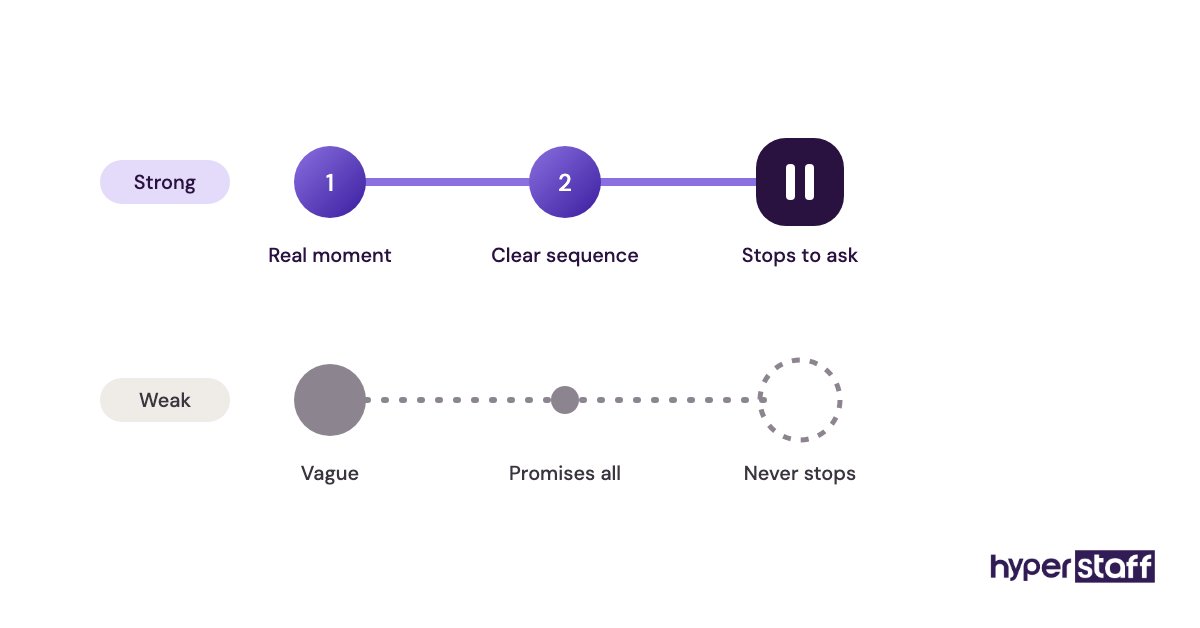
Strong answers to small business VA interview questions share three habits: they name a specific situation, describe a clear sequence of actions and show when the candidate would stop and ask. Weak answers stay general, promise everything or silently blame someone else.
Good Answer Examples
A Clear Escalation Answer
Asked about the after-hours refund request, a strong candidate says they'd reply to the customer that the request is logged and someone will confirm by a set time. Then they'd flag it to the owner with the order number and the policy line, and leave the decision there.
A Specific Past-Work Answer
On inbox management, a good answer names the labels or folders they used, how often they cleared the inbox and what they did with emails needing the owner. Specific numbers, even rough ones, are a good sign.
An Honest Skill-Gap Answer
Asked about a tool they haven't used, a solid candidate says so and names a similar one they know well. They might add how long it took them to pick up the last new tool, which is far more useful than a bluff.
Bad Answer Examples
The Can-Do-Everything Answer
A candidate who claims expert-level skill in bookkeeping, design, ads, support and video editing is guessing about at least half of it. Ask for one example in each, and the gaps show quickly.
The Vague Process Answer
"I'd just handle it" in response to a scenario tells you nothing. Push once for the first step; if the answer stays vague, score it a 1.
The Blame-Shifting Answer
When every past problem was a client's fault, expect the same story about your business later. Good candidates own at least part of a past mistake and describe what they changed.
9 Proven VA Interview Tips and Best Practices
These interview tips come from where structured VA hiring usually breaks down in practice.
- Send the two written screening questions before any call, and read them before you look at the résumé.
- Ask the same core questions in the same order to every candidate.
- Allow one follow-up per question, and make it "what did you do next?"
- Ask candidates to share their screen and show a task tracker or recent work.
- Score each answer within an hour of the call, before memory blurs.
- Run the interview during the hours you'd actually overlap.
- Pay for every trial task at the role's rate.
- Compare finalists on the trial output side by side, with names hidden if you can.
- Keep the script and scores, so a future replacement hire starts from your notes.
Overcoming Common VA Interview Challenges
The most common VA interview challenge is rehearsed answers. Popular questions like "what's your greatest weakness" have stock replies online, so scenarios from your own business work better.
Connection problems are another. Treat one dropped call as bad luck; two in one interview is useful data about the candidate's setup.
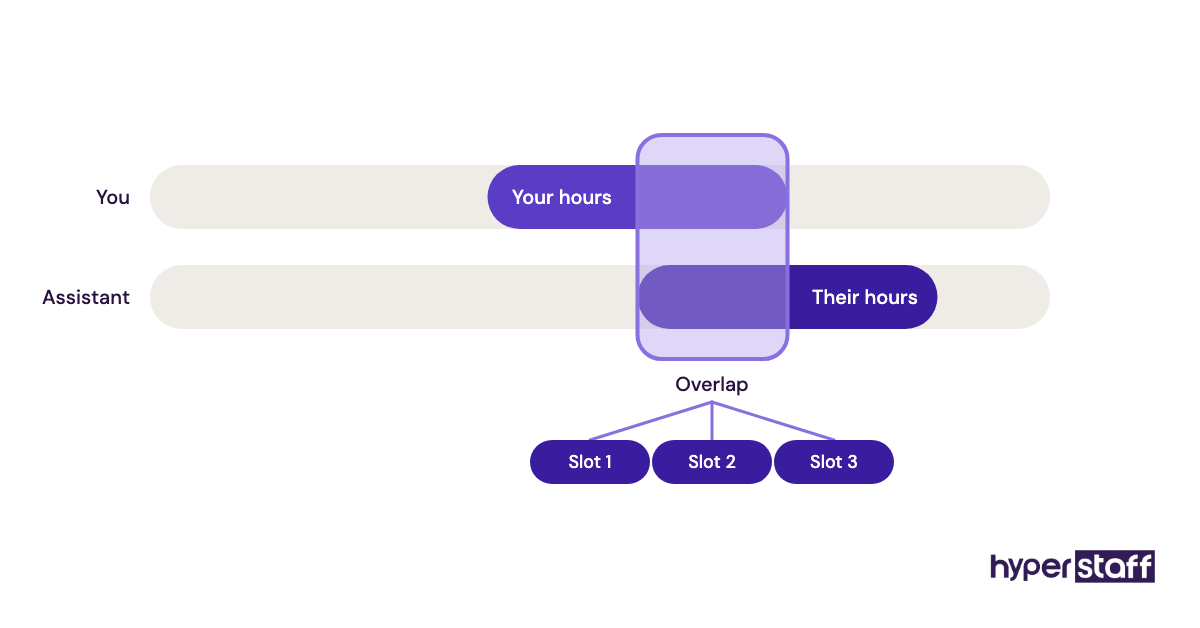
Time-zone gaps can make scheduling drag. Offer three fixed slots and let candidates pick, and you'll avoid a week of back-and-forth.
How Do You Know Your VA Interview Worked?
You'll know your VA interview worked when the hire performs in the first 90 days the way their scorecard predicted. Compare their week-four work against the scores for judgment, communication and role skills.
Watch how often they escalate. Too many questions about basics means a skills gap the interview missed; zero questions on money or customer issues means a judgment gap.
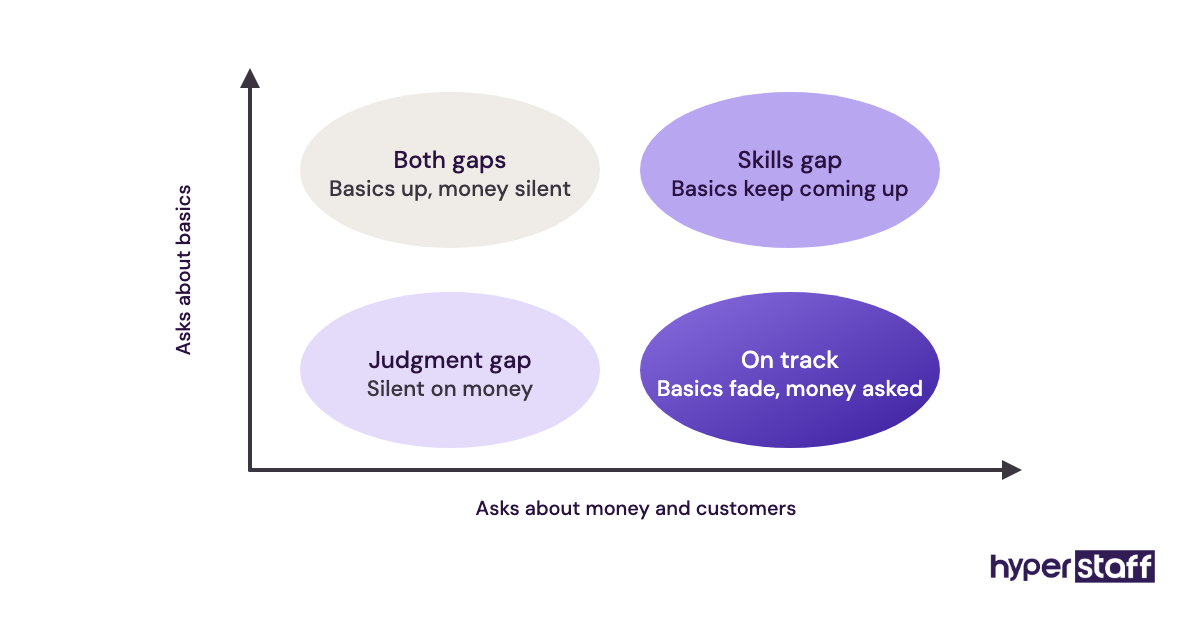
If the scores and the reality don't match, rewrite the weakest question before the next hire.
How Long Does It Take to Interview and Hire a VA?
Interviewing and hiring a small business VA yourself usually takes one to three weeks, from posting the role to a signed offer. The slow parts are waiting for applications and scheduling across time zones.
Trial tasks add three to five days, since candidates often fit them around current work. Reference replies can lag another day or two.
Going through a staffing agency shortens this. At Hyperstaff, placement takes 5 business days, followed by a 30-minute kickoff call and work starting that day or the next morning.
How Much Does It Cost to Hire a Small Business VA?
A small business virtual assistant hired through Hyperstaff costs from $3 to $12+ an hour depending on experience tier, sold in monthly bundles of 40, 80 or 160 hours. An in-house US administrative hire usually costs several times that once taxes and benefits are added.
| Option | Hourly cost | 80 hours/month | 160 hours/month | Hiring and replacement |
|---|---|---|---|---|
| Hyperstaff Essential (0 to 2 years) | From $3 | From $240 | From $480 | Placed in 5 business days, free replacement in 5 to 7 |
| Hyperstaff Professional (2 to 5 years) | From $6 | From $480 | From $960 | Placed in 5 business days, free replacement in 5 to 7 |
| Hyperstaff Expert (5+ years) | From $12 | From $960 | From $1,920 | Placed in 5 business days, free replacement in 5 to 7 |
| In-house US admin assistant | Roughly $18 to $30 in wages, plus 20% to 30% in taxes and benefits | Rarely part-time | Roughly $3,500 to $6,200 | You run recruiting and restart from zero if it fails |
Paying quarterly with Hyperstaff saves 10%. For a deeper breakdown, see our guide to small business virtual assistant cost.
Important: Hyperstaff prices above are starting rates and typical averages, not fixed quotes. Your final cost depends on the role, the experience tier, the hours you choose and the work your business needs done.
Is a Structured VA Interview Worth the Effort?
Yes, a structured interview is one of the highest-return hours a small business owner can spend, because it decides who handles your customers, leads and books for the next year. Done right, it turns a monthly payroll line into reclaimed hours you can bill or sell with.
Here's a rough calculation. A full-time in-house assistant at $22 an hour, plus about 25% in taxes and benefits, costs around $4,400 a month for 160 hours.
A Professional-tier assistant at $6 an hour costs from $960 for the same 160 hours, so the gap is roughly $3,440 a month. The structured interview itself takes perhaps 8 to 12 hours of your time across prep, calls and trial review.
The hidden cost is a wrong hire. Six weeks of training someone who then leaves can wipe out a month or two of those savings, which is why the scorecard and trial task pay for themselves. We look at the full picture in whether a small business virtual assistant is worth it.
How Do You Choose a VA Agency That Interviews for You?
Choose a VA agency by asking how it vets candidates, whether you meet finalists before committing, and what happens if the placement doesn't work. Vague answers on replacement terms are the clearest warning sign.
Ask who your day-to-day contact is, and whether your processes get written down so a replacement can start quickly. Without documented SOPs, every replacement means re-explaining your business from scratch.
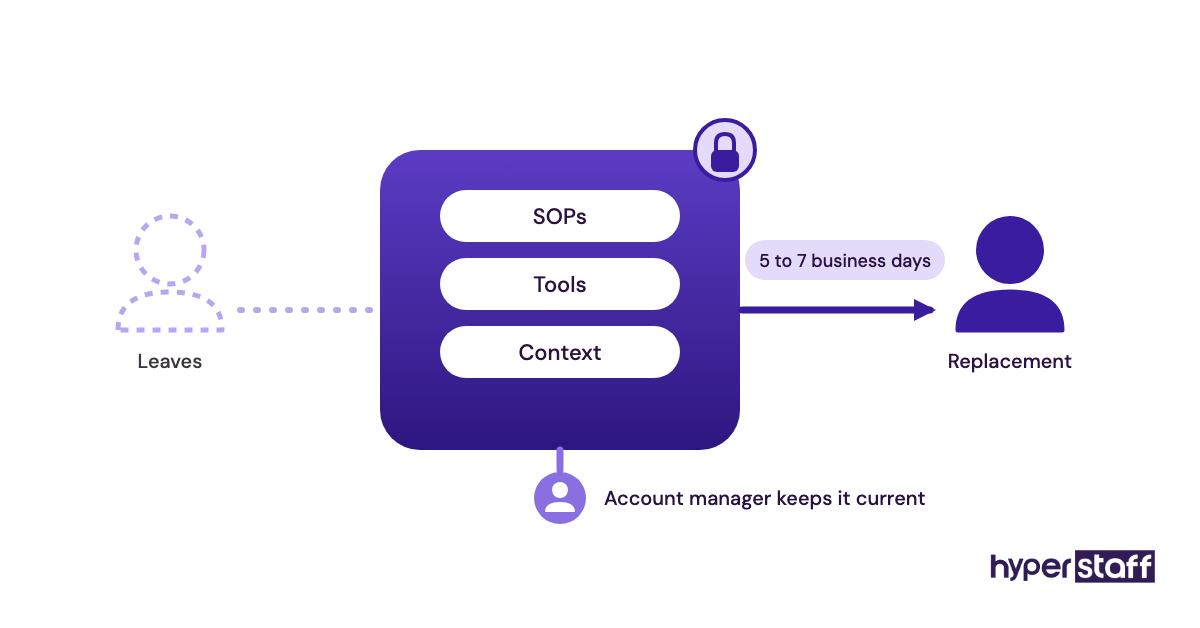
At Hyperstaff, every client gets a dedicated account manager, and your SOPs, tools and context live in an Operations Vault we write and maintain for you. If a placement doesn't fit, the free replacement in 5 to 7 business days is briefed from that vault. You can still run the Part C scenarios and a short trial on the candidates we put forward.
How Should AI Change Your VA Interview Questions?
AI should change your VA interview in two places: you should ask how candidates use AI tools in their work, and you should test writing live rather than relying on application answers. Polished written applications prove much less than they used to.
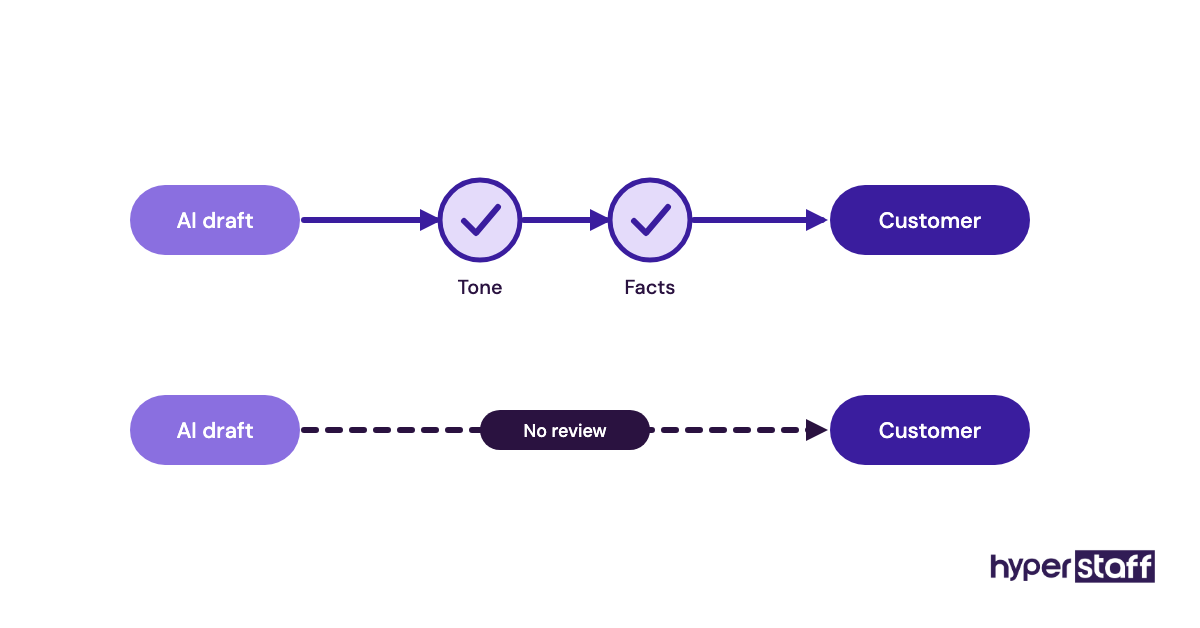
Ask which AI tools they use, for which tasks, and how they check the output before it reaches a customer. A candidate who drafts with AI and then edits against your tone and facts is useful; one who pastes output straight into customer emails is a risk.
Add one short live writing exercise during the call, such as replying to a real customer message in five minutes. It also helps to ask about the wider set of tools a small business VA uses daily, since AI features now sit inside most of them.
Heads-up: Tell candidates up front whether AI help is allowed on the trial task, since some will avoid it out of caution and others will rely on it heavily, and you want both groups judged on the same rules.
Disclaimer: This article is for general information only and isn't legal, tax or employment advice. Hiring rules, pay requirements and costs vary by location and change over time, so check with a qualified professional before making hiring decisions.
Common questions
How many interview questions should I ask a virtual assistant?
Around 15 to 20 questions fit a 45 to 60 minute call with room for follow-ups. More than that and answers get rushed, which hides the judgment you're trying to see.
Should a VA interview be on video?
Yes, at least for the main structured interview. Video lets you check connection quality and screen-sharing, and it shows how the candidate communicates when they can't edit their words first.
Is it okay to give a VA candidate an unpaid test task?
No, pay for any task that produces real work. Paid trials attract stronger candidates, and unpaid real work can raise legal and fairness concerns depending on where the candidate lives.
What's the biggest red flag in a virtual assistant interview?
The biggest red flag is a candidate who never says when they'd stop and ask. An assistant who decides alone on refunds, pricing or customer complaints will eventually make an expensive call without you.
Can I still interview a VA if I hire through an agency?
You can, and you should run at least a short version. Use the Part C scenarios and a trial task, since the agency has already checked skills, English and setup.
Book a free 15 min call
We place a pre-vetted specialist in 5 business days, fully managed, from $3/hour.