Small Business Virtual Assistant Job Description: A Free Template You Can Adapt
A copyable small business virtual assistant job description template, with a step-by-step guide to adapting duties, hours, tools and 90-day goals.
On this page
- What is a small business virtual assistant job description?
- Job description terms worth knowing before you write
- Why does a small business VA need a written job description?
- What goes into a small business VA job description?
- Small business virtual assistant job description template
- How do you adapt the job description template, step by step?
- Step #1
- Step #2
- Step #3
- Step #4
- Step #5
- What types of small business VA roles need different job descriptions?
- How is a VA job description different from other hiring documents?
- VA job description vs. in-house admin assistant job description
- VA job description vs. freelance gig post
- VA job description vs. SOP
- What are the pros and cons of a detailed VA job description?
- The benefits of a detailed small business VA job description
- The drawbacks of a detailed small business VA job description
- Which small businesses need a VA job description?
- Small business VA job description examples
- Good small business VA job description examples
- Bad small business VA job description examples
- 10 tips for writing a VA job description that attracts the right people
- What goes wrong when small businesses write VA job descriptions?
- How do you know your VA job description worked?
- How long until a VA job description pays off?
- How much does it cost to hire the VA in your job description?
- Is writing a detailed VA job description worth it?
- How do you choose a VA agency to hire through?
- Small business VA hiring trends that shape the job description
- Can AI write a small business VA job description?
- FAQs
Write the Role Right, Keep More Revenue
Hyperstaff has placed 70+ virtual assistants with 30+ clients, and every one of those placements started from a clear role brief like the template below. Our small business virtual assistant services match you with a pre-vetted specialist in 5 business days, from $3/hour, with a dedicated account manager and free replacement in 5 to 7 business days if the fit is wrong.
What is a small business virtual assistant job description?
A small business virtual assistant job description is a written brief that tells remote candidates what the role owns, how many hours it needs, which tools they'll use and how their work will be judged. It's the page a VA reads before applying and the page you check them against after the hire.
Small businesses lean on it harder than large companies do. A 12-person firm rarely has an HR team to fix gaps later, so the job description often becomes the first draft of the role's operating manual.
The role itself reaches well past inbox and calendar admin. Customer support, lead generation, digital marketing, operations and online business management all sit inside it, and our guide to what a small business VA does maps that full range.
Job description terms worth knowing before you write
- Role scope = the business areas the VA owns, written as outcomes.
- Hours bundle = a fixed monthly block of paid hours, such as 40, 80 or 160.
- Time zone overlap = the hours each day when you and the VA are both online.
- Dedicated VA = one person who works on your account and learns your business over time.
- SOP = a standard operating procedure, the written steps for a task that repeats.
- KPI = a number that shows whether the work is on track, like reply time or booked calls.
- Paid test task = a short, paid sample of real work used to screen finalists.
- Access level = the accounts and data a VA can view or change.
- Experience tier = the band of prior experience a role calls for, usually tied to the hourly rate.
- Replacement guarantee = an agency's promise to place a new VA if the first one isn't a fit.
Why does a small business VA need a written job description?
A remote hire can't learn the role by watching you work, so everything they need on day one has to be written down. The job description is the first page of that writing, and it shapes every page after it.
It also decides who applies. A post that says "help with admin" pulls in generalists by the hundred.
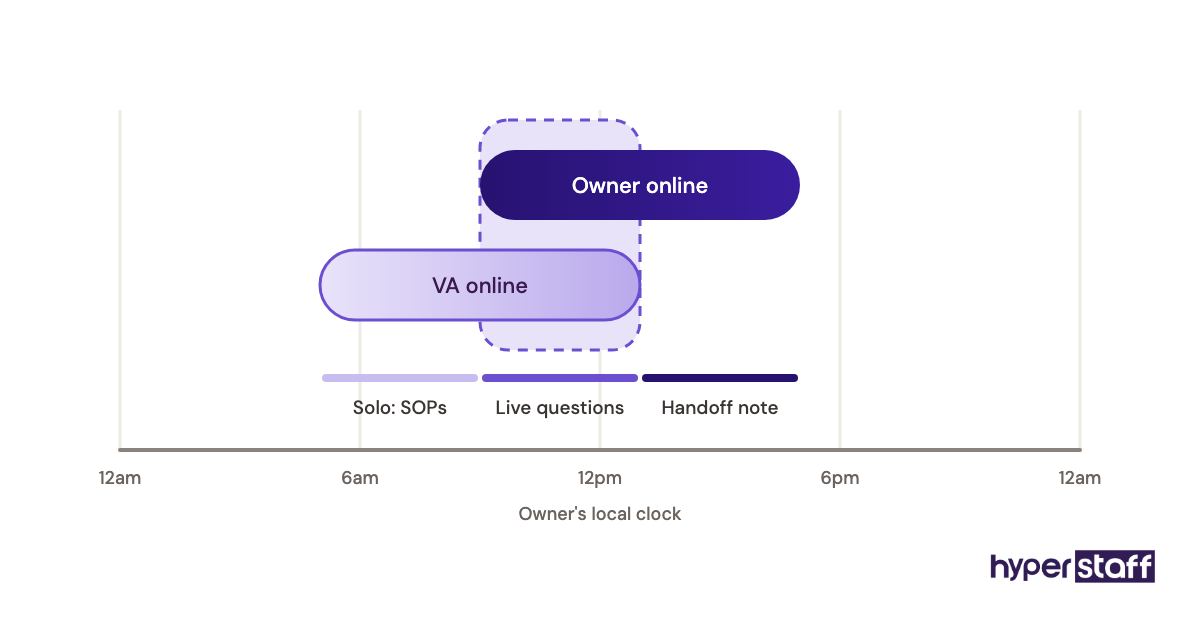
Name the CRM, a four-hour reply target and a 9am to 1pm Eastern overlap, and the pile shrinks to people who fit. You'll read fewer applications and like more of them.
Later, the job description turns into the yardstick for the first 90 days. An owner who wrote down three ranked priorities can point to the gap when month one feels off, while an owner who wrote nothing ends up arguing about impressions.
Worth knowing: In our experience, scope mismatch is the most common reason a small business VA hire falls apart early, since the owner pictured one job and the VA was hired for another, and two hours spent writing the brief is the cheapest fix there is.
What goes into a small business VA job description?
A small business VA job description needs nine parts. The order can shift, but each part has a typical slip that weakens the whole post.
| Section | What to write | Common slip |
|---|---|---|
| Job title | Main area + "Virtual Assistant" | "Admin Wizard" or other cute titles |
| Business snapshot | Size, industry, customers, busy periods | A paragraph of company history |
| Role summary | Two areas owned, hours, who they report to | No reporting line |
| Hours and time zone | Bundle size, overlap window, days | "Flexible hours" with no overlap stated |
| Responsibilities | 5 to 8 outcomes, ranked | 20+ unranked tasks |
| Tools | Each tool marked "must know" or "we'll train" | "Tech-savvy" with no tools named |
| Requirements | Experience, language level, setup | Asking for expert skills at an entry rate |
| Success measures | 30, 60 and 90 day targets | Left out entirely |
| How to apply | One specific question + paid test task | "Send your CV" |
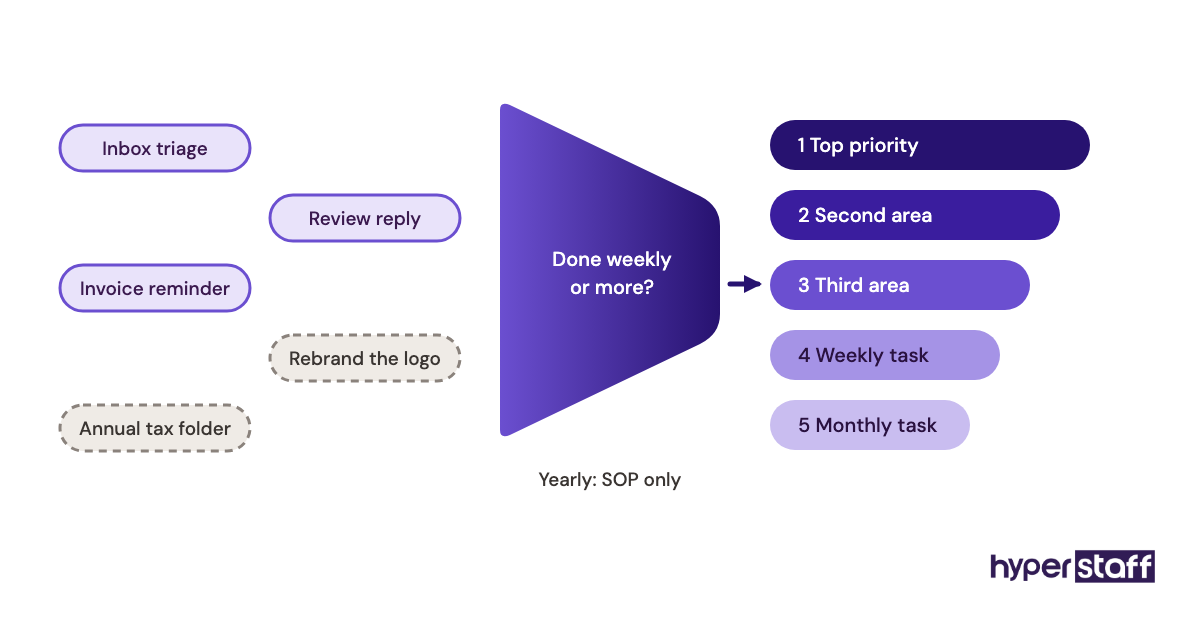
Responsibilities take the most thought. Pull them from a full checklist of VA tasks, then cut anything the VA won't touch at least weekly.
Small business virtual assistant job description template
Copy the template below into your doc or job board, and replace every bracket with your own detail. Lines that don't apply should be deleted, since a vague line reads to candidates as a duty you haven't thought through.
Job title: [Main area] Virtual Assistant for a [industry] business
About us: [Business name] is a [number]-person [industry] business based in [city, country]. We serve [customer type], and our busiest periods are [days, weeks or seasons].
Role summary: We're hiring a dedicated virtual assistant to own [area 1] and [area 2]. You'll work [40 / 80 / 160] hours a month and report to [name, title].
Hours and time zone: [Part-time / full-time], [number] hours a month. You'll be online [start time] to [end time] [time zone], [days], and the rest of your hours can be scheduled around that window.
What you'll own, in priority order:
- [Top area]: [outcome with a number, e.g. "reply to every customer email within 4 business hours"]
- [Second area]: [outcome]
- [Third area]: [outcome]
- [Weekly task]: [what, how often, who receives it]
- [Monthly task]: [what, by which date]
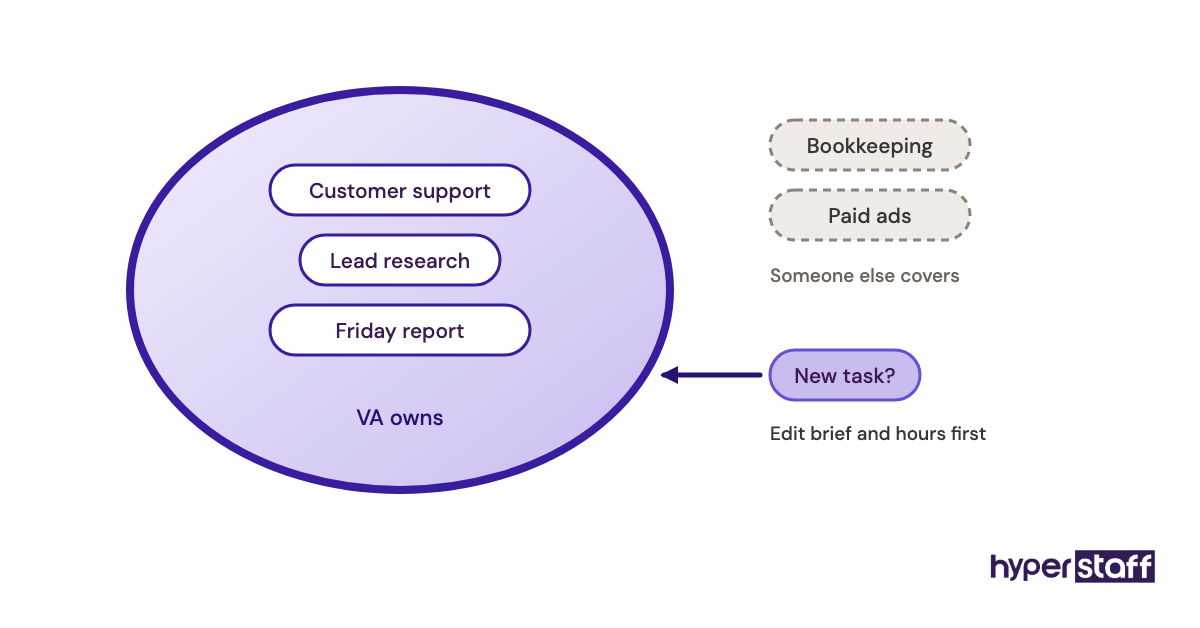
What this role doesn't own: [areas someone else covers, e.g. bookkeeping, paid ads]
Tools you'll use: [email platform], [CRM], [project tool], [chat tool], [password manager]. You should already know [tool]. We'll train you on [tool].
You'll fit this role if you have:
- [Number]+ years of experience in [area]
- Written English at the level of our customer emails
- Hands-on use of [tool]
- A reliable internet connection and a backup plan for outages
Nice to have: [industry experience], [extra skill]
What success looks like:
- 30 days: [top area] done from our written SOPs without reminders
- 60 days: [target number reached, e.g. reply time under 4 hours on 9 of 10 days]
- 90 days: [both areas owned end to end, plus one process improvement suggested]
How to apply: Send a short note answering [one specific question about the work]. Shortlisted candidates complete a paid [1 to 2]-hour test task: [describe it in one sentence].
The "doesn't own" line is the one owners skip most. It does more to stop scope creep later than any other line in the template.
How do you adapt the job description template, step by step?
Adapting the template takes five steps, and the first one happens away from the document. The job description is one stage of the wider process in how to hire a small business VA, so finish it before you post anywhere or brief an agency.
Step #1: Write down what you did last week
Start from your own calendar, inbox and task app. List every task from the past one to two weeks, then mark the ones a trained person could do from written steps.
Owners routinely miss the small items here: the invoice reminder, the review reply, the five-minute CRM update. Those fragments often add up to more hours than the big tasks you remembered first.
Step #2: Group the tasks and pick an hours bundle
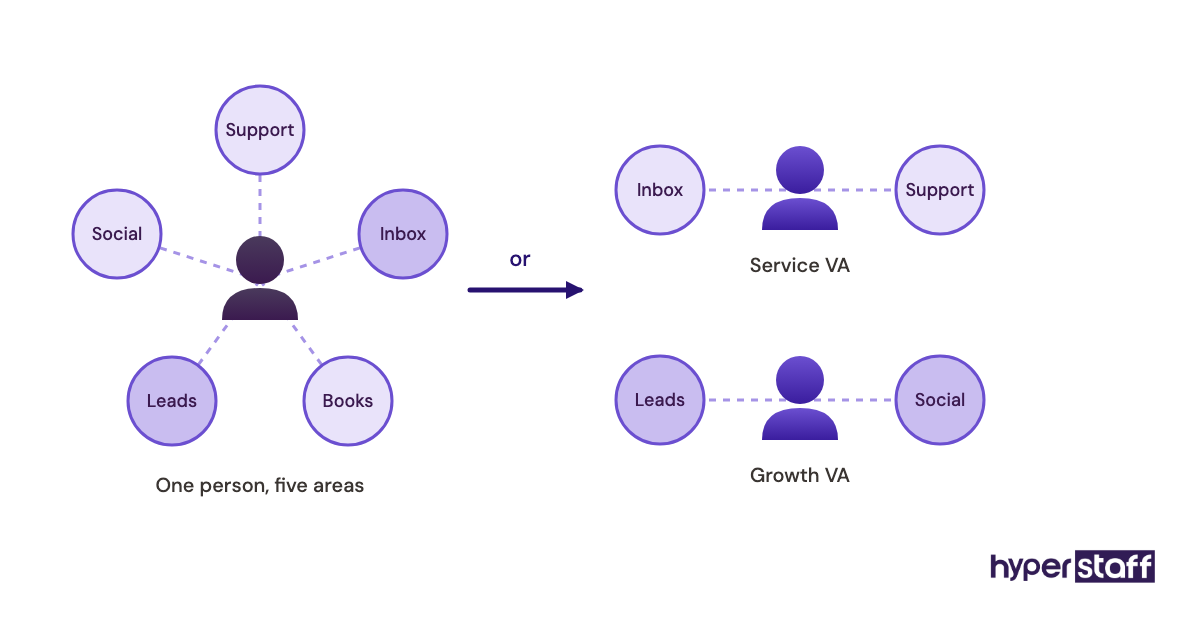
Sort the marked tasks into two to four business areas, then rank them by what costs you most when it slips. Roughly 10 hours of handover work a week fits a 40-hour month, 20 fits 80, and a full workload fits 160.
Leave some slack in the bundle. A VA who starts with every hour already spoken for has no room to learn your SOPs in the first fortnight.
Tip: If your tasks spread evenly across five or more unrelated areas, you may be describing two roles, and two part-time specialists will often outperform one full-time VA who's switching context all day.
Step #3: Name the tools and the access each one needs
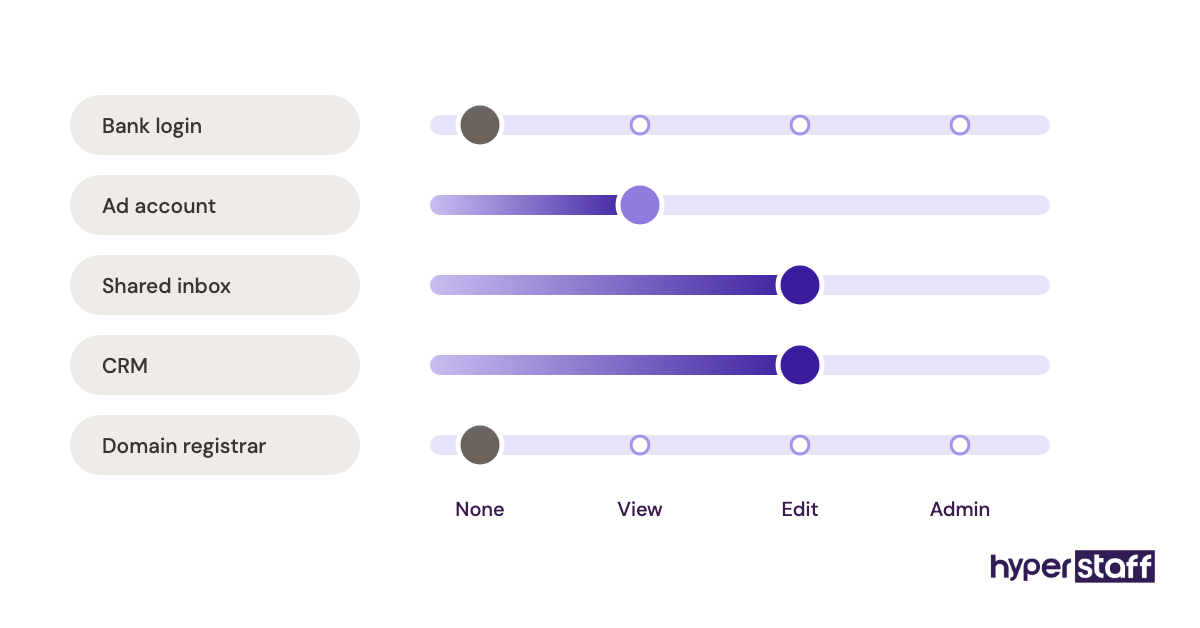
List every tool the VA will log into, and mark each one "must know" or "we'll train you". Our roundup of tools a small business VA uses is a good cross-check for anything missing.
Share logins through a password manager such as 1Password, Bitwarden or LastPass from the first day. Emailing passwords to a new remote hire is the habit that's hardest to undo once it starts.
Step #4: Write what success looks like at 30, 60 and 90 days
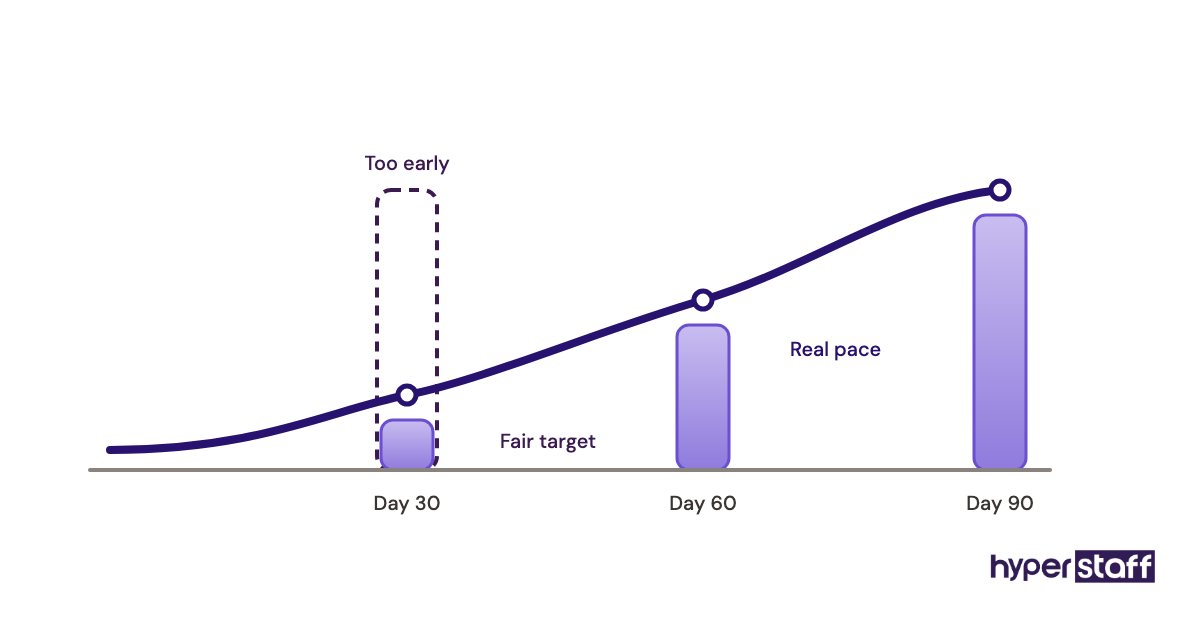
Success measures turn the job description into something you can manage against. Write one line per milestone and attach a number wherever the work produces one, such as reply time, booked calls or invoices sent.
Keep the 30-day target modest. A VA spends the first month learning your business, and a month-three target set for week four makes a good hire look like a bad one.
Step #5: Build the paid test task and screening questions
Turn your top-priority area into a paid test task of one to two hours, using real material with names and sensitive data removed. A support VA might draft replies to five past tickets, and a lead generation VA might research 15 prospects that match your ideal customer.
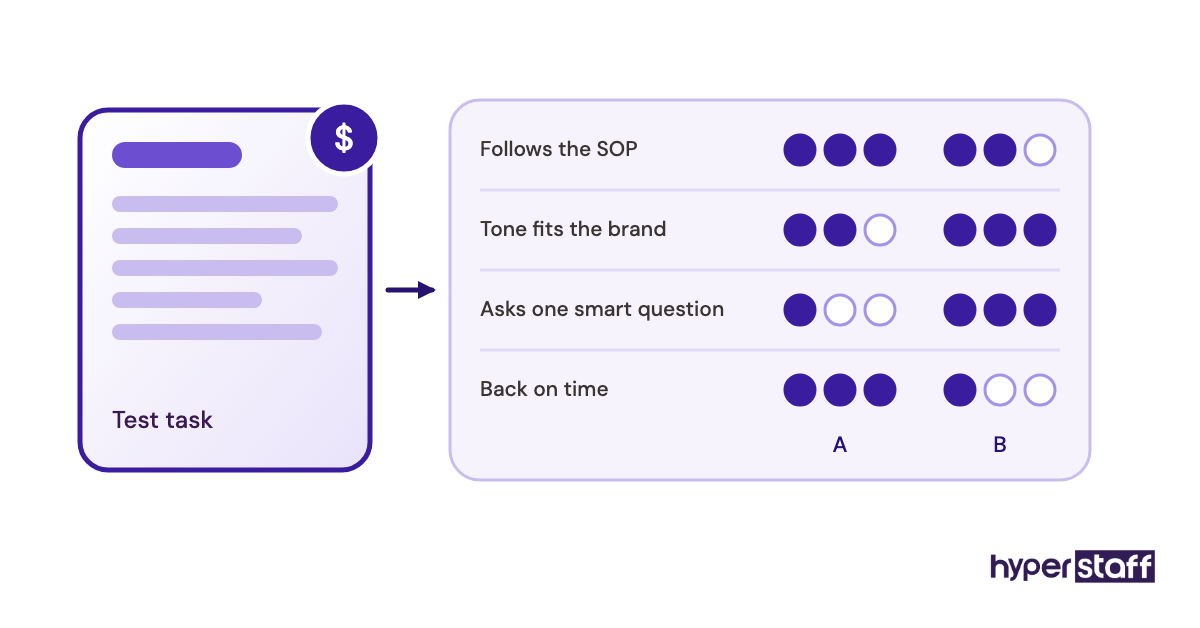
Pair the task with questions drawn from the job description itself. Our list of VA interview questions ties one question to each responsibility area.
What types of small business VA roles need different job descriptions?
Small business VA roles split into several types, and each needs a different emphasis in the job description. The table pairs common roles with the hours and experience tier that usually fit them.
| VA role | Typical duties | Hours that often fit | Experience tier | What the job description must spell out |
|---|---|---|---|---|
| General admin VA | Inbox, calendar, data entry, travel | 40 to 80 | Essential | Which inboxes and calendars, and reply rules |
| Customer support VA | Tickets, chat, returns, reviews | 80 to 160 | Essential or Professional | Reply-time target, overlap window, refund limits |
| Lead generation VA | Prospect research, CRM updates, outreach | 80 to 160 | Professional | Ideal customer profile, weekly volume, CRM |
| Digital marketing VA | Social posts, email campaigns, reporting | 40 to 80 | Professional | Channels, posting cadence, approval steps |
| Bookkeeping and back office VA | Invoicing, bill entry, reconciliations | 40 to 80 | Professional | Software, approval limits, month-end dates |
| E-commerce VA | Listings, orders, inventory, supplier emails | 80 to 160 | Essential or Professional | Store platform, order cut-off times, stock checks |
| Executive assistant VA | Owner's calendar, priorities, follow-ups | 80 to 160 | Professional or Expert | Decision rights, confidentiality, overlap hours |
| Online business manager | Projects, team coordination, SOPs, reporting | 80 to 160 | Expert | Outcomes owned, team members managed, budget limits |
How is a VA job description different from other hiring documents?
A small business VA job description sits close to three documents that owners mix up with it. Each one does a different job, and borrowing from the wrong one is where many weak posts come from.
VA job description vs. in-house admin assistant job description
An in-house admin job description assumes a desk, set office hours and a colleague nearby to ask. A VA job description has to state the time zone overlap, the tools and the written SOPs, because none of that gets absorbed by sitting near you.
Benefits, office location and commute drop out of the VA version, and access rules come in. The full comparison of a VA versus an in-house hire weighs cost and control as well.
VA job description vs. freelance gig post
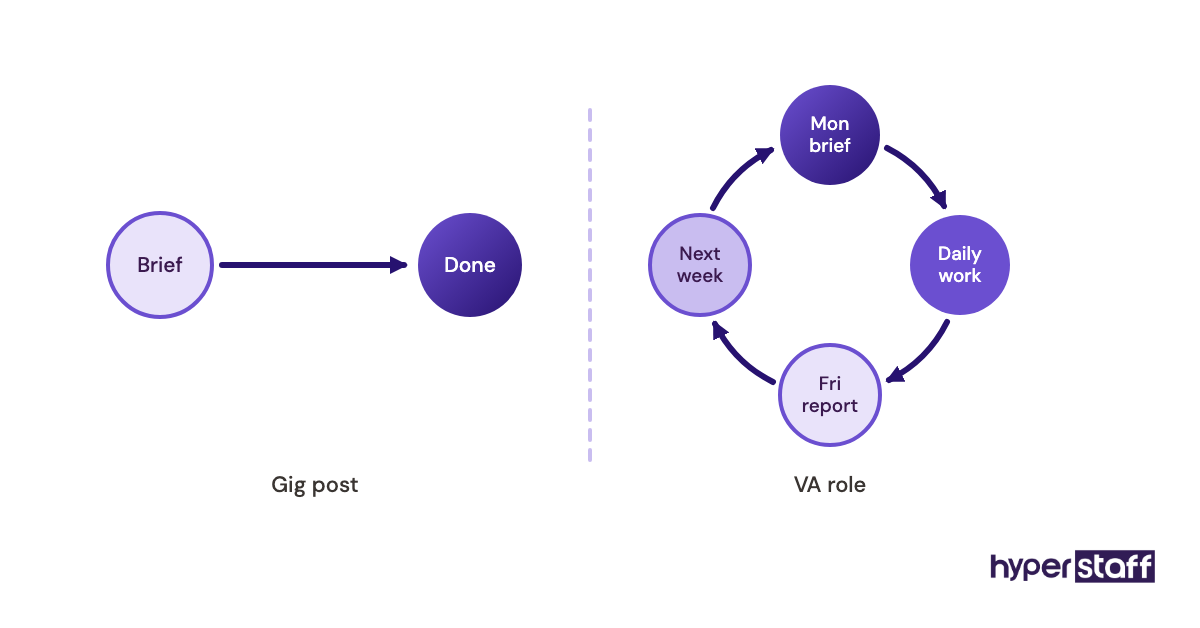
A gig post on Upwork or Fiverr describes one deliverable with a deadline. A VA job description describes an ongoing role with hours, ranked priorities and a 90-day picture.
Practitioners split on whether to publish the rate in either one. Posting it saves everyone time, and holding it back lets you meet a strong candidate slightly above budget.
We lean toward posting a range. Candidates who'd walk away over pay usually do so after the test task anyway, which costs you more.
VA job description vs. SOP
An SOP explains how one task is done, step by step. The job description names which tasks the VA owns and points to the SOPs behind them.
Cramming SOP detail into the job description produces a six-page post that strong candidates skim and close. Keep the how-to detail in the SOPs, which Hyperstaff writes down and maintains for clients in the Operations Vault.
What are the pros and cons of a detailed VA job description?
A detailed job description wins on hiring quality and costs a few hours of owner time. The trade is lopsided in its favour for most small businesses, though the drawbacks are real.
The benefits of a detailed small business VA job description
- Fewer, better applicants, because candidates can rule themselves out
- Faster screening, since every test task maps to a listed responsibility
- A fair yardstick for the first 90 days
- A quicker replacement if the fit fails, because the role is already written down
- A first draft of your SOPs and onboarding plan
The drawbacks of a detailed small business VA job description
- Two to four hours of owner time before anyone is hired
- It goes stale as the business changes and needs a review every few months
- Too much detail can put off a strong candidate who'd have grown into the role
Which small businesses need a VA job description?
Any small business hiring its first remote assistant needs a written job description, and so does any owner replacing a VA who didn't work out. It matters most in these situations:
- A first VA hire, when nobody has done the role before
- A replacement, where the old role drifted and nobody wrote down the drift
- Growing from 40 or 80 hours to 160, which usually adds a new area
- Adding a second VA, where the split between roles has to be on paper
Solo founders gain the most from a written brief and write one least often. With no team around, nobody catches a vague post before candidates see it.
Keep in mind: A job description written for an agency placement can be shorter than a public job post, since the agency runs the first round of screening, but the responsibilities, hours and success targets should stay just as specific.
Small business VA job description examples
The difference between a strong and a weak job description shows up line by line. Below are sample lines in the style owners write, with what makes each one work or fail.
Good small business VA job description examples
A support line with a number in it
"Reply to every customer email in Gorgias within 4 business hours, Monday to Friday, using our saved replies."
The line names the tool, the standard and the days. A candidate can picture the work, and you can measure it in week two.
A lead generation line tied to an outcome
"Add 25 researched prospects a week to HubSpot that match our ideal customer list, and book discovery calls from the replies."
Volume and the end goal sit together in one sentence. The VA knows the research exists to book calls, so they'll judge quality by replies instead of row counts.
An hours line candidates can plan around
"80 hours a month. Online 9am to 1pm US Eastern, Monday to Friday. The rest of your hours are yours to schedule."
A VA in Manila or Bogotá can check that window against their own day before applying. Owners who skip it often find the mismatch in week one.
Bad small business VA job description examples
The everything list
"Admin, social media, bookkeeping, customer service, research and other duties as assigned."
Nothing is ranked, so the VA will guess at priorities. "Other duties as assigned" tells candidates the scope will keep growing.
Expert skills at an entry rate
"5+ years in paid ads, bookkeeping experience, fluent Spanish. $3/hour."
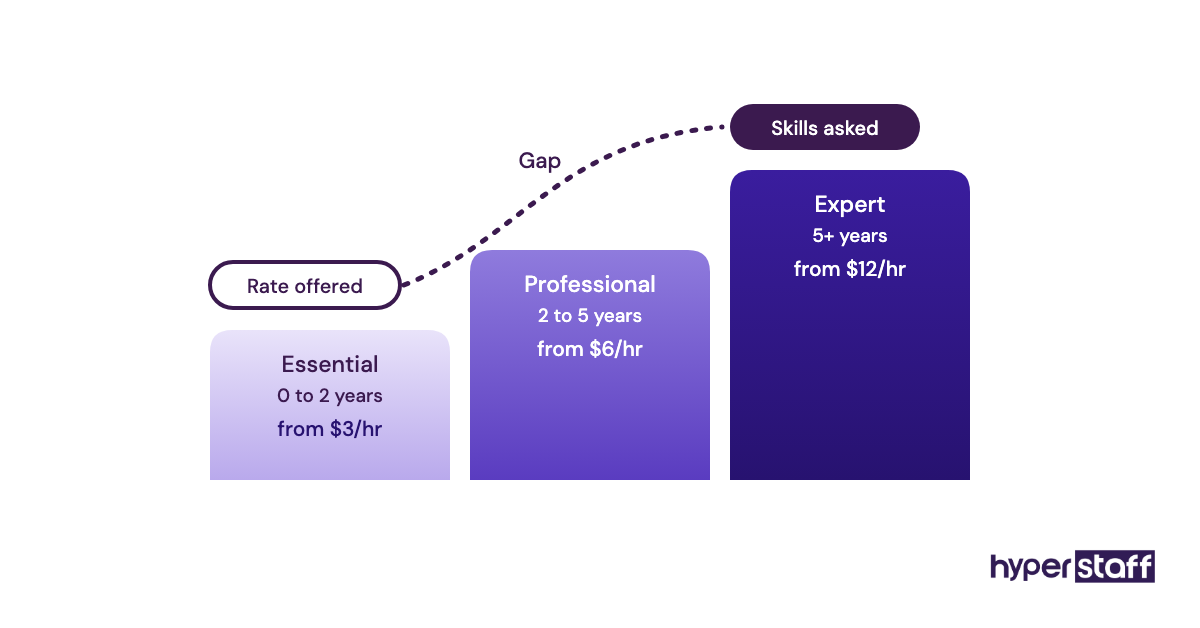
The requirements describe an Expert-tier specialist and the rate describes an Essential-tier one. Strong candidates skip the post, and the ones who apply rarely match the list.
Personality in place of work
"We want a go-getter self-starter with a can-do attitude who loves to hustle."
Every applicant believes this describes them. Replace it with one concrete line about how the VA will work without you, such as "you'll get a written brief each Monday and report back Friday."
10 tips for writing a VA job description that attracts the right people
These tips apply to any small business VA role, from a 40-hour admin bundle to a full-time operations hire.
- Put the top responsibility in the first three lines of the post.
- Write each responsibility as an outcome with a number attached.
- Cap the main list at five to eight responsibilities and rank them.
- State the time zone overlap in hours and days.
- Mark each tool as "must know" or "we'll train you".
- Match the experience tier to the work: repeatable tasks at Essential, judgment calls at Professional or Expert.
- Add a line that names what the role doesn't own.
- Ask applicants one specific question in their note to filter out copy-paste applications.
- Pay for the test task, and say so in the post.
- Re-read the job description at day 90 and update it before your next hire.
What goes wrong when small businesses write VA job descriptions?
Scope creep after the hire is the most common challenge. A VA hired for customer support ends up on social posts and invoices too, and nothing gets done well.
Fix it in the job description itself. Add the "doesn't own" line, and when a new task appears, update the brief and the hours bundle together.
The second failure is copying a big-company template full of phrases like "cross-functional stakeholder alignment". Our rundown of common small business VA mistakes covers the rest.
How do you know your VA job description worked?
A small business VA job description worked if the hire's real week at day 90 matches the ranked responsibilities you wrote. Compare their output against each success target, line by line.
Before that, track two earlier signals: how many applicants you'd shortlist, and how many passed the test task. A thin shortlist points to a vague brief.
A missed 90-day target after a strong test task usually points to onboarding instead. Check the SOPs before you blame the person.
How long until a VA job description pays off?
A small business VA job description takes two to four hours to write and starts paying off within the first month of the hire. Hiring through Hyperstaff, placement takes 5 business days, while a job board usually means two to four weeks of screening.
Expect a dead zone in weeks one and two, when the VA is reading SOPs and sorting access. Our guide to onboarding a small business VA walks through that stretch.
Most roles settle by weeks six to eight. That's why the 60-day target carries more weight than the 30-day one.
How much does it cost to hire the VA in your job description?
Hiring the VA your job description describes costs from $3 an hour at Hyperstaff, depending on experience tier and monthly hours. A full-time 160-hour month runs from $480 at the Essential tier to $1,920 at the Expert tier.
| Experience tier | Hyperstaff hourly rate | Hyperstaff, 80 hours/month | Hyperstaff, 160 hours/month | Typical US in-house equivalent, full-time monthly (wages + taxes + benefits) |
|---|---|---|---|---|
| Essential (0 to 2 years) | From $3 | From $240 | From $480 | About $3,500 to $5,000 |
| Professional (2 to 5 years) | From $6 | From $480 | From $960 | About $4,500 to $6,500 |
| Expert (5+ years) | From $12 | From $960 | From $1,920 | About $6,500 to $9,000 |
Hyperstaff bundles come in 40, 80 or 160 hours, and paying quarterly saves 10%. The full breakdown of small business VA cost compares regions and the costs owners tend to miss.
Important: Hyperstaff prices above are starting averages, not fixed quotes. Your final rate depends on the skills, experience tier, hours and time zone your role needs, which we confirm with you on a free discovery call.
Is writing a detailed VA job description worth it?
Yes. A detailed small business VA job description is one of the highest-return hours an owner spends on hiring, because it decides who applies, who passes the test task and what the first 90 days are measured against.
Here's a worked example. Say you value your own time at $60 an hour, and writing the job description and test task takes 3 hours, or $180.
Now picture the wrong hire from a vague brief: a Professional-tier VA on an 80-hour bundle, from $480 a month, plus about 10 hours of your own training time ($600). That's roughly $1,080 gone before you start over.
When the brief is right, the maths flips. Even if only 20 of those 80 hours replace work you'd otherwise do yourself, that's $1,200 of your time returned each month for $480.
For the wider case on hiring at all, read whether a small business VA is worth it.
How do you choose a VA agency to hire through?
Judge a VA agency by what it does with your job description. A good agency reads the brief, asks what's missing and shows you candidates measured against your top responsibility.
Ask each agency about these points before you sign:
- What the vetting actually tests, and whether it matches your top area
- How long placement takes
- What happens if the fit fails, and how fast a replacement starts
- Who writes down and keeps your SOPs
- Whether rates are published by experience level
- Which regions and time zones they place from
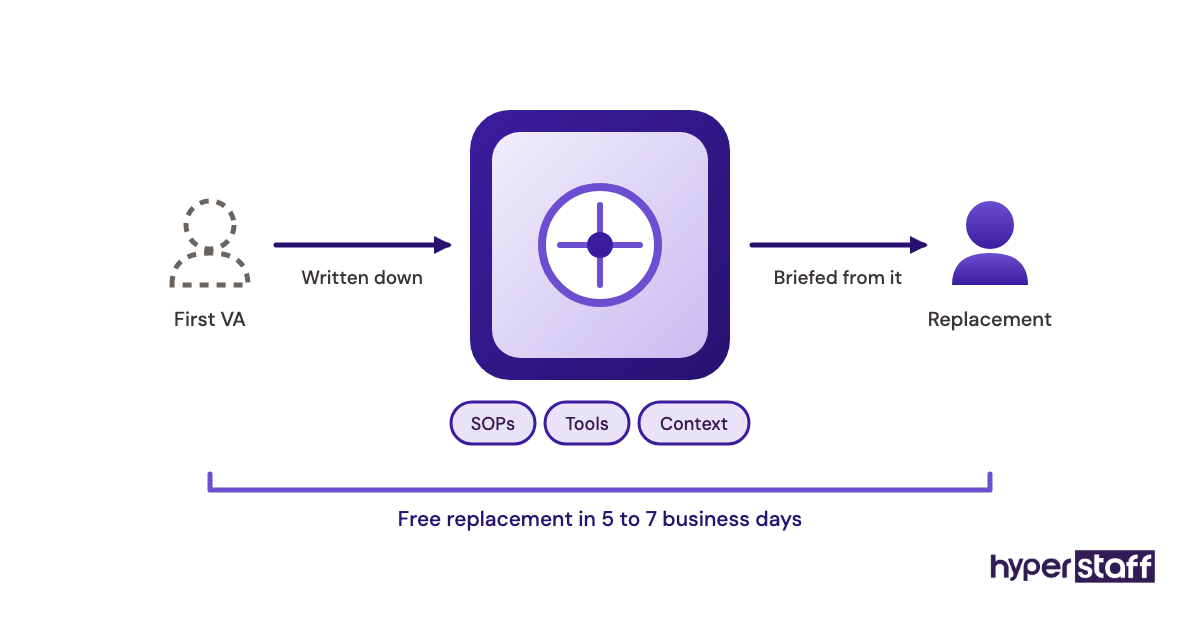
Hyperstaff places pre-vetted VAs from the Philippines, Latin America, India, Eastern Europe and the United States in 5 business days. Your SOPs, tools and context live in an Operations Vault that we write down and maintain, so a free replacement is briefed from it within 5 to 7 business days.
Every client gets a dedicated account manager. After a 30-minute kickoff call, work starts that day or the next morning.
Small business VA hiring trends that shape the job description
Small business VA job descriptions are getting more specific about tools, time zones and data access. In the briefs we see, "admin support" is giving way to a named CRM, a stated overlap window and a list of accounts the VA may touch.
First hires are also starting smaller. Owners begin at 40 or 80 hours, write the SOPs as they go, then grow the bundle once the role has proven itself.
AI tool use is moving into the requirements list. Lines like "comfortable drafting with ChatGPT or Claude and correcting the output" look set to become as ordinary as "knows Google Workspace".
Our prediction, and it's a guess: job descriptions will shift further from task lists toward outcome lists. As AI absorbs more small tasks, a VA's value moves toward judgment and follow-through.
Can AI write a small business VA job description?
Yes, AI can draft a small business VA job description in seconds, but the duties will come from an average business. ChatGPT, Claude or Gemini will give you a clean structure filled with generic lines.
Use AI after Step #1, once your own task list exists. Paste the list in, ask it to group and rank the tasks, then rewrite anything that sounds like a brochure.
AI also changes what to ask for. A VA who drafts with an AI tool and catches its mistakes gets more done in 80 hours, so add one line about AI tools to the requirements and test it in the paid task.
Quick check: Never paste customer names, contracts or financial data into a public AI tool while drafting, and add the same rule to the job description so your VA follows it from day one.
Disclaimer: This article is general information about writing job descriptions and is not legal, tax or employment advice. Hiring rules differ by country and worker type, so check with a qualified advisor before publishing a job post or signing a contract.
Common questions
What should a small business VA job description include?
A small business VA job description needs a job title, a business snapshot, ranked responsibilities, hours and time zone overlap, tools, requirements, 30, 60 and 90 day targets, and how to apply. The responsibilities and success targets carry the most weight.
How many duties should I list for a small business VA?
List five to eight responsibilities, ranked by priority. Longer lists attract generalists and leave the VA guessing what matters most.
Should I put the hourly rate in a VA job description?
Posting a rate range saves time for you and the candidate. Some owners hold it back to keep room for a strong applicant, but a range filters out mismatches before the test task.
Can one VA job description work for part-time and full-time roles?
You can reuse the structure, but the responsibilities should change. A 40-hour VA can realistically own one area, while a 160-hour VA can own two to four.
Do I need a job description if I hire a VA through an agency?
Yes. The agency screens against your brief, so a clear small business VA job description gets you better-matched candidates and a faster replacement if one is ever needed.
Book a free 15 min call
We place a pre-vetted specialist in 5 business days, fully managed, from $3/hour.